June 25th, 2014 · Comments Off on HVRA updates tree inventory
Construction, pollution, and invasive species threaten urban forest
By Chantilly Post
The Harbord Village Residents’ Association (HVRA) is updating its neighbourhood tree inventory thanks to the help of environmental scientist James Steenberg.
In 2007, the HVRA implemented NeighbourWoods, a method of quantifying the location, health, and strength of the trees in the village.
“[So far] it’s been great,” said Steenberg. “I can do nothing but applaud the volunteers and the people who’ve worked with this inventory.”
This community-based urban forest program analyzes the species, size, age, and other characteristics of the trees in the community. The comprehensive program requires minimal training to be used effectively, and creates a better understating of the urban forest’s structure and benefits.
Steenberg will also evaluate why, how, and where the urban forestry is most vulnerable, and re-assess the stability of the tree inventory.
Currently pursuing his PhD at Ryerson University, Steenberg uses NeighbourWoods as it is an efficient method for observing the vulnerability of the forest’s ecosystem, as well as for tracking the growth and mortality rates of the area’s trees.
“[There’s] not tons of ice storm damage along the major streets, and people’s front lawns, [where] the trees are doing great,” said Steenberg.
But, according to Steenberg, there is a problem with what he terms the “accidental urban forest,” which is the trees that sprout up in alleyways, parking lots, and along fences. Typically Manitoba Maple or White Mulberry, such trees grow fast, and are often cut down.
“Because [trees] live so long and because they are all around us in the city we tend to think they’re permanent,” said Steenberg.
Unfortunately, that’s a misconception.
The biggest threats to the city’s urban forests are construction, pollution, and invasive species like the Asian long-horned beetle and ash borer. The latter is a green beetle that destroys upwards of 860,000 ash trees on private and public lands throughout Toronto.
Other threats include drought and drainage problems, which can reduce a tree’s life span from 100 to 30 years in an urban environment.
However, “people are becoming more aware of [such threats], and in many neighbourhoods, especially in downtown and older residential neighbourhoods, the urban forests are getting better,” explained Steenberg.
Although trees have a major impact on our ecosystem, they are a very vulnerable kingdom. It is said that a minimum coverage of 30 per cent forestry is required to maintain a sustainable, healthy ecosystem.
Toronto alone has an estimated 10.2 million trees, 4.1 million of which are located on public property, including 3.1 million in the city’s parks, and 600,000 on the city’s streets. In all, the City maintains approximately 40 per cent of its urban canopy.
Steenberg and his crew of volunteers will be maintaining the Harbord Village tree inventory until August.
To conduct a tree inventory in your neighbourhood, please visit www. forestry.utoronto.ca/neighbourwoods/web/.
Tags: General
June 18th, 2014 · Comments Off on Former chief planner argues waterfront threatened
City’s Executive Committee votes to delay island airport decision
By Annemarie Brissenden
The night before City Council’s Executive Committee met to consider Porter Airlines’ request to amend the Tripartite Agreement for Billy Bishop Toronto City Airport, approximately 90 people gathered at the Duke of York pub on Prince Arthur Avenue to conduct a similar review. If passed, the amendment would allow Porter to extend Billy Bishop’s runways and fly jet-powered planes to and from the island airport in downtown Toronto.
Organized by Why Should I Care? (WSIC), a non-profit group that, according to its website, “provides a grassroots forum for discussing contentious issues in a non-partisan environment,” the event’s only speaker was City of Toronto’s former chief planner Paul Bedford.
“I’m told they couldn’t get anybody here to represent the positive side,” he joked to much laughter, before summarizing the views on both sides of the question. Although he highlighted convenience as the most positive attribute of the proposed amendment, he stands firmly against any changes to the current agreement.
Bedford, now an adjunct professor of city planning at the University of Toronto and Ryerson University and an urban mentor with Paul Bedford & Associates, characterized this as a watershed moment for Toronto.
“There are deep conflicts between the waterfront goals and the proposed expansion of the airport,” he said.
In his view, if the city allows Billy Bishop to expand, it will eventually dominate the waterfront, threatening the very balance city planners have worked so hard to develop.
“This whole thing is not about Porter, it’s about the waterfront. The fundamental question is what kind of waterfront do you want?” asked Bedford, as the crowd, including local notables Rosario Marchese (MPP, Trinity-Spadina), the provincial Liberal candidate for Trinity-Spadina, Han Dong, and mayoral candidate Sarah Thomson, loudly applauded.
Bedford also highlighted the conclusions of a [Review of Potential Future Safety Zones at Billy Bishop Toronto City Airport with Bombardier CS100 Jets ITALICS], issued that morning by Transport Action Ontario, a non-profit organization that advocates for sustainable transportation. According to the report, the new jets and the extended runways would have a different classification from those currently in place at the island airport, thus having a greater impact on the obstacle imitation surfaces, runway approach lighting, and marine exclusion zone than had been previously recognized. Bedford wondered how such limitations would affect development in the Portlands, and suggested the eastern limitations on marine traffic might stretch as far as Bay Street.
After concluding that, “given all the unanswered questions, the risks, the downsides, it is irresponsible for council to give even conditional approval” to the proposed amendment, Bedford led a lively question and answer session.
The majority of the speakers appeared opposed to the island airport expansion, citing concerns that ranged from noise to safety to questioning whether Porter was even viable in the long term.
Many of the same questions were raised in a city staff report that’s before the Executive Committee. In the report dated March 19, 2014, city staff recommends delaying a decision until further information, including the results of an environmental assessment, is available. The report also recommends a staged approach for managing growth at Billy Bishop, as well as compelling Transport Canada and the Toronto Port Authority to address how they will manage increased noise and traffic and related infrastructure needs caused by larger island airport.
For Bedford, the answer is clear.
“Don’t put everyone through the pain [of further study], fix the mess on lower Bathurst Street, and just say no.”
Subsequent to this writing, City Council’s Executive Committee voted on March 25 to accept the recommendations of the staff report with some amendments. City Council will consider the matter at its April 1 meeting. For further information on Transport Action Ontario, or to read its report, please visit www.transport-action-ontario.com. For further information on WSIC and its upcoming events, please visit www.whyshouldIcare.ca.
Tags: General
June 14th, 2014 · Comments Off on Toronto celebrates Lunar Fest
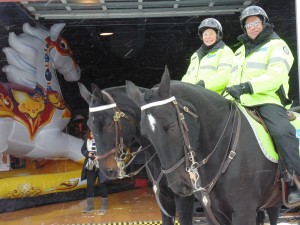
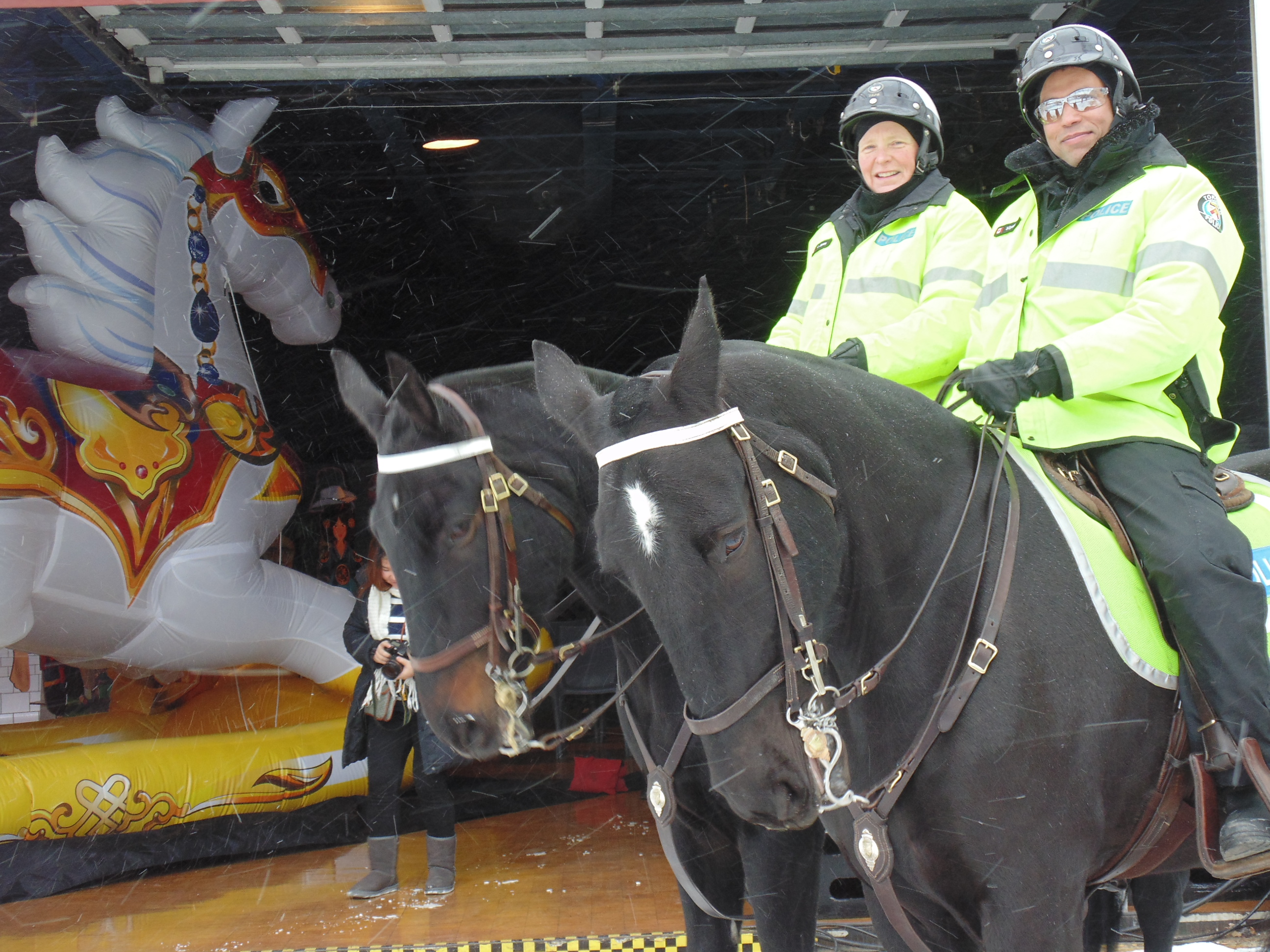
Sergeant Leanne Jones on Major, and P.C. Shane Syms riding Viscount, of Toronto Police Mounted Unit made a surprise appearance at the launch of the Year of the Horse. Brian Burchell/Gleaner News
With red lanterns and dumplings 2014 welcomes the Year of the Horse
By Samina Esha
The CIBC Lunar Festival celebrates one of Asia’s most eminent holidays, the Chinese New Year or the Lunar New Year, and 2014 is the Year of the Horse. The festival was held at the Harbourfront Centre on the weekend of Jan. 25 and 26 with colourful displays, workshops, theatrics, and even dumplings to corroborate Toronto’s diversity.
Toronto is famous for its cultural celebrations and for years the Harbourfront has been the setting for this cultural outlet.
“The core of this festival is to engage the community and Harbourfront is one cultural venue that engages communities of various different backgrounds,” said Charlie Wu, managing director of the Asian-Canadian Special Events Association, the organizer of CIBC Lunar Fest.
While the Lunar Fest is a means for the Asian community to bond with their heritage, it is also a way for other communities to get involved and explore a new culture.
“Chinese, Korean, Taiwanese, we all celebrate Lunar New Year and this event brings everyone together as one. This is the Year of the Horse which not only connects us to one of the creatures most significant to mankind but also brings back childhood memories for many,” said Mr. Wu.
To acknowledge the Year of the Horse – a symbol of grace, beauty, and strength – this year’s festival showcased a 15-foot rocking horse. The festival incorporates different elements of arts such as the lantern theatre, which combines artistry of both Canadian and Taiwanese lantern artists.
“Lanterns have always been used as a visual display but we are combining theatrics and taking a trip to different parts of Asia with fascinating stories and history,” said Mr. Wu.
Lunar Fest was established during the 2009 Vancouver Winter Olympics as a Legacy event. According to the festival organization, “Lunar Fest is Canada’s premier presenter of contemporary expression in Asian arts and culture. It endeavours to reach new Canadians and those who have been here for many generations to share in the diversity of Canada.”
Celebrated on the first day of the year of the Chinese calendar, which is lunisolar, the Lunar New Year is also called the Spring Festival. A traditional Chinese holiday, it is celebrated in countries including China, Singapore, Thailand, Indonesia, and Malaysia, to name a few.
The 15-day celebration not only includes family reunion but also collaborates everything that is red. The colour red is thought to be a symbol of good fortune, longevity, wealth, and happiness. A theme that can be seen in the traditional decorations from red lanterns, to red couplets and paper-cuts, along with fireworks.
The source of Chinese New Year itself goes back centuries and it gains its significance from several myths and traditions. Customarily, the festival was a time to honour deities and ancestors and to reconnect with family. According to folklore every New Year Nian, a mythical beast, would terrorize the villagers by eating their livestock, villagers, and especially little children. To stop Nian, villagers would put food on their doorsteps. However, one year they noticed the beast was scared of a little child wearing the colour red. From then on the villagers would decorate their houses, streets, and even themselves with red and a tradition was born.
For Zhang Li, a second-generation Asian, Lunar Fest is merely an instrument to reconnect with her roots.
“As an Asian-Canadian, events like Lunar Fest are not only important for our younger generation but also for our older ones. I am here today with my grandmother and although she does not speak English, these stories and foods take her back home,” said Li.
In its fourth year, Lunar Fest is part of the community building that fosters both culture and history with artistic components.
“Even eating dumplings plays a significant role in Asian culture and there is also the dumpling fest. We are just excited to bring an event that is truly for the entire family,” said Mr. Wu.
Tags: General
June 14th, 2014 · Comments Off on

Federal Liberal leader Justin Trudeau inspects the innovative Market 707 at Scadding Court Community Centre on April 23rd. The market allows start-ups to set up shop right on the sidewalk from within converted shipping containers. Brian Burchell/Gleaner News
Tags: General
June 14th, 2014 · Comments Off on Trinity Bellwoods Park renews strategies for alcohol crackdown
Park users face $125 fine for popping a cold one
By Samina Esha
After a brutal winter we all look forward to the hot summer days with bright sun and chilled beers. In recent years, Trinity Bellwoods Park has become one of Toronto’s favourite warm weather drinking spots and it has taken on a life of its own. A recent community meeting held on April 3 at the Trinity Bellwoods Community Centre became an open forum for discussing strategies to stop alcohol use in the park along with the park preservation. Staff Sgt. James Hogan of 14 Division says the community meeting was meant to be about education and awareness.
“Drinking in a public park ultimately leads to selfish and uncontrollable behaviour, followed by noise and loitering, which is just disturbing others,” said Hogan. “This meeting was part of an ongoing effort to promote awareness and education before the summer. We wanted to start a discussion about what respectful park use looks like along with listening to the output of the community.”
Located at the focal point of the inner city neighbourhood, this 14.6-hectare park on Queen Street West at Strachan Avenue was once home to Trinity College. The park sits above the now-buried Garrison Creek and contains eight tennis courts, two volleyball courts, an artificial ice rink, an off-leash area for dogs, a picnic area, a wading pool, and a children’s playground. The very picturesque park area spans the entire length of the neighbourhood with Trinity Community Recreation Centre located on the southwest section of the park.
People sipping beer and wine are a common sight at the park in the summer among mothers walking with their children in strollers, cyclists, and dog walkers.
“It’s funny because some people think the city bylaws don’t apply in the park. I am not sure how they came to that conclusion. Some said social media implies that you can bring all the booze you want and drink in the park. Not true,” said Staff Sgt. Hogan.
This is the second year that such a meeting has been held for public awareness. Although the numbers for public drinking have gone down, some people are still oblivious to the law.
“I was at the park last Tuesday and a young couple was out with a six pack of beer and they genuinely thought that they are legally allowed to drink in this park. So, to prevent such scenarios we are preparing pamphlets to make people aware of the situation,” added Hogan.
Last year’s meeting held by the park, community, police, and even Ward 19 Councillor Mike Layton, became a huge discussion point and an example for park drinking.
Part of the story leading up to the meeting had been a fairly new strategy by police called “Project Green Glasses”, which was described as an upcoming crackdown on park drinking in the western half of downtown, particularly in Trinity Bellwoods, Christie Pits, Dufferin Grove, and Alexandra parks. In Toronto, drinking in public can earn one up to a $125 fine, which is part of the Liquor Licence Act (LLA). Staff Sgt. Hogan mentioned that, under the City of Toronto’s park by-law, consuming, serving, or selling liquor in a park without a permit can result in a steep fine of $360. More police and bylaw officers will be patrolling the parks starting later this month.
“Overall we want parks to be a welcoming place for everyone and hopefully not to be handing out tickets for drinking,” said Hogan.
Thursday night’s meeting focused more on park conservation than on open drinking, with issues varying from public safety to noise control to tree preservation.
According to Eamon McGrath’s comment on Trinity Bellwoods Community Association’s website, “The notion of punishing people for consuming–and enjoying–alcohol in a public place, particularly in a city where most of its residents do not have the luxury of having a private outdoor area to consume it, is ridiculous and absurd.”
Tags: General
June 14th, 2014 · Comments Off on New plans for a new Ontario Place
Imagining a green space in the heart of the city
By Samina Esha
The revitalization of Ontario Place is a step closer to reality. On March 19, in a public discussion, Infrastructure Ontario, Waterfront Toronto, and designers LANDInc spoke about the progress of the new urban park and waterfront trail, with the vision of forests, summits, rocky beaches, a fire pit, and a “romantic garden.” The three-hour public meeting was a brainstorming process for the design team to further their vision along with the vision of Ontarians.
In 2012 the Ontario government announced the partial closing and redevelopment of the site. With 18 key recommendations involving a small ecological footprint and future benefits, the revitalization was set in motion.
Aligning with the recommendations, the conceptual design of the park will occupy 7.5 acres on the far eastern end of Ontario Place. According to the collaborating teams LANDInc and West 8, the former staff parking lot and administration area will become accessible to the public. “For the first time in more than 40 years, the public will have access to the spectacular views the site offers of the cityscape and of Lake Ontario in this new green space,” said Morah Fenning, assistant deputy minister of tourism, culture, and sport.
Earlier this year, in a public feedback, the groups leading the development of the park (the province and Waterfront Toronto) were asked for the recognition of local First Nations heritage. The new rendering of the urban park reflects the connection between the people, the land, and native heritage.
At the north end visitors would enter the park through an artificial ravine, and on the rocky walls there will be carvings from traditional First Nations moccasins on a section of the looping park trail that crosses the ravine on a suspension bridge. These carvings would be part of a provincial moccasin identifier project, which marks First Nations sites in urban areas with moccasin symbols.
“We believe the experience and the landscape typologies should begin right there to draw people in,” said Patrick Morello of LANDInc, the company leading the design process.
Other new elements for boaters include a floating dock near the park’s entrance, along with a fire pit at the central beach.
The east end will have access to rocky beaches and benches carved out of stone to provide seating areas along the path.
“The lower park has more of a pastoral setting. This is an area where there are open lawns for passive recreation and activities on relaxation, and its also an area where we will find Rocky Pebble Beach, something reminiscent of some of the shores on Ontario lakes,” said Morello.
The 980-metre multi-use trail will pass through the heavily planted upper portion of the park which contains forests, hills, boardwalk, and public seating. It will offer unique topography to add character, shape, and sightlines.
The park’s central esplanade and programming space will be used for various activities, including festivals, food trucks, and farmers’ markets.
The park’s south end, known as the summit, would be an open space that could be used to host events such as kite festivals and outdoor film screenings. This area would also be the highest point in the park.
With ecology in mind, rare and varied trees would be planted across the park to mimic the panoramic view of the city’s skyline.
The project did have its hiccups; one occurred when an ongoing environmental assessment found minor levels of contamination in the soil a result as the site being built on landfill.
“Studies so far show low levels of contamination on the site, but they’re manageable,” said Serge Chuskeev of Infrastructure Ontario.
Also, parking and accessibility was one of the most talked about topics during the discussion.
“Right now it seems like a long distance to walk to Ontario Place, but with the creation of the park, the north end of the park is a close distance to those parking lots,” said Morello.
While the name of the park is still undecided and the cost of this urban landscape has yet to be revealed, the province is confident about the 2015 Pan Am Game deadline.
“This is an ambitious timeline, but we have a strong plan and we’re on track,” said Morah Fenning.
With numerous feedbacks from the recent meeting the final unveiling is set to take place later this year, in the summer.
Tags: General
June 4th, 2014 · Comments Off on Realtor turns 42
Freeman finds support of community events a key success
By Chantilly Post
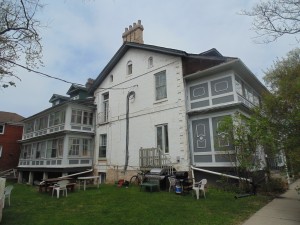
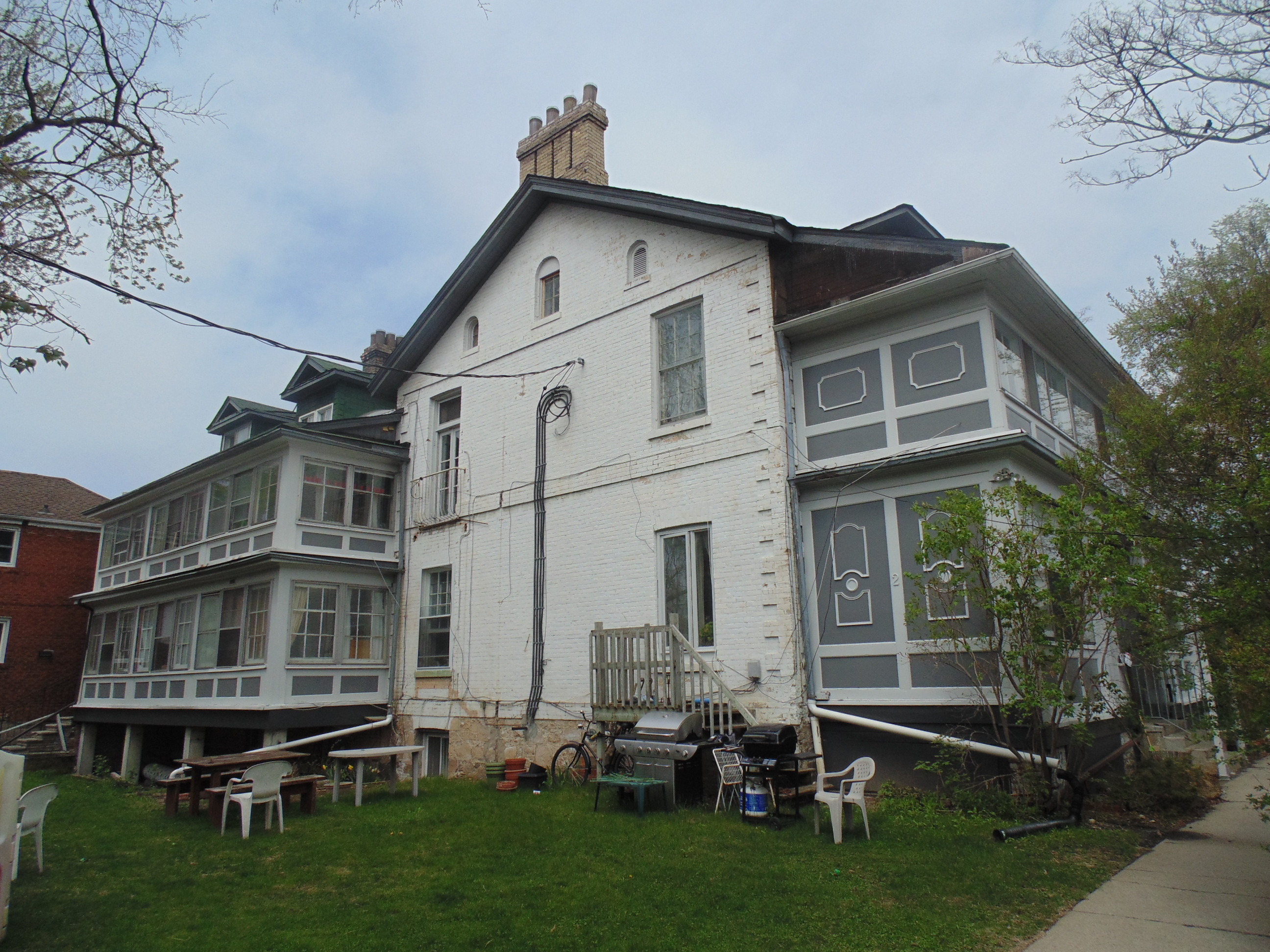
Located at 2 Vermont Ave., this is a very early Annex dwelling, the homestead of Patrick McGregor, who owned a large tract of land here in 1870. Learn more on the Annex Historical Walk on June 8. Brian Burchell/Gleaner News
Giving back to the community for 42 years has helped to make Freeman Reality a successful real estate company.
This locally owned family brokerage hosts and funds community events free of charge throughout the year, following the precedent of an earlier Freeman generation.
Barry Freeman opened Freeman Reality in 1972 when the act of giving back to the community first began. Today, the Annex family-owned brokerage is run by the brothers Elden and Daniel Freeman, who have learnt the importance of giving back to the community from their father, Barry. “In terms of community, my father was always involved,” Elden Freeman said. “He instilled in us this idea of giving back.”
Freeman Reality’s philosophy is to give back to the community that has always given back to them. “In this area, community is important,” Elden said. “They support us.”
One of the most popular events is the Historic Walk of Seaton Village, led by community history expert Marilyn Spearin. The tour starts at the Freeman Reality offices and then covers the unique history of homes located between Bloor Street West to Dupont, and Christie Street to Bathurst for an hour and a half. With approximately 1,200 Victorian homes dating back to 1860, the area holds much history and interesting sightseeing. For example, 699 and 701 Markham St. are the two oldest houses in the neighbourhood, built in 1860.
Two Vermont Ave. was the residence of Patrick McGregor, a Scottish-born lawyer who owned a bulk of land from Bathurst Street to Manning in 1870. The house is now divided into apartment suites, but still holds its unique character.
The next Historic Walk of Seaton Village will take place on the afternoon of June 8th. For more information and a brief account of Toronto’s history visit www.freemanrealty.com/historical-tours.
Freeman Reality also hosts a Mystery Bat & Moth Night in the Park led by moth expert David Beadle and Bill-Bat-Boy, an expert on bats for over 20 years. This hands-on event, previously held in Vermont Square Park, explores the variety of species of moths and bats that engage children of all ages. “I think it’s extremely important for the kids to take the time to see the amazing world we live in,” Bill-Bat-Boy said. “To take the time to not only see nature, but understand certain behaviours.”
Moth expert David Beadle has been a part of the Bat and Moth Night for two years now.
“[This event] just creates more awareness, most people don’t know much about moths, or how important they are to our environment,” Beadle said.
Another popular event is the annual pumpkin sale held with St. Alban’s Boys and Girls Club, where all proceeds go to support the club. The previous pumpkin sale was held during St. Alban’s Fall Harvest Festival, just before Halloween. “[Freeman Reality] purchased all the pumpkins for us, delivered them, and had them dropped off,” said Anna Sturino, director of operations at St. Alban’s Boys and Girls Club.
Events like these are important for St. Alban’s because they allow the club to network with local businesses. “A lot of the local businesses are parents or users of the facility,” Sturino said.
The money raised from the pumpkin sales support art, music, aquatics, and physical creative programs at the club.
This year, Freeman Reality will be sponsoring pony rides at various schools in the downtown area. They will also be continuing past events such as the historic walks, Mystery Bat & Moth Night in the Park, and community skating.
All information about events can be found via social media at www.facebook.com/FreemanRealEstateltdbrokerage.
Tags: Annex · General
June 4th, 2014 · Comments Off on Shop shows passion for pasteries
New business owner turns trauma into dream fulfilled
By Chantilly Post
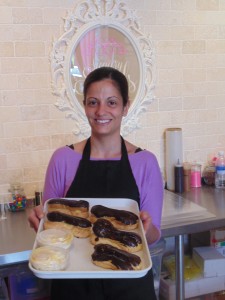
Sugary Swirl’s owner Sonia Esteves displays just a very small sample of the rich variety of her baked goods crafted exclusively on site. The shop is located just south of Dupont on the east side of Bathurst Street. Brian Burchell/Gleaner News
Sugary Swirls, at 1087 Bathurst St., is the newest specialty bake shop to open in the Annex. If cotton candy, Ferrero Roche, or ice-cream sundae cupcakes don’t sound inviting then maybe the modern-vintage decor and fresh flowers will invite you inside to order these treats and many more made fresh daily. Owner Sonia Esteves recognized her passion for baking at the age of six when she would spend time baking with her father. In June 2011, when she was diagnosed with breast cancer, she was told it was time to do something that she has never had the chance to do. “I have my family, I have my two kids, I’m good,” Esteves said. But after having a vision of the times spent baking with her father, Esteves knew that opening her own specialty bake shop was what she had to do. Sugary Swirls officially opened on February 11th. The colour pink throughout the shop represents breast cancer, white represents new life, while the black countertop represents sorrow that was endured. After having a dream of the perfect location for her bake shop, and then finding the location two weeks later, Esteves knew it was perfect. “I couldn’t ask for more,” she said. Growing up just blocks away, she felt the Annex was a prime location for Sugary Swirls, herself, and her family. Sugary Swirls is one of the three newest specialized bake shops in the Annex. Bake Them Pretty and a specialty gluten-free shop will be opening along Habord Street this summer. “Because of the condominiums and these new sort of areas with more people,” said Neil Wright, of Wright Real Estate, “it demands more of these great shops, and in this case it’s bakeries.” Each shop has its own baked specialties that appeal to different customers and that no one else is doing in the area. Sugary Swirls baked goods are freshly made, never frozen, and are always made with passion. The most popular treats are the Tiramisu Tulips a chocolate cup filled with tiramisu, and the Mil Folhas, a vanilla-custard slice. Customized cakes and cupcakes are also one of Sugary Swirls specialties. “Anyone who [has gone] through trauma or a life-altering experience and has a dream that hasn’t been fulfilled follow your dreams, no matter what the obstacles,” Esteves said. The shop is open Tuesdays to Saturdays between the hours of 10am and 5pm.
Tags: Annex · Food
May 27th, 2014 · Comments Off on Catching up with history
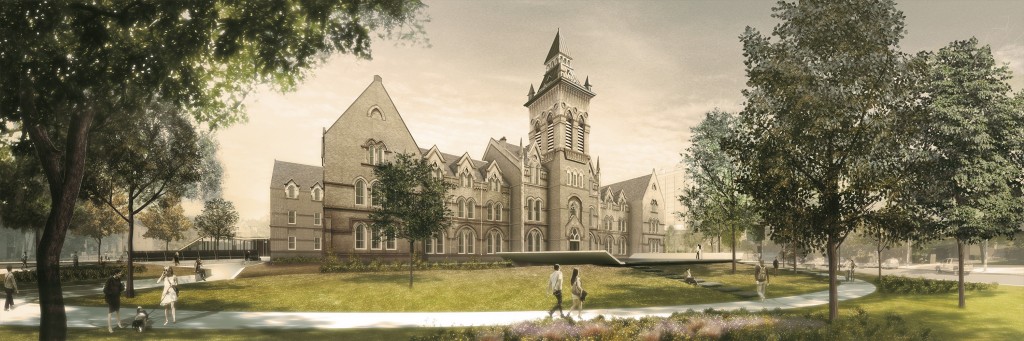
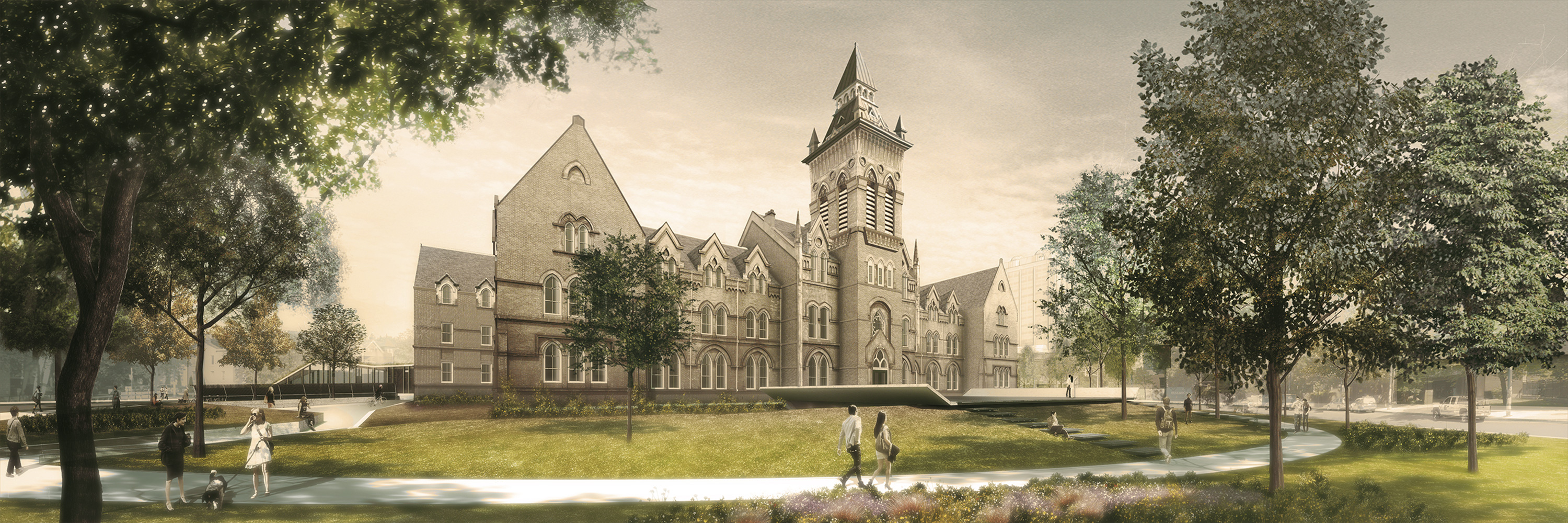
Once completed, One Spadina Crescent will be a gateway that not only bridges the university to the community but the past to the future.
COURTESY THE DANIELS CORPORATION
One Spadina Crescent embraces the past and welcomes the future
By Annemarie Brissenden
With its grey facade looming eerily behind a chain-link fence, One Spadina Crescent seemed destined to become the ramshackle province of ghosts. Instead, the nineteenth-century Gothic revival building is undergoing an ambitious renovation that will transform it into the new home of the University of Toronto’s John H. Daniels Faculty of Architecture, Landscape, and Design.
The transformation will occur in two phases. The first, scheduled for completion at the end of this year, is the renovation of the existing building, once home to Knox College and Connaught Laboratories. An irregularly-shaped contemporary wing with a multi-storey north-facing glass facade will be added to the building in the second phase, for which construction is scheduled to begin in the fall. Completion is expected in the 2015/2016 academic year. The design by Boston architect Nader Tehrani, principal of NADAAA, and his collaborator Katie Faulkner, is marked for openness to the surrounding neighbourhood, sustainable urban design, and preservation of the historic building’s heritage aspect.
Neil Wright, chair of the Harbord Street Business Improvement Area, characterizes the design as a “stunning mixture of heritage conservation and modern architecture” that creates an essential link between the community and the university. “It’s an opening where people will know they are coming into an academic and heritage area.”
“We see this project as literally designed as a crossroads. The structure is meant to link to the community in the west and the university in the east,” said Professor Richard Sommer, dean of the Daniels Faculty.
Tom Dutton, senior vice president of the Daniels Corporation, echoes this sentiment. The company, together with University of Toronto graduate John H. Daniels and his wife, Myrna Daniels, has donated $25 million towards the $50 million project.
“We see this circle in the middle of Spadina as being a bridge between the university community and the rest of the community,” said Dutton. “It will be an inviting pathway and a reason to cross Spadina.”
“It should contribute to the transformation of the entire area,” said Sommer, explaining that the original building dates to a time when the university was on the north edge of the city.
“When [Knox College] was built, all the city’s institutions faced south,” said Sommer. The university then found itself at the centre of the city and, preparing for a highway artery, “turned its back on Spadina.”
Now, with the Spadina Expressway long since defeated, the university is “catching up with history.”
In this way, the project is also a gateway between the city’s built heritage and its physical future, something that attracted both the Faculty of Architecture and the Daniels Corporation.
“We’re tying into the broader discussion regarding the future of built design in Toronto,” said Dutton. The Daniels Corporation is responsible for some of the city’s most visible mixed-use buildings, such as the TIFF Bell Lightbox on King Street West and the revitalization of Regent Park.
They’re also helping to produce the urban designers and architects of the future, added Dutton. “We now have the opportunity within the University of Toronto to create a state-of-the-art architecture and landscape faculty that’s up till now been working out of an inadequate facility.”
The faculty’s new home is also much needed following its own transformation from a very small fledging faculty into a new centre for visually-based thinking that now includes the department of visual studies.
“The building is a way to claim and have a physical setting that is an appropriate expression of our work and ambition,” said Dean Sommer.
For his part, Neil Wright is delighted that this “lovely orphan heritage building” is finally being adopted after so many years. “It’s something that everyone will be proud of, and it will be there for another 200 years.”
Tags: Annex · News
May 27th, 2014 · Comments Off on Westbank solicits ideas for Ed’s site
Mirvish Villagers stress link between affordability and character
By Annemarie Brissenden
Mirvish Villagers accustomed to battling real estate developers greeted an unexpected overture from Westbank Projects Corp. on April 30 at the Randolph Academy with polite skepticism. It was one of a series of introductory meetings hosted by the company, which last fall purchased a 3.47-acre site that includes Honest Ed’s and Mirvish Village.
“We do things differently,” said Ian Duke of Westbank to the approximately 60 people in attendance. “We don’t see ourselves as a developer, we see ourselves as city builders.”
Duke explained that Westbank currently doesn’t have a plan for the site, and hasn’t even hired an architecture firm. The sole dictate at this point is that the future site will be a mixed-use development of some sort, and it is unlikely that it would be a hotel.
Westbank’s goal for the meeting, then, was to introduce its representatives to the community and gain an understanding of what makes Mirvish Village special to those who live and work in the area.
Duke opened the discussion by presenting Westbank’s guiding ideas for creating what it terms a “community vision” for the site. The nine points included mixed use, sharing economy (for example, co-op daycare, car share, farmers’ market), heritage, community space, and urban mobility.
In response, those attending the meeting asked practical questions, suggested some guiding principles of their own, and shared their misgivings about developers in general.
On the practical side, business owners wanted to know when work would begin on the project (not until 2017 at the earliest) and how long it would take to complete (as long as two to three years).
With regard to suggested guiding principles, chief among them was affordability.
One speaker said “low rents provide an opportunity for certain kinds of businesses and artists [to] exist here.”
Another speaker related that Mirvish Village was thought to be the legacy of Ed Mirvish’s wife, Anne Mirvish, who had wanted to create a space for artists.
“Rent control is a boon to us. Moving 100 metres—rent would be four times what we pay,” added a third.
Duke admitted that affordability is “going to be one of our biggest challenges. We’ll obviously need to apply a lot of creativity to that.”
The participants kept returning to affordability, arguing that it is inextricably linked to something else they hold dear: Mirvish Village’s heritage and character.
“People come here because it’s not the same, because it’s different,” said one business owner.
“That will be a yardstick we apply to the final project,” answered Duke.
While the participants were cautiously optimistic about Westbank’s approach, they did express some cynicism about developers in general.
As one speaker commented, “It may not be like this in Vancouver, but in Toronto, developers don’t have a good reputation,” adding, “To what degree are you going to deliver on this excellent list?”
“We want to find out what things really hit the mark with people. What are must-haves, what resonates, what doesn’t,” said Duke. “One hundred people will have 100 different ideas. We want to distill a hierarchy of what’s important to get out of the process.”
“Just know that a lot of people will be watching that list,” responded a participant.
In addition to the Randolph Academy meeting, Westbank’s representatives met with four business improvement associations (BIAs) and four residents’ associations. The groups they spoke to included the Bloor-Annex BIA, the Harbord Street BIA, and the Palmerston Area and Seaton Village residents’ associations. It also held a similar introductory session with 45 members of the Centre for Social Innovation Annex on Bathurst Street, and is exploring how best to communicate with local residents and business owners, be it through a project website, twitter, or even a community kiosk.
Duke said Westbank anticipates presenting the results of these meetings at an open house in June, when there will be another opportunity to discuss the guiding ideas and get input from the community. He expects the company to hire an architectural firm in late summer or early fall and to present the first iteration of the plan for the area in December or January.
But he stresses that the timeline is a preliminary one, and Westbank could easily fall behind.
“We would rather do things right than quickly,” Duke said.
Tags: Annex · News · General
May 27th, 2014 · Comments Off on Mulcair, Cressy against island airport expansion, support transit funding
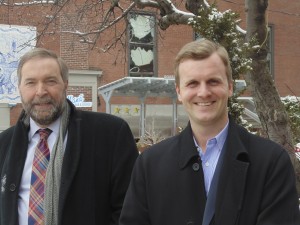
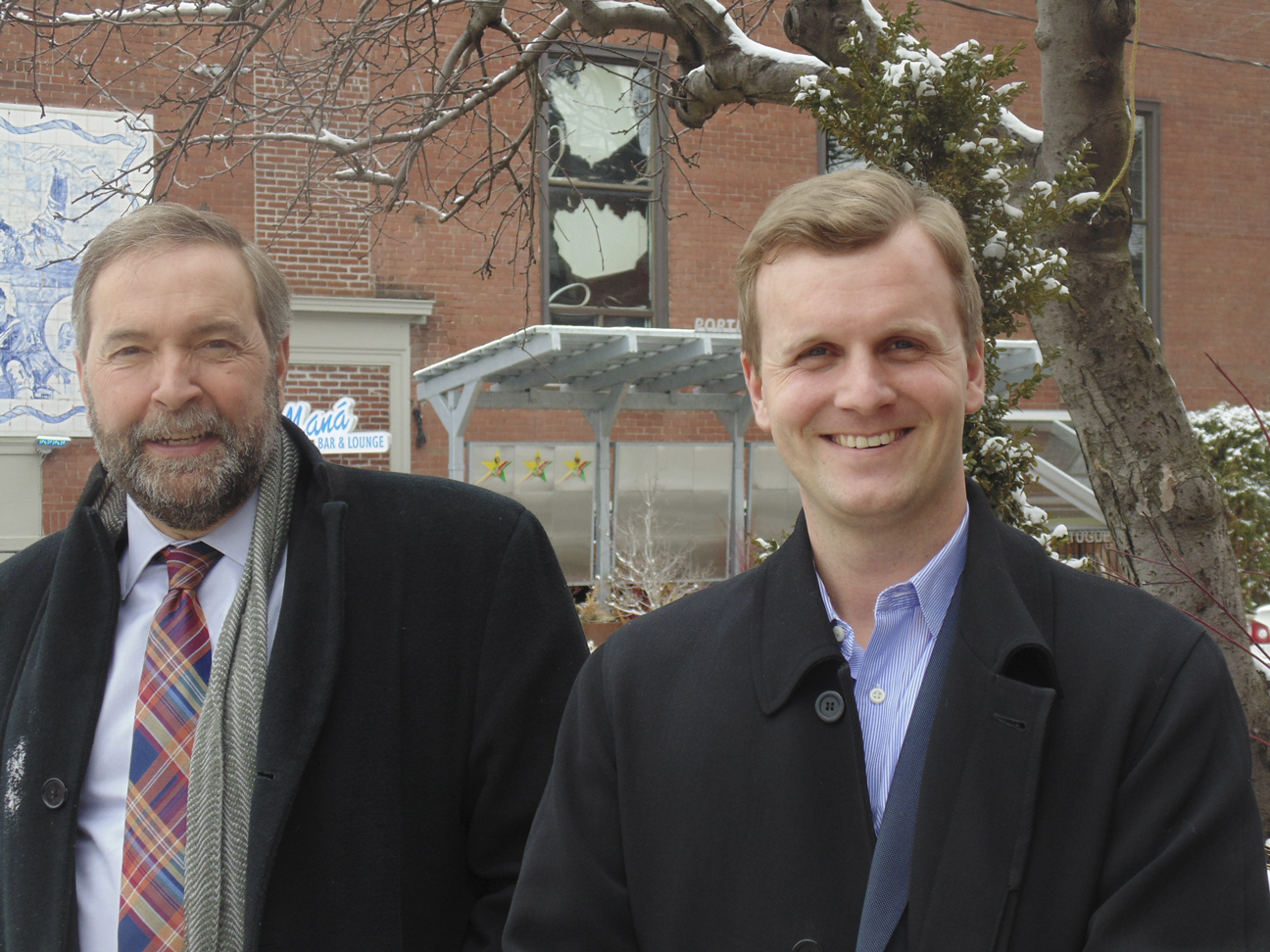
Leader of the Opposition and NDP leader Thomas Mulcair and federal by-election candidate Joe Cressy walk the walk with the Gleaner recently in Little Italy. BRIAN BURCHELL/GLEANER NEWS
By Annemarie Brissenden
Thomas Mulcair leaves his hockey hoodie at home in Montreal when he visits Toronto.
“When I went for my run this morning, I had on a great big Habs hoodie, and I thought…maybe I should bring this to Toronto, and then I thought…nah,” joked the official opposition and New Democratic Party (NDP) leader over an exclusive and wide-ranging conversation with the Gleaner last month. Accompanied by Joe Cressy, the NDP candidate for Trinity-Spadina, the gentlemen spoke over coffee at Il Gatto Nero, where nothing, not the Central Technical School field, the proposed island airport expansion, or the mayoral race, was off the menu.
It seems appropriate, given that a diversity of taste is what defines the area for Mulcair.
“We’re in an Italian café, I can see the Portuguese flag across the street, you’re in an area where you’ve got the best to celebrate every bit of Canadian diversity, which is magnified tenfold here in Trinity-Spadina,” said Mulcair.
For Cressy, it’s the parks that give the area its special flavour.
“This is a riding where our neighbourhoods define [themselves] by their parks. Christie Pits to Trinity-Bellwood…Bickford Park to Jean Sibelius. You talk about building a community, and with the condominiums in the south, the park is home,” said Cressy, who has keenly followed the Toronto District School Board’s attempt to bring a championship field to Central Technical School at Harbord and Bathurst streets.
A resident of Albany Avenue, he plays soccer on the field in the summer, so “I’ve been very involved, as have many, as I value Central Tech as a pillar in our community as a place to do recreation and come together.” And, he recognizes the concerns of the local neighbourhood about the proposal to bring in the dome.
“It’s not just around congestion and parking,” explained Cressy, “but access to our greenspace and our field.”
He is equally opposed to expanding the island airport, and defined the debate as a choice between “a large, diverse, and vibrant waterfront that happens to have a small airport” and “a large airport that happens to have a small waterfront.”
Mulcair agreed, noting that the tripartite agreement must be the starting point, and that any change would need broader support.
“The project that’s there now was controversial in its time,” commented Mulcair. “With the tripartite agreement in place, everyone has made their peace with the current situation, but [expanding the island airport] would be a huge change. We would never consider something like that without very widespread social adhesion, which doesn’t seem to be the case right now.”
The only mayoral candidate clearly opposed to expanding the island airport is Olivia Chow. Unsurprisingly, she is also the candidate that both Cressy and Mulcair support.
“I am an active supporter, and was an early encourager for Olivia to run,” said Cressy, who was the campaign chair for Olivia Chow and Mike Layton, and the president of the Trinity-Spadina federal NDP riding association. “Our city deserves better than our current mayor.”
“Rob Ford has been an embarrassment to Canada’s most important city,” added Mulcair. “I don’t enjoy the fact that the only time Toronto gets referred to in the American press is when his most recent video of his appalling behaviour is on display. I think Torontonians deserve better, and that with Olivia Chow they’ll have much better.”
Mulcair and Cressy admitted that it can be difficult to champion Toronto in the federal arena, but they are both committed to pursuing an urban agenda in Ottawa.
“We are a highly urbanized country. People tend to overlook the fact that we’ve stopped investing federally in those areas,” said Mulcair. “We’re asking municipalities to form the impossible. We’re giving them 8% of the tax base and we’re asking them to take care of 60% of the infrastructure. That is just a mathematical impossibility.”
“I am running to proudly champion downtown Toronto,” said Cressy. “Here in the GTA we’re losing $6 billion a year because of gridlock, in lost productivity. And so it’s a quality of life issue. It’s an environmental issue, and it’s also about economic productivity. If we’re going to get Torontonians moving again, we need stable, predictable, and permanent funding for transit. That’s the key. Not just for the next generation, but supporting existing transit to alleviate congestion.”
While for Cressy, then, transit is the most critical issue facing Trinity-Spadina, for Mulcair it is income inequality.
“For the past 35 years, the average Canadian family has actually seen their revenue drop. It’s the first time that’s ever happened in our history,” explained Mulcair. “Whether it’s a social program, or a social service, there are, from a social democratic view, things that you can do to create opportunity, but the fundamental role is to reduce income inequality in our society. That’s my number one job as a national leader.”
Tags: Annex · News · General
April 8th, 2014 · Comments Off on Raucous meeting on CTS field
Community dismayed by lack of dialogue
By: Annemarie Brissenden
A packed standing-room only January 9 meeting on the future of Central Technical School’s (CTS) field laid bare the challenge of balancing student needs and community concerns. Local residents fear the Toronto District School Board’s (TDSB) plan to install a championship field and seasonal dome at the school will increase traffic and create additional parking woes in an already dense downtown neighbourhood, while CTS staff and students are eager to replace an aging and contaminated playing surface with a state-of-the-art facility. At times resembling a media circus, the meeting was attended by Mayor Rob Ford—greeted by raucous applause from the football and rugby players in the room—councillors Adam Vaughan (Ward 20, Trinity-Spadina) and Mike Layton (Ward 19, Trinity-Spadina), as well as Central Tech staff, students, alumni, community members, a large TDSB contingent, and Matthew Raizenne, CEO of Razor Management Inc. (RMI), the private company set to redevelop the field.Central Tech’s principal Sheryl Freeman explained that the field provides an extraordinary opportunity for the students, who use the school’s three athletics facilities full-time, every period, every day.
“We value this type of conversation,” said Freeman, noting that the school houses well over 2,000 students during the day, and close to that number at night in continuing education. “We are hearing about the impact on the community, [and the] concerns regarding parking and traffic.”
But some local residents said that the TDSB isn’t taking the potential impact of the new field on parking and traffic seriously. “I can’t get to my house now…I’m not quarreling with the concept, but don’t minimize that we’re going to have a huge problem with traffic,” said one speaker, to applause, while another added, “you haven’t put forward a single solution to the traffic problem.”
Tim Grant, speaking at the meeting, characterized Central Tech “as the school that never sleeps” adding, “the danger is that this is a project that’s going to make the neighbourhood unliveable.” The chair of the Harbord Village Residents’ Association (HVRA) said in a follow-up interview that he was disappointed with the tenor of the meeting, which seemed more like a cheerleading sales job than a community consultation or question and answer session. “My understanding is that a deal was signed a year ago, [they’re] just going through the motions,” he said.Or as Susan Dexter, HVRA board member, shouted at the meeting January 9, “We should be able to have a dialogue, rather than something that’s presented to us.”
That frustration, which underpins the reservations of those in the neighbourhood who oppose the installation of the field, seems to come from a critical question: who owns the field, and who, ultimately, is responsible for deciding what should be built there? Gordon E. Petch, a partner with Municipal Law Chambers, which has been retained to represent the TDSB in its application for two minor zoning variations, attempted to “clear up some misconceptions” during his presentation at the meeting.
“School board lands are private lands, not public open space,” said Petch, adding that public access to these lands should only occur under the auspices of a permit, for insurance reasons. Access can happen without a permit, he explained, but that’s only because it’s difficult to police on a regular basis.
Central Tech teacher Suzanne Shebib echoed Petch’s comments when she stood up “to gently remind everybody that CTS is a school and must serve its students first…. It bothers me that we’re putting issues like parking above the needs of our students.” And time and time again, the school’s students spoke up about the critical need to replace their rundown, booby-trapped field, rife with holes and dog leavings. “We are at one of the most used tracks in the city, one of the most used fields in the city,” said Raizenne. “All of you are here, all of you care, and that speaks volumes.” Raizenne, who is passionate about athletics, stressed that his company will be replacing the chain-link fence with an iron one similar to that at Varsity Stadium, and putting it behind the tree line, as recommended by the Bathurst Street Study. The site will be remediated, and the energy-efficient dome (up during the winter months, i.e. mid November to April) will be among the most environmentally friendly around. He added that he’s learned lessons on managing traffic and parking from the Monarch Park stadium, which he plans to implement at Central Tech.“I know there is a way to work together with the community,” he said in a follow-up email adding that “it was a great meeting and it was great to see all our city leaders out.”
Tags: Annex · News · Sports · General