October 8th, 2014 · Comments Off on Re-discover these diverting parks
A rich treasure of design and history awaits
This is the second, and final part, of this year’s of this year’s Grading our Greenspace, our annual parks review, writers visited twelve local parks to rate them on a variety of factors, including amenities, cleanliness, and ambience. Do you agree with our assessment? Send us your thoughts to gleanerpub@gmail.com.
George Ben Park
Ossington Avenue, just north of
Dundas Street West
Time: 2:00 pm
Grade: C (Last year C)
Reason to go: Being a part of St. Luke Catholic School makes George Ben Park not too much of a park. Equipped with three benches, garbage cans, and a field—which the school uses also—this park would be ideal for any field sports or sprints, which frequently occur. Along the field are newly planted trees which over time will bring nice shade to the open space. There is also a baseball diamond that could use some updating and the grass could also do with some maintenance. Across the park on the east side is a fully equipped playground if the field gets boring.
Overheard: Children playing at the park across the road
Fact: George Ben sits on top of what was known as Garrison Creek.
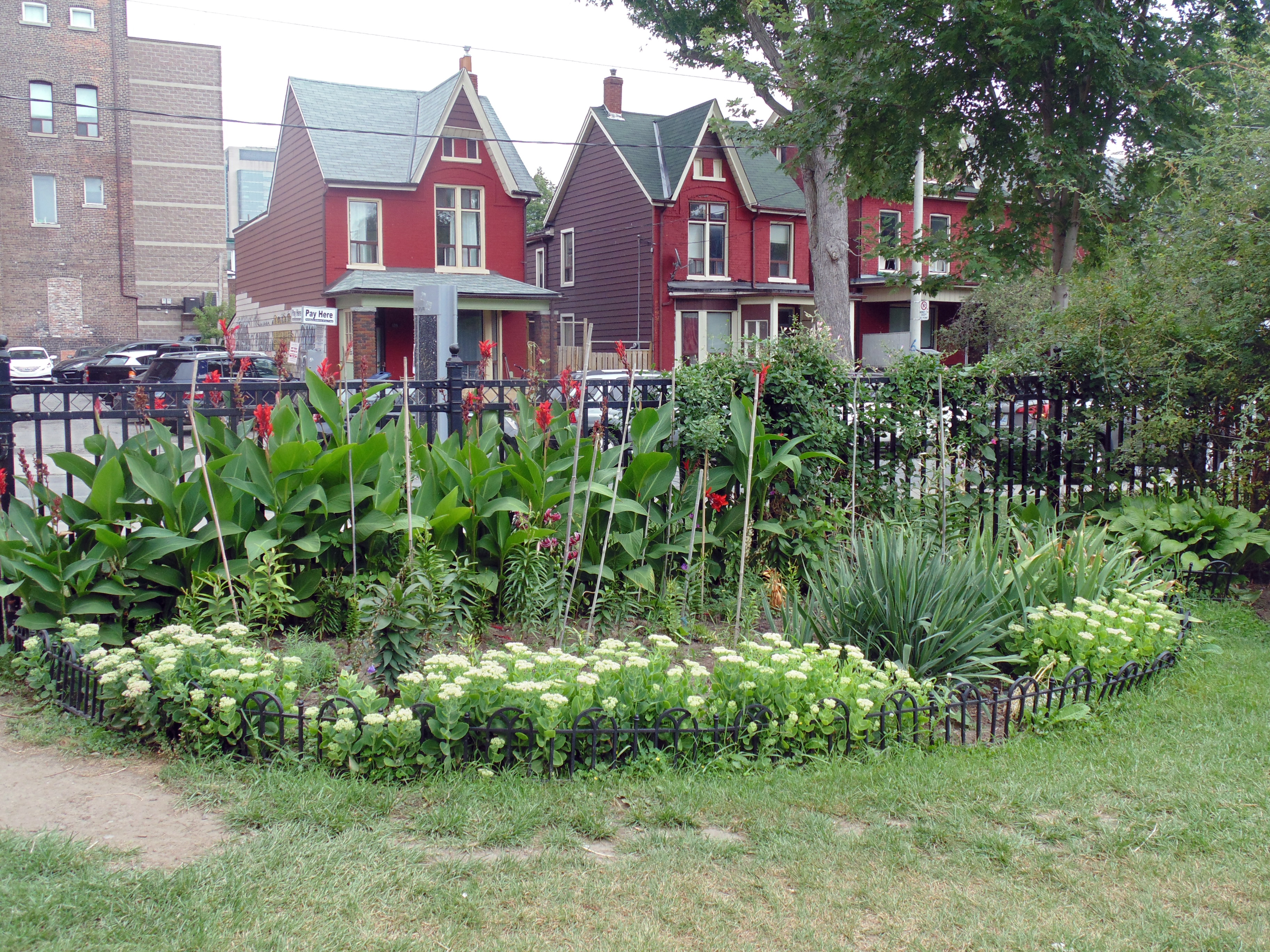
An oasis of wild flowers and vegetable plots awaits visitors to this green space shielded from College Street noise by the Lilian Smith Library.
BRIAN BURCHELL/GLEANER NEWS
Lillian Smith
Corner of Huron and Spadina, behind the library
Time: 12:00 pm
Grade: B
Reason to go: Lillian Smith Community Garden is a peaceful sidebar from the busy streets of College and Spadina. Filled with all kinds of wild flowers and vegetables, this community garden is lush and in full bloom. Located directly behind the library, it would be a great place to grab a book and enjoy a nice read. The park is divided up into separate plots where individuals can choose what they want to plant.
Overheard: Young men chatting over lunch
Fact: This community garden is named after Lillian H. Smith, who increased children’s services throughout Toronto.
Glasgow Parkette
11 Glasgow St.
Time: 12:15 pm
Grade: C-
Reason to go: By day, this park would be ideal for a busy street hideaway as it is situated in Glasgow alley off Spadina. There is a bench and a minor grass lounge area, which is all this small park has to offer. A few steps across the alley are the back doors of people’s houses, which cuts down on the ambience, and the park would not be safe once it gets dark because it is in an alley and a bit hidden from the busy streets.
Overheard: Construction from Spadina
Fact: The water fountain is broken, and looks like it has been untouched for a while.
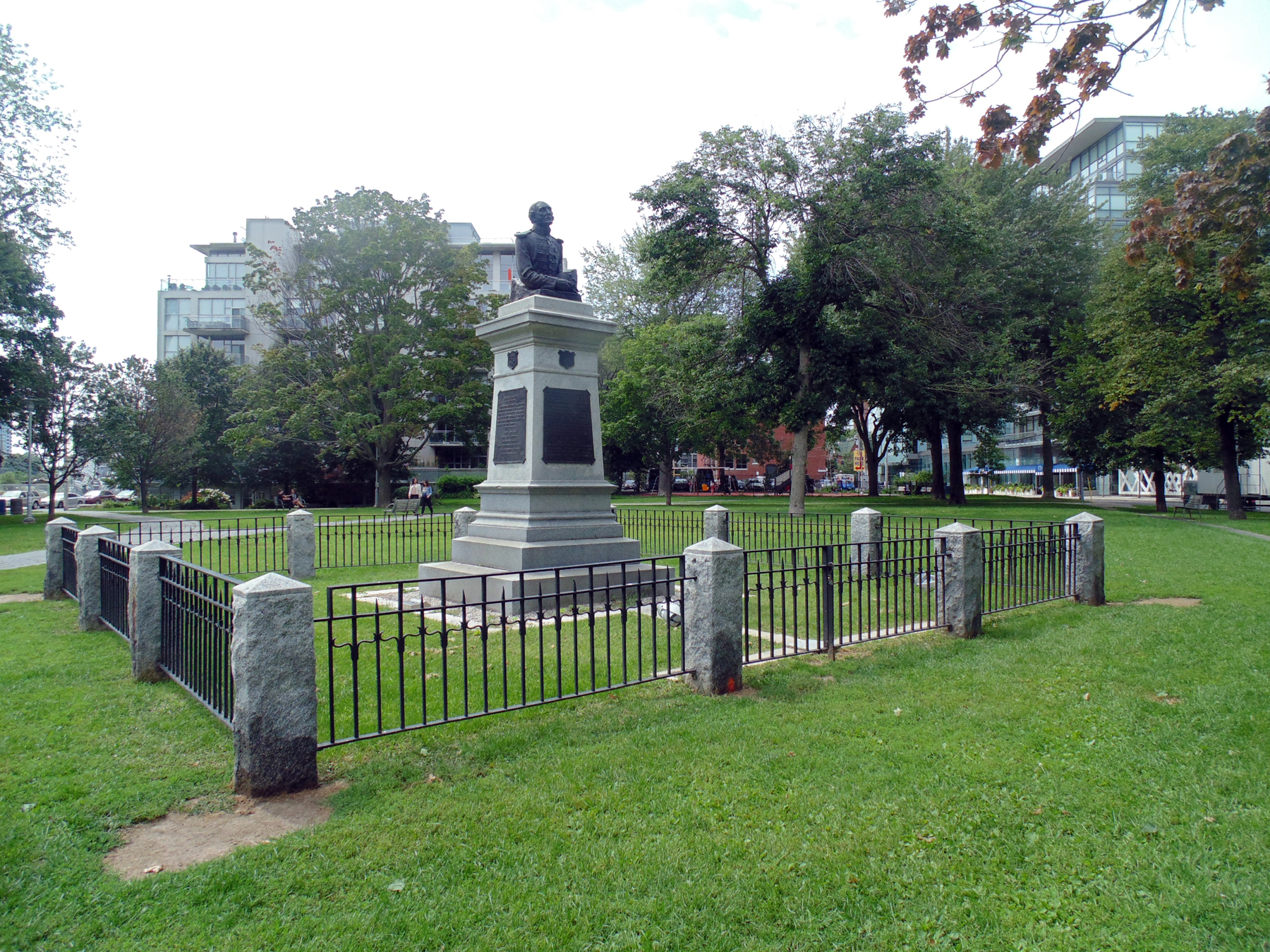
This is a solemn place. A memorial to many who died during the pe- riod of the War of 1812. Still the park is a free flowing green space worth a stroll.
BRIAN BURCHELL/GLEANER NEWS
Victoria Memorial Park
Bathurst and Wellington streets
Time: 12:30 pm
Grade: B (Last year A)
Reason to go: Being in the middle of the city, this park offers both the sounds of birds chirping loudly and cars driving by. It seems to be the spot for the condo-living dogs to run around in a space larger than their homes. The grass could definitely use some maintenance with the weeds almost taking over. The garbage bins are located at the outer sides of the park, which is why there is a handful of garbage left on benches. On the west side is a playground for the families that also occupy the park and have a rest while taking their toddlers for a stroll. In the middle is a statue of an older soldier that goes unnamed, but brings the together as a whole with original gravestones located at the east end of the park.
Overheard: Dog owners whistling to their dogs
Fact: Victoria Memorial Park was once a military cemetery created in the late eighteenth century.
Clarence Square
Spadina Avenue and Wellington Street
Time: 3:00 pm
Grade: C (Last year: N/A)
Reason to go: As a prime example of an inner city park, Clarence Square offers spacious benches and an off leash dog area. Lying between Spadina and Blue Jays Way makes for a busy environment that is mainly used for the hustle and flow of employees on break or going to and from work. There are a few garbage bins, but they appear to not be used judging from the amount of garbage all over the park.
Overheard: Dogs barking, birds chirping, traffic, and a man snoring
Fact: Across the road is Le Neuf Café, perfect for grabbing a coffee and croissant to enjoy in the square.
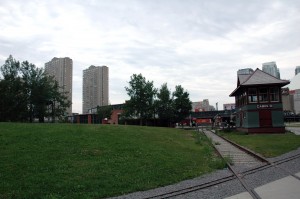
The live mini-steam train is worth the visit in Roundhouse park, bring a child to justify your visit, or just indulge yourself in the history of this great space.
BRIAN BURCHELL/GLEANER NEWS
Roundhouse Park
Corner of Lower Simcoe Street and Bremmer Boulevard, near the Gardiner Expressway
Time: 3:30 pm
Grade: A (Last year A)
Reason to go: This fun and spacious park is located in the midst of Toronto’s tourist attractions such as the CN Tower, Ripley’s Aquarium, and the Rogers Center. The park was created in 1997 and has a live mini steam railway running through it. There are a few benches and great areas to snap some photos of the old building that still remains. The walkway throughout the park can take you to the Railway Museum and the Steam Whistle Brewery.
Overheard: The mini trains driving on tracks
Fact: Roundhouse is 17 acres large and was formerly the Railway Lands.
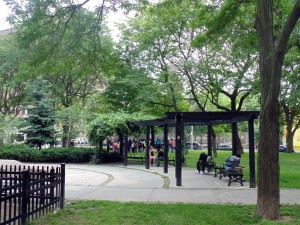
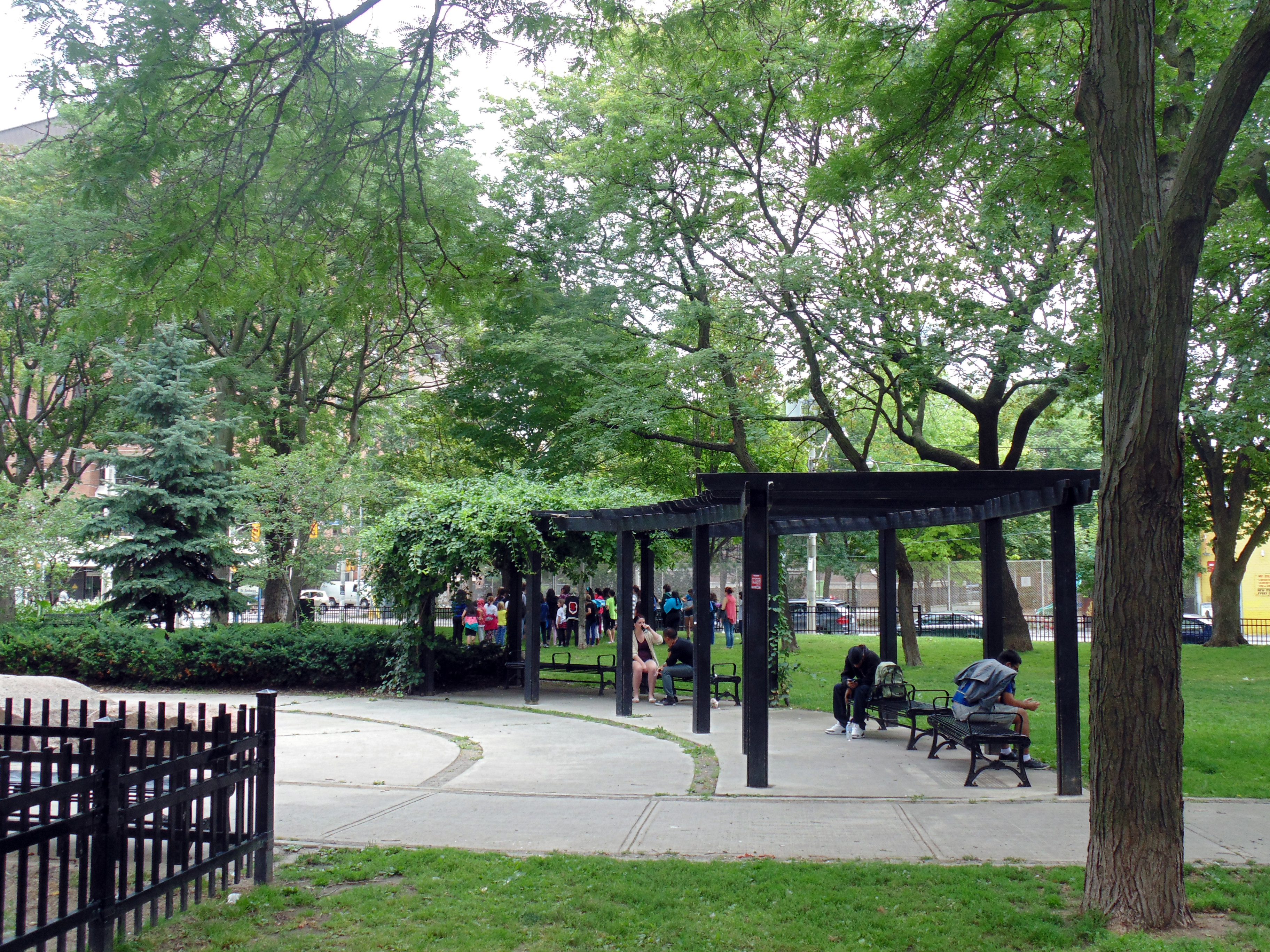
A beautifully executed arbour provides just the right amount of a sense of enclosure and is complimented by pavers with matching curvature.
BRIAN BURCHELL/GLEANER NEWS
St. Andrew’s Playground
450 Adelaide St. W.
Time: 2:00
Grade: B (last year **)
Reason to go: What makes this park a great place to lounge is the beautiful long curved arbour that sits in the centre, but being an inner city park there will always be some sort of graffiti or tagging, and in this case some tags are on the gazebo. Nonetheless, it provides great shade and relaxation. St. Andrew’s Playground has a small playground, dog off-leash area, many benches, and areas shaded by the variety of trees. The park seems to be maintained regularly with no signs of extensive litter and an overall cleanliness. As it is located directly off Adelaide Street West, one is easily a part of the rush hours in the city, but this doesn’t take away from the natural ambience of the park.
Overheard: “Jack, just let the birds eat.”
Fact: Neighbouring the park on the corner of Brant and Adelaide streets is Brant Street Café, a well-spoken-of diner with all kinds of great home-cooked dishes.
Lisgar Park
60 Lisgar St.
Time: 1:00
Grade: N/A (last year **)
Reason to go: Lisgar Park is currently under renovation with the major focus being on creating a more community friendly venue for the Queen West neighbourhood. New amenities will include sculptural seating, canopy trees, planting areas, and art poles made of timber from an industrial building adjacent to the park. These poles will provide
light to the upgraded venue, maintain event power, and stand as an event/art foundation. Date of completion is set for 2016.
Overheard: Trucks and construction.
Fact: Lisgar Park is located on a former, early 1900s warehouse site.
Canoe Landing Park
95 Fort York Boulevard (nearest intersection Spadina Avenue/Fort York Boulevard)
Time: 6:00 pm
Grade: B+ (last year n/a)
Reason to go: Opened in 2009, Canoe Landing Park in the Harbourfront neighbourhood is eight acres of privately constructed parkland which offers a great deal of creatively designed green space for residents “trapped” between the train tracks to the north and the Gardiner Expressway to the south.
A berm built at the south end supports a large red canoe, designed by artist Douglas Coupland, and from this vantage point one can see Lake Ontario over the Gardiner. Soil excavated from the foundations of neighbouring condos was used to construct the berm. Other displays of work by Coupland include some fishing bobbers between which water shoots out of the decking sporadically to the delight of children.
The park features an artificial surface being used at the time of the review for a pick-up soccer game, porta-potties, lots of green space, and a beaver dam artificial water feature that is not functioning. The artificial surface is surrounded by the Terry Fox Miracle Mile – two laps equals one mile.
Fact: The park is the result of Concord CityPlace developments and is unique at many levels not least of which is that it is a “private” park, intensively used by the public.
Suggestions for improvement: This park scores high for design, but suffers from lack of maintenance of the green spaces, and the impressive beaver dam water feature should be made functional.
Tags: General
October 8th, 2014 · Comments Off on It’s time to build our city again
Ex-candidate for federal seat eyes city seat
By Joe Cressy
Toronto is a great city. Survey after survey ranks Toronto amongst the top cities in the world. And we have much to be proud of: unique and engaged neighbourhoods; a diverse population; financial and innovation hubs; a thriving arts and cultural industry; and green spaces that rival those anywhere in the world.
And yet, and yet … there are so many problems still to be resolved: gridlock, ageing infrastructure, lack of affordable housing, high youth unemployment, and the challenges of preserving a healthy environment.
Sadly, during the four years of Rob Ford’s tenure as mayor, none of these problems have been tackled with any consistency. Instead, Toronto’s reputation has been sullied and we have been forced to fight against short-sighted ideas like downtown casinos, cuts to valuable services, and jets at the island airport.
It’s time to re-engage our communities in tackling our big issues, and to invest in city-building once again.
One of the exciting things about local government is the ability to incubate new ideas, pilot new projects, and make changes that directly affect people’s lives. If you can see it, smell it, touch it, or feel it, it’s municipal. And it’s why I’m running for city council: I want to work with our community to make changes now. Here are just three examples:
Transit. We can get our city moving again by investing real dollars from real government commitments into buses, street cars, and light rail transit. But, it’s got to be done based on research and expert advice – not political calculations and slogans. In downtown Toronto 41% of residents walk or bicycle to work, 34% take public transit, and only 25% drive. In our downtown communities, we can reduce congestion not by building more roads, but by investing in pedestrian and cycling lanes that are safer and more convenient.
Affordable housing. That shouldn’t be a dream but, right now, it feels that way. The average house price is over $1 million. The average rent for a 2-bedroom apartment is $1,700/month. And, according to Statistics Canada, 45% of Toronto adults aged 20-29 live with their parents, many because they cannot afford to move out. What can we do? Well, we can continue the transformation of public housing like the Alexandra Park revitalization project. And we can make sure that new developments have affordable housing included.
Environment. Yes, Rob Ford and Stephen Harper have their heads in the sand around climate change. But, in our local neighbourhoods, we have already experienced the effects of a changing environment, and the Annex Residents’ Association has already acted to improve the situation. Their TreesPlease program works to survey, protect, and expand Toronto’s tree canopy thereby providing more shade, removing industrial emissions from the air, and increasing property values. This is a win-win situation, improving our environment and beautifying our neighbourhoods in the process.
Three problems. Three good ideas to start solving the problems. And always ones that involve local residents.
Like many of you, I’m proud to live in Toronto. I’m also proud to live in downtown Toronto. Together, we can tackle the big issues at the neighbourhood level. It will take political will, an engaged and supportive community, good ideas around generating revenue, and a commitment to invest in our city again.
As residents and citizens — not just consumers and taxpayers — we are all participants. We all have a role to play in shaping and building our city.
So, let’s get started. Let’s build our city again.
Joe Cressy is a candidate for city council in Ward 20, Trinity-Spadina. He is a former senior advisor at the Stephen Lewis Foundation. He lives in the Annex with his wife, Nina.
Tags: General
October 8th, 2014 · Comments Off on A very Canadian solution
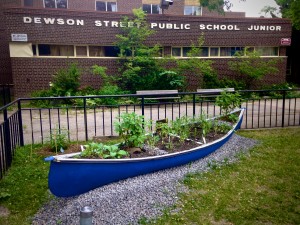
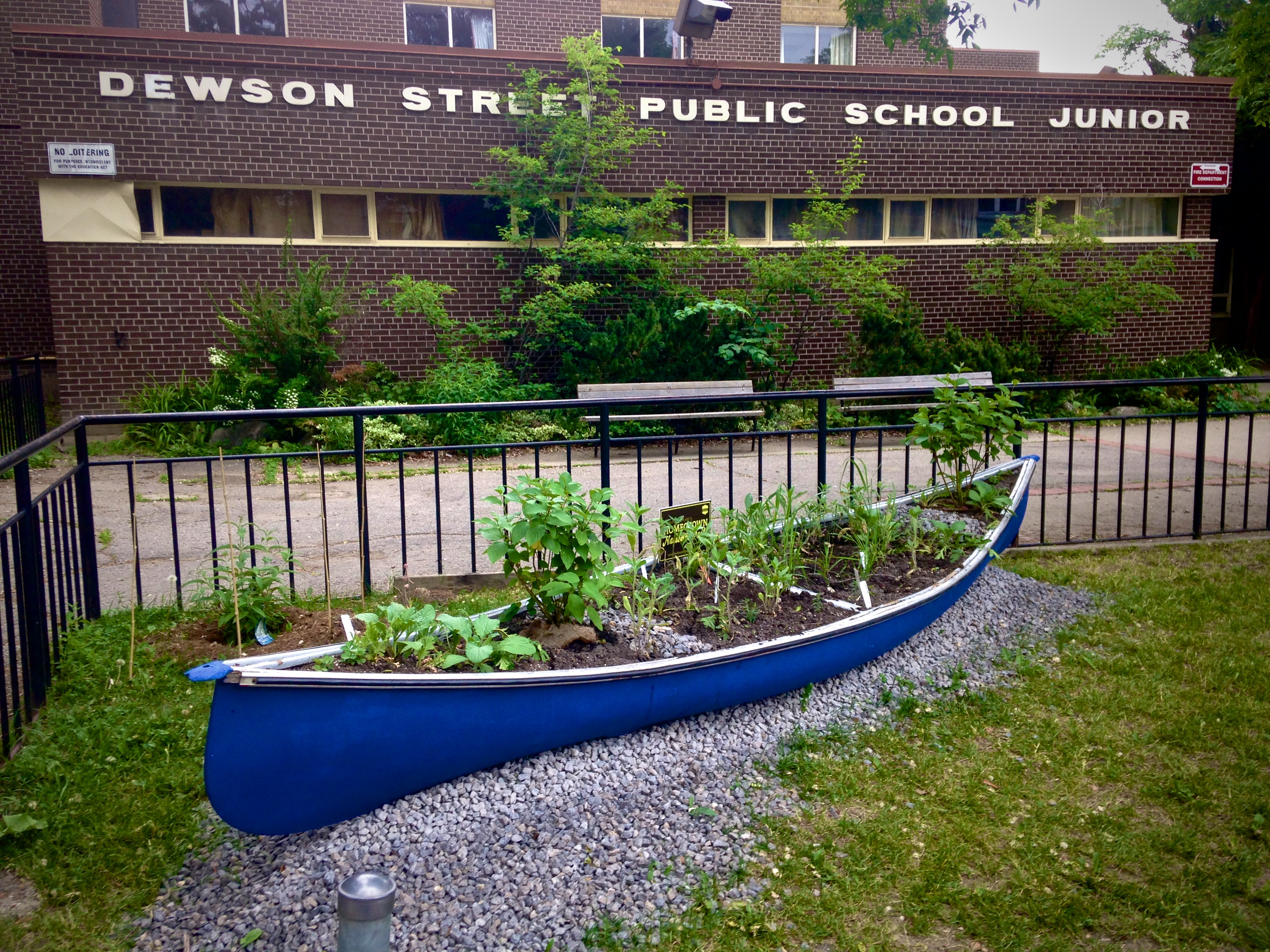
This canoe at Dewson Street Publc School functions as a planter for milkweed, essential for the survival of monarch butterflies and is a great nectar source for bees and other pollinators. Students at the school planted the garden. COURTESY JODE ROBERTS, DAVID SUZUKI FOUNDATION
Tired canoes re-purposed as pollinator point
By Samina Esha
On July 18, Homegrown National Park, a David Suzuki Foundation project, hosted their second successful year of a community Canoe Garden after last year’s effort to enhance Toronto’s green space.
The goal of the project is to fill canoe planters with native plants that are friendly for bees, insects, and birds to help with the pollinating process.
“My son helped plant one of the first canoes. So he has this deep connection to this canoe and the plants at Christie Pits. Every time we are down there he has to go and check it,” said Jode Roberts of the David Suzuki Foundation.
In 2014 the project was expanded into neighbourhoods throughout the Garrison Creek corridor, and it has recruited about two dozen trainees called Homegrown park rangers, who live, work, and play in their prospective areas.
“We connect them with different groups and encourage them to focus on the issues they are interested in. Then we let them loose while supporting them with their projects,” said Roberts.
Spearheaded by Parkdale resident and Homegrown ranger Aidan Dahlin Nolan, along with the David Suzuki Foundation, the project aims to see canoe planters installed in a number of city parks, including Christie Pits, Trinity Bellwoods, Little Norway, Bickford Park, and Stanley Park. Inspired by authors Richard Louv and Douglas Tallamy, the team embarked on a mission to establish the world’s first Homegrown National Park.
Dahlin Nolan got the idea about canoes and green space while he was camping with friends at the Algonquin Park.
“I started pitching different ideas to Ph.D. programs until I joined the David Suzuki Foundation,” said Nolan, who is project lead for Community Canoe and a Ph.D. student at York University. “The community really came forward for the Stanley Park Canoe. The plants we planted are suitable for bees and butterflies and other pollinating insects, and each canoe has a canoe captain who is a member of the community and is responsible for watering and weeding. So, there is someone always looking after them.”
Last summer the group fundraised 5,000 dollars over 20 days to buy used canoes and plants for the garden. And this summer they are continuing this process with schools and parks. The crowd-funded project to turn Toronto into Canada’s first Homegrown National Park was the first step to changing our ever-busy everyday grey life in this urban city.
All of the canoes so far have been through the old route of Garrison Creek and next year the group aims to remind Torontonians about the routes of other old river paths. However, finding these canoes can be hard.
“When canoes are busted people usually just send them out to landfills so there is a scarcity of retired canoes. We usually get most of them from donation or buy fixer uppers from Kijiji so the money raised is mostly used for planting. I currently have three canoes sitting in my back yard,” said Roberts.
Roberts also mentioned that the David Suzuki Foundation is constantly coming up with different projects. “We encourage and welcome people to go to the davidsuzuki.org/homegrown website where all of our different activities are listed. Some of these projects include planting pollinator gardens at school yard and parks hosting educational events regarding the environment, and generally encouraging people to get connected with nature,” said Roberts.
Teamed with neighbourhoods, volunteers, and experienced park rangers with diverse backgrounds, the project aims to bring residents, businesses, and institutions together to plant native trees and grow gardens. It challenges people to connect to nature.
“In the long term a canoe is just an element we can add to the parks or different green spaces including front yards, back yards, streets, rooftops, alleyways, and all the bits between them. It is the first step towards a more pollinator friendly green space,” said Roberts.
Tags: General
October 8th, 2014 · Comments Off on Equip officers with body cameras, tasers
Iacobucci calls for a shift to a “zero deaths” police culture
By Brian Burchell
It’s been just over a year since Sammy Yetim was shot and killed by Toronto police on a TTC streetcar on Dundas Street.
Constable James Forcillio of Toronto Police Service (TPS) 14 Division was charged just 30 days after the shooting by the Special Investigations Unit (SIU) with second-degree murder.
At the same time, Police Chief Bill Blair commissioned a review of the force’s use of force by police specifically in cases involving emotionally disturbed persons. Blair asked former Supreme Court Justice Frank Iacobucci for a review that focused on service-wide issues and how to make the force more effective in such encounters with the public.
This move by Blair is an unusual step which underscored a sense that the issues at hand go well beyond the specific circumstances of the Yetim shooting, but it also allowed to Blair to show that a transparent and arms length assessment was needed of TPS policy and procedures in such circumstances.
Justice Iacobucci released his eighty-four recommendations under nine broad topics on July 24, 2014.
The retired supreme court justice was not hesitant to observe that there needs to be a change in police culture, as well as more specialized training, increased availability of special intervention teams, the equipment of front line officers with body cameras, an increased use and an assessment of conducted-energy-weapons (or tasers as they are commonly known), more selective police recruitment strategies, and regular assessments of the mental health of police officers themselves; perhaps outside of his mandate, Iacobucci also made recommendations about the intersection of the mental health care system in Ontario and the role of the Toronto police.
Chief Blair welcomed the recommendations and he vowed at the press conference in remarks about the report that “this will not gather dust, but momentum.”
Gary Pieters, president of the Urban Alliance on Race Relations, welcomed the report: “What we would like to see is that this report gets into the hands of every single rank and file officer. We want to see that the recommendations, and the steps to make those recommendations reality in the daily work of policing, are embedded into the culture of these officers.”
According to the report, the TPS is dispatched to approximately 20,000 calls for service annually to “persons-in-crisis”, and about 8,000 of these events involve apprehensions under the Mental Health Act. Of these encounters, between 2002 and 2012, five have resulted in “emotionally disturbed persons” being fatally shot.
The data supplied by the TPS did not include 2013 and therefore does not include the shooting of Sammy Yetim.
In the TPS only supervisors carry tasers as an alternative to the more lethal weapon of a service revolver.
The taser proved to be utterly useless in the case of the Yetim shooting, as a sergeant arriving late to the scene demonstrated by choosing, perhaps inexplicably, to use it on Yetim after he had been shot nine times by Constable Forcillo.
Peter Rosenthal, a social justice lawyer, responded to questions from the Gleaner about the report and specifically about the suggestion of increased access to tasers for front-line officers. “In general, I welcome the Iacobucci Report. Its recommendations about de-escalation are excellent, and that is the crucial reform that is required to lessen police killings.”
Rosenthal was critical of the report’s recommendations around taser usage, especially since tasers are not the weapons that should be used when the person that police are facing has a weapon.
“The recommendation to increase taser use, even in a limited way, is unfortunate in my view. Many officers currently have tasers. The training is NOT to use a taser if someone has a weapon. This is because a taser is not adequate as an alternative to a firearm. The reason is clear: a taser is not reliable enough to ensure protection if a suspect presents an immediate threat of serious injury or death. Tasers are not effective unless both darts land properly, and it is very difficult to aim tasers, especially if the target is in motion (as the target can move substantially during the time the darts fly through the air). Thus increased availability of tasers will mean many people will be victims of taser use (as has happened even with the present restricted taser use) and it will not lessen police killings.”
The director of communications for the Toronto police, Mark Pugash, also responded to questions from the Gleaner about the report, specifically about the next steps and what has changed in the force since the shooting of Yetim: “The recommendations have not been costed. Keep in mind that the Iacobucci report also touches on bodies other than the TPS. Chief Blair has created an external advisory committee and made clear the sense of urgency he feels with respect to implementing the recommendations. The Iacobucci report was commissioned in the aftermath of the Yetim shooting, to examine our training, policy, procedures, equipment, supervision. It has come back with 84 recommendations. We have started the process of implementation.”
Pugash urged that people recognize “the shooting of Sammy Yetim by a Toronto police officer last year was one percent of a much larger picture, and the report helps us see all the rest.”
Tags: General
September 11th, 2014 · Comments Off on Remembering ‘institution row’
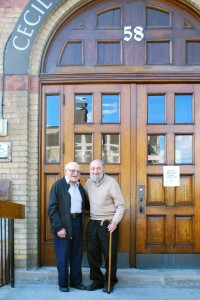
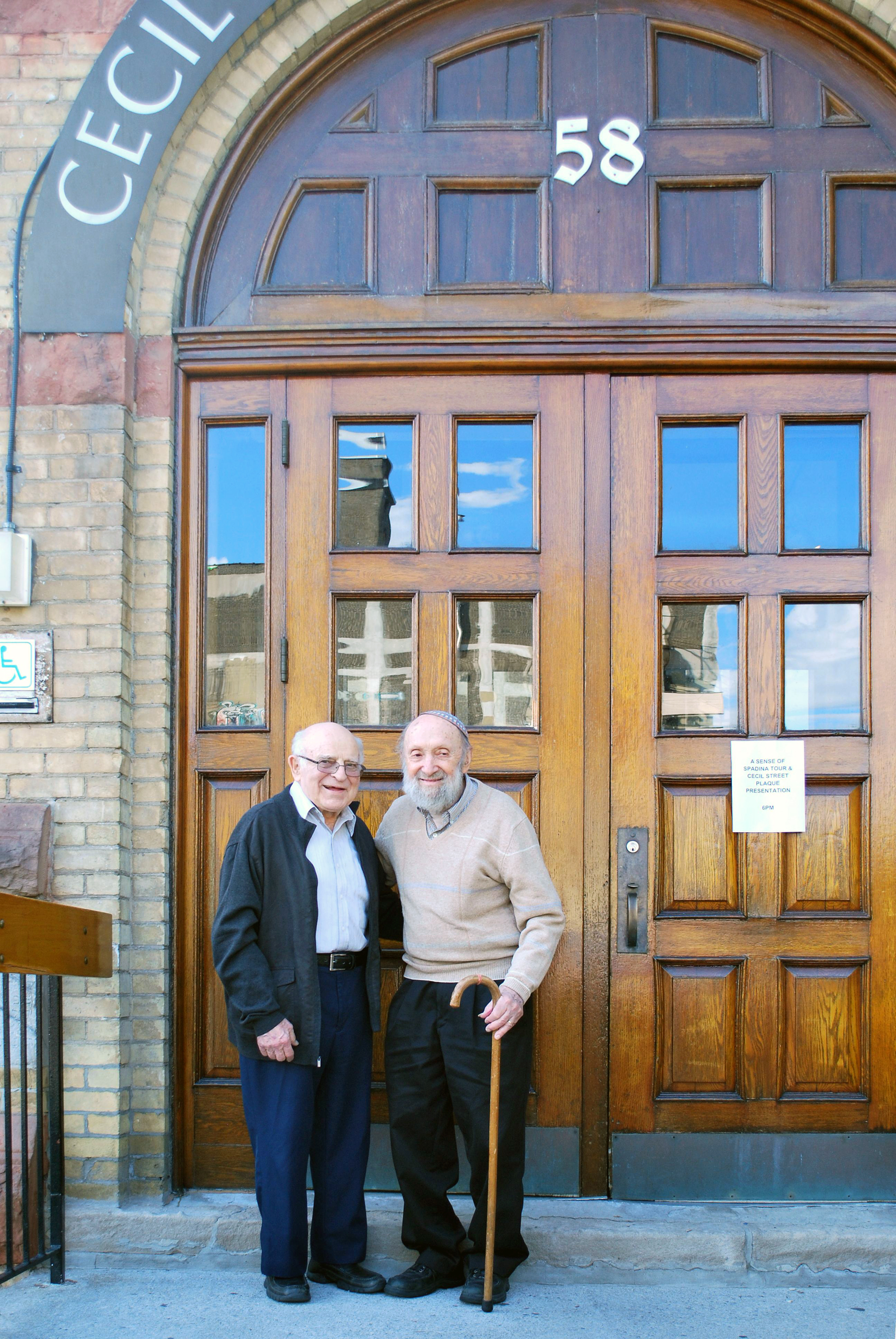
Gurion Hyman and Gordon Perlmutter recreate the 1938 picture that is memorialized on a Heritage Toronto plaque. Unveiled in early July, the plaque, which is the thirteenth to commemorate Toronto’s Jewish her- itage, will be installed in front of the Cecil Street Community Centre. Marcus Mitanis/Heritage Toronto
By Annemarie Brissenden
Heritage Toronto marks Cecil Street Jewish roots
In 1938, two young boys posed for a picture on the front steps of the Ostrovtzer Synagogue at 58 Cecil Street. Three-quarters of a century later, Gurion Hyman and Gordon Perlmutter, now grown men with a wealth of history behind them, stood once more on those same steps on a balmy July evening, recreating the picture for a new generation.
Although the neighbourhood— like the synagogue, which is now a community centre—has changed dramatically in 75 years, signs still re- main of a time when Cecil Street was “institution row” to the city’s growing Jewish community. And, on July 9, Heritage Toronto unveiled “Cecil Street’s Jewish Heritage”, a plaque that commemorates the stretch from Spadina Avenue to Beverly Street. Featuring the 1938 picture, it also includes a map of the area from Goad’s Atlas (fire insurance maps published by Charles Goad) and a picture of the Jewish Old Folks Home, both dated 1923, and a description highlighting some of the local landmarks.
“Cecil Street and the surrounding area was the crucible for our lives,” said Avi Hyman, Gurion Hymon’s son, at the plaque unveiling. He was joined by Brent Pearlman of Heritage Toronto, Adam Nelson of sponsor
Scotiabank, and Eric Slavens, who was on the board of Heritage Toronto for six years and is now the chair of the Ontario Jewish Archives (OJA).
Slavens, who related that one of his grandfathers worked at a hat factory around the corner while another sold newspapers in the neighbourhood, said the area was a “key setting where our collective identity as Jewish Torontonians was framed.”
The area was actually home to the third wave of Jewish settlement in Toronto, which dates back to as early as the 1830s.
“It’s a bit of a misconception that Cecil Street was the first place that Jews settled in,” explained Sharoni Si- bony, an OJA tour guide who led a walk through the neighbourhood after the unveiling. The earliest Jewish immigrants settled around King Street East, closer to the lake and near the Pape Avenue cemetery. The second wave arrived between the late 1800s and early 1900s, and landed in St. John’s Ward, the area that is home to City Hall.
The Ostrovtzer Synagogue—once a church—was purchased in the 1920s and, with that, the area be- came a beacon of Jewish life for over 40 years. It is now the Cecil Street Community Centre, and remnants of the synagogue, like the ladies’ gallery in the auditorium, two plaques in the hallway, and the cor- nerstone marker, are still embedded in the building.
Likewise, signs of the street’s Jewish past are there for all who care to look. One woman on the tour, who grew up in the neighbourhood, re- called going to the Labour Zionist Centre three days a week after school to learn Jewish songs and dances.
“It was a wonderful place to come, but we resented leaving school to go to school,” she said ruefully of the centre, which is now home to the Bethune Institute.
Across the street was the Jewish Old Folks Home. Also pictured on the plaque, it grew from a semi-de- tached home on Cecil Street into Baycrest, a hospital on Bathurst Street that specializes in geriatric care.
A little further down at the end of Cecil Street is the Russian Orthodox Church. Located on Beverly Street, its front faces Institution Row. Orig- inally the Beth Jacobs Synagogue, the building, which dates to 1922, was designed by Benjamin Brown, Toronto’s first Jewish architect, who would go on to design the Balfour building at Adelaide Street West and Spadina Avenue. Seating approxi- mately 200 people, the synagogue not only had a ritual bath but it also featured a retractable roof that was pulled back for use during the autumn festival of Sukkot.
If you look closely, other markers remain, even further afield from Cecil Street.
For example, John’s Italian Cafe on Baldwin Street still has the Yiddish sign from Mendell’s Creamery etched on its windows.
These are but some of the many markers that serve as a reminder of
“how far back [Jewish heritage in Toronto] goes,” as Slavens said, and just “how pervasive it was over time.”
The OJA regularly conducts walking tours of Kensington Market from April to October. For further information, please visit www.ontariojewisharchives.org, and for more information on Heritage Toronto, please visit www.heritagetoronto.org.
Tags: General
September 9th, 2014 · Comments Off on A strategy run amok
Once again the proposal to lease out the Central Tech field to a developer for twenty-one years has failed to clear a hurdle. School board officials took the unusual step of launching a legal challenge of a municipal by-law allowing the City to say whether or not the plan needed a special application. The court recently sided with the City.
So impoverished is the Toronto District School Board (TDSB) that it cannot maintain its Central Tech field, and yet it has seemingly endless re- sources to fund legal challenges to the City of Toronto’s right to consent to the commercial use of school lands.
It appears that the TDSB would like to be regarded as an island, and a sovereign one at that. It attempted in its recent Superior Court application to equate the renting of a gymnasium to Scout groups to the lease of an entire playfield (the Central Tech field) to a private company for 21 years. While in principle they are the same, in reality, orders of magnitude matter. The Scout group leaves no mark on the landscape, its impact is negligible, and the developer makes no apology for the significant impact of its plans. Fair-minded people disagree about whether or not the proposal is a good idea, but they all agree it is a big deal.
Somewhere along the way the school board’s plans to create a championship field at Central Tech got wed to a singular solution: (A) a private operator (Razor Management), (B) an artificial surface, and (C) a dome for use in winter months. The TDSB then put blinders on to all other possibilities. The Harbord Village Residents’ Association (HVRA) claims to have an anonymous donor who is willing to restore the field to a natural, playable surface. The school has not even replied to that offer.
In some respects, it’s a solution looking for a problem and it has driven the cart of the TDSB horse ever since. Perhaps ironically, when the board started to explore the dome plan, soil tests revealed that the field was contaminated and it was promptly padlocked. The time spent in thinking about this proposal has resulted in loss of use for everyone. There is much disagreement about what would be necessary to remediate the soil, as the results of the tests have not been revealed. The TDSB says it would cost $1,000,000 (a nice round number); the HVRA has a quote for $104,000. It’s impossible to know if the field is “unsafe” for natural use in its current form or not. What about the decades of use by previous high school students and community members; are they facing elevated health risks? The TDSB is silent on this.
The TDSB argues that the City’s by-law is vague when it comes to the commercial use of school board lands and that it lends too much potentially arbitrary decision-making to the City. The chief building official can decide which building application requires an application for a minor variance which invites community consultations, God forbid. The court ruled that the by-law worked as long as the parties acted reasonably, and the chief building official seems to have been “reasonable” according to the decision that this plan required a variance application. After an application for a dome at Monarch Park Collegiate, the community was consulted and the TDSB and developer were permitted to proceed. The TDSB wilfully participated in that process and got the result it wanted. This time around it did not, and now it questions the rules of the game.
This “you are not the boss of me” attitude from the TDSB to the City and to the community is juvenile and wasteful of public resources. Hope- fully, the students are not watching their schoolmasters.
Tags: General
September 9th, 2014 · Comments Off on Liberals sweep Trinity-Spadina
Cressy contemplating running for city council
By Annemarie Brissenden
It was always going to be an uphill battle for Joe Cressy.
As the federal New Democratic Party candidate running to replace Olivia Chow in Trinity-Spadina, he was facing a riding whose changing demographics were lending it an in- creasingly Liberal hue. And that was before Adam Vaughan, a well-known councillor and seasoned journalist, seemingly hand-picked by the young and dynamic Liberal leader, joined the race.
Then, long-standing and much loved MPP Rosario Marchese lost his seat to Liberal candidate Han Dong in the provincial election held only a week before the June 30 by-election.
In the end, after a spring spent knocking on doors and appearing at community events with NDP leader Thomas Mulcair often at his side, Cressy lost.
Vaughan handily defeated him by 6,745 votes, with the rest of the candidates, the Conservative and Green parties included, barely even registering in the results.
But Cressy remains philosophical about the outcome.
“I’m incredibly proud of the campaign we ran,” said Cressy, adding that he loved every minute of it. “We talked about the big issues, but it was not a race we were going to win.”
Acknowledging that his political career is still in its early days, Cressy, who turned 30 on July 10, said Adam Vaughan had earned the win.
“He has served our community for many years, as a councillor and a journalist. He has earned his standing,” explained Cressy, while “I’m still earning [mine].”
He said he regularly encountered that sentiment while canvassing in the neighbourhood.
The Liberals “had a strong candidate in Adam Vaughan, whom people knew and decided to support,” as the Liberal party both federally and provincially reached out to down- town voters.
There was a different strategy at work provincially, he argued, where the “campaign did not target the downtown core on behalf of the NDP,” and Marchese became a casualty of “strong desire [in downtown Toronto] to stop Tim Hudak”.
Cressy, still on leave from the Stephen Lewis Foundation, where he
has worked for the past four years, is readjusting to life after a four-month campaign.
“I’m just back from the cottage, where I was reconnecting with my wife and family, sleep, good food, and a canoe.”
And he’s been doing a lot of thinking, because he has some “big decisions about what to do next.”
One option?
Running municipally to take over the council seat just vacated by Vaughan.
There would be some interesting analogies should he become councillor for Ward 20, Trinity-Spadina.
He wouldn’t just be his competi- tor’s successor but, like Vaughan, he also would be following in the foot- steps of his father. Gordon Cressy spent 12 years in local politics, in- cluding time as a city councillor and chair of the Toronto District School Board.
“I’m getting lots of encouragement in that direction from neighbours, community members, and residents’ associations,” admitted Cressy, who hasn’t made any decisions as yet. “I owe it to my community, my ward, and myself to think about it.”
Subsequent to the writing of this article, Joe Cressy announced his councillor candidacy for Ward 20, Trinity-Spadina.
Tags: General
September 9th, 2014 · Comments Off on Inspired by a small act of help
New MPP focused on transit, development, and services for seniors
By Annemarie Brissenden
There is an oddly poetic quality to Han Dong’s defeat of Rosario Marchese in the recent provincial election. Dong, the newly elected Liberal member of provincial par- liament for Trinity-Spadina, was inspired to seek office by Bob Wong, the Liberal MPP who lost his seat to NDP Marchese in the 1990 Ontario election.
Shortly after Dong, at age 13, and his family immigrated to Toronto from mainland China, his father, who was having trouble get- ting citizenship for the family, ran into Wong. Although the matter was a federal problem, explained Dong, Wong was able to help the family, something that has stayed with the new MPP ever since.
“It was inspiring to learn what little things an elected official can do to change a life, or a family’s life,” he said. And now, he is “satisfied to be in a position to help people.” Dong, who has been appointed
parliamentary assistant to the Minister of Training, Colleges and Uni- versities, brings a diverse mixture of public, not-for-profit, and private experience to the role. He previously spent nine years at Queen’s Park as a community organizer, prior to which he was the market- ing director for Chianti Foods. A resident of Trinity-Spadina, also home to his parents, for the past 15 years, he has volunteered with the Philippines Independence Day Council, the Toronto International Dragon Boat Race Festival, and at many local centres for seniors.
Although he’s encouraged by the Liberal government’s pledge to in- crease funding for senior community grants, he wants to draw more attention to the challenges faced by seniors locally and across the province.
“This community is one of the most popular destinations for im- migrants, who settle here and develop a network of friends,” said Dong. But seniors are “finding it harder to continue living in this community, and it shouldn’t be this way.”
He believes part of this is because services, which haven’t kept pace with the growth and demographic shifts in Trinity-Spadina, aren’t consistent across the riding.
While some neighbourhoods have access to new community centres and libraries, for example, there are other “areas where buying groceries is a problem, and residents are competing for parking space.”
“This is no longer a transition place for young professionals,” said Dong, “but a place to form and raise a family…to stay around for years.”
It’s partly why residents, he added, are increasingly concerned about the future of the area, some- thing he heard over and over again while knocking on doors during the campaign. “Development decisions have to stay local. The community should get their say about how the neighbourhood will look in 10 to 15 years.”
He’s scheduled a meeting with local councillor Mike Layton (Ward 19, Trinity-Spadina) as he wants to be a part of that discussion and work to find a “practical tool” to govern such a process.
The MPP is also keenly aware that transit is “by far the number one issue in the riding,” and that “we need to get people from home to work” and back again more efficiently.
He’s focused on improving pub- lic transit, but also wants to ad- dress the other challenges he sees on his daily walk to work: congestion and the need to accommodate alternative methods of transporta- tion, like bike lanes.
It all comes down to “fighting for more resources, and speaking up for the community,” said Dong. “After you become a parent, you look at the community in a different way. You shift from looking at the entertainment and fun side to the future for your kids, your parents, who are on a fixed income, and look at what services [are avail- able].”
A frequent visitor to the restaurants on the Ossington Street strip, he loves how an area as vibrant and diverse as Trinity-Spadina still manages to retain a sense of small community.
“I feel extremely fortunate to be able to raise a family [here],” said Dong, “and I want to make sure other newcomers to this riding will have the same opportunities. I want to make sure Trinity-Spadina remains a family-friendly community.”
Tags: General
September 9th, 2014 · Comments Off on Dome plan squashed by courts
City’s right to declare what requires a bylaw variance upheld
By Brian Burchell
The Toronto District School Board (TDSB) has lost another round in the fight to lease the Central Tech- nical School field to a commercial operator who would apply artificial turf and a dome for winter use.
Superior Court Justice D.L. Cor- bett released his decision June 13, 2014, rejecting the TDSB’s argu- ment that since the proposed Cen- tral Tech dome project would be on school land it was educational and therefore should be exempt from city zoning bylaws. Justice Corbett ruled that the chief building official of the City of Toronto did have the authority to identify the commer- cial development of the Central Tech field as requiring a zoning vari- ance.
In the May edition of the Annex Gleaner (see “Dome plan goes to court) it was reported that the
TDSB had taken the unusual step of seeking a court order to limit the City’s right to require the board to seek a minor variance of a bylaw. The TDSB had lost its application in March to lease the Central Tech field to a commercial operator, who planned to apply artificial turf and build a dome over the field, for 21 years at the City’s Committee of Adjustment. Then the TDSB chose to challenge the city’s requirement for it to have to apply for the bylaw variance in the first place.
Tim Grant, the chair of the Har- bord Village Residents’ Association, told the Gleaner “this strategy of using the courts instead of the On- tario Municipal Board excludes third parties like residents’ associa- tions, and I am beginning to think that for the TDSB it’s too delicious a prospect to get the courts to tell the City it has no jurisdiction over school board lands, they will just
keep funding the legal strategy as far as possible. I wonder if this is no longer about Central Tech specifi- cally. It’s too bad they don’t just take that funding, fix the field, and get on with it.”
At the heart of the TDSB’s posi- tion is that the city bylaw is too vague. It permits commercial use of school property by renting space for community meetings and Scout groups for example, even if those uses are not “educational”. But, when the board wants to allow a commercial operator to build a dome on the field that actually does allow for some educational use, the City says it needs to seek an exemp- tion to the bylaw.
Justice Corbett rejected the TDSB’s line of reasoning as follows: “Commercial exploitation of TDSB facilities is not a ‘school use’ of TDSB premises. This does not mean that commercial exploitation of TDSB facilities is never permis- sible under the Exemption. The City interprets the Exemption to permit incidental use of school premises for purposes other than education or instruction by the TDSB, so long as the basic charac- ter and nature of the school use of the facilities is unchanged. Where the intensity of this non-TDSB use rises above incidental, then it is no longer within the Exemption. This court need not decide precisely where to draw the line for permissi- ble ‘incidental use’ by persons other than the TDSB. This is a matter for the City to decide on a case-by-case basis, so long as its decisions are rea- sonable.
“The Proposal falls well across the line of ‘incidental use’ of TDSB fa- cilities for commercial purposes. It is not covered by the Exemption. It therefore follows that the City’s decision to this effect was reasonable, and the TDSB followed the correct procedure in seeking a minor vari- ance from the Committee of Ad- justment. The proper process for the TDSB to follow now is an ap- peal from the Committee of Ad- justment to the OMB. And so, for the reasons that follow, this applica- tion is dismissed.”
The TDSB may appeal the deci- sion to Divisional Court or proceed with its OMB application to over- turn the city’s decision.
Tags: General
August 14th, 2014 · Comments Off on
Tags: General
August 14th, 2014 · Comments Off on
Tags: General
August 14th, 2014 · Comments Off on Gluten-free can be a real treat
How to skip the gluten and the cost of store-bought
By Susan Oppenheim
“Gluten sensitivity (also gluten intolerance) is a spectrum of disorders including celiac disease in which gluten has an adverse effect on the body. Symptoms include bloating, abdominal discomfort or pain, diarrhea, constipation, muscular disturbances, headaches, migraines, severe acne, fatigue, and bone or joint pain.
Gluten, named from the Latin gluten meaning glue, is a substance that gives elasticity to dough helping it to rise and to keep its shape. It is found in many staple foods in the Western diet. It occurs in wheat and other grains, including barley and rye, and in foods or drinks derived from them, but not in corn, rice, or oats. Gluten is a protein composite consisting of a gliadin fraction (alcohol soluble) and a glutenin fraction (only soluble in dilute acids or alkali).”—Wikipaedia.
We now see gluten-free product lines regularly in the supermarkets. We also notice that because they are for special diets they tend to be more expensive, and it is becoming increasingly challenging to come up with treats that are edible for the entire family.
Last week I was visiting my daughter in Kitchener. She does part-time after-school care for a little 3-year-old girl the same age as her daughter Olivia.
Isla carries her own lunch every day as her parents have rigid diet restrictions for her.
She does not always understand being “different” with full-time working parents that do not fetch her from school, and only eating her special foods, but she is a good sport with great resiliency. And she loves to eat! So when I visited I brought a treat for both Isla and Olivia.
The Original Gluten-Free cookie – the coconut macaroon. The basic recipe is very easy to modify and personalize.
Coconut macaroons
Ingredients
- Coconut, use unsweetened, from fine to coarse grind
- Vanilla – I substitute other flavourings – almond, lemon, orange
- Hide dried fruit bits, nuts, or chocolate chunks inside cookies
- With zests (lemon or orange grated peel), also add a bit of food colouring
I melt my dark chocolate chips in a double boiler (or pan inside a saucepan) but no water can get into it, then dip the cookies generously and turn right side up to cool.
If you must use sweetened coconut, reduce the sugar in this recipe from 1/4 cup to 1 tablespoon:
- 1/4 cup sugar
- 2 1/2 cups unsweetened shredded coconut
- 2 large egg whites (yolks can be added to omelettes or pancakes)
- 1 teaspoon pure vanilla extract
- Pinch of sea salt
Preheat oven to 325 degrees. Line a baking sheet with parchment paper.
Combine sugar, coconut, egg whites, vanilla, and salt in a nice big bowl. Don’t worry if a bit of yolk gets in.
Using your hands, mix everything up very well.
Have a bowl of water near by, dampen your hands in it, and form mounds of about 1 1/2 tablespoons on the baking sheet, about an inch apart.
Bake for 16 to 17 minutes. You can open the oven half way through and rotate the baking sheet to bake uniformly.
Cool on a wire rack or leave on the baking sheet.
If I am rushing I put it in the fridge for 10 minutes to cool completely.
When cooled and hardened on top, take each cookie, turn it upside down, and dip into the melted chocolate, and then leave to cool again on the baking sheet. I only single stack them when packing them up.
This makes about 18 nice sized cookies. And they are nut-free, so they can also go to school in lunches.
Tags: General