October 25th, 2014 · Comments Off on

Ashley James Thomas of The Art House Gallery, 594 Markham St. participated in the The Mirvish Village
Sidewalk Sale on Markham Street Saturday & Sunday, September 20-21 with, among others, this painting
of the Bloor Street Viaduct.
COURTESY LAURA BURNHAM, MIRVISH VILLAGE BIA
Tags: General
October 25th, 2014 · Comments Off on

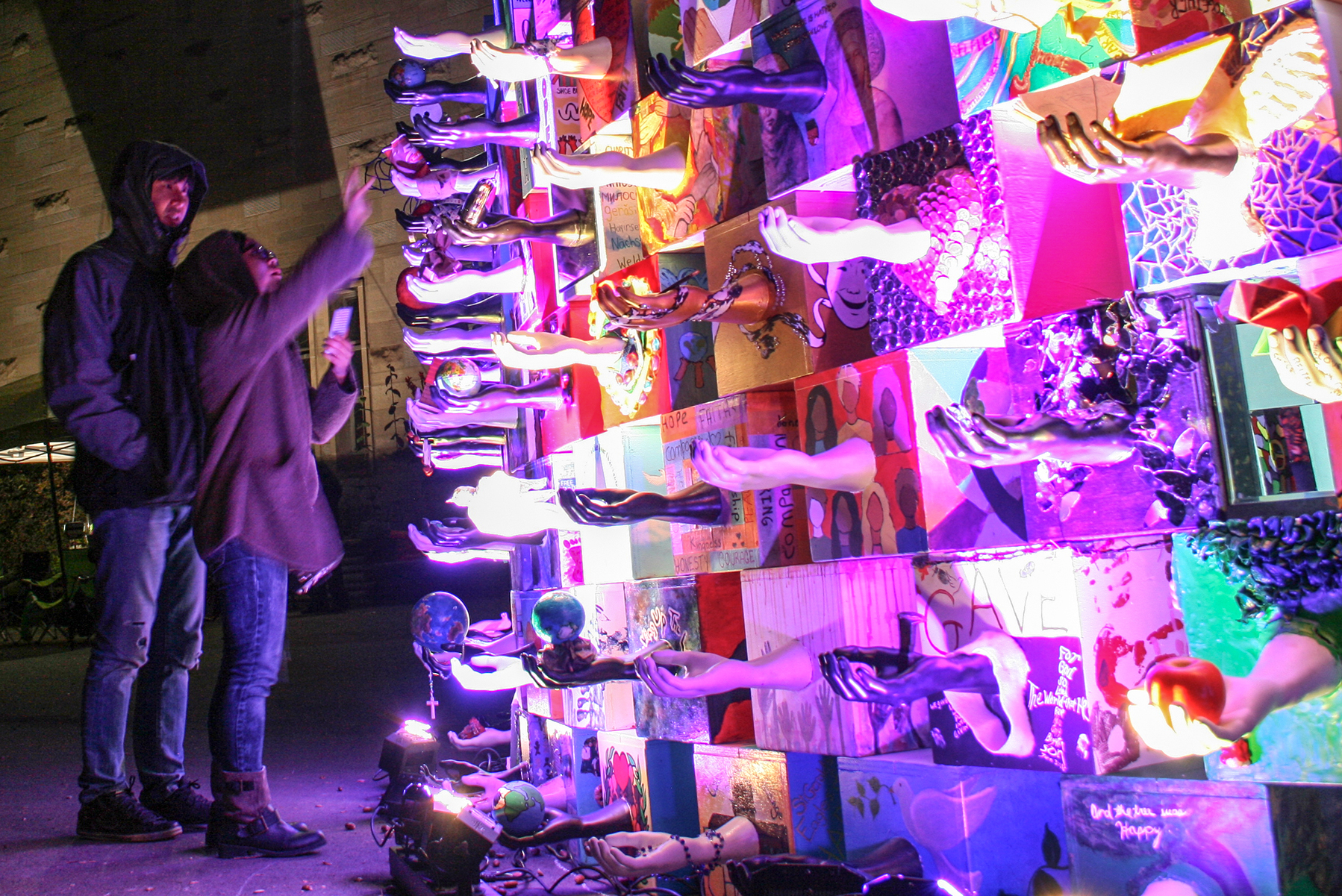
Students from 201 Toronto Catholic District School Board schools contributed to Project Reach, a collaborative
installation on display at Brennan Hall (81 St. Mary St.) as part of Scotiabank Nuit Blanche. Each
school made a “box of charity” to show their view on the meaning of charity. The hands symbolize people’s
ability to reach out and change the world around them.
NEILAND BRISSENDEN/GLEANER NEWS
Tags: General
October 25th, 2014 · Comments Off on We can curb waste with district energy systems
Energy efficiency is the lowest hanging fruit on the environmental front
By Terri Chu
Everyone is waiting nervously to see what the future of Honest Ed’s will hold for us. In addition to the importance of onsite electricity generation which I wrote about last month, it would be fantastic if combined heat and power could be included in these plans too. Electricity generation produces a lot of waste heat. In a lot of places in the world, that heat is captured and put to use. That “waste” heat is often put into what’s called a “district energy system”.
District energy can often result in substantial energy savings thanks to higher efficiency heating and chilling equipment (in general, they are better maintained than those in stand-alone buildings). Only in Canada would we have an electricity generating station located beside a warehouse where one vents excess heat to the atmosphere while the other burns natural gas for space heating!
When compared to most of Europe, Canada seems very far behind in terms of energy efficiency. Part of that is no doubt thanks to our abundance of cheap and plentiful resources. It has been a bit of a mixed blessing. At the same time as cheap energy has allowed us to prosper, the resource trap we find ourselves in will severely curtail the next generation’s ability to do the same.
Ever since the oil crisis four decades ago, Scandinavia has been investing heavily to reduce their reliance on imported oil. Sweden in particular has led the way with district energy systems. As a primer, district energy simply refers to a thermal grid. It works much the same way as any other grid such as natural gas or electricity. In this case, we take large pipes and send hot and/or cold water down them for buildings to use for heating and/or cooling. When both heating and cooling is involved, four pipes are needed. Needless to say, the investment can be quite substantial.
Scandinavia has figured this out and has dramatically dropped their energy consumption. In Toronto, we have a few projects (notably Regent Park in Toronto and Enwave’s Deep Lake Water Cooling System), but growth of the systems has been very slow. Attempts to build such a system for the waterfront condos did not go so well.
Depending on who you ask, you will get a different story as to who is to blame.
District energy requires high density to be economically viable for us until we, like Sweden, can achieve economies of scale and build systems at a much lower cost. There are communities who are looking at incorporating district energy into neighbourhood plans. Project Neutral, a local group aiming to create net zero carbon communities, has been a very vocal proponent.
District energy systems need allies in the community. Residents need to be aware that there are alternatives to having natural gas furnaces burning in individual homes. We are so used to having them right in our basements that we have adapted to the risks that come with them. A natural gas leak can cause asphyxia and poor ventilation can cause carbon monoxide poisoning. These risks can be reduced by eliminating the furnace and taking heating energy from a thermal grid instead.
For me, it is frustrating to see Toronto, with all its density, take next to no political leadership in this area whereas communities like Guelph and Markham have already put many kilometres of pipe into the ground. Energy efficiency is the lowest hanging fruit on the environmental front. As residents of high density neighbourhoods, we should be championing innovative solutions that will make our homes and communities more energy efficient. For the benefit of our growing city, make sure your leaders understand that a low carbon future is important to you.
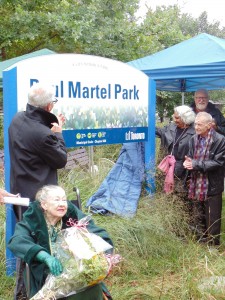
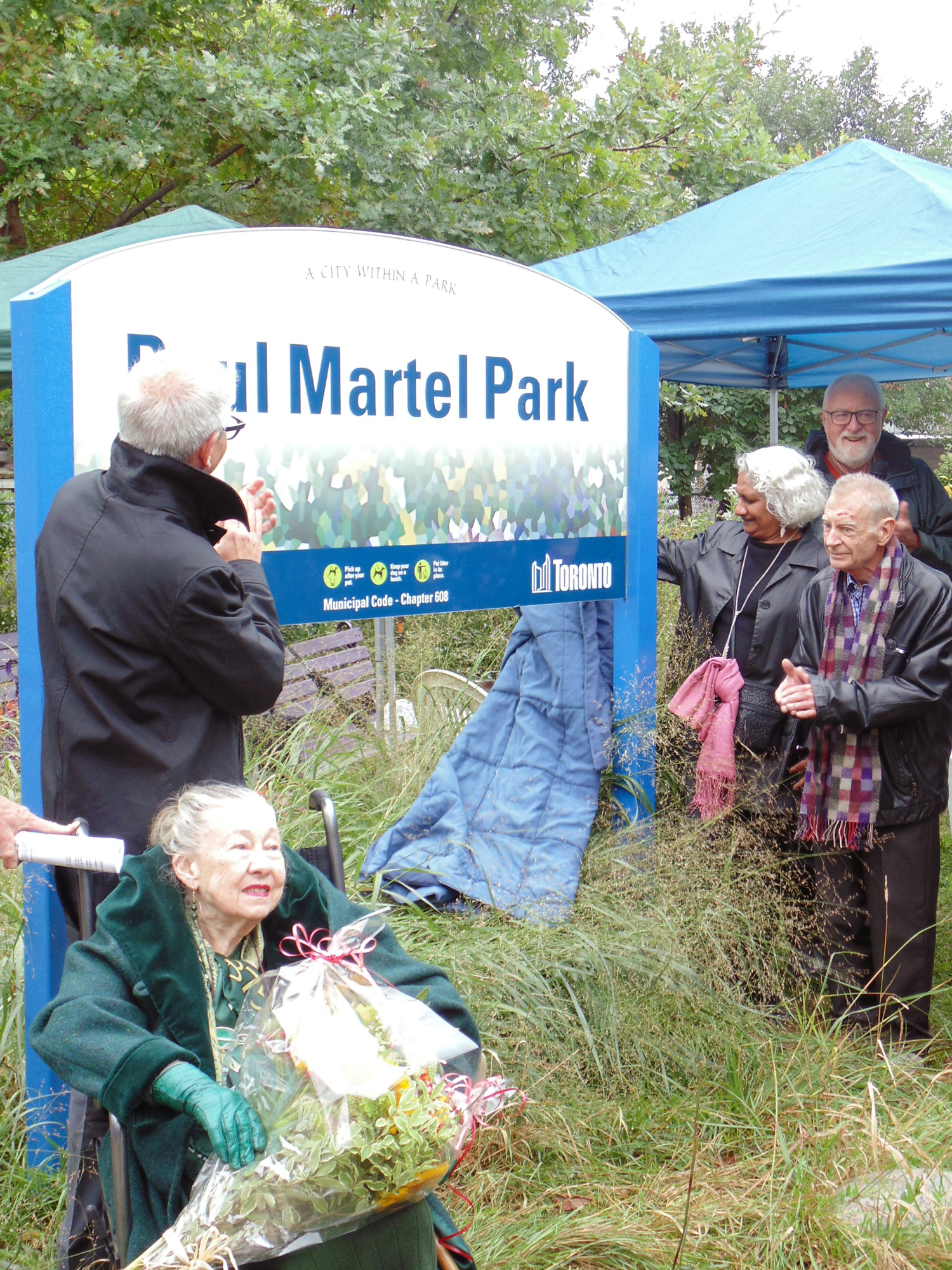
Long-time Annex resident Paul Martel (pictured at right) The
former Ecology Park on Madison Ave., just north of Bloor, has been
renamed in his honour. Through his efforts and the efforts of others,
an empty lot became an oasis of tall grasses, shrubs, wild flowers and
shade trees.
BRIAN BURCHELL/GLEANER NEWS
Tags: General
October 25th, 2014 · 1 Comment
New Gleaner wine expert shares some local secrets
By Jason Nykor
This week I had the opportunity to sit with Pierre LeBoudec, assistant general manager at the University of Toronto’s Faculty Club. He is a Breton now living in Canada who never misses the chance to extol the virtues of French wines.
The club, at 41 Wilcox Street in the centre of St. George campus, was originally a social centre for faculty, but it is now trying to broaden its audience by offering a $30 “community membership.”
The yearly fee allows access to the Oak and Beaver Pub and to the newly renovated patio with a retractable roof.
Besides the great location, the club’s wine mark-ups are “lower than most restaurants,” says LeBoudec.
More importantly, he has also changed most of the wine list to feature more consignment wines, which are wines not available at the LCBO and which must be purchased from the local agent. Usually wines from the consignment program are from more unique, hand-crafted smaller wineries.
TIP: If you have a wine at any restaurant in the city that is not available at the LCBO, ask the sommelier or your waiter and they will gladly get you the information on how to contact the agent. Don’t be scared: wine agents are happy to have your business, and will usually deliver the wine free of charge in the GTA, right to your front door! Most have websites that make purchasing easy as well.
The Oak and Beaver has a robust wine list featuring imported wines from around the world, as well as Ontario VQA “Faculty Club Selections” and wine features that LeBoudec changes roughly every three months.
This month, the club is featuring two wines from Lodi California — a Chardonnay and a Cabernet Sauvignon — as well as a Pinot Noir from the Central Coast AVA of California. Lodi, known as the Zinfandel capital of the world, is just south of the famous Napa wine region. The Central Coast AVA runs from Santa Barbara in the south all the way up to the San Francisco Bay to the north.
The first featured Lodi wine is 99 Vines Chardonnay. If you are looking for an oaky Chardonnay, stop reading now. This Chardonnay is a crisp, clean wine. Aromas of citrus, melon, and a little butterscotch on the nose. The taste is crisp with good acidity. This wine would pair perfectly with the Oak and Beaver’s warm Ahi Tuna Taco or the Cobb salad. At home it will also go well with pasta and cream sauces, chicken either roasted or barbecued, and popcorn. Serve cold!
The second feature wine is the 99 Vines Cabernet Sauvignon. It has aromas of dark fruits, plum and cherry, and it tastes a little sweet at the beginning and the end tannins are quite tame. This wine would pair well with the Oak and Beaver homemade Black Angus burger, as well as the veal parmesan sandwich. At home, this wine works great with roasted and barbecued meats and sausages, pastas with tomato sauces, or on its own with as many friends as possible.
And last but not least, my favourite grape, Pinot Noir. The 2011 Ballard Lane Pinot Noir is an elegant wine. As with other Pinot Noirs, this wine is medium bodied and goes well with food or on its own. The 2011 Ballard Lane has aromas of plum and is very fragrant. The tannins are elegant and light. Enjoy this wine at the club with the Australian rack of lamb. At home, pair this wine with meats, cheeses, anything, even your husband or wife. It is as versatile as you will find.
All of these wines are available at the U of T Faculty Club for the next three-month feature or you can purchase them for yourself from grape.
Tags: General
October 25th, 2014 · Comments Off on School board appeals ruling and loses, again
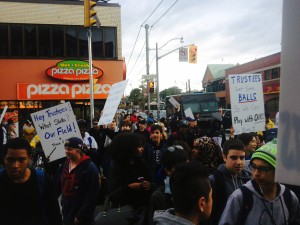
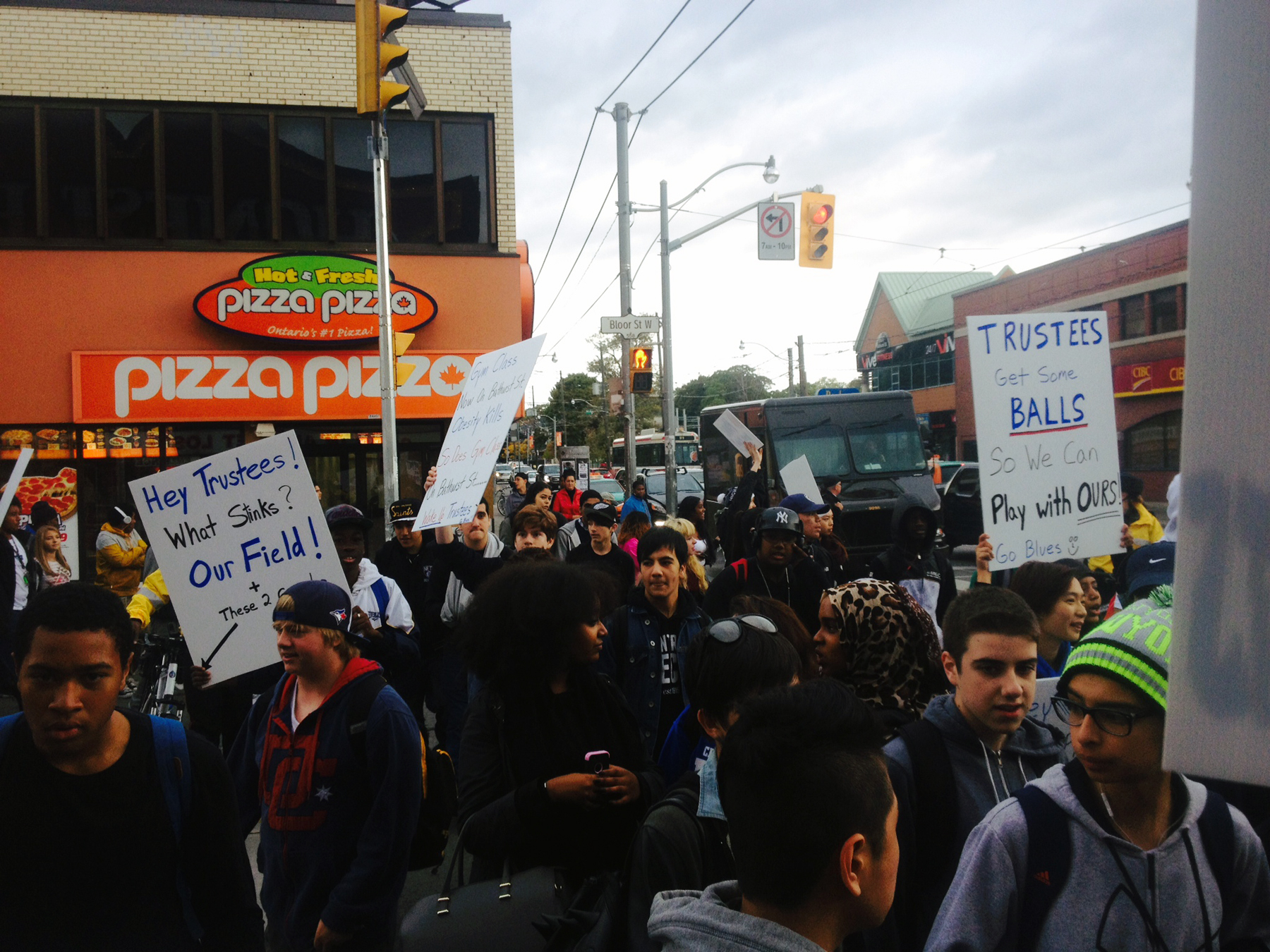
Central Tech students rally along Bloor street on October 12 calling for
action to get their playing field back in action.
BRIAN BURCHELL/GLEANER NEWS
Question of city authority to rule on application hung in balance
By Brian Burchell
The fate of the plan to put artificial turf and a dome on the Central Tech field was again in the hands of the courts. The Toronto District School Board (TDSB) had appealed the June decision of the Superior Court and has lost again at divisional level. This decision confirmed the right of the city’s building officials to rule what does or does not require a variance application for commercial development of school board lands.
The appeal was heard on August 22nd at Osgoode Hall by three Divisional Court justices. Gordon Petch, the lawyer in the matter for the TDSB, declined to comment until after the court decision and did not fulfill a request to provide the position it advanced at the appeal proceeding. Subsequent to the failed appeal bid, Petch did not respond to a request from the Gleaner for comment. The Harbord Village Residents’ Association (HVRA) was granted intervener status at the appeal, over the objections of the TDSB. Divisional Court Justice Ian Nordheimer had ruled on August 5th that the local impact of the dome project should be part of the information laid before the court.
The TDSB decision to pursue a legal challenge to the City of Toronto’s authority over its commercial development proposal is unusual. Normally, those whose development proposals are opposed by the city appeal to the Ontario Municipal Board (OMB). The avenue of the OMB remains open to the TDSB, and indeed this process was started and then stopped when the legal action was initiated.
Chris Bolton, a school board trustee and TDSB chair, resigned suddenly in June. This triggered a process to select an interim trustee. Briony Glassco was chosen to serve out Bolton’s term. Ms. Glassco also declined comment on the matter.
The Gleaner has obtained the arguments advanced by the TDSB and by the city at the appeal proceeding. At the heart of the TDSB position was that it is “as of right” able to proceed with the plan with no variance to the restrictive by-law required. Trustee Glassco wanted the TDSB to proceed with development ahead of the appeal ruling and tried to make a motion at a meeting on September 12th forcing TDSB staff to consummate the deal to proceed with the development. Upon hearing advice from the board’s lawyer the chair ruled the motion out of order. On September 8th, Glassco had distributed a newsletter which included a “Central Tech Championship Field Timeline”. Inexplicably, the timeline omits the very court proceeding and unsupportive decision that the TDSB is appealing.
One key issue before the appeal court is whether or not a variance is required when the “user” is not the school but the school board itself.
In this case, the TDSB proposes that Razor Management would be the developer and operator of the site for twenty-one years, using the site as a rental facility outside of school hours and all summer.
The TDSB argued that the “use” for “teaching or instruction” (required in the by-law) would be effectively fulfilled by Razor and that the city is mixing up “user” and “use”, when only the latter matters. Furthermore, the TDSB argued that the proposal falls within the “accessory use” exemption of the by-law a point it feels the initial court ruling did not accurately address.
The city disputed the notion this is confusing with words “use” and “user”. In the city’s submission to the appeal proceeding, it quotes the application made by Razor Management, done under the authority of the TDSB: “the existing soccer field is currently zoned for school use only. We are proposing a change of use [emphasis added] to allow outside private community user groups to the sports field after hours (local soccer clubs, academies).”
The TDSB argues that if the proposal fails the by-law test that school board lands be used “only for teaching and instructional use” then it ought to be regarded as an “accessory use”, which is exempted in the by-law. The city in rebuttal recalled the Chief Building Officer’s (CBO) initial determination which observed that “the proposed use was as a private recreational facility and would operate as such 70% of the time. Such a use could not be considered incidental to, or subordinate to, teaching or instructional purposes.” Justice Corbett, whose ruling the TDSB is appealing, concurred with the CBO’s assessment and added that “the proposal could not be considered accessory or incidental to the principal use of the lands because it would change the overall nature of the use of the premises as a school.”
While the parties awaited the Divisional Court’s ruling on the appeal, the HVRA has filed numerous freedom of information requests with the TDSB seeking disclosure of environmental assessments (related to the contamination of the field), contracts (with the proposed developer and operator Razor Management), and tender requests (including contamination amelioration).
Tags: General
October 25th, 2014 · Comments Off on It’s time to build our city again
Ex-candidate for federal seat eyes city seat
By Joe Cressy
Toronto is a great city. Survey after survey ranks Toronto amongst the top cities in the world. And we have much to be proud of: unique and engaged neighbourhoods; a diverse population; financial and innovation hubs; a thriving arts and cultural industry; and green spaces that rival those anywhere in the world.
And yet, and yet … there are so many problems still to be resolved: gridlock, ageing infrastructure, lack of affordable housing, high youth unemployment, and the challenges of preserving a healthy environment.
Sadly, during the four years of Rob Ford’s tenure as mayor, none of these problems have been tackled with any consistency. Instead, Toronto’s reputation has been sullied and we have been forced to fight against short-sighted ideas like downtown casinos, cuts to valuable services, and jets at the island airport.
It’s time to re-engage our communities in tackling our big issues, and to invest in city-building once again.
One of the exciting things about local government is the ability to incubate new ideas, pilot new projects, and make changes that directly affect people’s lives. If you can see it, smell it, touch it, or feel it, it’s municipal. And it’s why I’m running for city council: I want to work with our community to make changes now. Here are just three examples:
Transit. We can get our city moving again by investing real dollars from real government commitments into buses, street cars, and light rail transit. But, it’s got to be done based on research and expert advice – not political calculations and slogans. In downtown Toronto 41% of residents walk or bicycle to work, 34% take public transit, and only 25% drive. In our downtown communities, we can reduce congestion not by building more roads, but by investing in pedestrian and cycling lanes that are safer and more convenient.
Affordable housing. That shouldn’t be a dream but, right now, it feels that way. The average house price is over $1 million. The average rent for a 2-bedroom apartment is $1,700/month. And, according to Statistics Canada, 45% of Toronto adults aged 20-29 live with their parents, many because they cannot afford to move out. What can we do? Well, we can continue the transformation of public housing like the Alexandra Park revitalization project. And we can make sure that new developments have affordable housing included.
Environment. Yes, Rob Ford and Stephen Harper have their heads in the sand around climate change. But, in our local neighbourhoods, we have already experienced the effects of a changing environment, and the Annex Residents’ Association has already acted to improve the situation. Their TreesPlease program works to survey, protect, and expand Toronto’s tree canopy thereby providing more shade, removing industrial emissions from the air, and increasing property values. This is a win-win situation, improving our environment and beautifying our neighbourhoods in the process.
Three problems. Three good ideas to start solving the problems. And always ones that involve local residents.
Like many of you, I’m proud to live in Toronto. I’m also proud to live in downtown Toronto. Together, we can tackle the big issues at the neighbourhood level. It will take political will, an engaged and supportive community, good ideas around generating revenue, and a commitment to invest in our city again.
As residents and citizens — not just consumers and taxpayers — we are all participants. We all have a role to play in shaping and building our city.
So, let’s get started. Let’s build our city again.
Joe Cressy is a candidate for city council in Ward 20, Trinity-Spadina. He is a former senior advisor at the Stephen Lewis Foundation. He lives in the Annex with his wife, Nina.
Tags: General
October 25th, 2014 · Comments Off on Avoid rope-a-dopers
A seven-point checklist for councillor selection
There are over 20 registered candidates running to represent Ward 20, Trinity-Spadina, as city councillor. It’s a large and diverse pool, and we play homage to all those who have put their names forward, as they contribute to our democratic process and make our city a great place to call home. That said, with such a sizeable pool of candidates, it’s virtually impossible to feature each of their views on the municipal issues. Further, this ward cuts a wide swath through the readership area of the Annex and Liberty Gleaners; roughly from the train tracks at Dupont Street all the way to the harbour, and from Bathurst Avenue in the west to University Avenue in the east. And the list of issues facing the ward is as large as the ward itself. So instead of a round-up on each candidate, we have prepared the following checklist to keep in mind while you consider who should earn your support to be this ward’s next city councillor.
Are they one-issue wonders? Ward 20 has a lot of files that the sitting councillor must carry. So, if the candidate is only on about hot dog carts, bike lanes, or building blimps to get us to and from Pearson Airport, then perhaps you should give them a pass.
Do they understand that Toronto, and the ward itself, is a collection of neighbourhoods, divided in more ways than we can list? Most of these neighbourhoods include main streets, where the intersection of residents and small (and large) businesses matter. Maintaining diverse business strips to serve the needs of residents helps keep our communities liveable. Do they know that business property taxes are too high?
Does the candidate “get” city building? This encompasses a lot of files: transit, congestion, efficient energy management, the Billy Bishop City Centre Airport, the Pan-Am Games, and more. Each of these comes with down and upsides for specific neighbourhoods, but on the whole what’s good for the city is generally good for us all in the long run.
Listen to the loudest voices with a grain of salt. We live in a representational democracy. Interest groups ought not to dictate the councillor’s actions, though they should inform his or her views. The successful councillor should possess courage of conviction. There will be another election in four years. So what. Too many councillors live in fear of that judgment day. This fear renders too many politicians impotent throughout their terms, unable to take effective action for fear of reprisal of the voters. If at all possible, you should select a candidate who is prepared to lead in the spirit of his or her conscience.
Is the candidate a team player (and the team we refer to is Team Toronto)? For the most part the business of municipal governance is not a left-right game, though somehow this has been entrenched as an accepted reality in the city council chambers.
The successful candidate must “play” on both sides to try and get what is best for the ward and for the city as a whole. Sometimes that will mean that a “left-leaning” politician should support private garbage collection, while at other times it will mean that a “right-leaning” one must support building more affordable housing. In each case, it will be because it’s the right thing to do.
The successful candidate ought not to be afraid of change. The only constant after all is change itself. In a city so widely rich in diversity the real challenge is how to embrace it. Opposing it is counterproductive.
In a meeting with business improvement areas, mayoral candidate John Tory noted that “some councillors employ rope-a-dope,” a technique used by former heavy weight boxing champ Muhammad Ali: assuming a protective stance, Ali would lean against the ropes, which in turn would absorb most of his opponent’s blows, eventually causing his opponent to punch himself out. In Toronto, some councillors lean on the bureaucracy, and avoid having to ever take decisive action. Avoid that candidate.
That may be a tall order, but hopefully you choose someone that meets at least some of these criteria.
Tags: General
October 25th, 2014 · Comments Off on A very Canadian solution
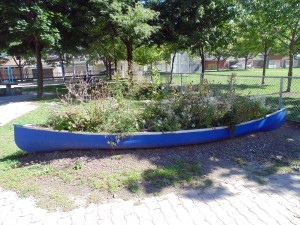
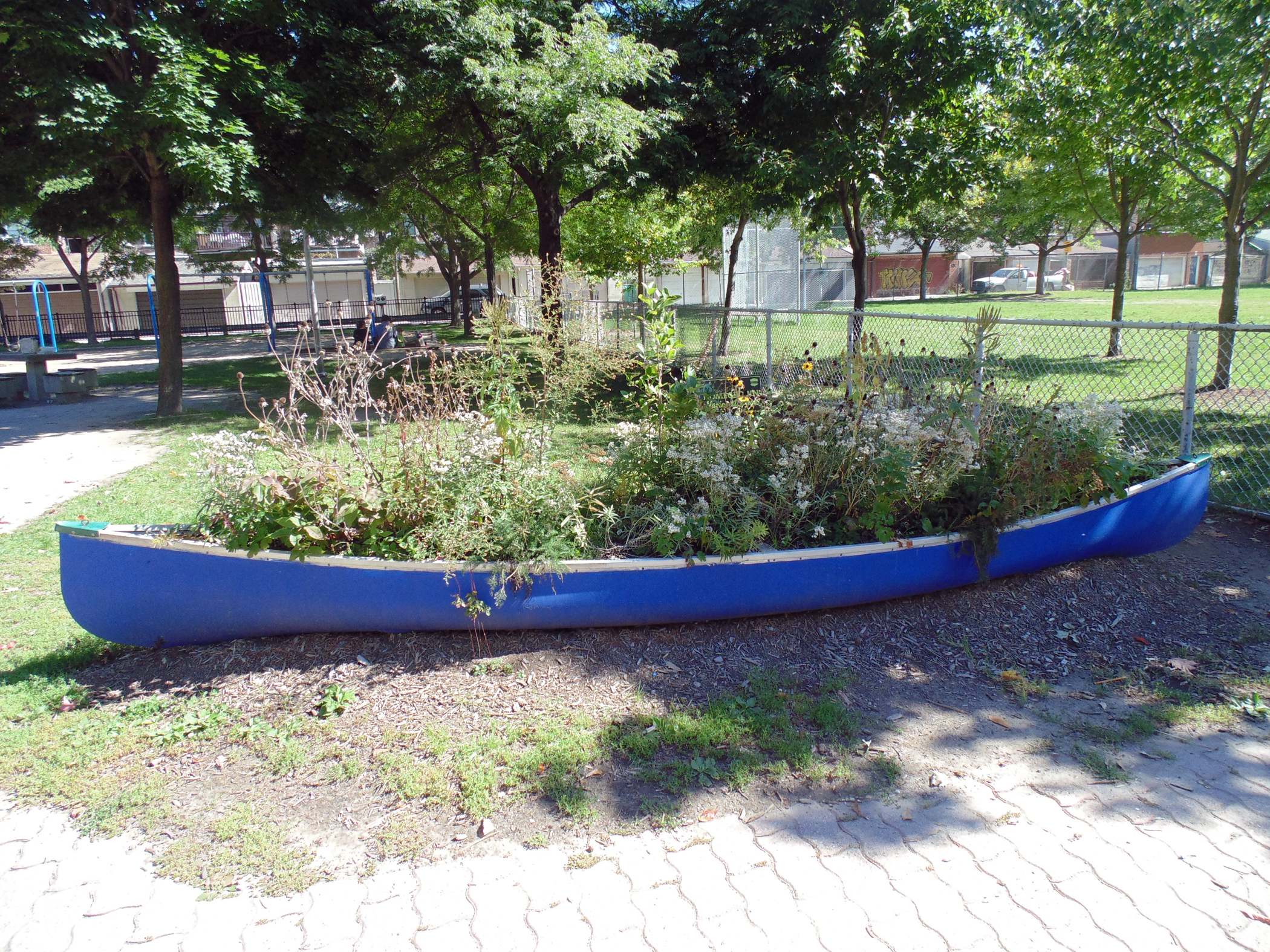
This canoe at Christie Pits Park serves as a planter for milkweed, essential for the survival of monarch butterflies. It is also a source of nectar for bees and other pollinators. COURTESY JODE ROBERTS, DAVID SUZUKI FOUNDATION
COURTESY JODE ROBERTS, DAVID SUZUKI FOUNDATION
Tired canoes re-purposed as pollinator point
By Samina Esha
On July 18, Homegrown National Park, a David Suzuki Foundation project, hosted their second successful year of a community Canoe Garden after last year’s effort to enhance Toronto’s green space.
The goal of the project is to fill canoe planters with native plants that are friendly for bees, insects, and birds to help with the pollinating process.
“My son helped plant one of the first canoes. So he has this deep connection to this canoe and the plants at Christie Pits. Every time we are down there he has to go and check it,” said Jode Roberts of the David Suzuki Foundation.
In 2014 the project was expanded into neighbourhoods throughout the Garrison Creek corridor, and it has recruited about two dozen trainees called Homegrown park rangers, who live, work, and play in their prospective areas.
“We connect them with different groups and encourage them to focus on the issues they are interested in. Then we let them loose while supporting them with their projects,” said Roberts.
Spearheaded by Parkdale resident and Homegrown ranger Aidan Dahlin Nolan, along with the David Suzuki Foundation, the project aims to see canoe planters installed in a number of city parks, including Christie Pits, Trinity Bellwoods, Little Norway, Bickford Park, and Stanley Park. Inspired by authors Richard Louv and Douglas Tallamy, the team embarked on a mission to establish the world’s first Homegrown National Park.
Dahlin Nolan got the idea about canoes and green space while he was camping with friends at the Algonquin Park.
“I started pitching different ideas to Ph.D. programs until I joined the David Suzuki Foundation,” said Dahlin Nolan, who is project lead for Community Canoe and a Ph.D. student at York University. “The community really came forward for the Stanley Park Canoe. The plants we planted are suitable for bees and butterflies and other pollinating insects, and each canoe has a canoe captain who is a member of the community and is responsible for watering and weeding. So, there is someone always looking after them.”
Last summer the group fundraised 5,000 dollars over 20 days to buy used canoes and plants for the garden. And this summer they are continuing this process with schools and parks. The crowd-funded project to turn Toronto into Canada’s first Homegrown National Park was the first step to changing our ever-busy everyday grey life in this urban city.
All of the canoes so far have been through the old route of Garrison Creek and next year the group aims to remind Torontonians about the routes of other old river paths. However, finding these canoes can be hard.
“When canoes are busted people usually just send them out to landfills so there is a scarcity of retired canoes. We usually get most of them from donation or buy fixer uppers from Kijiji so the money raised is mostly used for planting. I currently have three canoes sitting in my back yard,” said Roberts.
Roberts also mentioned that the David Suzuki Foundation is constantly coming up with different projects. “We encourage and welcome people to go to the davidsuzuki.org/homegrown website where all of our different activities are listed. Some of these projects include planting pollinator gardens at school yards and parks hosting educational events regarding the environment, and generally encouraging people to get connected with nature,” said Roberts.
Teamed with neighbourhoods, volunteers, and experienced park rangers with diverse backgrounds, the project aims to bring residents, businesses, and institutions together to plant native trees and grow gardens. It challenges people to connect to nature.
“In the long term a canoe is just an element we can add to the parks or different green spaces including front yards, back yards, streets, rooftops, alleyways, and all the bits between them. It is the first step towards a more pollinator friendly green space,” said Roberts.

The second annual Homegrown Park Crawl is a celebratory event that brought participants through four city parks along Toronto’s former Garrison Creek. Renowned broadcaster, author and scientist David Suzuki joined the parade organized by his foundation. NEILAND BRISSENDEN/GLEANER NEWS
Tags: General
October 25th, 2014 · Comments Off on Bad Boys to take Sonic Boom space
When the Sonic Boom record store moves out this October, a Bad Boys Superstore will move in. The 12,000-square-foot space is located on the corner of Bathurst and Bloor and is part of the Honest Ed’s building complex. The plan was announced on July 20 during Honest Ed’s 66th anniversary celebration; David Mirvish presided at the event, which featured free T-shirt giveaways, free lunch, and a family magic show. Mirvish said he was “proud to reveal the partnership with Blayne and Mel Lastman of Bad Boys.” Like Honest Ed’s, Bad Boys will offer discount prices on its merchandise. “We thought putting [both stores] side by side would be a great shopping experience,” Mirvish said. “Bad Boys intends to continue for many many years.” Honest Ed’s will still be closing its doors on Dec. 31, 2016. “I didn’t want to say good-bye in two weeks the way retail stores usually do, so we’ve taken three years to say good-bye and we have a long life here still,” Mirvish said. The Honest Ed’s site is slated for redevelopment by Westbank Properties of Vancouver. Head of advertising at Honest Ed’s, Franca Longobardi, is pleased with the partnership and the turnout at the celebration. Every year is full of familiar faces and new customers of Honest Ed’s. “I think it’s exciting, I’ve been here such a long time and it hurts me that we have to leave one day, and the fact that Bad Boys is coming in is giving me hope that I’m going to be around for a couple more years,” Longobardi said. Blayne Lastman of Bad Boys says this partnership is worthwhile. “With the Honest Ed’s name and the Bad Boys name, finally after 60 years in the making it was a great deal.” The Annex can look forward to discount prices on brand name furniture, electronics, and appliances until Dec. 31, 2016.
—Chantilly Post/Gleaner News
Tags: General
October 25th, 2014 · Comments Off on Popular staffer takes the torch, temporarily
Trinity-Spadina (Ward 20) welcomed new city councillor Ceta Ramkhalawansingh this past July.
Long-serving city councillor Adam Vaughan resigned this spring for a successful run in a federal by-election in Trinity-Spadina. He is now the new member of parliament for the riding. Ramkhalawansingh was appointed by city council on an interim basis until the municipal election this fall.
Nothing but kind words have been said about her appointment by local residents’ associations.
Having been connected to Ward 20 for over four decades, Ceta has activated for issues throughout the spectrum from the establishment of a feminist studies program at the University of Toronto to minimizing the barriers faced by immigrant families with the Toronto school system. “[Ceta] knows the ropes,” says Tim Grant, chair of the Harbord Village Residents’ Association. “We are very pleased to have her.” “[Having] worked with Ceta over the years in her position with the Grange Resident’s Association, [we] admire her tenacity and dedication towards civic issues,” says David Harrison, chair of the Annex Residents’ Association, which was in support of her appointment. Ramkhalawansingh’s involvement within the community is evident, and the mark she has left is undeniable. She recently completed an almost 30-year career as a city staffer where she retired as Toronto’s diversity manager.
Ramkhalawansingh has no plans to seek the seat in the October 27th election.
—Meron Asefaw/Gleaner News
Tags: General
October 25th, 2014 · Comments Off on Report: equip officers with tasers
Iacobucci calls for a shift to a “zero deaths” police culture
By Brian Burchell
It’s been just over a year since Sammy Yatim was shot and killed by Toronto police on a TTC streetcar on Dundas Street.
Constable James Forcillo of Toronto Police Service (TPS) 14 Division was charged just 30 days after the shooting by the Special Investigations Unit (SIU) with second-degree murder.
At the same time, Police Chief Bill Blair commissioned a review of the force’s use of force by police specifically in cases involving emotionally disturbed persons. Blair asked former Supreme Court Justice Frank Iacobucci for a review that focused on service-wide issues and how to make the force more effective in such encounters with the public.
This move by Blair is an unusual step which underscored a sense that the issues at hand go well beyond the specific circumstances of the Yatim shooting, but it also allowed Blair to show that a transparent and arm’s-length assessment was needed of TPS policy and procedures in such circumstances.
Justice Iacobucci released his eighty-four recommendations under nine broad topics on July 24, 2014.
The retired supreme court justice was not hesitant to observe that there needs to be a change in police culture, as well as more specialized training, increased availability of special intervention teams, the equipment of front line officers with body cameras, an increased use and an assessment of conducted-energy-weapons (or tasers as they are commonly known), more selective police recruitment strategies, and regular assessments of the mental health of police officers themselves; perhaps outside of his mandate, Iacobucci also made recommendations about the intersection of the mental health care system in Ontario and the role of the Toronto police.
Chief Blair welcomed the recommendations and he vowed at the press conference in remarks about the report that “this will not gather dust, but momentum.”
Gary Pieters, president of the Urban Alliance on Race Relations, welcomed the report: “What we would like to see is that this report gets into the hands of every single rank and file officer. We want to see that the recommendations, and the steps to make those recommendations reality in the daily work of policing, are embedded into the culture of these officers.”
According to the report, the TPS is dispatched to approximately 20,000 calls for service annually to “persons-in-crisis”, and about 8,000 of these events involve apprehensions under the Mental Health Act. Of these encounters, between 2002 and 2012, five have resulted in “emotionally disturbed persons” being fatally shot.
The data supplied by the TPS did not include 2013 and therefore does not include the shooting of Sammy Yatim.
In the TPS only supervisors carry tasers as an alternative to the more lethal weapon of a service revolver.
The taser proved to be utterly useless in the case of the shooting, as a sergeant arriving late to the scene demonstrated by choosing, perhaps inexplicably, to use it on Yatim after he had been shot nine times by Constable Forcillo.
Peter Rosenthal, a social justice lawyer, responded to questions from the Gleaner about the report and specifically about the suggestion of increased access to tasers for front-line officers. “In general, I welcome the Iacobucci Report. Its recommendations about de-escalation are excellent, and that is the crucial reform that is required to lessen police killings.”
Rosenthal was critical of the report’s recommendations around taser usage, especially since tasers are not the weapons that should be used when the person that police are facing has a weapon.
“The recommendation to increase taser use, even in a limited way, is unfortunate in my view. Many officers currently have tasers. The training is NOT to use a taser if someone has a weapon. This is because a taser is not adequate as an alternative to a firearm. The reason is clear: a taser is not reliable enough to ensure protection if a suspect presents an immediate threat of serious injury or death. Tasers are not effective unless both darts land properly, and it is very difficult to aim tasers, especially if the target is in motion (as the target can move substantially during the time the darts fly through the air). Thus increased availability of tasers will mean many people will be victims of taser use (as has happened even with the present restricted taser use) and it will not lessen police killings.”
The director of communications for the Toronto police, Mark Pugash, also responded to questions from the Gleaner about the report, specifically about the next steps and what has changed in the force since the shooting of Yatim: “The recommendations have not been costed. Keep in mind that the Iacobucci report also touches on bodies other than the TPS. Chief Blair has created an external advisory committee and made clear the sense of urgency he feels with respect to implementing the recommendations. The Iacobucci report was commissioned in the aftermath of the shooting, to examine our training, policy, procedures, equipment, supervision. It has come back with 84 recommendations. We have started the process of implementation.”
Pugash urged that people recognize “the shooting of Sammy Yatim by a Toronto police officer last year was one percent of a much larger picture, and the report helps us see all the rest.”
Tags: General
October 25th, 2014 · Comments Off on Twenty-two’s a crowd in Ward 20
Vaughan’s vacancy creates competition
By Madeline Smith
Ward 20 is one of the toughest races in this year’s municipal election. Without an incumbent, the ward has attracted a huge selection of candidates—the most city council hopefuls in all the ward races— with 22 currently in the running.
Running from Dupont Street to the waterfront, Ward 20 is bounded by University Avenue to the east and Bathurst Street to the west, with the northernmost part of the ward stretching west beyond Bathurst Street to Christie Street.
Former city councillor Adam Vaughan held the Ward 20 seat for nearly two terms after being elected in 2006. But he resigned in June to run in a federal by-election, which he won. Ceta Ramkhalawansingh was named his interim replacement in July, but she is not running for re-election, leaving the seat truly up for grabs.
Determining the best approach to new development is the most prevalent and contentious issue throughout Ward 20.
Many of the communities are concerned with preserving the original character of their core neighbourhoods and avoiding intensification of residential areas. “Part of the problem is that most of Ward 20 is zoned as downtown,” Harbord Village Residents’ Association (HVRA) chair Tim Grant says. “Therefore, when developers are looking at a map, they think, ‘Why can’t we put a 40-storey building at Spadina and College?’ But buildings like that would overwhelm the nearby neighbourhoods.” The approval of a 24-storey residence building at 245 College St. for U of T students is one such building, which the HVRA and the Grange Community Association both opposed.
Development that leads to gentrification is also seen as problematic in some Ward 20 neighbourhoods.
In Kensington Market, residents mobilized to protest plans to build a Loblaws store, and they most recently fought against plans to build a big-box retail complex with a Walmart. Kensington Market resident Dominique Russell says the issues in her neighbourhood point to Toronto’s overall development challenges. “All the issues that face Toronto are really writ large in Kensington Market,” she says, noting the trends of longtime residents being pushed out by unaffordable housing and increasing gentrification driven by developers bringing chain stores to main streets. “A true mixed income neighbourhood is becoming less and less of a reality.”
Robert Lunney, Director of Condo Relations for the Toronto Entertainment District Residents’ Association, is also in favour of mixed-use proposals—something not always on the table at first—in a neighbourhood where 18 condo buildings are currently in development. “We coexist well with the people who work in the offices here. The residents want to come out on the street to go to restaurants and use the public spaces, and people who work in those buildings want to live close by, so the property values increase.”
Making room for pedestrians, cyclists, streetcars, and cars alike on Ward 20’s main streets is a challenge. Brian Burchell, chair of the Bloor Annex BIA and publisher of the Annex Gleaner, says the stretch of Bloor Street between Spadina Avenue and Bathurst Street is especially dangerous for cyclists. “We want to slow the street down. The cars that come through on Bloor Street are not necessarily our customers — they’re commuters,” he says.
“There’s a tension between city building and community building. Maintaining main street business tracts is important to both goals. We may need fewer cars on Bloor and more transit options.” In the southern part of the ward, Lunney says King Street is “a mess,” and echoes Burchell’s hope that commuter traffic travelling through the neighbourhood can be significantly slowed down or diverted elsewhere.
There is a lack of green space in Ward 20, which is also a concern linked to development—once completed, new condo buildings will increase the ward’s dog population despite the lack of space to exercise them.
The need for green space is a major factor in the battle over the planned redevelopment of the Central Technical School field.
Perhaps Joe Cressy likely has the best name recognition in Ward 20 out of the 22 candidates on the ballot. He has already been campaigning in the Trinity-Spadina community for months, after running unsuccessfully for the NDP in the federal by-election for Olivia Chow’s seat — which he lost to former Ward 20 city councillor Adam Vaughan. He has aligned himself with Ward 19 incumbent Mike Layton as well as with Chow’s mayoral campaign.
Terri Chu is an engineer and community activist from the Annex, and authors a monthly column for the Annex Gleaner. She is the founder of Why Should I Care?, a non-profit group that hosts meetings to discuss political issues and encourages citizens to get involved in community affairs.
While this is Chu’s first time running for political office, she has the support of former councillor Adam Vaughan’s campaign team, and four Ward 20 candidates dropped out of the race and endorsed her in the days leading up to the nomination deadline.
Candidate Graham Hollings is an ESL teacher and community activist from Kensington Market. He is best known for his work with the group Friends of Kensington Market and their successful campaign against development company RioCan’s plan to build a big-box retail development, including a Walmart store, next to Kensington Market.
Hollings’s platform focuses on promoting mixed-use development and overhauling transit and cycling infrastructure.
Anshul Kapoor worked as a digital communications specialist for Rogers before entering the Toronto political scene as the founder of the organization No Jets T.O., which gave him a platform to speak out against the expansion of Toronto’s Island Airport. He believes introducing jets at the airport will jeopardize the revitalization of the waterfront.
Annex Residents’ Association board member and environmental lawyer Albert Koehel works for a non-profit environmental law organization and is a 25-year resident of the Annex. He is a founder of Bells on Bloor, an event that calls for better safety for residents and cyclists.
Koehel also advocates to protect migratory birds from collisions with windows of downtown high-rises and has won precedent-setting cases against landlords under the Environmental Protectional Act and Species at Risk Act.
Among the aforementioned notable candidates is Sarah Thomson. Thomson entered the Ward 20 race less than a week before the nomination deadline after abandoning her mayoral campaign. She also previously ran for mayor in 2010 and campaigned for a provincial seat for the Liberal party in 2011. Thomson has earned significant media attention in the past for what some consider to be publicity stunts, which include claiming to have the Rob Ford “crack video,” only to release a promotion for her transit plan instead.
A full list of candidates is available by ward at app.toronto.ca/vote/ wardList.do.
Tags: General