February 15th, 2015 · Comments Off on City moves quickly to get ahead of Westbank application
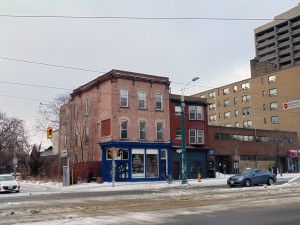
Long in need of a rethink, the corner of Bathurst and Bloor streets is currently the focus of renewed scrutiny, as City of Toronto planners work to lay down guidelines in advance of a much-anticipated application to re-develop the Honest Ed’s site, and adjoining land.
This area is bounded by London, Lippincott, Lennox, and Markham streets, and includes the entire area marked for redevelopment, as well as the Bathurst Street subway station.
The planners are reviewing the possibility of designating parts of Mirvish Village and Honest Ed’s under the Ontario Heritage Act, and hope the developer, Westbank Projects Corp., will commemorate the store’s contributions to the neighbourhood somewhere within the new project.
The four corners study is part of a larger project that has been underway since 2013, and is aimed at developing a built form and land use vision for Bathurst Street from Dupont to Queen streets.
Public consultation has been a major part of the process, and the City has met with local business improvement areas, residents’ associations, and held open public meetings.
Issues under consideration have included pedestrian and cycling connections, heritage conservation, open and green space, residential unit size, affordability and diversity, as well as the relationship between the transit station and its surroundings.
Some consistent themes emerged from this process: sidewalks should be wider on Bathurst Street, which is particularly unfriendly to pedestrians; there should be more green space and public seating areas; big box retail is not popular; and, building heights and densities remain a concern, as does the lack of affordable housing.
The City has already approved a planning statute as a result of the study. Official Plan Amendment #246 limits retail in size and frontage at 3,500 square metres and 12 metres respectively.
Westbank has appealed the amendment to the Ontario Municipal Board.
For further information on the study, please visit http://toronto.ca/ planning/bathurst.htm.
—Brian Burchell/Gleaner News
Tags: Annex · News · General
February 15th, 2015 · Comments Off on BIAs get behind youth basketball
Two universities are tied in the standings in the city’s inaugural BIA Cup tournament. Supported by the Toronto Association of Business Improvement Areas (TABIA), the Cup is a men’s and women’s varsity-level basketball tournament between the University of Toronto and Ryerson University.
The U of T women prevailed 74 to 71 over Ryerson, while the Varsity Blues lost 92 to 68 to the men of Ryerson in the first games of the series held Jan. 7 at U of T’s newly-built Goldring Centre for High Performance Sport.
The BIA Cup runs until Feb. 11, when the final games will be held at Ryerson’s Mattamy Athletic Centre. The women’s game will be held at 6 p.m., while the men’s will play at 8 p.m.
The TABIA initiative, which was championed by Neil Wright and the Harbord Street BIA, is not only aimed at supporting varsity sports, but also intended to introduce Toronto’s youth to the high-performance sports facilities and athletic programs available at these post-secondary institutions.
“Sports is an extremely powerful tool for building healthy communities, teams, and personal growth,” noted a TABIA news release. “For several years TABIA has promoted partnerships between BIAs and Toronto youth in the area of sport and physical activity. This initiative encourages senior high school students to aspire to higher education as well as varsity-level sport.”
Members of many youth organizations from across the city were invited to the games, which also featured half-time under-12s exhibition play, with the young athletes from East York playing in the impressive Goldring facility for the first time.
—Brian Burchell/Gleaner News
Tags: Annex · Liberty · Sports
February 15th, 2015 · Comments Off on

The University of Toronto and Ryerson University women’s basketball teams battle it out in the first game of the inaugural BIA Cup on Jan. 7 at U of T’s Goldring Centre.
The tournament, which runs to Feb. 11, is a series of games aimed at promoting high-performance post-secondary athletics to male and female adolescents across the city. Photo Martin Bazyl, U of T Faculty of Kinesiology and Physical Education
Tags: General
February 15th, 2015 · Comments Off on Risky rails?
Lac-Mégantic derailment looms large at community meeting on rail safety
By Madeline Smith
Nearly two hundred people gathered at the Church of the Messiah in the Annex in late November to voice their concerns about rail safety. Three Liberal members of parliament, Adam Vaughan, Chrystia Freeland, and Carolyn Bennett attended, along with Transport Action Ontario president Peter Miasek and Transport Action Canada board member Howard Levine.
It was a chilly night, but the room was packed to standing room only.
“The headcount here is an important message for us to take back to Ottawa,” St. Paul’s MP Bennett said.
In Toronto, the CP rail line runs along Dupont Street, which includes the northern edge of the Annex. The CN line runs along the city’s northern edge, parallel to Highway 407.
After a derailment led to a major disaster that killed 47 people in Lac-Mégantic, Quebec, in 2013, many people who live along the rail lines in Toronto are concerned about their own safety. Complaints have been raised about DOT-111 railcars, an older model that CN and CP have said they will phase out over four years in favour of a more robust container. All the railcars that derailed in Lac-Mégantic were DOT-111s.
Meanwhile, transportation of volatile materials such as crude oil by rail has been on the rise. According to local action group Safe Rail Communities, an estimated 140,000 railcars carried hazardous materials across Canada in 2014, up from just 500 in 2009.
“[Rail] infrastructure is about to be subject to a lot more strain,” Vaughan said. “We need to get ahead of this train, so to speak.”
Vaughan, who became the MP for Trinity-Spadina in a summer by-election in 2014 after serving as Toronto’s Ward 20 councillor, is now in a position to tackle rail safety concerns. Although rail lines run through cities such as Toronto and affect residents on a local level, the system is regulated by the federal government, not municipalities.
“We need to figure out how to manage the movement of volatile goods in this country,” Vaughan said.
The horrifying impact of the derailment in Lac-Mégantic was on many residents’ minds at the meeting, but Miasek reminded the audience that derailments aren’t uncommon, underlining the need for investment in rail infrastructure.
“People forget that [Lac-Mégantic] was only one of many accidents,” Miasek said in an interview. CN derailments in Alberta and New Brunswick, among others, were also problems in 2014.
Miasek favours a public-private partnership, or P3, to invest in rail transport. The main issue with rail safety in Canada, he said, is the system’s lack of capital. Both CP and CN have been privately owned since CN was privatized in 1995, and Miasek said they are unable to invest in maintenance.
“We need to take a page out of the U.S. model, where government contributes money to the building of rail infrastructure,” he said. “They were at the place where we are about 20 years ago. Their solution was to put more government funding into rail, both federally and at the state level.”
Miasek said taking volatile materials off rail lines entirely is not a solution—while crude oil might be transported instead through pipelines, hazardous material like ammonia, chlorine, and acid is still moved by train, which he said is safer than transportation by truck.
In spring 2014, Helen Vassilakos and Patricia Lai started Safe Rail Communities as a way to raise awareness about what they say are inadequate safety standards for rail transport in Canada.
Since then, both have spent significant time researching the issue out of concern for their Runnymede-area neighbourhood, where some people have trains running right by their backyards.
“We’re arguing that the regulations aren’t enough,” Vassilakos said. “I think our government needs to take on more of a role. Every rail line should have the same requirements and it should be government that decides how things are done, not the rail lines.”
Toronto mayor John Tory and Mississauga mayor Bonnie Crombie, both elected in October 2014, recently voiced their support for trains with dangerous goods to be rerouted instead of passing through their cities. But that, Lai and Vassilakos argue, doesn’t adequately address the problem.
“To advocate for rerouting without having the safeguards put in place is not solving the problem,” Vassilakos said. “We’re concerned that if things get rerouted and it’s just forgotten, this could be a wasted opportunity.”
Vassilakos and Lai said it has been frustrating to bring public attention to rail safety, but said that the November meeting was encouraging. They hope their concerns, and the worries many other residents raised at the forum, mark a step towards better accountability and transparency for rail safety in Canada.
“We would like to have a voice,” Lai said. “We’re questioning the commitment to true safety.”
Tags: Annex
February 15th, 2015 · 1 Comment
Funny business going on at Wiener’s Home Hardware
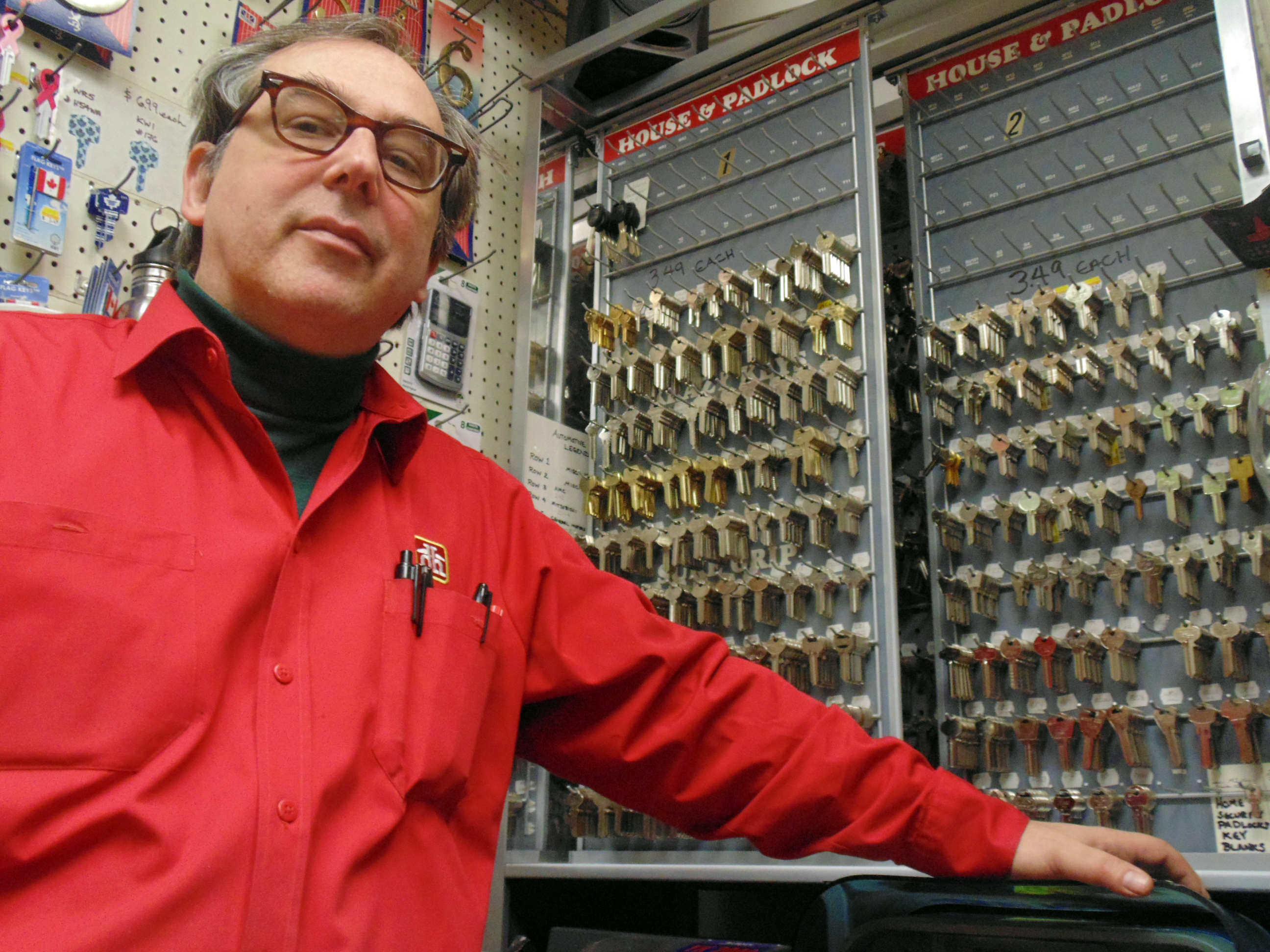
Howard Pressburger, a familiar face at Wiener’s Home Hardware, on Bloor Street, dispenses daily doses of fix-it yourself advice and is all the while quietly contemplating a comedic plot. photo Brian Burchell, Gleaner News
By Nicola Kivell
Howard Pressburger, a longtime Annex local, actor, and employee at Wiener’s Home Hardware, gets it.
Especially when it comes to the imminent struggle and conflict between who we are and what we do.
He also understands how to put an absurd and comedic twist on a otherwise overwhelming theme and find the humour in our day-to-day struggles. Through his comedy project, Nuts and Bolts, he explores the looming reality that we all face when it comes to how and what we identify ourselves with and how we do so. There’s no question that a large majority of us identify specifically with what we do, how much money we make, and whom we associate ourselves with. So what happens if we lose all that?
Howard found the answer with Nuts and Bolts. After consistent requests from the community for him to create a television comedy revolving around the everyday absurdity and craziness of working in a hardware store, he was finally able to do it. The opportunity came to life with the CBC ComedyCoup Contest. ComedyCoup provides comedy creators from all over Canada the framework to create hilarious videos and pieces and put them together to develop their comedic projects. It is a contest left in the hands of the viewers. It’s up to you to vote and advance your favourite projects closer to the $500,000 production financing prize to create a half-hour-long comedy special for CBC prime time. With this fabric, Howard, along with his co-writer and girlfriend Shana Sandler, producer and co-writer Josh Tizel, and producer and director of photography Peter Ivaskiv, started to develop the comedy.
Nuts and Bolts is about a man named Howard who essentially loses everything, from his money, his job, and his wife to his identity itself. Howard ends up back in his hometown where he takes up a job at a local hardware store. It is here where Howard tries to put back together the pieces of his life and, in doing so, discovers a whole new outlook on what really holds us together as people and the fact that sometimes you have to go right down to the simple framework of it all to find yourself again. The comedy depicts real-life, hilarious anecdotes and stories from Howard’s years of experience working at the hardware store, dealing with the day-to-day, sometimes bizarre and comical struggles we all face.
Having never written or developed a TV show, ComedyCoup gave Howard the platform and tools to create something really special, but the inspiration for the idea truly came from the community itself. “This was really a project fuelled and generated from the community at large,” notes Howard. “ComedyCoup gave us the framework and the opportunity but we’re in this for the long run, we’re in it for the experience, and we’re in it to do something with our community.” Not only does Nuts and Bolts portray the hardware store community and the realism of everyday obstacles, it also finds the humour and absurdity in the ordinary and mundane. Because seriously what’s more funny than real life? Nuts and Bolts is a comedic gem because it’s relatable, it’s unique, and it’s absurdly hilarious in all the right ways. So make sure you check it out! You can go to comedycoup.cbc.ca/nutsandboltstv to see videos and cast your vote.
Tags: Annex · People
February 15th, 2015 · Comments Off on Cities can do more than fix potholes
City should emulate Guelph and Chicago
By Terri Chu
Coming off an election campaign, I was often asked why I decided to run for city council. When members of Adam Vaughan’s old campaign team asked me to put my name forward, I had to think long and hard about putting life on hold in the name of public service.
However, the more I thought about it, the easier the decision became. As an energy consultant, the biggest challenges we face are usually political, not technical. Municipalities have more impact on climate change than any other level of government. We’ve sadly reduced the role to pothole fixer but there’s a lot that can be done at the city level. I congratulate all the elected officials in our city and sincerely hope that, in the coming term, more attention will be paid to our crumbling infrastructure.
Municipalities can push above and beyond provincial building codes. We saw that when David Miller pushed Green Roofs on the city. Chicago was able to limit the amount of window area in a condominium to 40% of total wall space in order to force higher efficiency buildings. Waterfront Toronto lost a prime opportunity for District Energy mostly due to a political standoff, not a technical problem. Guelph, with a much lower population than Toronto, has been able to lead in energy efficiency while Toronto falls behind despite the influence we could have.
While doing my Masters in Civil Engineering, one of the course projects I did was retrofitting a century home to meet modern energy efficiency standards.
I used my own home as a base model, measuring the thermal insulation value (there wasn’t much) and coming up with strategies to make it less of an energy hog. I also calculated roughly a 30-year payback – far too long for any homeowner to invest in. This is the curse of artificially cheap energy in Canada. We have more incentive to use than save.
Years later when I finally did have the money to renovate my home, the only retrofit strategy we could realistically afford was spray foam insulation. The house is much more comfortable, but I don’t pretend that I did it for any kind of financial payback. If we are to maintain our stock of heritage homes, as a city, we have to make it realistic for homeowners to insulate and lower their energy consumption. The city has a vested interest in this since it takes demand off our already stressed electricity grids. I’d like to see the City of Toronto provide a home energy loan program that is attached to the property and paid back through property taxes as opposed to the homeowner. This way, if the homeowner must sell or move, the new owner who will benefit from the lower energy bills will also be the one paying back the cost of insulation through the property taxes.
The stressed electricity grid is another issue the city needs to address. As more and more condos are built, the stress on the distribution lines will become unbearable, prompting a third transmission line into the city.
Nobody wants to see homes bulldozed for transmission towers. Council should be forcing new developments to become the centre of a smart grid with onsite generation. This is much more efficient than electricity travelling hundreds of kilometres to us (line loss is big) and would reduce our exposure to catastrophic failure.
Speaking of electricity, I truly believe we have to stop this nonsense of burying our trash hundreds of kilometres away.
Europe, Asia, and now even Australia have very clean energy from waste technologies that make us look positively Neanderthal in how we deal with trash.
It’s time we recovered both electricity and waste heat from our trash bin rather than leave our bits of plastic to ocean birds thousands of kilometres away (where it inevitably ends up).
Terri Chu is an engineer committed to practical environmentalism. This column is dedicated to helping the community reduce energy use, and help distinguish environmental truths from myths. Send questions, comments, and ideas for future columns to Terri at terri.chu@whyshouldicare.ca.
Tags: General
February 15th, 2015 · Comments Off on First Narayever marks 100
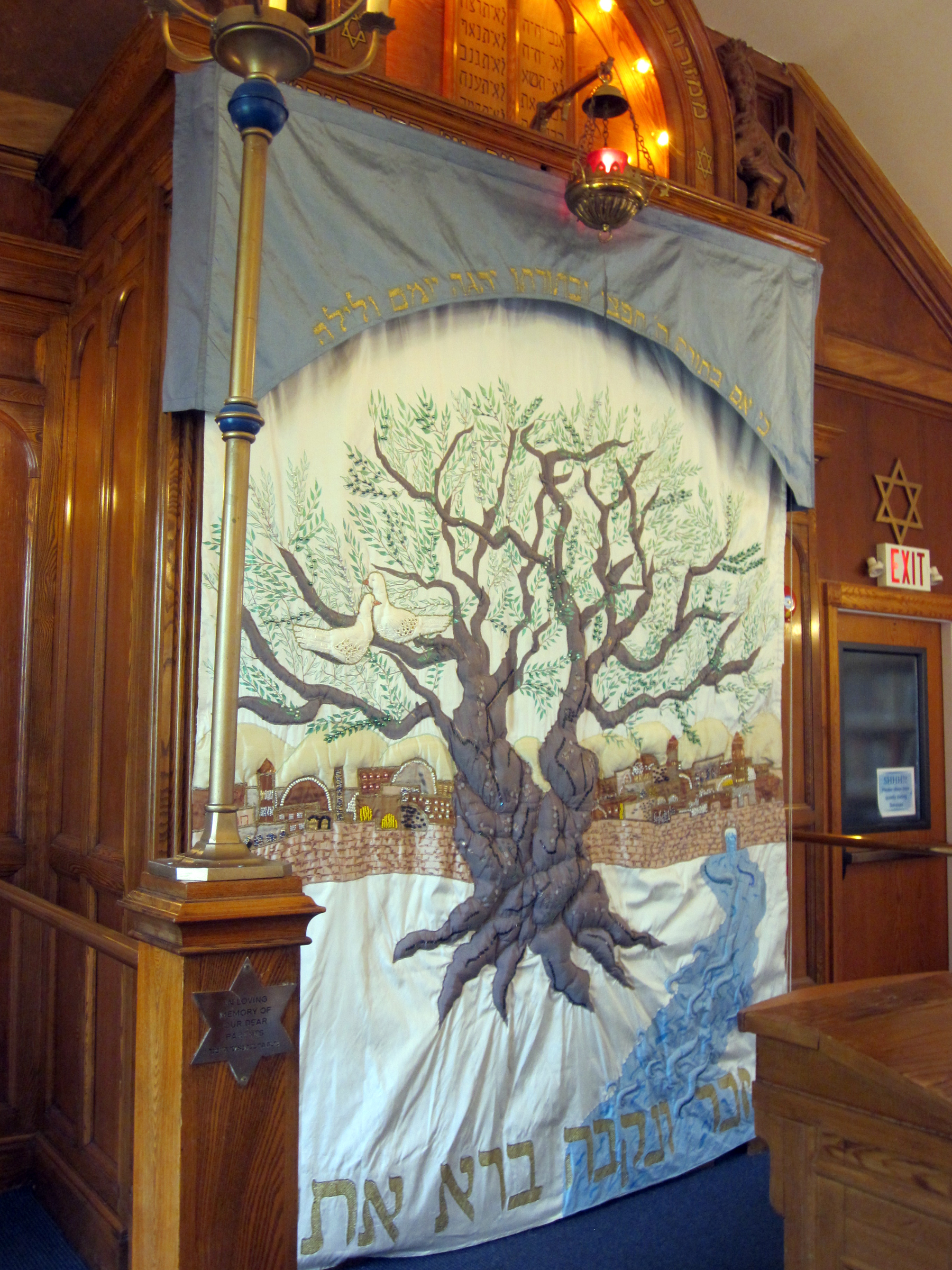
Designed by congregant Dianne Saxe and embroidered by Israeli-Canadian artist Tova Raz, the synagogue’s ark curtain draws on traditional symbols of Jewish life to emphasize the high value the congregation places on gender egalitarianism. The Book of Psalms inspires the central imagery, in which a tree planted by flowing water symbolizes how a Torah-centred life gives a pious Jew the strength to flourish. In the curtain, the intertwining trunks of the tree represent the interwoven male and female aspects of the congregation.
History reflects growth and development of Toronto’s Jewish population
By Annemarie Brissenden
In May 1914, with the world on the brink of war, 13 men formed an association to provide social benefits such as medical care and religious customs to all those sharing a link to the same small village in Eastern Europe. Today, that association is a thriving 680-member congregation based out of a synagogue on Brunswick Avenue. And while it developed along a well-worn path that echoes the growth of the city it now calls home, the First Narayever Congregation has evolved into a unique model of traditional egalitarianism that meets the needs of both its religious and broader downtown communities.
“I could have predicted the story: the Jewish community’s moves around the city; its part in the post-war boom; the return of people to the Annex; and the revival of downtown Jewish life, anchored in part by the Narayever,” said Sharoni Sibony, the curator of Traditions and Transitions: 100 Years of the First Narayever Congregation, an exhibit that ran throughout October at the Miles Nadal Jewish Community Centre in conjunction with the synagogue’s centennial celebrations.
“First Narayever starts as a typical, immigrant working class synagogue,” explained Sibony, meeting in the homes of its members, before renting a space at Huron and Dundas streets for approximately 20 years.
By 1943, the congregation had raised enough money to purchase its current home, a building at 187-89 Brunswick Ave., previously a Foresters’ Hall and home to Bethel Church, the first English-speaking Mennonite congregation in Toronto.
Although “the downtown area was the original hub of Toronto’s Jewish community, many people left the neighbourhood [starting in the 1950s] and moved north,” said Harry Schacter, First Narayever’s president.
“There was a severe decline in the Jewish population in downtown Toronto,” added Rabbi Edward Elkin, the congregation’s spiritual leader since 2000. “Lots of little immigrant synagogues closed altogether. Ours was teetering, and hung on until the renaissance in the 1970s.”
That renaissance precipitated an ideological shift that made First Narayever into the congregation it is today: moving from an orthodox practice to a traditional-egalitarian one in which women would play an equal role in the service and running of the congregation.
“This made us unique at the time,” explained Elkin. “We were holding on to all of the traditional observances and trappings, while being egalitarian.”
Sibony said that one of the things that really struck her as she prepared the exhibit on the congregation’s history was “how much the early egalitarian activists seemed to value orthodoxy.”
And the question of how to make women’s participation full and inclusive in a traditional setting is “a conversation that is very much alive 35 years later,” she said.
“It was a very dramatic shift at the time,” said Schachter, adding that it also made the synagogue more participatory. “It did much to involve ordinary people in the running of the service.”
Sibony also suggested that the move to egalitarianism created a less hierarchical structure in the running of the congregation, and explained how the building itself facilitated this evolution.
“The closeness of the podium area and audience area feels rare to me. The smallness of the building facilitates that closeness, and really empowers the people,” she said.
The combination of traditionalism and egalitarianism has proven successful at attracting those people who are returning to the neighbourhood and choosing to live downtown.
“All of these people coming in, because of our ideological decision, we were ripe for some of those people,” said Elkin.
“We have become a home for newcomers looking for a new place for themselves,” added Schachter, noting, “the population is continuing to grow around us.”
Although it has shifted ideologically, it has remained true to its social justice roots, as it continues to evolve in its egalitarianism.
“In 2009 we voted to extend same-sex marriage as a principle of the synagogue, which is also a rarity,” said Sibony. The congregation also continues to serve its members and the surrounding community by participating in a local Out of the Cold program with other faith-based institutions, sponsoring refugees, and developing sustainable, local, and affordable food choices.
As the congregation contemplates the next one hundred years, said Schacter, “we have to think about where we are going. We have to continue to think about our place in the downtown Jewish community, and the broader community as a whole.”
“We feel quite rooted in the Annex,” said Elkin. “We have to continue to be good neighbours and citizens of a downtown community where a lot of diverse people continue to thrive and live.”
Tags: Annex
February 15th, 2015 · Comments Off on Build improvements all agree on
Re-elected in a landslide victory, Layton pushes transit file
By Mike Layton
There is no silver bullet to Toronto’s transit woes. Almost as rare is finding a transit plan that all Torontonians can agree with.
But though seldom as it is, it does happen on occasion.
Toronto needs a relief subway line to alleviate congestion on the Yonge-University subway line, there is no doubt about that. Putting trains underground in areas where surface trains are feasible, and are the preferred option, is a waste of money. Re-drawing transit plans that take transit away from deserving neighbourhoods in order to fund another scheme is a waste of time and is not fair to residents.
With the debate about Toronto’s transit future set to enter another round, one solution that City Council has consistently supported is better integration of existing GO Transit stations and lines into our TTC system. Metrolinx has also showed support for this as did all mayoral candidates.
Toronto transit riders deserve to be better served by the six rail lines and 16 stations already running across the city centre, and there is a need for immediate relief to our existing system without spending a dime on costly improvements. Our provincial taxes already pay for them, so why aren’t they working better for us?
Liberty Village is a great example. This growing community is now home to 10,000 residents and 7,000 workers, and will continue to grow for the next decade. Liberty Village residents predominantly rely on public transit to get to work, which is evident in the number of riders on the overflowing King streetcar, the busiest surface transit route in Toronto.
There is a GO Train service on the Lakeshore West line with trains that stop every 30 minutes in Liberty Village, but it costs an extra five dollars for the seven minute ride to Union Station, making it the most expensive ride per kilometre across the GO Train network. A transit ride will cost you eight dollars if you take the subway when you reach Union Station. The same trip on the King streetcar would take almost an hour when you take into account the four full streetcars that pass by. If we integrate the fare, riders would save time and money while making their transit experience more enjoyable.
In cities across the GTA, Metrolinx works with local transit agencies and reduces the cost of fares for transit trips that involve both systems. In Milton, riders pay an extra 60 cents to get on local transit if they present their GO Train pass. Why not Toronto?
I, like many others, have recognized the potential of this and have written to Metrolinx as early as February 2011 asking for more use out of the Union-Exhibition track. This was followed in 2012 with a motion from council, seconded by me, in support of adding more stations to the Kitchener GO Train line. The motion passed council by a vote of 40 to 2.
Then on Oct. 23rd, 2013, the TTC was asked by its commission to work with Metrolinx on a fare integration strategy for GO Transit stations at Bloor and Exhibition Place.
All this is consistent with Metrolinx’s 2008 Big Move which acknowledged the importance of using the GO Transit lines for local travel.
If everyone agrees, why hasn’t anything been done? The Ontario government has been given a clear mandate by the residents of southern Ontario to fix our transportation system. Long-term solutions are still needed, but one of the easiest, fastest, and cheapest fixes would be to use existing infrastructure more effectively.
We all agree, it’s not a new idea, now let’s make it happen!
Mike Layton is the councillor for Ward 19, Trinity-Spadina.
Tags: General
February 15th, 2015 · Comments Off on Mobs don’t rule, nor do pawns
It’s sad to see the students of Central Tech used as pawns to advance a singular solution to the problem of the school’s playing field. It’s a complicated issue and the students are being fed an easy-to-swallow pill about who is to blame for the state of their field.
On October 12th some classes at Central Tech mysteriously stopped and placards were available for students to march along Bloor. Teachers were positioned along the street to corral the throng, and police who happened to be in the neighbourhood tried to keep everyone safe. Had the small army of cops on bikes not coincidently been there to stop traffic, then personal injury to students was a real possibility. It was irresponsible for Central Tech administrators to have permitted this.
The students were carrying placards saying such things as “Why are my sports in your courts” and “Trustees get some balls so we can play with ours”. The first is a reference to the Toronto District School Board’s (TDSB) decision to take the City of Toronto to court after the application to give the field to a commercial operator for 21 years was rejected. The operator, Razor Management, proposes to apply artificial turf and a winter dome to the playing field but this plan was rejected by the city’s committee of adjustment. If the deal comes to fruition, it’s not clear if the students even know that 70% of the available time they would not be allowed on the play surface, as the operator would be accommodating its commercial clients – primarily private sport groups. The TDSB did not ask the court to rule on the merits of that decision (because that is what the Ontario Municipal Board is there for) but rather asked the court to say that the city has no business applying the existing by-law, which was created to regulate development on school board lands. The court decided against the TDSB, who then appealed, and they again lost in a unanimous three judge decision. It is the TDSB that keeps bringing the apparently specious case to the “courts”, not the local community or the city. How much the TDSB is spending on lawyers when it could be fixing the field is not known.
The suggestion that “trustees need to get some balls” is a not so thinly veiled suggestion that the deal with Razor should be immediately consummated and damn the torpedoes with the city and the courts. In fact, interim trustee Briony Glassco tried just that in September. This would be a singularly irresponsible move, but it is consistent with the rash and reckless approach that the TDSB has taken to date on the matter.
Although it was quite a spectacle to witness the “spontaneous” student protest on Bloor, it was recently superceded by another. A small mob of students, again armed with placards, chose to crash Harbord Village Residents’ Association (HVRA) Annual General Meeting on November 3rd. That event was complete with television cameras and major daily media who somehow knew it would be happening. The major media outlets were all too eager to take the bait.
The HVRA is a stakeholder group that opposed the project. The Bloor Annex and the Harbord Street Business Improvement Areas (BIAs) supported it, each with their own conditions about mitigating community impact, specifically parking and traffic management. In a free and open democratic society that’s how it works. Fortunately, we have representative governments to decide what is best for everyone. Through the Committee of Adjustment, a determination was made that this project should not proceed. The ringleaders of the student protest are not taking them to city hall, where the decision was made, nor are they outside the courthouse where the TDSB was so soundly rejected. Both the city and the courts wield the real authority. The volunteers at the HVRA dared to espouse a contrary view, and even to offer alternatives, and now they have been vilified.
This latest chapter in the TDSB saga is indicative of their consistent lack of transparency, and it also represents their mounting desperation which is illustrated by them sacrificing student interests while allegedly acting for them.
Tags: General
February 15th, 2015 · Comments Off on Residence casts long shadow
University still to deliver updated proposal for Spadina-Sussex development following neighbourhood outcry
The northwest corner of Sussex and Spadina avenues is the site of a pending development of a student residence. Brian Burchell – Gleaner News
By Annemarie Brissenden
A private developer’s plans to build a 25-storey, 829-bed university residence on College Street between Huron Street and Spadina Avenue is casting a dark spectre on plans to develop another residence at the corner of Spadina and Sussex avenues.
“We don’t want a tall tower like the one on College Street,” said Julia Marsh, a local resident who has lived on Robert Street near the corner of Sussex Avenue for about five years. “We don’t want that cookie-cutter kind of approach.”
Kingstone Capital Management purchased the College Street site, only to sell it to the University of Toronto, and then lease it back with the intent of building and operating the residence. The university is following a different model for developing the proposed Spadina-Sussex residence, and is working with the Daniels Corporation, a company known for critically-lauded projects like Regent Park and 1 Spadina Crescent, the university’s future home for its architecture and design school.
Community members, however, remain unconvinced that the university is committed to working with them to develop a housing alternative that is palatable for everyone.
“The problem is the university at this point still has to demonstrate that it understands the broader community,” said Sue Dexter of the Harbord Village Residents’ Association (HVRA). “It responds to its own demands and needs as if they’re handed down from the mountain.”
Little progress has been made in recent months. University representatives admitted at a November 10 community liaison committee meeting that they hadn’t moved the file forward since an October 20 meeting in the office of Ceta Ramkhalawansingh, the interim councillor for Ward 20, Trinity-Spadina. At that October meeting between city planners, Robert Street residents, HVRA members, as well as representatives from the university and the Daniels Corporation, residents expressed their main concerns.
“The message is to dramatically lower the height of the project,” said Marsh. Under the current proposal, the building’s height stands at 22 to 25 storeys, which, said Marsh, “is still massive when it sits on the perimeter of a community like ours.”
Marsh acknowledged that there is an existing tall building in the area at 666 Spadina Avenue, but “just because we’ve had bad design in the past, doesn’t mean we need to go forward with that in the future.”
She added that the neighbours also want to retain some access to the tennis and ball hockey courts, are opposed to having a cafeteria in the building as it would result in “trucks driving up and down the streets in the wee hours,” and are “vehemently against locating the building’s entrance on Sussex Avenue, as it would bring too many students into the neighbourhood.”
Finally, Marsh and Dexter are also unequivocal about preventing what they term a “monoculture” of first year students.
“Does it need to be that all the first year students end up at Sussex and Spadina?” asked Dexter. “[The university] has the Mississauga and the Scarborough campuses. It has lots of options.”
“Do you really want 550 first years running around the neighbourhood?” added Marsh.
Dexter would like the university to develop a different kind of residence, one that mixes first years with graduate students and students with families, which she believes would integrate better in the broader Annex community.
In her view, it’s still an open question, as there isn’t really a clear proposal on the table just yet.
“We’re neutral at this point rather than optimistic,” said Dexter. “There’s a possibility that we could do something inventive and neat. Daniels has a track record of doing neat things, but it’s too early to tell.”
Marsh, noting that “the university does tend to build beautiful buildings on campus” and that “it’s great to see what’s happened with Regent Park,” said she is heartened by the school’s association with the Daniels Corporation.
“We know [this residence] is going to happen,” said Marsh, “but can we find something that respects the tone of the neighbourhood more?”
In an e-mail to the Gleaner, Scott Mabury, vice-president, University Operations, for the University of Toronto, declined to comment on the project, saying only that he had no updates and that community consultation continues. Martin Blake, vice-president of the Daniels Corporation, refused to answer the Gleaner’s request for an interview.
Tags: Annex
February 15th, 2015 · Comments Off on

On Nov. 16, the Santa Claus parade came along Bloor Street. The Bloor Annex BIA reprised its popular kissing stations with mistletoe hanging from some of the BIA’s lights on the streets. Some were more lucky under the lights than others.
Tags: Annex
February 15th, 2015 · Comments Off on Dome plan inches closer
The Toronto District School Board (TDSB) has signed a deal with a developer, Razor Management, which contemplates applying an artificial surface and winter dome over the Central Tech playing field. The current slate of school board trustees is at the end of their term of office. The newly elected trustees, together with the two city councillors for the area Mike Layton and Joe Cressy, wrote a letter urging the current board to hold off the decision since they felt that signing the deal was premature and was not a concept they supported.
Tim Grant, the chair of the Harbord Village Residents’ Association (HVRA), said he is “not surprised” by the decision, “but the outgoing board made a decision that is very disappointing. The wishes of the voters in this area were totally ignored. This issue was very much part of the city council election and school trustee election. There were ‘pro-dome’ candidates in each election, and in total, they got no more than 10% of the vote.”
Outgoing local TDSB trustee Briony Glassco, who voted in favour of signing a deal now with Razor, ahead of the planning approval, did not respond to a written request for comment.
The TDSB is currently being examined under a microscope by the provincial government as Education Minister Liz Sandals tries to respond to widespread reports of governance issues with the board itself. Sandals has appointed Margaret Wilson, a former registrar at the Ontario College of Teachers, to conduct an examination of “operational issues and focus on the TDSB’s governance structure”. Wilson’s report is due by Dec. 31st.
The proposal forms part of an application before the Ontario Municipal Board (OMB) that appeals an earlier City of Toronto decision rejecting the proposal. If initial mediation fails between the city and the TDSB then a hearing will be held in June 2015 where the OMB can make a final determination. The HVRA and the Palmerston Residents’ Association are parties to the proceedings.
—Brian Burchell/Gleaner News
Tags: Annex