April 16th, 2015 · Comments Off on Bloor Street West
Photo: Brian Burchell, Gleaner News
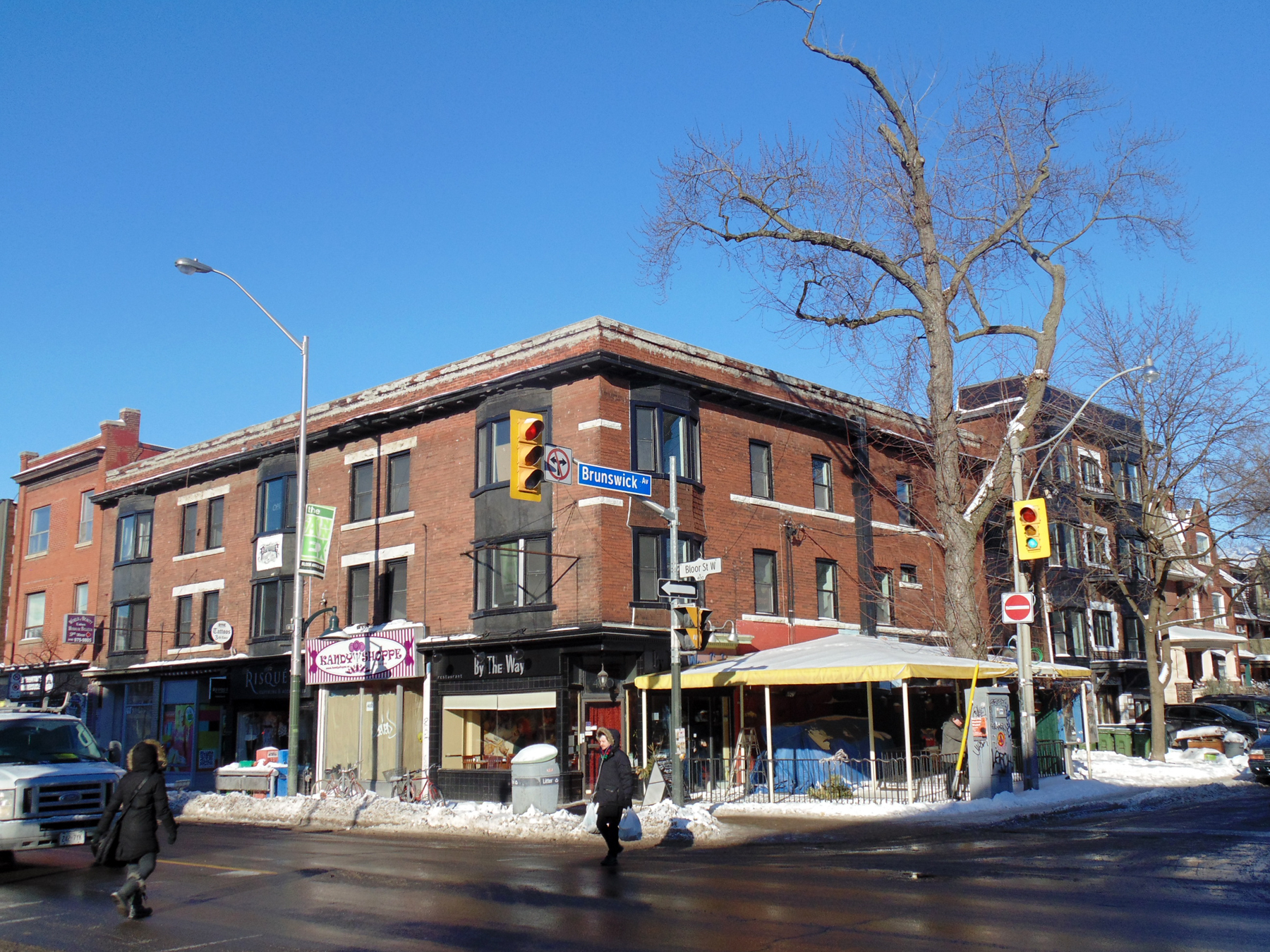
The stretch of Bloor Street West book-ended by Bathurst Street and Spadina Avenue is going through a transformation. The question is whether it’s a good one. We’re finally seeing an end to so many “Store for Rent” signs, but that’s been at the expense of a lot of chains moving in. It remains to be seen whether that will bring an end to the strip’s unique character. The futures of two landmark corners also remain up in the air. We’re still keeping an eye on the northwest corner of Bloor Street and Spadina Avenue, which the City has identified as a site that could facilitate a large building. Also on our radar: the parcel of land at Bloor Street and Brunswick Avenue that includes the By the Way Café and four buildings to the west of the restaurant. It was sold last year to a new owner who has renovated the commercial and residential spaces, and is now renting them out; good news at least in the short term.
Annemarie Brissenden, Gleaner News
Tags: General
April 16th, 2015 · Comments Off on Hotel Waverly and Silver Dollar Room
Photo: Brian Burchell. Gleaner News
Owner/Developer: The Wynn Group
Status: Pending, before the OMB
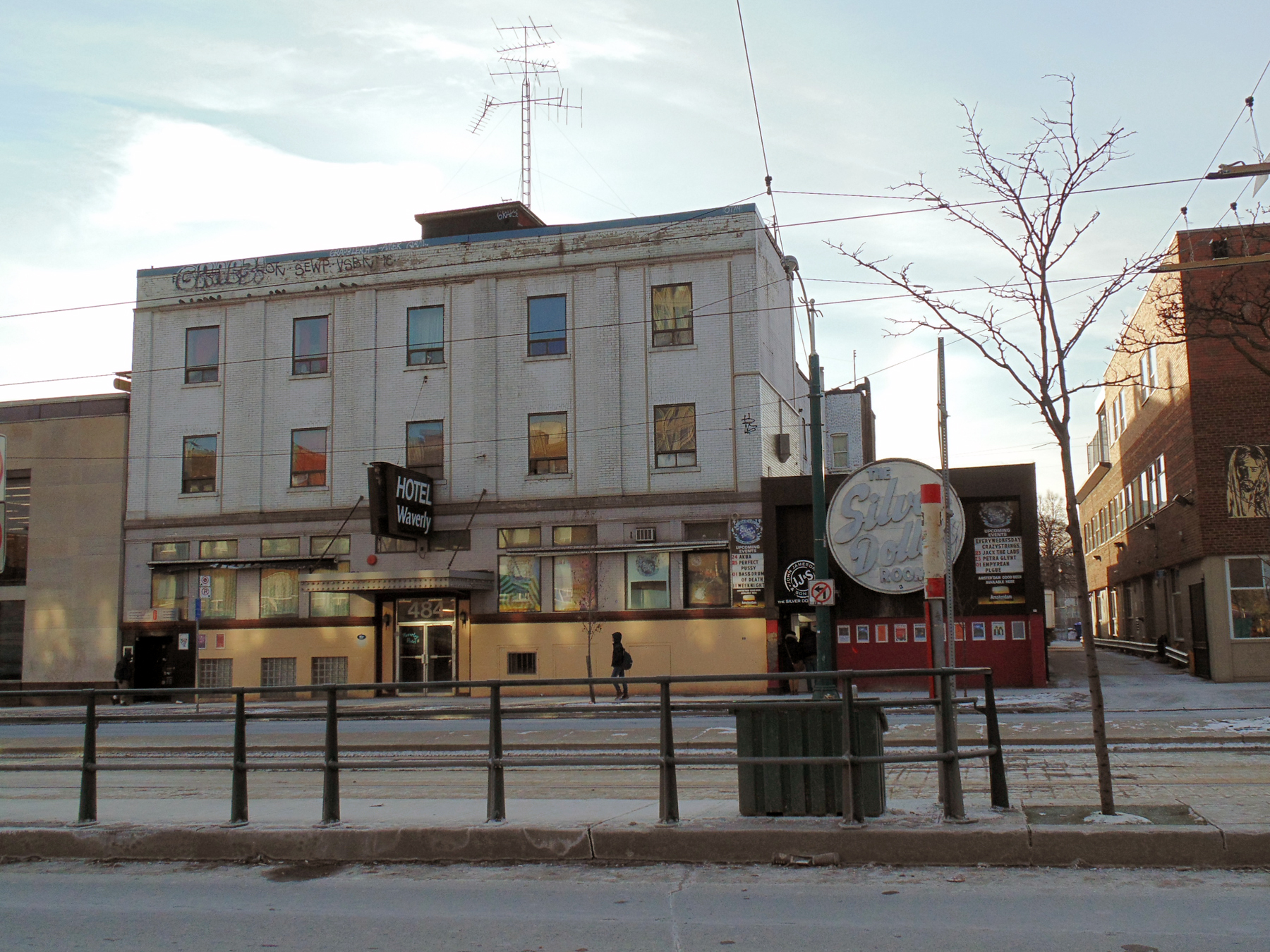
We reported last year in this space that the City had rejected the Wynn Group’s proposal to build a 22-storey private student residence, fitness club, and recreate the Silver Dollar Room at the College Street and Spadina Avenue site. The developer has appealed the matter to the OMB, and final arguments were heard on Jan. 30. The City has also advanced the matter, declaring the Silver Dollar Room to be of cultural heritage value or interest. The storied hotel, home to poet Milton Acorn in the 1970s, provides low income housing to transient members of the community right now, and deserves a more creative, heritage-minded hand guiding its future. That said, given the OMB’s track record of siding with the developer, it’s unlikely that that will happen.
Annemarie Brissenden, Gleaner News
Tags: General
April 16th, 2015 · Comments Off on 698, 700, 702, and 704 Spadina Ave.
Photo: Brian Burchell, Gleaner News
Owner/Developer: Mix of private owners, University of Toronto
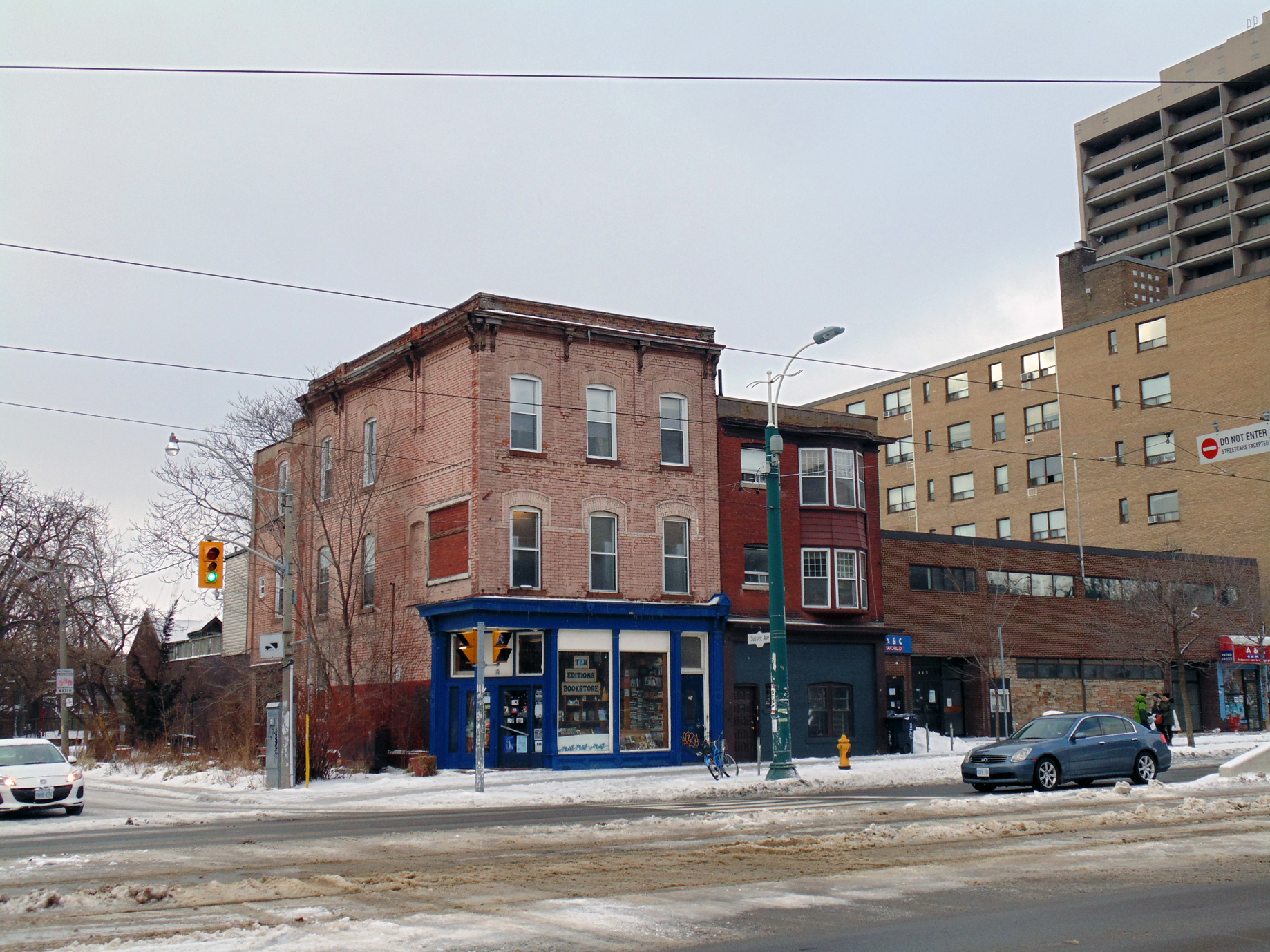
On the face of it, U of T is an academic institution. It’s also one of the city’s most prominent landowners and developers. And clearly, it’s still figuring out how to balance its academic needs with responsible development. Consider its proposal to develop a student residence at Spadina and Sussex avenues. On the one hand, the University is working with the Daniels Corporation, a company known for critically-lauded projects like Regent Park. On the other, community members are frustrated with the way the institution is pursuing the project, and believe it has yet to demonstrate that it respects the broader community. Neighbourhood representatives want the height of the proposed building lowered dramatically, and for the University to consider developing a residence that mixes students from different years, as opposed to dedicating it to first year students. Little progress has been made to date, but we expect this site to be under greater scrutiny in the coming months.
Annmarie Brissenden, Gleaner News
Tags: General
April 16th, 2015 · Comments Off on The College Street spectre
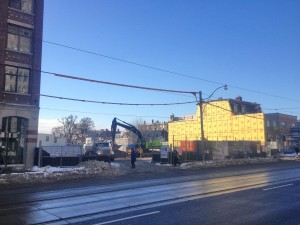
Photo: Brian Burchell, Gleaner News
Owner/Developer: Tribute Communities, Knightstone Capital Management
Status: Underway
For many community members, College Street is an example of what not to do when it comes to development. Height is the predominant feature of two major projects that are now underway: Tribute Communities’ College Condominium at 297 College St. and Knightstone Capital’s private student residence at 245-253 College St. At 15 storeys, the Tribute development at the edge of Kensington will also bring a 20,000-square-foot Loblaws to the neighbourhood. It’s set to open mid next year. Meanwhile, the OMB approved Knightstone’s application to build a 25-storey, 829-bed private residence in June, reversing the City’s January 2014 decision to deny the developer’s proposed plan. It not only sets a new height threshold for potential projects on College Street, it’s also what has community groups stepping up their opposition to similar developments elsewhere. But as long as the OMB continues to hold sway over Toronto’s built future, questions over height and preservation of heritage are largely out of the City’s hands.
Tags: General
April 16th, 2015 · Comments Off on John H. Daniels Faculty of Architecture, Landscape, and Design
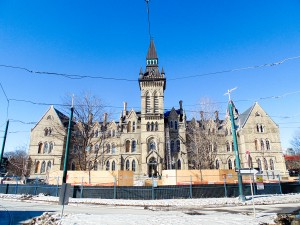
Photo by Brian Burchell, Gleaner News
Owner/Developer: University of Toronto
Status: Under construction
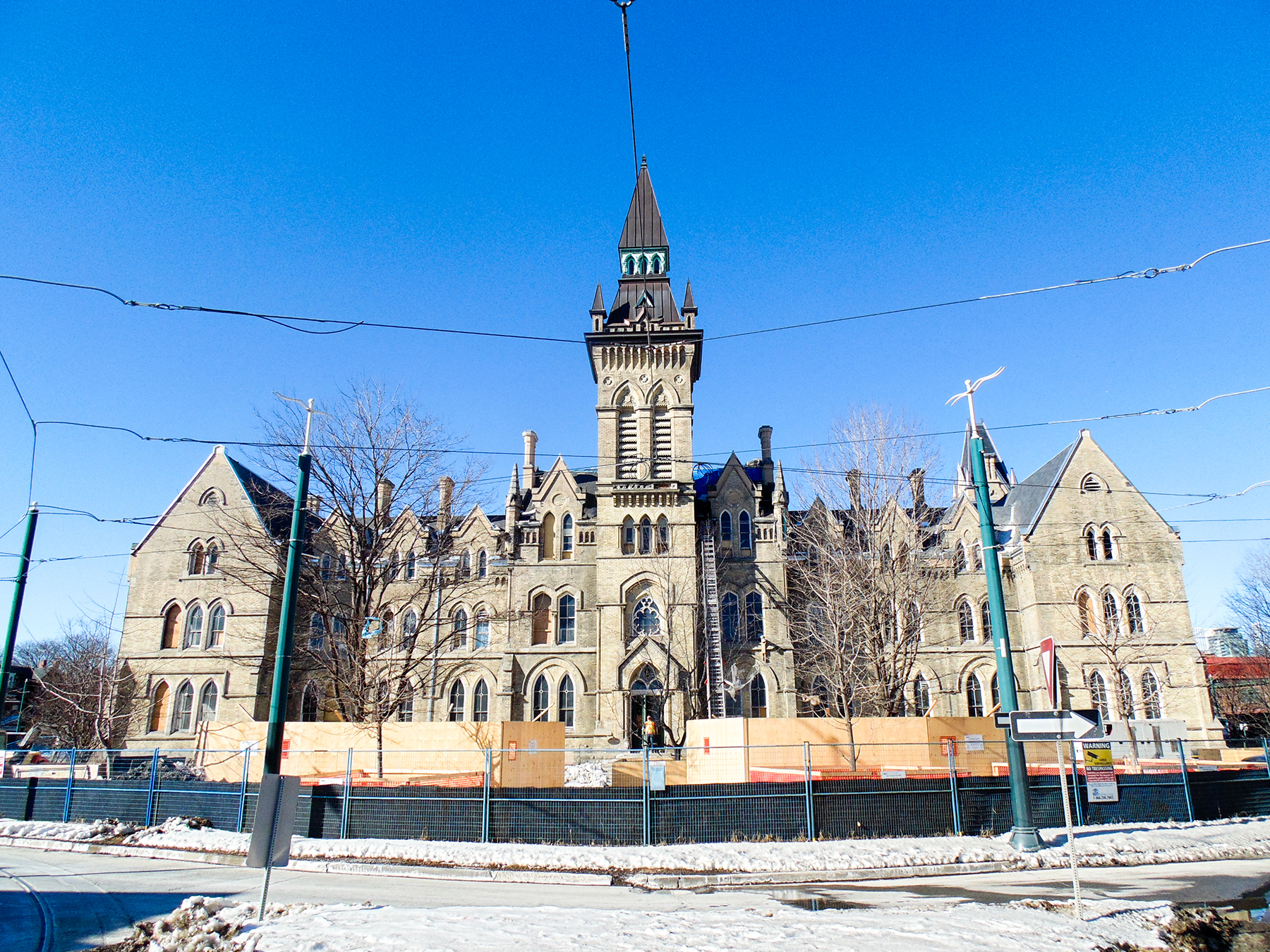
Construction is well underway at 1 Spadina Cres., the nineteenth-century Gothic revival building that was previously home to Knox College and Connaught Laboratories. Once completed some time in the 2015/2016 academic year, the building will be a mix of old and new, with the restored historic building facing south, and the contemporary multi-storey glass façade providing an open embrace to the north. Unique due to its sustainable urban design and preservation of the heritage aspect, the faculty building is also aimed at creating a link between the community and the university. In a city that’s still learning how to balance its built history with its modern ambitions, this is a project to watch.
Annemarie Brissenden, Gleaner News
Tags: Annex · Liberty · News
April 16th, 2015 · Comments Off on Bathurst Street
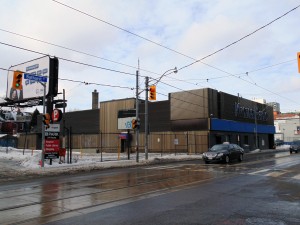
Photo by Brian Burchell, Gleaner News
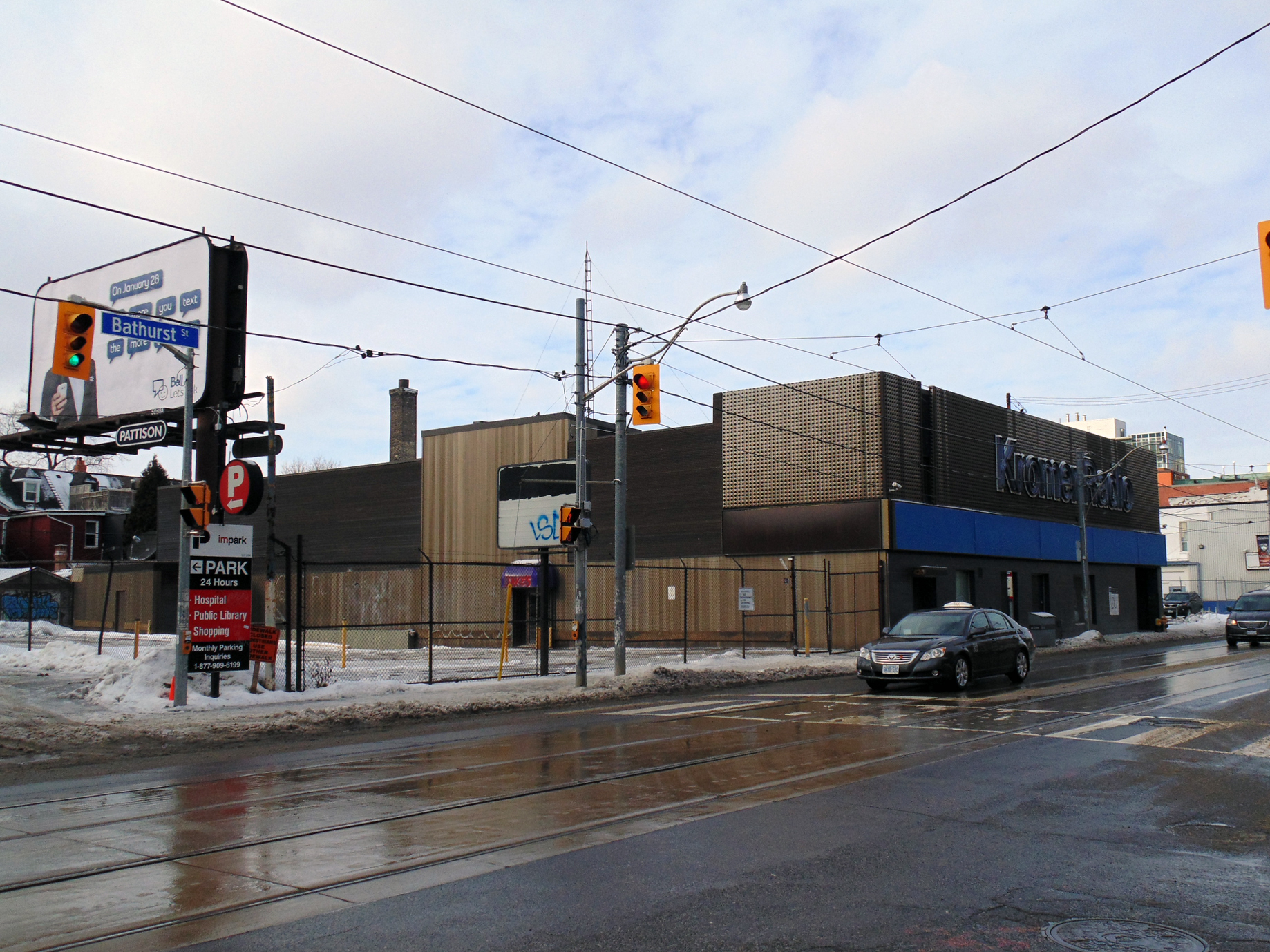
While Bathurst Street still looks the same as it did at this time last year, much has changed at the planning level. In July, RioCan and the City reached a compromise regarding the redevelopment of 410-446 Bathurst St., the former site of Kromer Radio. Walmart will not be a tenant for at least 15 years in the mixed-use development, whose retail square footage has been reduced, overall height capped, sidewalks expanded, and street-level parking added for bicycles. And in August, City Council passed an amendment to the Official Plan that reflects the results of a multi-year study of the future of Bathurst Street from Dupont to Queen streets. Aimed at preserving Bathurst Street’s unique character and facilitating the transition from neighbourhood to mixed use, it includes provisions for enhancing pedestrian access, regulating height limits, and promoting retail frontages on the street.
Annmarie Brissenden, Gleaner News
Tags: General
April 16th, 2015 · Comments Off on Mirvish Village and Honest Ed’s
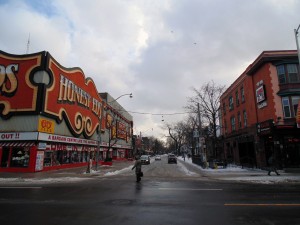
Photo by Brian Burchell, Gleaner News
Owner/Developer: 500 Bloor Street Property Inc., a wholly-owned subsidiary of Westbank Corp.
Status: Proposal pending
Community members are eagerly anticipating Westbank’s second open house on March 3, when it will present the initial concept for the redevelopment of the $100-million, 1.8-hectare southeast corner of Bloor and Bathurst streets. So far, Westbank is modelling a new approach to development in the area, bringing the community in for consultation prior to presenting a proposal. It’s a breath of fresh air for the neighbourhood, whose residents are long used to viewing developers as competitors, not collaborators. For architect Gregory Henriquez, however, it’s simply the right way to do business. Not only in tune with what are perceived as traditional Annex values, social activism and environmental stewardship, Henriquez has mused publicly about respecting the site’s unique history, establishing a St. Lawrence-type market in the space, and favouring purpose-built rental across different scales in lieu of condominiums. It remains to be seen whether Westbank and Henriquez will deliver on their promises, but we’re optimistic, given the progress so far.
Westbank’s second open house will be held on Tuesday, March 3, at 6.00 p.m. on the main floor of the Park Hyatt Hotel.
Annemarie Brissenden, Gleaner News
Tags: Annex · News · General
April 14th, 2015 · Comments Off on Banking on the benevolence of the OMB
Board destructive to environment
Most people in this neighbourhood have a horror story or two to tell about the Ontario Municipal Board (OMB). No doubt the majority of cases to hit the OMB are ruled in the developer’s favour. While many will focus on the aesthetics and neighbourhood impact of the board, I tend to focus on how destructive they are to the environment. The OMB has effectively taken control of energy planning out of the hands of planners and municipalities and put it into the hands of benevolent developers who we hope will do the best thing for the environment.
Very few places outside of North America would have an electricity generating station venting waste heat into the atmosphere while right next door a warehouse sits with its own set of shiny new furnaces. Energy is so cheap in Canada that our modus operandi is to waste it. If the provincial Liberal government is serious about taking action on climate change mitigation and adaptation, it needs to start enabling municipalities to take control of their own climate futures. Small legislative changes cost the province relatively little and can make a large impact down the road.
Ontario needs the province to create a framework for municipalities to run with their own thermal energy planning. District Energy, in a nutshell, is a network of underground pipes carrying hot and cold water from a central plant to end-users for the purposes of space heating and cooling. On its own, District Energy is only slightly more efficient than the status quo (and often this is debated), but with the use of waste heat and innovations such as Toronto’s Deep Lake Water Cooling, it’s a hands-down efficiency winner. So the question becomes, why are there so few systems?
Like most things in life, this boils down to cost. In a big congested city, it can cost millions for a single kilometre of piping that no one in their right minds would lay unless there were an ample supply of customers willing to buy from them. Buildings can’t take on district energy that doesn’t exist yet and is not designed for them. North Vancouver solved this chicken and egg problem by declaring the region a thermal energy zone. In short, if you want to build there, the building must be “District Energy Ready”.
Ontario municipalities trying to emulate North Vancouver’s success will often stumble across the OMB.
Forcing developments above and beyond code is a difficult endeavour. As it stands, Ontario falls behind as the rest of the world wakes up to the fact that, in order to be efficient and resilient, we should be recovering waste heat and generating electricity close to where it is consumed.
If Premier Wynne is serious about Ontario addressing climate change mitigation and adaptation, allowing municipalities to set their own energy futures is an easy and cost-effective way to go about it. Unless there is a framework to deal with thermal energy, not just electricity, Ontario will quickly fall behind our peers. The Ministry of Energy needs to have a formal mandate to deal with thermal energy and municipalities need to have greater control over local building codes above and beyond provincial codes.
Dealing with climate change is a difficult issue and Ontario needs to leverage the talent, willpower, and enthusiasm of its municipalities. Binding them to the OMB will not accomplish that.
Terri Chu is an engineer committed to practical environmentalism. This column is dedicated to helping the community reduce energy use, and help distinguish environmental truths from myths. Send questions, comments, and ideas for future columns to Terri at terri.chu@whyshouldicare.ca.
Tags: General
April 14th, 2015 · Comments Off on Toronto needs a partner in Ottawa
One-time announcements rob City of ability to plan
By Adam Vaughan
The delay of the federal budget has only really delayed bad news for Toronto. Our city has exceptional needs in housing and transit. Ottawa is nowhere to be found on these files, and it appears from questions asked in the House of Commons that there is next to no chance the federal government will deliver needed funding in the budget if and when it is tabled.
On the housing file, Toronto is staring down a $900 million capital repair backlog. It has a waiting list of 92,000 households, and young families looking to get into the real estate market are finding it harder and harder. We have an affordable housing crisis and a crisis in housing affordability.
The next budget should not only fund new housing starts and repairs, but it must also renew affordable housing agreements and in particular stabilize the co-op sector. The Canada Mortgage Housing Corporation must also be given a new mandate to better manage the private housing market to promote affordability.
On the issue of transit, the absence of federal funding makes Canada the only G-7 country without a national transit strategy. Instead of steady improvement and constant expansion, we get one-time announcements that rob the City of the ability to plan and maintain our transit system.
We also know that our national rail system is lagging terribly. The Dupont tracks carry some of the most volatile cargo on the continent. Instead of investment and proper regulation, we get the exact opposite. This is bad for the economy and puts our community at risk.
The money to address these challenges is already in Ottawa. The federal government is planning to fork over the funding to the most affluent Canadians. Income splitting looks as though it will form the centrepiece of the next federal budget.
Instead of handing billions to the 15 per cent most affluent and well-housed Canadians, the money should be used for building a stronger country. Investing in the needs of cities will not only make Toronto a better place to live, but building housing and transit will also put Canadians back to work.
Since being elected to parliament and named Liberal Party Critic for Housing and Urban Affairs, I have been meeting with mayors across Canada.
The common theme expressed by locally-elected leaders is that cities not only need a new deal from Ottawa, but they also need a new partnership. For too long, the federal government has announced one-time funding that spans years. The last infrastructure announcement will not see money flowing for a long time.
For large cities, this unnecessarily politicizes planning and distorts priorities. For small cities, it often means going “without” for extended periods of time. Instead of complex and politically skewed funding announcements, a more significant, equitable, and dedicated share of the tax base needs to be delivered to cities.
Waiting years for funding, no matter how large it is, is not good financial planning, nor does it allow cities to grow responsibly. This must change.
I have also been visiting and discussing with non-profit housing providers what a new housing program should look like. Housing will be a key issue in the Liberal plan. Stay tuned for an announcement.
Infrastructure and a new relationship with municipalities will also be a key ingredient of our platform.
Building strong cities is the best way to tackle poverty and environmental challenges, secure jobs, and improve health outcomes. In short, it boosts the quality of life for virtually everybody.
As your representative in parliament, I have been holding the current government to account on these issues, which are critical to the health of Toronto.
Highlights from the House of Commons are available on my website, www.adamvaughanmp.ca.
Adam Vaughan is the MP?for Trinity-Spadina.
Tags: Annex · Liberty · News
April 14th, 2015 · Comments Off on Rocket science for pre-schoolers
The edict from Liz Sandals, the province’s education minister, to the Toronto District School Board (TDSB) that it must, among other things, decide on which underutilized schools should close might just break the institution into shell-shocked pieces.
Closing schools in any school board is a task requiring courageous confidence. Governing for the benefit of the whole, because it will ultimately pay dividends for the individual parts, takes chutzpah. To ask the TDSB to summon such leadership would be laughable if the potential consequences of them trying and failing were not so damaging.
Over one third of the TDSB inventory of schools is in “critical” need of repair or renovations, according to an Ontario-wide standard facility index. One in five schools has less than 65 per cent occupancy, or in the language of the sector, “utilization rate”. Taken together these facts necessitate a consolidation of capital resources, for in terms of its physical resources, the board has ailing parts, and not all parts are needed for the foreseeable future.
It all seems so logical. But deciding whether or not to close a school is as difficult as deciding which streets to make one way, where to put a clean injection site, or where to locate a new minimum security prison to house sex offenders. Opposition to closing schools can be ferocious.
Deciding which school buildings and land to sacrifice to benefit the whole system is not for the weak-willed. Parents who have taken on a $1 million mortgage in part because there was a school their children could safely walk to will have something to say about this. The mayor has weighed in on other public “interests” including community use, heritage values, and green space. Imagine, for example, closing Central Technical School and selling off the land. Central Tech’s utilization stands currently at 53 per cent, and it is not expected to rise above 50 per cent for the next 20 years. It’s a lot of land and, if sold, it could generate considerable resources for the school board. Imagine that outcome. The fight over whether or not to turf and dome the field would, by comparison, seem like a minor skirmish within the community of stakeholders.
With a dysfunctional board made up of self-interested trustees, it’s not a battle the TDSB is ready to fight.
A provincial audit of TDSB governance was revealing. Margaret Wilson, commissioned by Minister Sandals to assess the governance at the board, said it lacks the political will to “right size” the system. Trustees, she wrote, “horse-trade” for votes and support each other in saving schools in their respective wards. In other cases, trustees invite interference from city councillors or even MPPs.
There is a certain amount of clairvoyance required in the business of planning the future need for school buildings. Demography, immigration, transportation development (i.e., where the subways, LRTs, and smart tracks will go), and curricula all figure into the equation. If those are not enough variables to balance, consider the fact that the Toronto District Catholic School Board has the same issues to grapple with, and the two boards sometimes “trade” properties. On a technical level, landing a probe on a comet for a little walkabout might be easier. On a political level, this task requires the wisdom of Solomon and the TDSB board has neither wisdom nor maturity in spades. The province, of course, knows this and will likely take over and place the board under supervision, nullifying the power of the trustees and the director alike. It may be the time out needed to bring common sense to bear. Perhaps though we should not forget that it was another common sense revolution that got us into this pickle to begin with. Thanks again, Mr. Harris.
Tags: General
April 14th, 2015 · Comments Off on Trinity-Spadina redistributed into two ridings
By Annemarie Brissenden
Jennifer Hollett received the New Democratic Party nomination for the new riding of University-Rosedale earlier this month at a lively meeting packed with party faithful. Trinity-Spadina councillors and trustee Joe Cressy (Ward 20), Mike Layton (Trinity-Spadina), and Ausma Malik (Ward 10), as well as Peggy Nash (MP, Parkdale-High Park), were among those who showed up to support the broadcaster, academic, and self-described “leading digital expert and visionary,” who was also the digital director of Olivia Chow’s mayoral campaign.
“Olivia is one of the reasons I got into politics. She made it real,” said the acclaimed Hollett, who added she was honoured by the energy and support of those who attended the meeting.
She will face Liberal Chrystia Freeland (MP, Toronto-Centre) in the new riding, which goes into effect with the next federal election, currently fixed for Oct. 19, 2015.
“Most people don’t know that there’s been a boundary change,” said Hollett. “It seems to have flown under the radar.”
The Electoral Boundaries Readjustment Act mandates a review after every 10-year census, and provides a mechanism for reflecting changes and movements in the nation’s population in the House of Commons.
The representation formula itself is found in the Constitution, although the Fair Representation Act of 2011 introduced a new formula for seat allocation and shortened the process’s timeline.
Ontario received 15 more seats as a result of the review, with Toronto increasing from 23 to 25 ridings.
The Gleaner’s coverage area is home to one of the major changes, as Trinity-Spadina and Toronto-Centre are being redistributed into three new ridings: Toronto-Centre, whose northern boundary going forward will be Bloor Street; University-Rosedale, which includes the north ends of the old Trinity-Spadina and Toronto-Centre ridings and extends to Dundas Street West, where Spadina-Fort York picks up, encompassing everything south to the lake.
“I’ll miss attending events in the north end of the riding,” admitted Adam Vaughan (MP, Trinity-Spadina), who will stand for the Liberals in Spadina-Fort York. But he sees the redistribution as reflective of the city’s growth and hopes that Toronto will be better served under the new boundaries.
Like Vaughan, Freeland will miss parts of her old riding, but is keen to start reaching out to the new one.
“I’m sad that I will no longer have the privilege of representing some of the people in Toronto-Centre,” said Freeland. “Having said that, I hope to have the privilege of representing the Annex.”
The author and journalist is familiar with the area, lives close by, and regularly attends local events, like Harbord Street’s pumpkin festival, a highlight for her children last year.
“I love the Annex,” she said. “I used to live there, so it’s a place I feel very comfortable in.” Both Freeland and Hollett, who recently moved there herself, pointed to the strong feeling of community, and the unique social democratic history of the area, as well as its small town atmosphere.
“It’s a version of Jane Jacobs’s idealized city,” explained Freeland. She’s already begun connecting with people in the area, working with Vaughan and Carolyn Bennett (MP, St. Paul’s) to put together local events on rail safety and youth unemployment.
The latter issue is also on Hollett’s radar.
“University plays a big role in the community; students are worried about unpaid internships and job security,” she said.
Jobs, growing inequality, climate change… these are the concerns that spurred her into running. Hollett is “worried about Canada, but it is easier to sit back and complain. It’s up to us to see change.”
“Jenn is a smart, dynamic, and impressive community leader,” said Cressy, who gave her his enthusiastic support at the nomination meeting, closing the proceedings with “this is a family. Let’s keep it orange.”
He said he doesn’t “like the way the boundaries were redrawn, because it splits communities of interest and historic neighbourhoods.”
But for Hollett, the redistribution, due simply to population growth, is an opportunity to “create a new identity as a riding.”
Vaughan agreed.
“The growth of the city, managed responsibly, led us to this change,” he said, adding, “It’s good for politicians to be a little bit nervous about their future.”
As of writing, the Conservative Party of Canada does not appear to have any candidates nominated for either University-Rosedale or Spadina-Fort York, and did not respond to the Gleaner’s repeated requests for an interview.
The NDP has not yet nominated a candidate for Spadina-Fort York.
For further information on the
redistribution and to see the new riding boundaries, please visit
Elections Canada’s website at www.elections.ca.
Tags: General
April 14th, 2015 · Comments Off on Arrests made in brutal assault
Police have arrested three suspects in connection with a brutal alleyway assault last summer. Feyzullah Cetin, 19, and an 18-year-old who cannot be named under the Criminal Youth Justice Act have been charged with conspiracy to commit an indictable offence, robbery, attempted murder, assault to cause bodily harm, aggravated assault, and assault with a weapon. A third man, Dominik Rezi, 19, has been charged with conspiracy to commit an indictable offence and robbery, also in connection with the case.
The three men, who are all in police custody after appearing at a preliminary hearing at Old City Hall on Jan. 19, allegedly robbed and viciously beat a fourth young man on Aug. 4 after befriending him during a night out in the College Street and Spadina Avenue area. The young man, whose name police are withholding from the public, had followed his alleged attackers into an alleyway, believing they were all going to a club together. He has since recovered from his injuries.
If you have any information about the crime, please contact the Toronto Police Service at 416-808-1400.
—Claire Kirkpatrick/Gleaner News
Tags: General