April 17th, 2015 · Comments Off on How do you make it real?
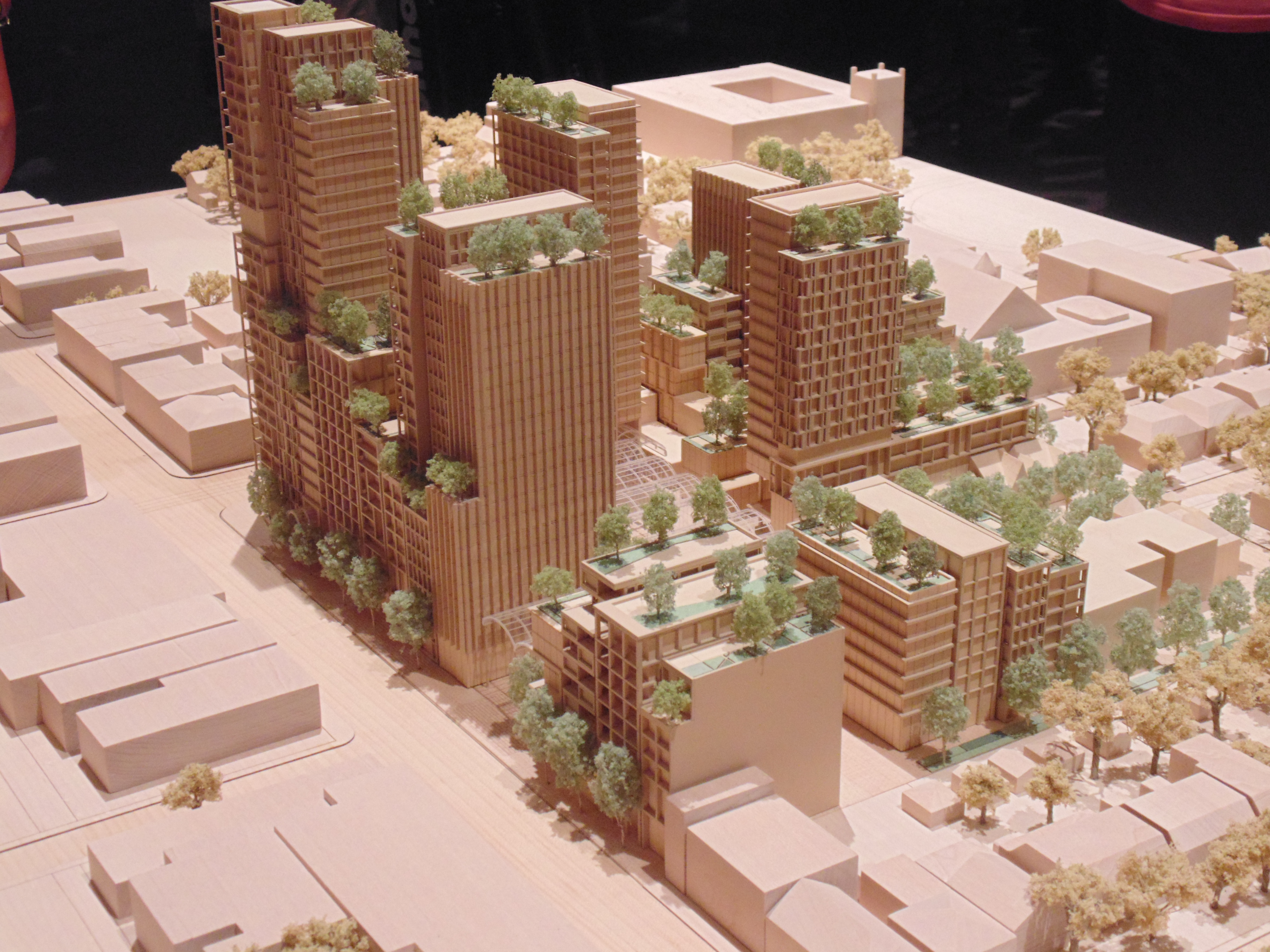
Westbank’s initial concept for Bloor and Bathurst streets includes a cluster of buildings at varying heights. Photo: Brian Burchell, Gleaner News
Cautious optimism greets Westbank proposal
By Annemarie Brissenden
Annex residents could be forgiven for thinking that creative, civic-minded developers are as rare as hen’s teeth. Long accustomed to property owners whose large and imposing concrete monstrosities loom over the area, they arrive at planning meetings prepared to fight. But what happens when the field of battle turns out to be a zone of conciliation?
Such is the case with Westbank Corp. and its plans to redevelop Mirvish Village.
“Normally you walk in [to an open house or planning meeting], have a plan put in front of you, and everybody begins to shout,” explained Neil Wright, chair of the Harbord Street Business Improvement Area. “This is a huge cultural shift: I don’t think people can comprehend it until they have had time to think.”
Shortly after a packed open house in early March, during which Westbank gave the community its first glance at the developer’s plans for the southwest corner of Bloor and Bathurst streets, residents are still trying to absorb the proposal, which is unlike anything they’ve ever seen.
“It’s quite different, and took some people by surprise,” said local councillor Mike Layton (Ward 19, Trinity-Spadina). “It’s an interesting take on how development can happen at that site. Elements of it are quite unique, and will add to the character of the neighbourhood.”
Forty to 50 interconnected buildings, the majority of which will be under 10 storeys, except for three at 29, 22, and 21 storeys, will house one thousand rental units, at least half of which will be two bedrooms or more. The buildings, which will appear to be separate when viewed from the outside, will also include live-work spaces, artist studios, and a daycare. There are plans for a covered public market, an alley with micro retail, bicycle valet parking, and auto share. And, 14 heritage buildings on Markham Street will be preserved.
Although these initial concepts for the site have not been presented to the City, Westbank is canvassing the community for feedback on its ambitious plan.
So far, the reviews are cautiously optimistic.
“At first glance, it’s very exciting, very creative,” said David Harrison, chair of the Annex Residents’ Association, who added that it’s a new idea in Toronto. “It’s all rental, [and] directionally that’s a good thing.”
“This is seriously family-style rental housing,” said Layton. “We struggle to get [developers to include] 10 to 15 per cent two and three bedrooms.”
He also praises the “beautiful little micro retail” and the public market, delighted with how the project’s architect has aimed to “replicate hundreds of years of development in Amsterdam and Paris.”
Harrison believes that’s due to the rental aspect of the project, not just because it was something the community identified as being important. “Developers are interested in investing in the public realm, because they have to live with it, as they will still own it.”
That said, it does seem as though they “are ticking all the boxes,” he said. “What’s surprising is they actually listened to so much of the input from the community groups.”
“I don’t think I’ve seen a developer get so far ahead of a process and engage the community and city planners in a dialogue that was so authentic and ultimately had an impact on the development,” agreed the chair of the Bloor-Annex Business Improvement Area, Brian Burchell, who also publishes this newspaper.
Ian Scott, a board member of the Palmerston Area Residents’ Association, said he’s mostly initially positive about the proposal, but, he noted, “discussion at the open house was directed at the things they wanted to talk about, not what we wanted to talk about.”
Among the things left out was consideration of how the area will absorb that much density.
“Have they done any studies about what traffic will look like? What will it do to the neighbourhood during construction?” asked Scott. “I am not convinced that I know enough about the scale not to be concerned about how it’s going to fit into the neighbourhood and not be disruptive in the long term.”
Other concerns raised included questions about the affordability of the units, the desire for greenspace, and the capacity of the nearby subway station.
“Neither Westbank nor the City appear to be engaging in a dialogue with [the TTC, which] is a glaring omission,” said Burchell. “Bathurst Street subway access to Bloor Street is in dire need of renewal. It can’t handle current capacity, and it’s safe to say, there will be more.”
Then there’s the height of the tallest tower.
“We’re trying to keep towers in the low twenties,” said Harrison, a comment echoed by Sue Dexter of the Harbord Village Residents’ Association.
“Twenty-nine storeys is high. That’s density that you want to be concerned about.” She’s keen to get into the nitty-gritty of the project to understand “how it would work. We don’t know how each building relates to the other, who’s going to program Markham Street,” or what the buffer from the street would be for those living in the units.
Still, Dexter views it as a positive step, even if there’s “lots of stuff to understand and there are concerns.
“Looking at the complexity of it, and marvelling at how much they’ve managed to embrace of the community,” she said, the question is, “how do you make it real?”
Tags: Annex · News
April 17th, 2015 · Comments Off on Agreement reached for CTS field
Community guaranteed free access to track during off-school hours
By Annemarie Brissenden
The field at Central Technical School may be fallow no more.
It’s been almost 18 months since the field at Central Tech was fenced off due to contamination in the soil while local residents’ associations and the Toronto District School Board (TDSB) battled over whether to hire Razor Management Inc., a private management company, to replace the field, install a seasonal dome, and manage the site for the next 20 years.
But the parties came to a mediated agreement that was verbally approved by the Ontario Municipal Board (OMB) on Mar. 23, and the field may be reopened by September.
“I’m very pleased that we’re finally reaching a conclusion in this whole journey,” said Helen Zhou, Central Tech’s student council president, who is also a member of the Friends and Neighbours of Central Tech, one of the parties involved in the deliberations at the OMB.
A man who says he prefers building community facilities to accruing lawyer’s fees because he likes seeing people active, Matthew Raizenne of Razor Management Inc. has a “good feeling” about the agreement.
“Everyone got most of what they wanted,” he said.
Under the terms of the agreement, the private company will install a new artificial turf football field and a new 400-metre rubberized running track, and manage the facility. For no longer than six months a year, it will also erect a seasonal dome, which will be no larger than 44.2 metres long, 65.5 metres wide, and 18 metres high. This is significantly smaller than the size of the dome under Razor Management’s original proposal, and will no longer include the running track. There are provisions for free community access to the facility outside of school hours, with the track being available at least 98 per cent of the time during those periods. Dogs and other pets will not be allowed on the field.
A Facility Management and Community Liaison Team has also been established to approve regional tournaments, have input on programming for user groups, and resolve operational issues, especially those, like parking and traffic, which may impact the community. Finally, Razor Management will work with the TDSB to run a local program for youth served by a neighbourhood agency, and make an annual donation in support of a community swim program at Central Tech.
“There’s been a transformation in the proposal, which [now] gives the neighbourhood access and structure for oversight,” said Sue Dexter of the Harbord Village Residents’ Association, one of the parties involved in the mediation. “It’s apparent from the result that [Razor Management] was prepared to be responsive to the needs of the community…. There’s now quite a number of community benefits.”
Like many of the parties, Ausma Malik (Ward 10, Trinity-Spadina), the TDSB trustee who inherited the file when she was elected in October, said she’s “excited to move forward with something that everyone is happy with.”
Malik characterized the willingness of all parties to come to a resolution as encouraging. The lengthy process, she added, demonstrated that “community consultation is absolutely critical” given that the broader community sees schools as the heart of their neighbourhoods.
“It’s been a stark and critical lesson for me.”
Zhou said she is sympathetic to the concerns raised about the project—particularly noise and parking—but added, “at the same time, this is an issue that has been affecting students the most.” After all, the field has been closed for half of the time she’s spent at Central Tech.
Like Malik, Zhou has gained much from the process, which was initially “very confusing because a lot of information was held back from us. A lot of the discussions were between adults and the people in charge.” Everything became “less of a mystery.”
Although it may have seemed acrimonious at times, explained Neil Wright, chair of the Harbord Street Business Improvement Area (HSBIA), the “process was really about the entire community trying to put something there [at Central Tech] that would be good for students and the area.
“And over the course of time,” he said, “that is what happened.”
Wright said that the HSBIA views this as “a wonderful opportunity. It’s fantastic for the school and for the community. We want to have the community come together.”
Perhaps that’s the most important lesson for everyone involved, including Zhou, who said the experience has taught her a lot about how the community can work together towards a common goal.
Now that the parties have agreed, Raizenne can move ahead with getting the facility opened. In a “perfect world,” that would happen for Sept. 1. However, he warned, “there’s a lot of things that need to work in order to make that happen.”
Tags: Annex · News · Sports
April 17th, 2015 · Comments Off on UTS goes pink, students unite
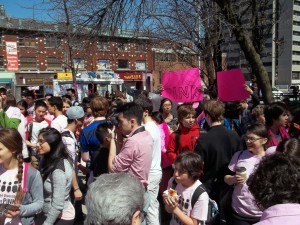
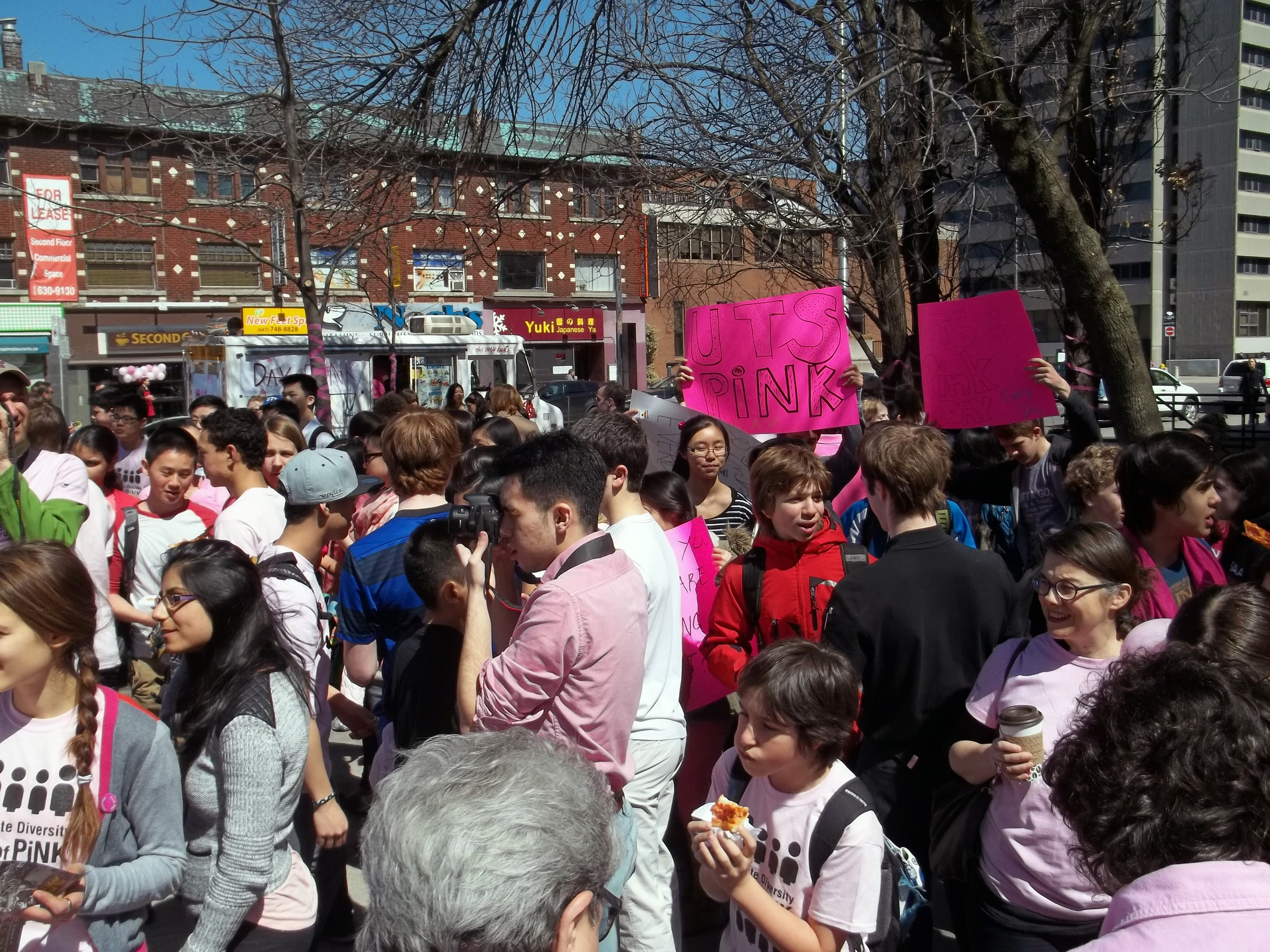
Photo: Catherine Kaiser, UTS Schools
For the second year in a row, University of Toronto Schools (UTS) will once again celebrate International Day of Pink on Apr. 8, at 1:30 p.m., in Matt Cohen Park at the corner of Bloor Street and Spadina Avenue.
Led by UTS guidance counsellor Catherine Kaiser, the 45-minute outdoor event is designed to engage the community and to build awareness of homophobia, bullying, and discrimination in schools and communities. Last year’s inaugural event attracted 300 students, or roughly half of the school’s population. This year, Kaiser anticipates the number of student participants to rise to 450. “It’s hugely validating for the students to get outside with their message of tolerance and inclusiveness, and have that validated by cars going by honking in support.”
A survey completed anonymously by UTS students before last year’s event revealed that a handful of closeted gay students were terrified, anxious, and afraid of what staff and other pupils would think if their sexual orientation was made public. This led Kaiser to open up to her students in a school-wide assembly about being gay herself. “I don’t think I had the support in my school or the role models to help me answer questions I didn’t know how to answer,” she said. “I take it upon myself to stand up and go ‘I’m gay, who cares’.”
The event has attracted support from local businesses, including this newspaper, and the Bloor Annex BIA, as well as the Toronto Police Service, whose mounted unit will attend in support of the cause. Participating UTS students and staff can win donated prizes from: Midoco, BMV books, Starbucks at Albany Avenue, Hot Docs Cinema, Cobs Bakery, Wiener’s Home Hardware, Annex Photo, Queen Video, Menchellas, Tea Shop 168, PoutineVille, and Almond Butterfly.
Community members are encouraged to attend, wearing pink of course! For further information, please contact Catherine Kaiser at (416) 946-0223 or catherine.kaiser@utschools.ca.
—Brian Burchell/Gleaner News
Tags: General
April 17th, 2015 · Comments Off on Police shooting on Spadina Road
Toronto Police responded to a call about a man with a knife near 140 Spadina Rd., just south of Dupont Avenue, at approximately 9 p.m. on Feb. 18. The armed man was shot when an exchange resulted between him and the officers shortly after they arrived at the scene.
The man, David Andrew Doucette, 49, was taken to St. Michael’s Hospital, where he was pronounced dead.
Initially, the Special Investigations Unit (SIU) assigned four investigators and two forensic investigators to the case, but subsequent reports announced that seven investigators and three forensic investigators have been assigned to look into the incident and determine whether or not to lay criminal charges against the officers involved.
The SIU investigates every incident involving police in Ontario if someone has been seriously injured, dies, or alleges sexual assault.
When asked if the officers who witnessed the incident were co-operating with investigators, Monica Hudon, the SIU’s communications coordinator, replied that, “the officers have a duty to co-operate,” but declined to provide further comment due to the ongoing nature of the investigation.
Anyone who may have information regarding this case is asked to contact the lead investigator at 416-622-2150, or 1-800-787-8529 ext. 2150.
—Claire Kilpatrick/Gleaner News
Tags: Annex · Liberty · News
April 17th, 2015 · Comments Off on Thefts on the rise?
New system for counting crimes skews data
By Claire Kilpatrick and Brian Burchell
Area thefts are on the rise according to a new statisical system called Versadex instituted by the Toronto Police Service (TPS). In fact, a summary provided by the police shows that crime appears to be up according to almost all major indicators within 14 Division, but reported thefts in particular portray an alarming trend. Auto thefts in 2014 are up 14 per cent from 2013, robberies (including muggings) are up 20 per cent, and theft over $5,000 (including bank robberies and “white collar” crimes) are up 35 per cent.
14 Division covers a wide swath of downtown spanning Spadina Avenue to the east, Dufferin Street to the west, and Dupont Street in the north down to the waterfront. In addition, the division includes the southern half of Parkdale (south of Queen Street West).
Though the increase in crime appears dramatic, Detective Sergeant Brian Kelly of 14 Division cautioned that there is more to the story. In late 2013, the division started tracking crime according to the new system. All crime incidents are stored on the system.
The way this new system tracks data has skewed the statistics dramatically, resulting, according to Kelly, in the false appearance of a rise in theft.
Kelly provided an example of how the change to Versadex has created a situation where an apples-to-apples comparison is not possible. “Before the changeover, if a lone robber were to approach a couple and demand their phones, it would count as one robbery, because it was one incident. After the changeover, however, that same crime would be recorded as two robberies, because there are two victims.” There have been other changes in the new system as well. According to Constable Victor Kwong of Toronto Police Corporate Communications, theft from cars as a category of crime is no longer reported in the published statistics.
Kelly said that “enough time hasn’t gone by to properly assess the stats from one year to the next.” By this time next year, the new Versadex system will have been in effect long enough to begin gleaning more useful results.
Included in the data is a column about whether or not a crime is “cleared”, meaning solved. The entire service average of cleared cases is 50 per cent. In 2014, 14 Division performed slightly better clearing 53 per cent of cases.
Tags: General
Amenities matter in city intensification
By Joe Cressy
I’m proud to live in downtown Toronto. I was born downtown, raised on Walmer Road, and my wife and I live in the Annex, near Bathurst and Bloor streets. Downtown Toronto is a great place to live, but we have much to do to make sure we protect and build the character of our downtown communities.
Downtown Toronto is the heart of our city. That may not always be the most popular thing to say, but there is no shame in saying it.
All of Toronto wins when the downtown does well. Some numbers help tell the tale…downtown Toronto, as defined by the city’s official plan, is the area from Bathurst Street to the Don River, and from the waterfront to Dupont Street and the Rosedale Valley.
Over 200,000 people live downtown, but during the day it nearly triples in size as the daytime population grows to nearly 750,000 people. It is 17 square kilometres in size and represents just 3 per cent of the city’s landmass. A third of all the jobs in the entire city are located downtown; a quarter of the city’s tax-base is generated downtown; and more than half of the city’s GDP is created downtown.
However, as we all know, it is about much more than numbers and economic benefits. It is about the neighbourhoods and institutions that give life to our city. It is the three universities and numerous community colleges located downtown; it is the cultural institutions and festivals like the AGO, TIFF, Hot Docs, and the Harbourfront Centre.
It is the mixed-use neighbourhoods like Kensington Market, Chinatown, and St. Lawrence Market; and despite decades of disappointment, it is the insufferable Leafs, the occasionally successful Blue Jays, and the increasingly exciting Raptors.
We have a lot to be proud of downtown. However, for those of us who live here, we must do a better job of building neighbourhoods, rather than simply adding density and building condos.
Over the last 20 years we’ve witnessed transformational change in the area. Amidst the remnants of 20th century infrastructure like the railway lands, industrial warehouses, and the Gardiner Expressway, new neighbourhoods have risen up.
In the railway lands, an entirely new neighbourhood, CityPlace, has been built in two decades. In the Entertainment District, defined as Front Street to Queen Street and University Avenue to Spadina Avenue, the population has grown from 240 people in 2001 to 3,600 people today, and is estimated to grow by another 18,000 people when all of the approved developments are built. Despite this tremendous growth, we have not adequately invested in the vital community services that make a neighbourhood liveable. These services include community centres, libraries, affordable childcare, and parks.
In fact, we are so far behind that we don’t have solid information on which services are most oversubscribed in each neighbourhood. However we are finally working to catch up now.
Density is not something to be afraid of, as long as we’re planning for a mixture of housing options and building the physical and social infrastructure to support it. If you are a family living in a two- or three-bedroom unit in a condo or a tower, the park becomes your backyard. The community centre and library become your den or playroom. Building liveable neighbourhoods requires that we plan for families. Over the next few years, we at City Hall plan to change our planning framework to do just that.
During the last term of council, a motion was passed instructing planning staff to conduct a comprehensive study of the downtown to answer two critical questions: how much development can downtown handle? And, what infrastructure (both social and physical) is needed to handle it? These are critical questions that we must answer in order to move forward.
The five-year study, entitled TOcore, is now 50 per cent complete. The intention is to develop a new master plan for the downtown and to put forward specific official plans and bylaw amendments to regulate and mandate more equitable and liveable development. Whether it is a downtown parks strategy or a downtown community services and facilities study, these plans will guide any future growth, development, and public investment.
Downtown Toronto is many different things to many different people. But, it has always been a wonderful place to live for those of us that call it home.
As our city continues to grow, let’s make sure it stays that way for generations to come.
Joe Cressy is the city councillor for Ward 20, Trinity-Spadina.
Tags: Annex · Liberty · News
April 16th, 2015 · Comments Off on They walk the talk
The recent unveiling of plans to redevelop the Honest Ed’s site and adjoining Mirvish Village left a largely local audience in awe. At the opening curtain on the proposed plan, yet to be submitted to the City for approval, Westbank Corp. of Vancouver displayed an innovative plan of multiple residential towers, “small-grain” retail, open public space, preserved architecture (Mirvish Village), and a street (Markham Street) dedicated to pedestrians. They did almost exactly what they said they would do—they listened.
City planners have long anticipated this application, having sharpened their axes on the now sidelined plan to erect a Walmart on Bathurst Street south of College Street. One worry was how to prevent a big box at Bathurst and Bloor streets. The City approved an amendment to the Official Plan, which limits retail frontages to nine metres (about the width of Wiener’s Home Hardware on Bloor?Street) and total retail area of any one tenant to 3,500 square metres (about the size of the Metro grocery store on Bloor Street). But Westbank did not need a bylaw to tell them that “small-grain retail,” a phrase that Westbank is introducing into our lexicon, was the way to go. Such stores will define the lower periphery of the northern (Bloor Street) and eastern (Bathurst?Street) flanks, Mirvish Village, and a new lane running north from Lennox Street (at the rear of Victory Café) to about halfway up the property. In all, 200,000 square feet of retail will be provided.
What surprised many was the plan for rental—1,000 units in total. According to Employment and Social Development Canada, Toronto’s rental vacancy rate stood at a scant 1.7 per cent in 2014. While no figures are available on the subject, creating vacancy at a major intersection, and on a subway line, could be argued as fulfilling an acute need. One-half of the units proposed are two or more bedrooms, read the possibility of “families.” Bravo to Westbank!
Too many condominium projects built in recent years consist mostly of bachelor units. Condo developers have taken advantage of low interest rates and a desire for downtown living, and have built an endless skyline of concrete cubicles, with little creativity and many with no nearby amenities. No one accuses the condo kings of city building.
The approach of Westbank to this project ought to go into a how-to book somewhere for wannabe city builders who have “leaving a legacy” somewhere in their mantra. They consulted, and apparently they were listening. There is no great sentimentality around Honest Ed’s the store, and there is little evidence of its preservation in the development. There is, however, a lasting affection for Anne and Ed Mirvish. And their names live on. Moreover, Anne’s vision for Markham Street (Mirvish Village) is maintained and reinvigorated in the plan. Westbank listened when they were urged to consider that Mirvish Village is more than the built-form of Victorian buildings, it’s an eclectic mix of shops, restaurants, and bars, and above those venues, writers and other artists. Some balance must be struck so that it does not become another Yorkville.
Contrast the Westbank plan with what is proposed at Bloor Street and Madison Avenue, formerly the site of the Restaurants Association of Canada. That unnamed developer did zero community consultation, and just dropped an application off at the City for 42 storeys of condominiums (over 500 units), on what is arguably a postage stamp lot by comparison. It’s quite a juxtaposition of approaches.
The Westbank plan needs some scrutiny in respect to setbacks. One of the biggest obstacles that faces Bloor Street is accommodating pedestrian and cycling traffic. There is also a missing puzzle piece, and it’s glaring, and that is improved access to the subway. This is where the City should focus on helping the project. Improving access to the Markham Street subway entrance (yes, the Bathurst subway station has another entrance point, it’s a secret to most) would take pressure off the narrow sidewalk adjacent to the CIBC on Bathurst Street. Someone should really convene a meeting between the TTC, the City, and Westbank. The City could “city build” too and get behind this laudable plan.
Tags: Annex · Liberty · Editorial
April 16th, 2015 · Comments Off on Smart growth for our community
Provincial proposal aims to give residents greater say
By Han Dong
Recently, I attended an event at the Fort York Foundation Visitors’ Centre with the Hon. Ted McMeekin, Minister of Municipal Affairs and Housing, where he announced that the Government of Ontario is proposing reforms to the Planning Act and the Development Charges Act. These proposed reforms would give residents a greater say in how their communities grow and would provide more opportunities to fund community services such as transit and recycling.
The Smart Growth for Our Communities Act was introduced on Mar. 5. The Smart Growth for Our Communities Act introduces reforms to the Planning Act and the Development Charges Act that would make sure that growth in Ontario is managed smartly.
Our proposed amendments would give residents a greater, more meaningful say in how their communities grow; and would make the planning and appeals process more predictable. The changes would also give municipalities more independence and would make it easier to resolve disputes at the community level.
The proposed Planning Act changes, if passed, would give municipalities and community groups an enhanced tool, called the community planning permit system, to encourage an innovative way to plan and address local needs. The development of this system would include residents and other stakeholders, and when one is in place, would not be subject to private appeals for five years.
The proposed changes would also ensure residents are better consulted at the beginning of the planning process for new developments, and encourage residents to provide feedback on the future of their communities. Furthermore, the changes would help municipalities resolve potential planning disputes earlier, reducing the involvement of the Ontario Municipal Board (OMB).
These changes would also extend the review of new municipal official plans to 10 years, instead of the current five-year cycle.
The proposed changes to the Development Charges Act, if passed, would help municipalities recover costs for transit services and waste diversion, and create clear reporting requirements for capital projects that were financed though development charges. The reforms are based on recommendations from the review of the land use planning and appeal, and the development charges systems. We will also be setting up working groups of stakeholders to review further more complex development charges issues, and to take a considered look at some land use planning elements.
It is important that all communities are engaged in a meaningful discussion regarding Smart Growth in Ontario. The Smart Growth for Our Communities Act will assist residents of Trinity-Spadina by putting the tools for effective advocacy in residents’ hands. With these important tools in place, and at their disposal, residents can be assured that they have a meaningful say in how their community grows.
The Act, if passed, will strengthen the community’s voice, address local needs, allow for quicker dispute resolutions, and provide a well informed avenue for concerned residents. Helping communities grow is part of the government’s economic plan for Ontario.
The four-part plan is building Ontario up by investing in people’s talents and skills, building new public infrastructure like roads and transit, creating a dynamic, supportive environment where business thrives, and building a secure savings plan so everyone can afford to retire.
For more information on the Smart Growth for Our Communities Act, community information sessions, the OMB, and all other provincial issues, please contact my office at 416-603-9664, hdong.mpp.co@liberal.ola.org or visit www.handong.onmpp.ca.
Han Dong is the MPP?for Trinity-Spadina.
Tags: Annex · Liberty · News
April 16th, 2015 · Comments Off on Delivering history in Harbord Village

Photo: Neiland Brissenden, Gleaner News
HVRA lane-naming project leads to The Postman
By Annemarie Brissenden
There are nearly 500 miles between Miliford, Del. and St. Catharines, Ont. These days, it would take approximately 10 hours to drive a highway that meanders through New Jersey, Pennsylvania, and then New York, before finally reaching Ontario. One hundred and seventy-five years ago, it would have been a different matter altogether.
Imagine bundling up your seven children, ranging in age from three to 16, gathering your meagre possessions, and making the journey on foot. You travel at night, because you’re escaping slavery, and are being hunted. Should you not evade capture, you would be returned to a life in chains, or worse.
For Anne Maria Jackson and her children, who would eventually walk the equivalent of 20 marathons along the Underground Railroad, freedom would not be elusive. They would make it north and settle in Toronto, where the family would prosper.
The youngest child, Albert, would grow up to become the city’s first African-American postman. But that success would not come without struggles of a different sort. Albert Jackson’s white colleagues refused to work with him, and it would take the intervention of Canada’s first prime minister, Sir John A. Macdonald, to secure Jackson’s position at the post office. Jackson would remain in this role for the rest of his life, buying several houses in the greater Annex, which was also home to his postal route.
“It’s the largest family group ever to come to Canada [via the Underground Railroad],” explained David Ferry, the artistic director of Appledore Productions, which will debut The Postman, a promenade-style musical play that will recreate Albert Jackson’s life along local streets this summer.
Ferry first learned of the story following media coverage of the Harbord Village Residents’ Association’s Laneway Naming Project, which unearthed Albert Jackson’s story. Inspired as much by Jackson’s mother as by Jackson himself, Ferry promotes the play, in which different scenes will be performed from different porches along Jackson’s postal route in Harbord Village and the Palmerston Avenue area, with infectious enthusiasm.
In workshops, he bubbles with energy, and just can’t help himself from dancing along as the cast rehearses the musical numbers. Such ebullience is necessary as he marshals community members to help with logistics and volunteer their front yards for performances, and collaborates with seven playwrights of diverse backgrounds on the script.
“It’s my first experience working almost in a collective. You’re trying to be distinct in your writing, yet finding a singular voice,” explained Leah Simone-Bowen, Obsidian Theatre’s artistic producer, one of the play’s writers. Layne Coleman, who’s playing Sir John A. Macdonald, also spoke about Ferry’s unique approach. “There’s not harmony in the way the story telling usually is,” said Coleman, “but David is threading it all together with music, [which] adds some unity.” Coleman, who has played Sir John A. several times before, believes there is “something particularly mythic about the Jackson family.” Like Ferry, he’s inspired by their horrifying and remarkable journey.
“Consider what it’s like to walk 500 miles at night in the northeastern states pursued by very unscrupulous people,” he said, adding he’s learned so much about the history of Toronto, and the deep roots of the city’s Black community thanks to the play.
“Learning that there was so much history, and Black history, was stunning to me,” echoed Simone-Bowen. In some ways, “[Jackson’s] story is such a specific story,” but in others, “it’s very similar to every immigrant story ever,” she added.
“It is such an empowering story overall,” said Laurence Dean Ifill, the actor playing Albert Jackson. Not an at-risk youth while growing up (“my father was and still is a beautiful role model”) he believes “stories like this should be told. “Would it make a difference to someone?” wondered Ifill, who has always been interested in historical pieces when it comes to theatre.
He has been involved in The Postman ever since Ferry brought the idea to him while they both working on a Eugene O’Neill play three years ago. “[The play] is like a journey for me,” said Ifill.
Moved by the life Jackson and his wife built in the Annex, the actor notes how the end of Jackson’s journey is as inspiring as its beginning. Jackson and his wife achieved so much, and built such a life here. “They made a beautiful team,” he said. “All because his mother decided to escape. That’s beautiful.”
Tags: General
April 16th, 2015 · Comments Off on A blaze adjacent to “unsafe house”

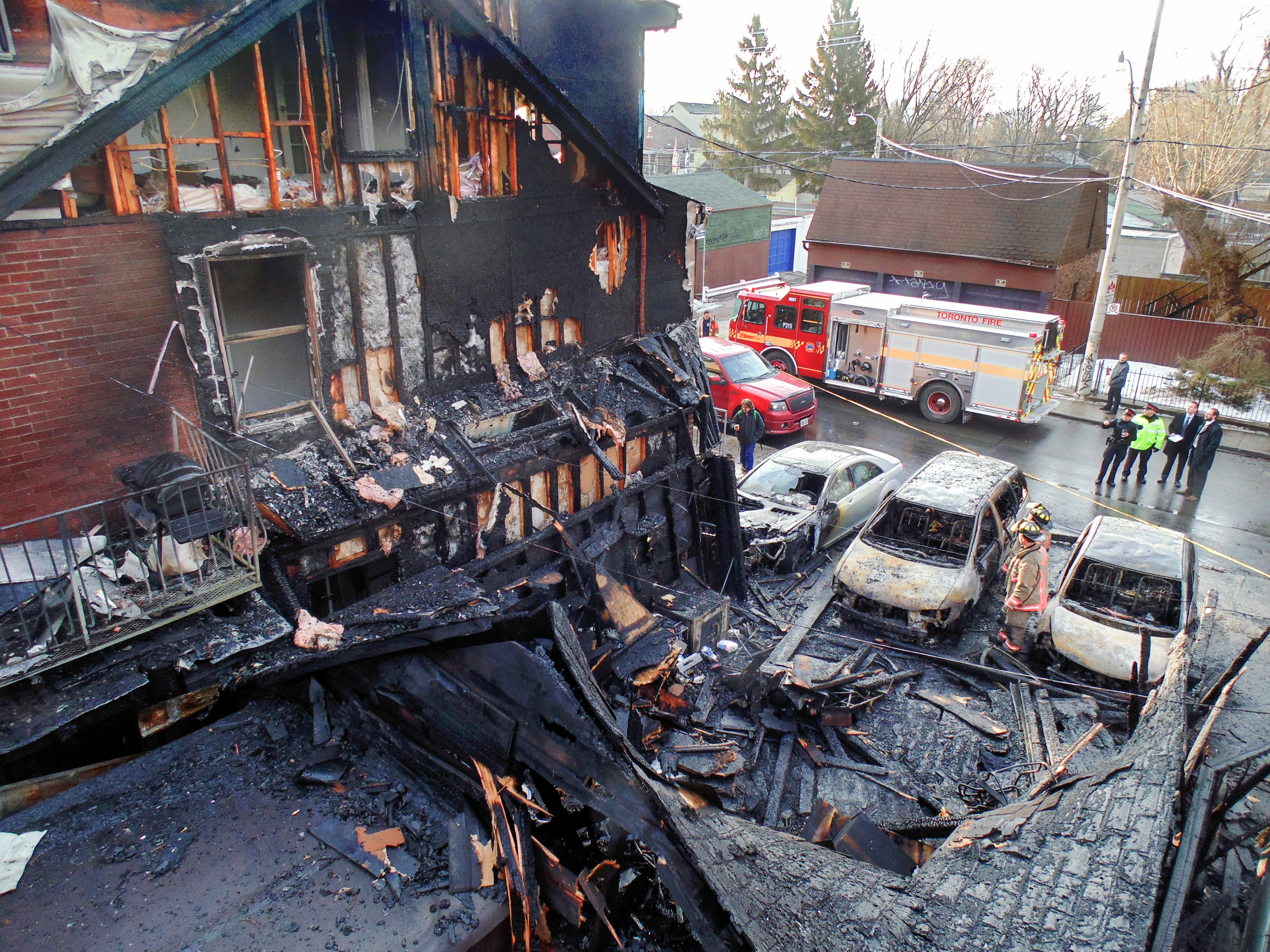
Photo by Cole Burchell, Gleaner News
Residents of the Bathurst and Ulster streets area awoke to sirens early in the morning of Mar. 16 as a two-alarm blaze demolished a garage and did damage to the side of a house on Ulster Street. Vehicles parked in front of the garage suffered serious damage as well but no injuries were reported. The cause of the fire is unknown, fire officials said. The blaze was reported at around 5:30 a.m. and fire crews had the flames under control 30 minutes later. Leigh Harrison, a resident on Bathurst Street whose balcony backs onto the scene of the fire, said she awoke at around 5 a.m. to her whole apartment being lit up by the glare and that “the fire was well underway by the time I left the house.” Harrison added that she had submitted noise complaints due to “rampant construction” on the property late last year. The City of Toronto Bylaw Investigation webpage confirms that 104 Ulster St. was the subject of a removal notice early last year. The house was said to be unsafe for multiple dwellings due to a lack of fire safety measures including fire alarm systems and adequate fire exits. Despite these concerns, up to 18 residents were living in the building at one point. The dwelling was renovated into a multiple-room household without a bylaw permit. Police on the scene did not comment on the blaze.
—Cole Burchell, Gleaner News
Tags: Annex · News · General
April 16th, 2015 · Comments Off on Density done right
Infrastructure is the key to Green
By Terri Chu,
I ran into many neighbours at a recent community consultation for the Honest Ed’s redevelopment project. Westbank unveiled its plans, which consist entirely of rental units with a strong emphasis on the key buzzword of the day, “microretail”.
I heard barely any complaints about the rental-focused development, though a few people did object to the 29-storey height. On the environmental front, they said mostly the right things though details are murky at the moment. Very little has been done in terms of detailed plans as most of them are still conceptual. Included in the plans are my personal favourites: combined heat and power and urban agriculture (despite being token small plots). I am concerned about how much energy-sucking window area will be allowed, but have been assured they will stick to the 40 per cent maximum threshold.
I look forward to having higher density in the area, despite the existing car parking issues. It will be an accomplishment if the developers can encourage more people to live car-free and walk across the street and primarily take transit. Given how convenient Bloor Street is, this is certainly a possibility.
The Bloor-Danforth subway line is not nearly at the capacity that the Yonge line is, so I view development along it as a good thing. Let’s make sure we use the existing infrastructure that we have, not just build new (underused) lines. Density has been an issue for neighbourhood businesses as evidenced by the empty storefronts along Bloor Street. In the recent past, a home in this neighbourhood might have housed a half-dozen people, but it now typically houses two or three.
As gentrification takes hold, multi-unit homes are increasingly being turned back into single-family ones. Without adequate density, it is difficult to maintain walkable communities. Businesses need people to thrive, and one individual can only eat so many muffins.
More concerning than the Honest Ed’s project to me is the 80-storey project east of us at the old Stollery’s location at Yonge and Bloor. While the Danforth line still has some ways to go before reaching anywhere near the ridership that the Yonge line enjoys, Yonge-Bloor is already a dangerously busy station. Adding 80 more storeys in an area before existing infrastructure to service it is in place seems to me counterintuitive.
If done right, in theory the complex could provide everything that people need and its existence in and of itself relieves people from the need to travel. Not executed right, we are putting more people on an overtaxed subway system possibly encouraging frustrated riders to take the car instead. I can’t say Toronto’s development boom was “done right” given the need for Liberty Village residents to crowd source their own bus service.
I’d like to see bigger, grander plans for transit, waste, sewage, electricity, and then for those bigger plans to go ahead together as opposed to the piecemeal method of infrastructure we have been seeing of late. Letting development occur, then figuring out how to service it later hasn’t been serving us well. Toronto has tremendous opportunity, however, since a lot of development work is still going on. Anyone who has read my previous columns knows that I am a huge fan of district energy.
Unless there is a grand plan that involves more than just one developer, ambitious projects like that don’t just happen. As residents of Toronto, I think it’s important that we show support for good projects so developers know that we will not stand in the way of responsible, community-focused developments.
I think it’s also important we let the City know that we want to see a bigger plan in place and not just a hodgepodge of condos here and subways there (if they were correlated I might be less upset).
Good city planning needs engaged citizens to be part of the process.
I was heartened by seeing the turnout at this event but clearly there’s still a ways to go. Don’t be shy about writing your councillor and asking “what about the infrastructure?” Until we say it’s important, it isn’t.
Tags: Annex · Liberty · General
April 16th, 2015 · Comments Off on Easy meringue
Use whatever you have in the pantry for crust
By Susan Oppenheim
Who didn’t grow up 50-odd years ago with something that was totally special, totally yummy, and very, very easy to make?
Ask my mother, a daughter of an amazing baker, about her cooking skills, and she will make a joke. She admits openly that she didn’t cook. She worked full-time six days a week and I do not remember broccoli, cauliflower, or anything else cooked besides corn on the cob or mashed potatoes. Absolutely everything for the four boomer kids in our house came out of a box or a can.
About once a month there were four couples, my parents included, who got together for poker night. They took turns hosting the game, but when it was our turn my older sister and I would sneak onto the stairs and dare each other to run into the kitchen while they were engrossed in the dining room, playing out their hands. With the doors closed off so that no one saw us, we’d grab ribbon tea sandwiches. Imagine salmon and egg together in one bite on alternating white and brown bread.
One thing my mum made on those occasions was an icebox cake, which was likely the predecessor to Oreo cookies! The base ingredients for this were chocolate wafers in a box sold upright and stacked, with a simple recipe on the side. It involved whipping cream, flavoured sugar, and the cookies. They were placed in a stack, horizontal with the sweetened cream between them, then frozen and eaten slightly thawed. I think you can still buy these cookies on grocery shelves today.
What I did not realize at the time was that this is not so different from a convenience store, non-bake icebox pie made with cookie crumbs and a filling of your choice.
It’s finally spring, so I’m posting a lemon meringue pie for you all with a standard graham cracker crust. Feel free to change this any way you want with chocolate cookies, vanilla wafers, even cookies in a cupboard that you stashed and never got to.
Lemon pie from
Kate Aitken cookbook
Make sure to separate your eggs when cold so no yolk gets into the whites.
Standard crumb crust
graham cracker crumbs (or any cookie you have)
- 1/3 cup white sugar
- 6 tablespoons warm butter, melted
Mix these together well and then pat into your pie plate. Pretty easy huh? If you don’t have a kitchen processor just put the cookies in a strong bag and roll your rolling pin over them, crushing until fine. Put enough into the pie plate to make a good base.
Filling
- 3 tablespoons cornstarch
- 3 tablespoons all purpose flour
- 1 cup white sugar
- 1/4 teaspoon salt
- 1 1/2 cups boiling water
- 2 eggs separated
- 6 tablespoons lemon juice (fresh squeezed)
- 2 teaspoons lemon zest (grate the outside peel of the lemon)
- 1 tablespoon butter
Mix cornstarch, flour, sugar, and salt in the top of a double boiler; add the boiling water stirring all the time. Cook over direct heat until thick and smooth, stirring constantly. Cover and cook over boiling water for another 10 minutes. Mix together the egg yolks, lemon juice, and zest, then stir into the hot starch mixture. Blend well, and continue cooking for another three minutes. Remove from the stove, add the butter, and cool. Using a hand beater, beat it up light and fluffy then spoon gently into your crumb shell.
Meringue
- 2 egg whites stiffly beaten at room temperature (no yolk)
- 3 tablespoons white sugar
- 1 teaspoon cornstarch
Combine egg whites, white sugar, and cornstarch using a hand mixer on its highest setting. Beat until peaks form and it is not sticky. Cover the lemon pie making sure you reach all the edges as the meringue will shrink a bit. Bake it in the centre of a 350 degree oven until puffy and browned, about 10 minutes. Serve cooled. If the meringue seems too much, just whip up some cream and use that.
Tags: Annex · Liberty · Food