May 29th, 2015 · Comments Off on Why do the Conservatives keep missing the boat?
The orange wave has toppled the bastion of blue.
The New Democratic Party’s (NDP) recent sweep to power in Alberta should put the Conservative Party of Canada (CPC) on notice. Even if the right wing was united in that province, the combined seats of the Conservative and Wild Rose parties would not be enough to crush the wave. Meanwhile, the Liberals caused barely a ripple. It’s a clear signal that those living in the province wanted change.
It also reflects changing demographics.
People from the rest of Canada are moving to Alberta seeking jobs. But not all of them are ending up on oil rigs; just as many are settling in urban centres like Edmonton and Calgary, bringing with them their urban sensibilities and urban concerns. If we are lucky, it will force the western-centric CPC to start paying attention to the urban agenda, if only as a means of survival.
But, if past experience is any indication, we won’t be so lucky. The federal government has a history of ignoring cities, particularly Toronto. Even when the Liberals were in power, spouting lots of rhetoric about pursuing an urban agenda, that rhetoric rarely materialized into action.
As for the Conservatives, their strategy ignores the basic realities of our nation: 80 per cent of us live in cities. And one of those cities — the city that everyone loves to hate — Toronto, is an economic engine that drives the wealth of the country.
As with the Liberals before them, Conservative members of Parliament don’t seem to champion an urban- or Toronto-centric agenda. The Minister of Finance, Joe Oliver, serves a large Toronto riding, but you’d never know it when the budget is tabled.
At least, however, the CPC pays attention to Eglinton-Lawrence. It’s been ignoring Trinity-Spadina for years, fielding laughable candidates without any hope of success. One wonders if it’s the Conservatives’ version of hazing: sending the newbie to run in downtown Toronto, just to see how the candidate fares against the likes of well-known community stalwarts like Adam Vaughan, Olivia Chow, or Joe Cressy.
This election, however, the party had a chance to demonstrate its intent to take the riding seriously. The change in electoral boundaries has seen Trinity-Spadina split into University-Rosedale, Toronto-Centre, and Spadina-Fort York. Trinity-Spadina’s current MP, Adam Vaughan, will run in Spadina-Fort York, while Chrystia Freeland (MP, Toronto-Centre) will run in University-Rosedale. While both are Liberal, Freeland is new to parts of the Annex, as is NDP newcomer Jennifer Hollett, who will run against her.
In University-Rosedale, then, the CPC has a chance it hasn’t had in years: the opportunity to run against those who haven’t established a political toehold in the area. Further, with the boundary change, the party has demographics in its favour: a greater number of voters likely to flow to blue aligned against a group of voters who could run red, orange, or even green.
Except the Conservatives have already bungled it.
For one thing, waiting for the Conservatives to answer a Gleaner inquiry is akin to waiting for Godot. We’re trying not to take that personally.
What we are more concerned about is the candidate they’ve fielded. Young and energetic, Karim Jivraj has a website (that’s all we have to refer to) that focuses on his bilingualism, international perspective, and legal acumen, all of which (according to him) have positioned him as a successful future legislator. What the website doesn’t reflect, or even discuss, is an understanding of issues specific to University-Rosedale, or even Toronto. It also fails to mention that he hasn’t even lived here for a year. Is that the whiff of a carpet bag we smell?
It’s time for the Conservatives to take our neighbourhood, and our city, seriously.
Tags: General
May 28th, 2015 · Comments Off on Canoe garden lands on the shore of Lake Iroquois
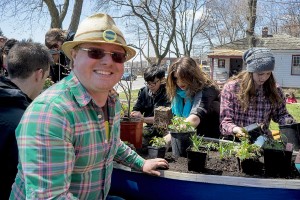
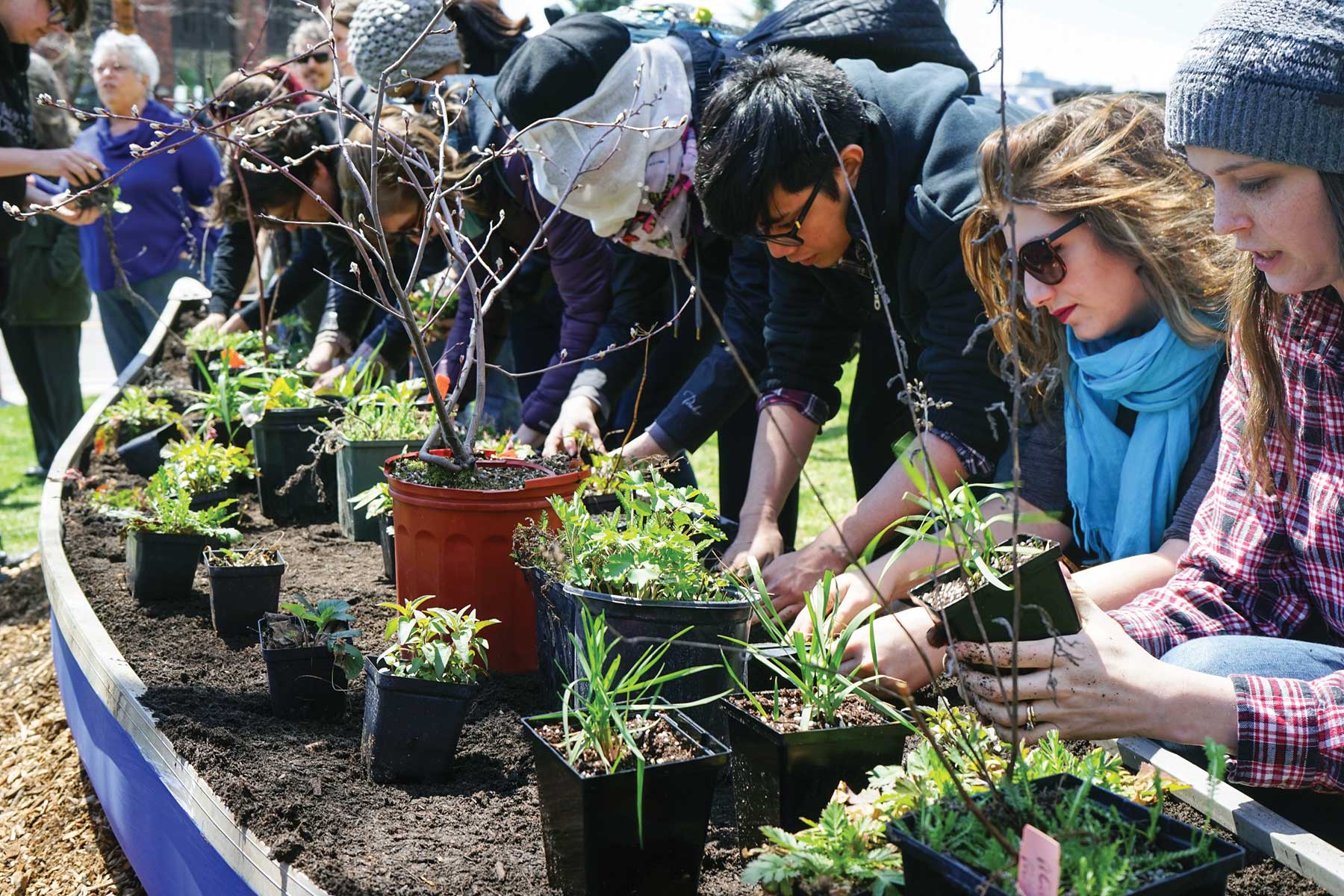
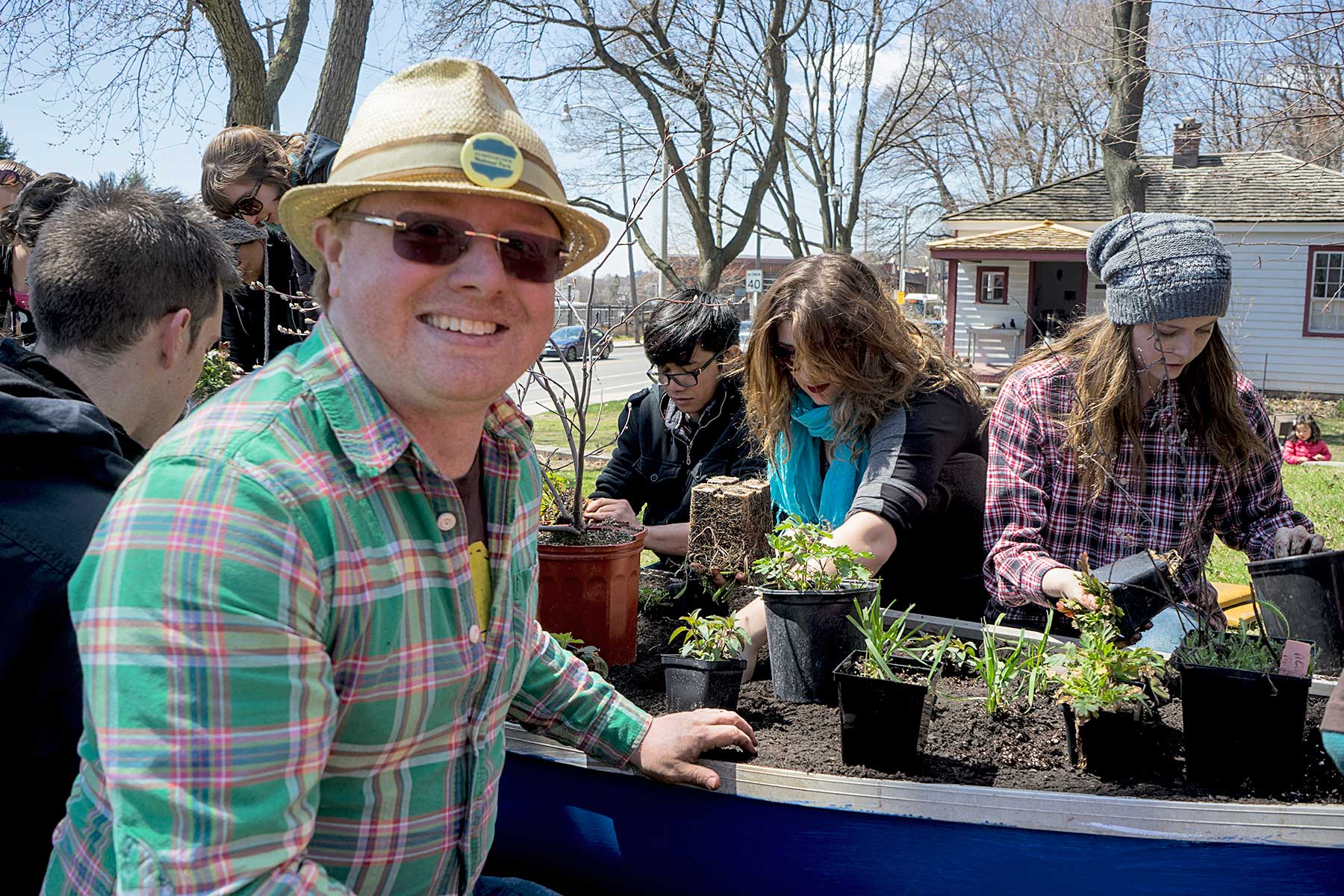
Led by David Suzuki Foundation Neighbourhood Park Ranger Aidan Nolan (above left), volunteers transform a canoe into a garden in front of the Tollkeeper’s Cottage at Bathurst Street and Davenport Road. A Community Canoe Garden Network initiative, the garden — one of 11 installed along the corridor of old Garrison Creek — creates an abundant habitat for bees, birds, bats, and butterflies while reminding residents of the lost rivers that flow beneath the city. Photo: Neiland Brissenden, Gleaner News
A native plant garden is taking root in a derelict canoe positioned on what was once the shore of a lake dating to the last ice age. Located in Tollkeeper’s Park at Bathurst Street and Davenport Road, it is one of 20 urban installations that will make up the Community Canoe Garden Network, itself part of the Homegrown National Park Project. Each canoe garden is beached along Garrison Creek, one of the city’s old waterways, and provides a habitat for local bees, bats, butterflies, and birds.
Aidan Nolen, a David Suzuki Foundation volunteer, which the foundation terms a Neighbourhood Park Ranger, is leading the initiative, and planning to install nine more community canoes this year.
“Nolan is a super volunteer who has committed an extraordinary amount of time and energy to this cause,” said Jode Roberts, a foundation staff member. “He has taken it a step further by including an educational component about lost rivers, and has started to include First Nations groups who identify with the canoe as a cultural symbol.”
A corridor for native and European travellers alike for generations, the location of this particular canoe is especially historically significant.
All of downtown south of Davenport Road was once under Lake Iroquois, until approximately 12,000 to 13,000 years ago, when the last ice age ended and the receding waters formed Lake Ontario. Still visible, the old shoreline is noticeable in the dramatic changes in elevation at Bathurst Street north of Davenport Road.
Thought to have been a trail stretching from Montreal to Niagara, this route along the edge of an ancient lake was documented by Elizabeth Simcoe (wife of then Lieutenant-Governor of Upper Canada John Graves Simcoe) in 1776. Only the section between the Humber and Don rivers is in its original location.
The Tollkeeper’s Cottage, also part of the park, is a museum about tolls, roads, and nineteenth-century life. The oldest structure of its kind Canada, it dates to 1835, a time when private developers built roads, and charged all those travelling along them a fee, or toll, per use. Think of it as an early Highway 407 built on a native pathway.
Interested in hosting a canoe installation? For further information, or to make a donation, please visit www.communitycanoe.ca.
—Brian Burchell/Gleaner News
Tags: Annex · Liberty · News
May 28th, 2015 · Comments Off on Inaction frustrates residents
Government urged to act now to reduce the risk of a rail catastrophe
By Arthur White
About 200 people attending an April town hall on rail safety learned that little has changed since they last met in November.
“I was asked to tell you what progress we’ve made,” said Josh Matlow (Ward 22, St. Paul’s), flanked by Liberal MPs Chrystia Freeland (Toronto Centre), Adam Vaughan (Trinity-Spadina), and Carolyn Bennet (St. Paul’s). “Very little to none.”
Afraid that an oil train derailment could turn their neighbourhood into another Lac-Mégantic, the residents who crowded into the Church of the Messiah on Avenue Road blasted the government for what they see as dangerous inaction. Proving the point, Matlow went over the unanswered slew of motions, letters, and meetings city council has used to try and press Lisa Raitt, the Minister of Transport, to take further action.
“We have been contacting her quite often and have actually received no response,” reported Patricia Lai, a co-founder of Safe Rail Communities, an advocacy group from the Junction dedicated to tackling the crude oil threat. She has also been trying to reach Raitt with petitions and letters, but has come up against a wall of indifference.
![“One thousand people could just go [to an unprotected rail crossing] and refuse to move,” proposed Peter von Bitter at an April town hall on rail safety. He was one of many residents at the meeting frustrated with the federal government’s lack of progress on rail safety. Photo: Brian Burchell, Gleaner News](http://gleanernews.ca/wp-content/uploads/2015/05/Page6aWeb-300x200.jpg)
“One thousand people could just go [to an unprotected rail crossing] and refuse to move,” proposed Peter von Bitter at an April town hall on rail safety. He was one of many residents at the meeting frustrated with the federal government’s lack of progress on rail safety. Photo: Neiland Brissenden, Gleaner News
Every day, hundreds of tank cars rattle by the church, which sits right next to the Canadian Pacific Railway Limited (CP) line along Dupont Street. Many carry tens of thousands of litres of volatile crude oil. Almost two years ago, 72 of those cars passed by here on their way to Lac-Mégantic, Que., where they derailed and exploded, killing 47.
“That could have been us,” said Lai.
In April 2014, Transport Canada announced tougher standards in response to the fatal derailment in Lac-Mégantic and moved to take 5,000 of the most dangerous DOT-111 tank cars off the rails. The remaining cars, which the Transportation Safety Board (TSB) has repeatedly called “inadequate for the safe transport of dangerous goods”, will have to be retrofitted by 2017. For Matlow, that isn’t nearly fast enough.
“Minister Raitt has made various piecemeal announcements that respond to perhaps the most dangerous cars,” said Matlow. “But the many, many hundreds throughout the country that are not the most dangerous, but still extremely dangerous, are still going through our neighbourhoods every single day and night.”
Since the last town hall in November, three rail accidents have struck Ontario, all near Gogama, south of Timmins. Bennett and Vaughan both said the derailments reveal the inadequacy of the standards Raitt announced last year. The cars met the new regulations, but still leaked and caught fire, in one case polluting nearby waterways.
“We were already concerned that the changes to the DOT-111 cars were not sufficient,” said Bennett. “Now it’s proven.”
This March the Ministry responded with new standards that require full head shields, thicker steel, and thermal jackets on all cars, measures the TSB has been recommending for decades. But the changes leave 10 years for the industry to catch up, allowing dangerous cars to plow through Toronto until 2025.
Many at the town hall were unhappy with this timeline, with one person pointing out that defective consumer products are immediately recalled whenever they present the slightest safety risk. Contacted after the meeting for comment, Raitt’s press secretary, Zack Segal, said that there is a “balance to be struck”, and the deadlines in place are “aggressive”. But industry can’t replace a tank car fleet numbering well over 200,000 from one day to the next, especially when many are based in the United States, which has laid out an even slower timeline.
“We must increase the safety of rail cars as soon as possible,” he said, “but we must also provide tank car owners with enough time to comply with the new requirements.”
Infrastructure was another major issue at the town hall, especially given that TSB reports reveal a possible link between weak rail lines and the Gogama crashes. Vaughan brought the problem home to Toronto, warning about the risk posed by the dozens of level crossings along the city’s rail corridor. The Conservatives have committed only $10 million to improve them, he told the audience, a sum that “doesn’t even cover the environmental assessment”.
Vaughan was stark about what an accident would do to the Annex.

A relatively new rail tank car, part of a train that stretched as far as the eye could see, was parked on the CP rail line just north of Loblaws at Christie and Dupont streets on April 29. It appeared the entire train was carrying the same cargo, Flammable Liquids, as denoted by the red symbol defined as such by Transport Canada’s website. Photo: Brian Burchell, Gleaner News
“If those cars crash they blow up; an explosion in a dense urban area is not going to be anything other than an extraordinary, horrific tragedy.”
Segal took issue with Vaughan’s charges, responding that the $10 million improvement fund is only one part of the ministry’s plan to address safety at level crossings. He added that Transport Canada has also imposed regulations that provide crossing safety standards and clarify the respective responsibilities of rail and road authorities.
Those regulations will still do nothing to upgrade level crossings to overpasses, however, a measure Vaughan views as a priority.
Lai’s most scathing criticism focused on what she sees as a lack of government oversight, a problem both she and Freeland blamed on the Conservatives’ push for industry self-regulation.
“Right now railways are responsible for creating their own audit system and auditing themselves,” explained Lai. “The federal government just sort of says, ‘Oh, you have an auditing system, check. Oh, you’ve done an audit, check. You’re done, we’re good.’”
In response, Segal said that industry self-audits do not replace regulations, rules or standards, and that Transport Canada expects rail companies to take “necessary corrective action” if its audits detect a significant deficiency. He further emphasized that Transport Canada conducts approximately 30,000 inspections and audits per year and that there have been no cuts to inspections, to the department’s core operating budget, or to “front-line safety and security”. Still, those policies did not succeed in finding the track problems that triggered the Gogama crashes, or in preventing the Lac-Mégantic tragedy.
After tearing apart the government, the town hall opened up to audience questions, and the talk turned to solutions.
Lai said methods already exist to reduce the volatility of Bakken oil from North Dakota, a particularly explosive form of fracked oil that’s led the surge in rail transport through Toronto. She said that volatile oil can by stabilized, and such technologies are required in some jurisdictions, like Texas, but that North Dakota has yet to impose similar regulations.
“What’s good enough for Texans, who are not a people known for hyper-regulation, is good enough for my constituents,” said Freeland, arguing that the Conservatives’ inability to convince American officials to improve regulations represents a failure in diplomatic relations.
Henry Wiercinski, one of the directors of the Annex Residents’ Association, drew particularly warm applause when he called on the government to “slow the trains down”. Though the speed limit on the line through Toronto is 35 miles per hour for hazardous goods, Wiercinski said, the cars are known to puncture at even lower speeds. Someone in the audience shouted that they’ve seen the trains going much faster.
(Reached for comment subsequent to the meeting, CP?press officer Salem Woodrow said that the company monitors its crews using on-board recording systems and that failure to comply with speed limits would “result in consequences for employees. Train speed limits are strictly adhered to. “If residents believe that a train is exceeding the speed limit, they should report it to CP.”)
Bennett stirred up a bit of controversy when she called for “a serious conversation about rerouting”. There might be formidable political obstacles to bypassing Toronto, one woman noted, since the rail line running north of the city passes right through Raitt’s Halton riding.
But Safe Rail Communities doesn’t support rerouting. The group has grown into a national organization, and Lai doesn’t think shifting the problem to another community is a real solution.
“If we say we don’t want them in our backyards, well, who will?” she asked. “Some people are saying ‘move it up to Milton’; well, those places are populated too, and saying that this group of citizens’ lives are more valuable than that group is not going to effect any meaningful change.”
Despite the occasional disagreement, all of the panellists agreed that, between strengthening tank car standards, improving infrastructure, and increasing government oversight, something could be done to make communities safer. Freeland, who lives only a block away from the rail line, put it bluntly.
“Look, the reality is, this is very fixable,” she said. “Ultimately it is the job of the federal government to regulate and it is the job of the federal government to keep people safe. And a federal government that cared about that could fix this really quite quickly.”
As the debate went on, some in the crowd started to propose more drastic tactics to force Raitt’s hand. Peter von Bitter, who said he helped stop the Spadina expressway from cutting through the Annex more than 40 years ago, called for another round of civil disobedience.
“There are all these unprotected crossings,” he said. “So one thousand people could just go there and refuse to move. Surely the newspapers would be invited.”
Lai didn’t think she’d lead the charge for direct action, but said blocking the rails might do some good.
“We agree that those kinds of things are part of the discussion and solution,” she said. “Maybe not for us personally, but absolutely, those kinds of people do get attention, and that’s what we need.”
A few in the crowd seemed eager to join von Bitter, including Dionne Renée, a former mayoral candidate.
“I’m sure many people will join on the corridors of Toronto to stand there in front of the trains and say ‘You’re not moving forward!’ in order to get Lisa Raitt, or anyone else, to start taking action,” she said, before throwing a question back at the MPs sitting behind her.
“I ask our elected officials, would you be on the front of the line standing on the tracks with us?”
Tags: Annex · Liberty · News
May 28th, 2015 · Comments Off on Preserving a historic street
Madison Avenue to become a Heritage Conservation District
By Annemarie Brissenden
What may be one of Toronto’s most historic streets was almost demolished to make way for an urban expressway.
And now, after championing its survival over the Spadina Expressway, the Annex Residents’ Association (ARA) is leading an effort to ensure the preservation of Madison Avenue well into the future by seeking to designate it as a Heritage Conservation District (HCD).
Falling under the purview of the Ontario Heritage Act, HCDs allow a municipality to protect and enhance the special character of a property or group of properties.
There are currently 20 in the city, three of which are in the Gleaner’s coverage area: Harbord Village Residents’ Association (HVRA) I and II, and the East Annex. In addition to the proposed Madison Avenue HCD, two more studies are underway for HVRA III and the West Annex.
They “are an incredibly important tool under the heritage act,” said Joe Cressy (Trinity-Spadina, Ward 20), “to not just designate a property, but to preserve an entire area’s unique character.”
It’s something Madison Avenue has in spades.
In 1886, Simeon Janes, a late-nineteenth-century land speculator, purchased a large parcel of land to create a residential suburb for middle and upper class professionals. He prohibited the development of anything but single-family homes, and eliminated lanes for horses and carriage storage. That area — from Bedford to Spadina roads, and Dupont to Bloor streets — became the Annex, and its houses reflect one of the most prolific and creative periods of Toronto’s built history.
Of all the streets in Janes’s Annex, Madison Avenue remains the best example of that history, retaining much of the same character that marked the street when it was created.
“It is the relative completeness of the original fabric, the original streetscape, the concentration of the uniquely Annex style houses, as well as examples of a variety of other architectural expression that warrant protection,” writes architect Catherine Nasmith in a report for the ARA on the street’s heritage. “Almost all of the original structures survive, and it is this continuity of heritage fabric that it is important to protect and preserve.”
If established, the Madison Avenue HCD would apply to the exterior of the residential properties from Bloor to Dupont streets, except those that front on Bloor Street. Even those that do not contribute to the heritage character of the street would be included, and would be subject to district guidelines should any major alterations or construction be proposed. There would be no impact on selling the property, and changing the property use would fall under the city’s existing zoning regulations.
Nasmith’s report, available on the ARA website, describes the architectural elements that would be accounted for under the proposed HCD: windows, brick, stone masonry, roofs, and front yards. There’s no guidance about the back of the houses, except that any additions must not exceed the main roofline of the property as seen from the sidewalk.
The guidelines also encourage homeowners to eliminate front yard parking and paving if possible, adding, “depressed garages are disruptive to the streetscape”.
Madison Avenue homeowners attending a meeting on the proposed HCD in April seemed mostly in support of the plan, said Sandra Shaul, the ARA board member who has been working on the HCD since 2005. She added that those with concerns were worried about having to get approvals for repairs.
According to Heritage Preservation Service’s (HPS) website, routine maintenance and minor alterations that do not affect a property’s heritage character would likely be approved, while major changes that have an impact on the property’s heritage attributes or involve demolition, requiring a city permit anyway, would need additional approval by city council.
HCDs are not meant to “freeze a street in time, but help manage and guide growth,” noted Cressy. They are “intended to preserve the view of the heritage elements from the street.”
He added that HPS consults with property owners regularly, and pointed to the city’s grant program, which provides funds for the preservation of heritage properties, as well as a tax rebate for eligible heritage property owners.
“Madison Avenue has been identified by architectural historians in the past as a gem,” said Shaul. “We have the opportunity to preserve an intact streetscape. We have already lost St. George Street and Spadina Avenue.”
The city is seeking comments on the Madison Avenue HCD Study & Plan (available at www.hcdtoronto.wordpress.com) until May 15, at which point the plan will be updated and finalized for review and approval by community council, followed by city council.
ROMwalks, a volunteer initiative of the Royal Ontario Museum, features a walking tour of the Annex that includes Madison Avenue and presents an extensive review of the area’s history. The next walk runs July 12 at 2 p.m. For further information, visit www.rom.on.ca/romwalks.
Tags: Annex · News
May 28th, 2015 · Comments Off on
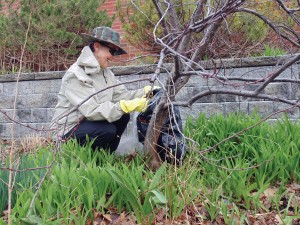
Christie Gardens residents clean up
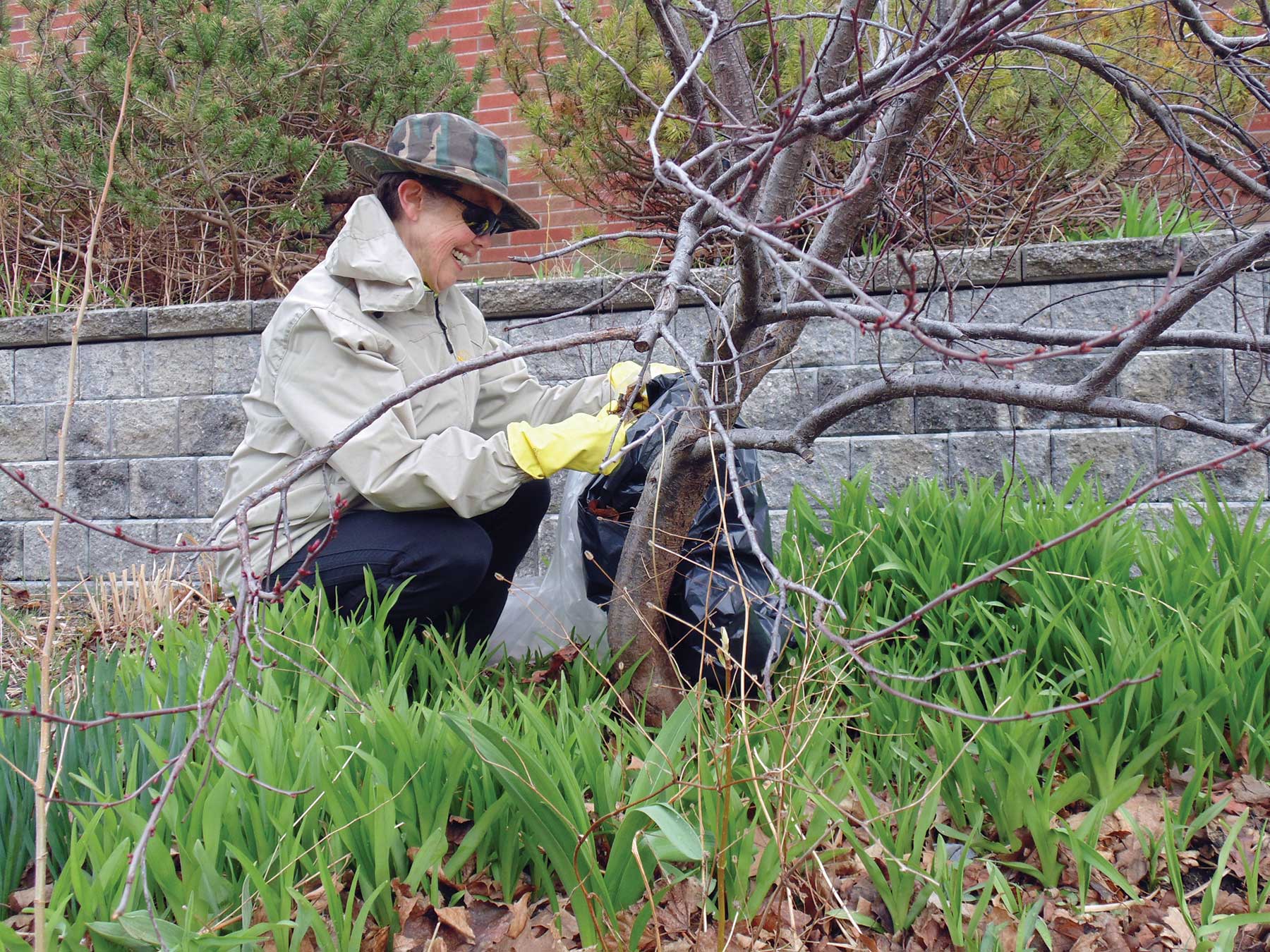
Veronica Mallon-Dupuis, a resident of Christie Gardens Retirement Residence, helps to clean up the area on Earth Day, April 22. A small group of Christie Gardens residents picked up litter not only around the large building, but also from the grounds of neighbouring Frankel Lambert Park.
Photo: Brian Burchell, Gleaner News
Tags: General
May 28th, 2015 · Comments Off on

Local residents, David Suzuki Foundation volunteers, and members of the Mississauga First Nation fill a canoe — donated by the Beattie family of Collingwood — with plants that will create a thriving garden attractive to pollinators. Photo: Neiland Brissenden, Gleaner News
Tags: General
May 28th, 2015 · Comments Off on How much is too much?
Questions of density raised at PARA AGM
By Annemarie Brissenden
Palmerston Area Residents’ Association (PARA) members hoping to gain special insight into Gregory Henriquez’s plans for the redevelopment of the corner at Bloor and Bathurst streets had to settle for a presentation on the values underpinning his work.
The architect, chosen by developer Westbank Corp., was the featured guest at PARA’s well-attended annual general meeting on May 11. He was joined by Graig Uens, a Toronto planner coordinating the City of Toronto’s response to the development, who explained the planning process as it relates to the Mirvish Village/Honest Ed’s site.
The meeting itself evolved into a bit of a dance as attendees challenged Henriquez to reveal his plans for the site and pushed Uens to set up community consultation meetings as soon as possible, while both gentlemen did a lot of arm-waving as they tried not to comment on a proposal that has not yet been submitted to City Planning for formal review.
“There is no application in for the site yet,” explained Uens. “Once the application comes in, we will begin our internal review and response process.”
In general terms, if the application comes in at the end of May, the planning department expects to have comments from the city’s agencies in July and present its preliminary report to the Toronto East York Community Council in the fall, likely in October. It would then work toward submitting a final report in late fall or early winter. It will also, as with any application of this nature, conduct community consultations, something that’s not without a unique set of challenges when it comes to this site in particular.
Westbank’s plans have generated a great deal of interest, drawing comment not just from members of neighbouring communities, but also from a broad range of stakeholders. Westbank’s March open house, for example, attracted over 500 people. In this case, the traditional model of community consultation may not work, admitted Uens, “so we may have to come up with significant and unorthodox gestures” for meeting with local residents. All avenues of communication are under consideration, he added, included open houses, pop-up tents at community fairs, on-line materials, and outreach through residents’ associations and business improvement areas.
If the questions from PARA’s AGM are any indication, local residents want to understand the planning review process, as well as what impact a development like the one Westbank presented at its open house would have on their daily lives.
“What effect would 3,000 extra people have on the 12,000 people who are already living there?” asked one resident. “How will I get to work?” “Will we never be able to park on our street again?”
“What will it mean for Bloor Street?” asked others.
“Will the difference to the people living here be huge or marginal?” asked yet another attendee at the meeting, who summed up the general tone of the questions.
Uens stressed that the city will include the answers to these questions in its final report, adding that it will also consider the proposal in conjunction with other approved developments for the area, as well as the results of the four corners study on Bloor and Bathurst streets that is set to be finalized this summer.
The question and answer period made it clear that local residents are still unsure what to make of Westbank and the Vancouver-based architect.
During his presentation, Henriquez discussed the “commodification of density” and the impact of “rapid growth over a short period of time” on Vancouver. In reviewing his previous projects, he stressed his commitment to a values-based architecture and a high level of sustainability, and his desire to find a balance between his client and the community.
“Partnerships with groups like PARA are essential if we are going to do good in the world,” said Henriquez, reassuring the crowd that he was definitely the architect for the site, and that this wasn’t part of some elaborate bait and switch, as one person suggested.
Acknowledging that Vancouver’s exceptional density “is shocking, we are doing things that are needed. The question is, how to do it.”
This seems to be the biggest challenge facing the area, whose residents are mindful of the need for additional density; the question is how to absorb it.
The conundrum is not lost on the planning office, either.
“Toronto is a growth centre,” said Uens, noting that the city attracts 50,000 new residents each year.
But for many PARA members at the AGM, the basic question remains, how much is too much, and how will we know if we have reached the limit?
Tags: Annex · News
May 28th, 2015 · Comments Off on
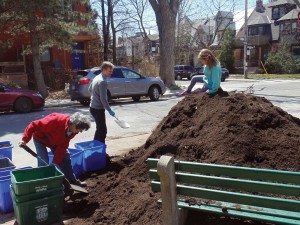
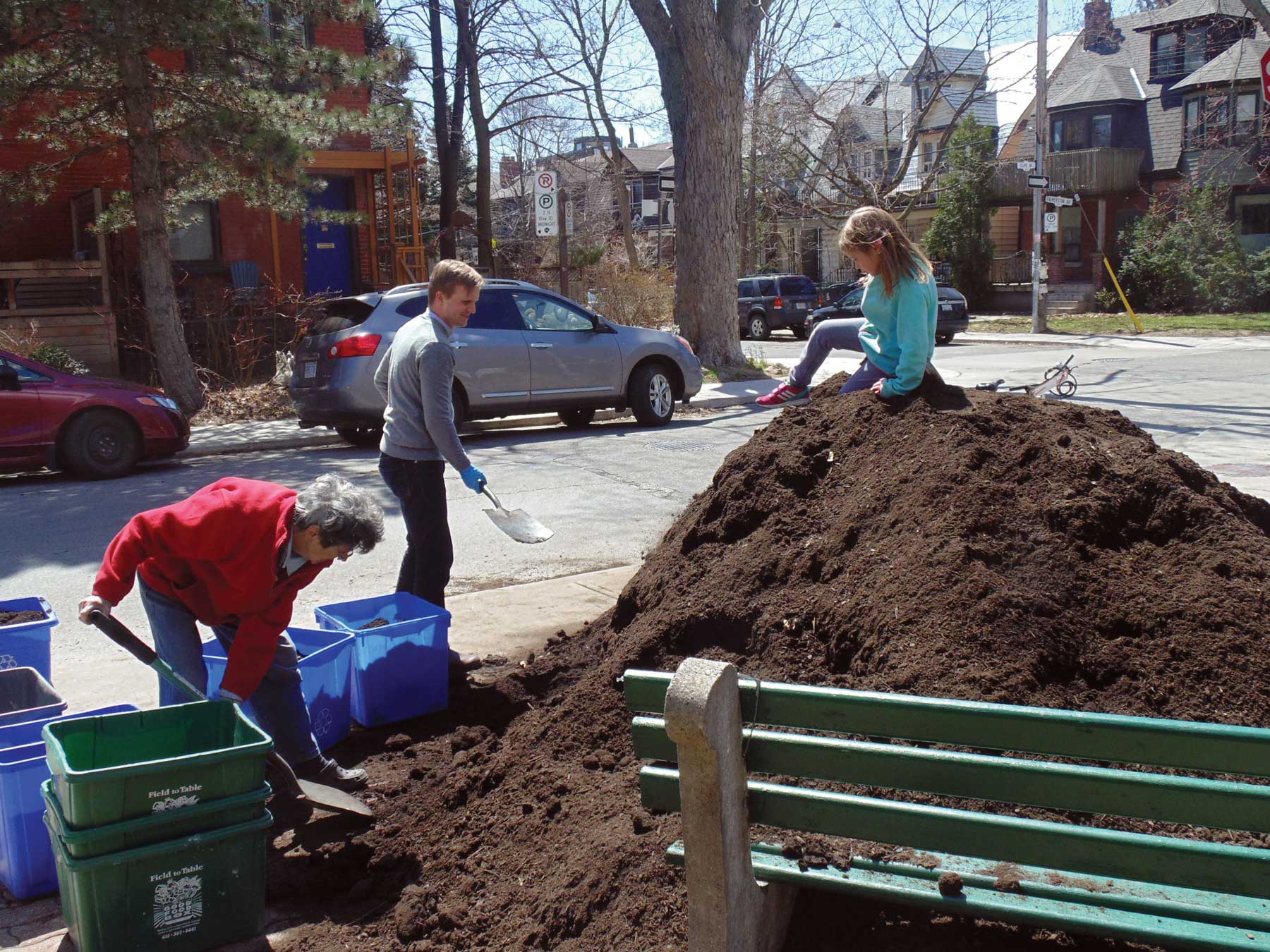
Joe Cressy (Ward 20, Trinity-Spadina) gets his hands dirty for Earth Day on April 22 by helping to fill buckets of compost that the city provides annually to local residents with gardens. Photo Brian Burchell, Gleaner News
Tags: General
May 28th, 2015 · Comments Off on The right to a healthy environment
Toronto should join the chorus
By Mike Layton
As Canadians, we celebrate our differences from coast to coast, but there is one important thing that we all share in common, our natural environment.
As spring blooms we are reminded of the beauty of the world around us. We reflect on the importance of the natural environment and how it nurtures and sustains us. The air we breathe, the water we drink, the food we eat. We all contribute to it, we all have an impact on it, and we all benefit from it.
There is an undeniable link between human health and environmental health. The City of Toronto recognized this long ago, and we are investing now for our future and for the future of our children.
We work hard to prevent smog days by reducing air pollution and have invested in infrastructure and programs to prevent pollution from entering our waterways because we know the damage it can cause. In fact, the World Health Organization estimates that environmental contamination, including polluted air and water, causes as many as 36,000 premature deaths annually in Canada.
So why isn’t our right to breathe clean air, drink clean water, and have clean soil in which to grow food protected under the law?
A hundred and ten governments around the world have recognized that their citizens have the right to a healthy environment, but not Canada.
Five provinces and territories (Quebec, Ontario, the Yukon, Northwest Territories, and Nunavut) have some form of environmental rights legislation and six cities in Canada have passed environmental rights declarations, including Yellowknife, Montreal, and Vancouver.
Still, Canada’s Charter of Rights and Freedoms does not explicitly recognize or address environmental rights, leaving us among the few countries that do not yet recognize the rights of its citizens to a healthy environment.
Many Canadians, including one of my personal heroes, David Suzuki, think that environmental rights should be protected under our Charter of Rights and Freedoms, and I agree.
That is why I put forward a motion at the May 5 meeting of city council recommending that Toronto join the chorus of cities who have passed environmental rights declarations in support of the Blue Dot campaign, an initiative of the David Suzuki Foundation and its partners.
The foundation has been working with cities across Canada to recognize the rights of their citizens to a healthy environment with the adoption of a municipal declaration of environmental rights.
My motion recognizes that all people have the right to live in a healthy environment, to breathe clean air, drink clean water, consume safe food, access nature, know about pollutants and contaminants released into the local environment, and to participate in decision-making that will affect the environment. The motion was referred to the Executive Committee for a public hearing in June.
Toronto needs to re-establish itself as a champion of environmental stewardship and the emerging low-carbon economy. We have made some progress.
Last year, I moved a motion at the Parks and Environment Committee to establish a subcommittee on climate change and recommended that Councillor Gord Perks be appointed as chair.
The Climate Change Mitigation and Adaptation Subcommittee had their first meeting on March 2, 2015. It was the best attended meeting of this term of council.
Public deputations went until midnight as residents and experts shared their ideas and priorities with city councillors.
The issues shared ranged from urban agriculture to clean air, and from transit to animal habitats. Further public hearings and round tables on these issues will be hosted by the subcommittee in the coming months.
A Toronto declaration of environmental rights would show support for our residents’ rights to clean air, clean water, and safe food, signalling Toronto’s continued leadership in building a healthy, sustainable city and drawing attention to the Canadian Charter’s unfortunate silence on environmental issues.
Mike Layton is a Toronto city councillor for Ward 19.
Tags: Annex · Liberty · News
May 28th, 2015 · Comments Off on Chiarandini’s hippies on canvas
Artist was fascinated by Yorkville and hippie culture

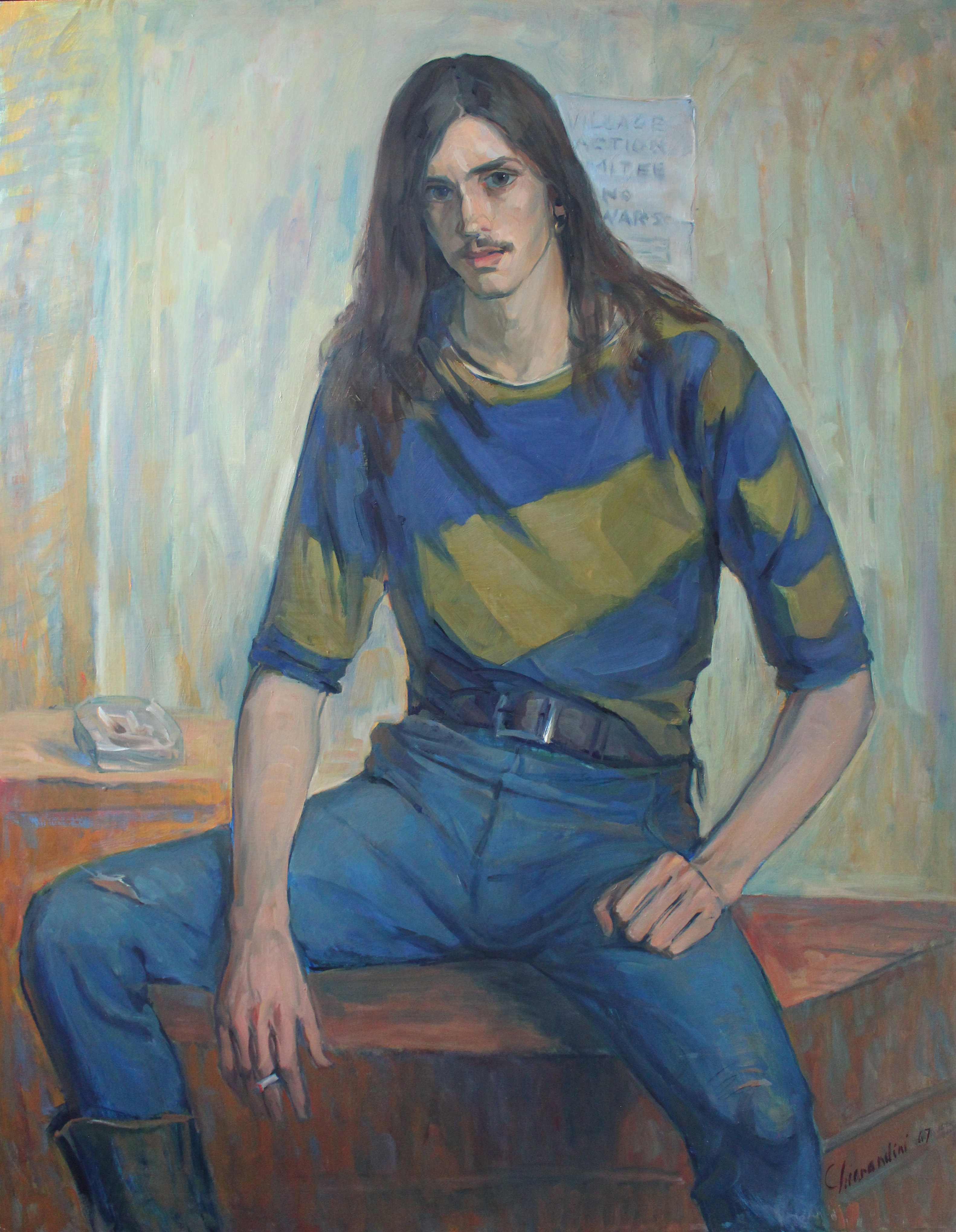
Michael Waage was from Queens, New York. He came to Toronto in the 1960s working for a circus and loved it so much he returned. He became a street worker or social worker helping Yorkville hippies. Waage moved out to Vancouver in the early 1970s and passed away in 2006 from lung cancer. Courtesy of a private collection
By Joan Tadier
It was 1967: the year of Expo in Montreal, the Summer of Love, Haight-Ashbury was in full swing. Love was in the air and flowers were in our hair. Yorkville Village was abuzz with music, hippies, Blow-Up, The Penny Farthing, The Purple Onion, the Riverboat, and much more.
Artist Albert Chiarandini rented a studio near Yonge and Bloor streets. He had arrived in Canada in 1932 at the age of 17, and enrolled at the Ontario College of Art, where he studied under the guidance of Frederic Challener, John Alfsen, and Franklin Carmichael of the Group of Seven.
The centennial anniversary of his birth is celebrated this year. Chiarandini frequented Yorkville, looking for interesting models. He was fascinated by hippies and the hippie culture, and wanted to capture their way of life on canvas. Many of them agreed to model, and he created several portraits.
Ten of these hippie portraits will be displayed together for the first time at Gallery Gevik (12 Hazelton Ave.). The paintings come from private collections, the Carrier Gallery, the Georgina Arts Centre and Gallery, and the University of Ottawa.
One is owned by the City of Toronto and hangs at City Hall. Chiarandini kept a detailed list of names of the hippies he painted. From this list, with the help of Linda R. Goldman and others, names can be linked to the paintings.
Chiarandini was a versatile artist. He painted society portraits, commentary pictures, and landscapes. In 2004, nearly 200 of his paintings were donated to the Georgina Arts Centre and Gallery in Sutton, by the art collector Bruce Smith.
This major collection was included in The Group of Seven Project, citing Chiarandini as “the unknown member of the Group of Seven”.
The exhibition Chiarandini: Yorkville Hippies will take place at Gallery Gevik, June 13 to 20. There is a musical event on Saturday, June 13, 1 to 5 p.m., starring prominent musicians from 1967 Yorkville: Keith McKie, Dede Higgins, Klaas Van Graft, Sebastian Agnello, and Stan Endersby.
On Sunday, June 14, from 1 to 5 p.m. Yorkville 1960s superband Luke and The Apostles will be playing an outdoor concert. The exhibit will include photographs, 1960s memorabilia and clothing.
—With files from Linda Goldman. Joan Tadier is Albert Chiarandini’s daughter.
Tags: Annex · Arts · People
May 28th, 2015 · Comments Off on Take advantage of used and local
Avoiding the consumer trap that awaits new parents
About five years ago, the first of my friends had a child. I was viewing the periphery of this mega-industry and didn’t really appreciate what the environmental impact of having a First World baby was until I was faced with having one of my own. The industry is more hawkish than the wedding industry — convincing every parent that unless their kids have helmets to sleep in, they might spontaneously combust (I wish I was joking about the sleeping helmets, but they actually exist).
The industry has also equated spending copious amounts of money on an infant with love — not unlike De Beer’s campaign, which equates large diamonds with true love.
What was amazing to me was the sheer volume of baby stuff we are told we need — stuff that has a life cycle of at most three years (maybe five or six if siblings are involved) and it inevitably ends up in the landfill. We are already swimming in plastic waste and now encouraged to buy more products with short life spans.
My way of decreasing my personal baby footprint was to host a “wisdom party” in lieu of a baby shower. Since five of my girlfriends have their due dates around the same time as mine, I decided to invite the neighbourhood moms and grandmoms to share their bountiful baby advice with us.
In the invitation, I also asked these moms and grandmoms to bring used baby items they no longer needed.
What I found was that those who still had such things were more than happy to pass them on. A lot of used baby stuff is still in great shape, but the moms don’t know what to do with it. Gifting used items seems awkward, so a lot of things just sit there. The societal pressure of buying things new also renders a lot of the stuff to the dump. To have a request for used baby items seemed to be a welcome change.
I also learnt that there is an Annex Parents Facebook group. I joined recently and posted my need for more baby preparation items. I was able to obtain great secondhand items at a fraction of the retail price. I also kept more plastic junk from flowing into the landfill for the time being.
I don’t believe raising a child should be this much of an environmental burden.
Yes, our lifestyles are not sustainable by definition, but we shouldn’t have to add to the craziness. I’m told my perspective might change once my baby cries and I rush out and buy whatever device might give my sanity a few precious minutes of relief.
Certainly that bridge is for crossing when I get there. In the meantime, it’s great to know I live in a fantastic neighbourhood with a parents group that shares a minimal waste philosophy.
So far I have seen postings for art classes, gently used children’s items, babysitting, etc. There is no doubt it is a good resource for new parents in the area.
Going used also has benefits beyond simply saving money and keeping things out of the landfill. When it comes to baby toys, products, and clothes, many items available in Canada are manufactured for a U.S. market where it is mandated they be doused in flame-retardant chemicals. These chemicals have been shown to be both carcinogenic and neurotoxic. In other words, you don’t want your baby exposed to this stuff. Getting used items has the benefit of some of it having been washed off over time (though no guarantees). A safe alternative is to buy baby sleepwear that is made in Europe (a solution that hardly decreases your carbon footprint).
There are no easy answers to raising a kid it seems. We can only do our best. It’s great to know there are groups out there like the Annex Parents that can help even just a little bit.
Terri Chu is an engineer committed to practical environmentalism. This column is dedicated to helping the community reduce energy use, and help distinguish environmental truths from myths. Send questions, comments, and ideas for future columns to Terri at terri.chu@whyshouldicare.ca.
Tags: Annex · Liberty · News · Editorial
May 28th, 2015 · Comments Off on Cinnamon, the magic ingredient
How to spice up the kitchen this spring
Nothing seemed more delicious to us as kids when we got in the door right after school on a cold day than hot buttered raisin bread toast lavishly sprinkled with cinnamon and white sugar with a cup of hot chocolate.
In Mexico and Guatemala, Mayans make drinks from barred chocolate specially prepared with granulated sugar and densely peppered with cinnamon. The texture is ready to mix easily with hot milk or coffee.
When I lived in Costa Rica, an agrarian paradise, I researched and wrote articles on locally grown products and I wrote about cinnamon.
I was surprised to find out that commercially grown cinnamon or “canella” is not cinnamon at all but a hybrid called cassia.
Ground cinnamon is more difficult to distinguish from ground cassia.
True cinnamon is tan in colour with a warm, sweet flavour, whereas ground cassia is a reddish brown, usually coarser in texture, with a more bitter, stronger flavour and a more aromatic bouquet. Cassia comes in peeled and unpeeled quills, as well as ground.
For health benefits, you must use true cinnamon. If you’re ready to start taking cinnamon as a natural remedy, check with a naturopath for dosages and origins.
True cinnamon is available in Toronto at various spice specialty stores. House of Spice in Kensington Market is an excellent location.
The origin countries of cinnamon are Sri Lanka, India, Vietnam, and Indonesia.
Ingesting cinnamon will lower cholesterol, aid in blood sugar regulation, offer yeast infection help, provide cancer prevention, and give anti-clotting and arthritis relief. It is antibacterial when added to foods. Smelling cinnamon boosts cognitive brain function. It also fights E. coli in unpasteurized juices, and it is high in the following nutrients: manganese, fibre, iron, and calcium.
The Cinnabon chain has a pretty good gimmick. They pipe their smell out into the areas outside the store doors to get you in. Their buns are very rich and dense. A bit too much sometimes for my lactose intolerance issues.
I am leaning toward the West Indian bakery these days at the Bathurst subway station to get a roll on the run. They are only $2.50 and they are huge. The bread dough is great and I can slice, toast, or freeze them.
When we went to sleepaway camp as kids, there were weekly menus.
Fridays at lunch we always had homemade “Chelsea buns”. They were so fresh and yummy — I can still smell that mess hall aroma — and so will you when you try this recipe. You can make as much of the sticky stuff as you want and you can add or subtract the cinnamon you add to taste.
Cinnamon buns
Makes 10 large ones. This is not that hard, just requires a bit of organizing.
- Easiest homemade white bread
- 1 package or 2 teaspoons dried yeast — the longest expiry date possible
- 1/2 cup lukewarm water
Sprinkle yeast over water. Let stand 8 to 10 minutes. Stir to dissolve then add 1 tablespoon vegetable oil and 3/4 cup warm milk or cream to yeast mixture. Stir well.
- 3 cups flour
- 1 1/2 tablespoons white sugar
- 1/2 teaspoon salt
Mix these next 3 dry ingredients well. Little by little add everything together. Knead on lightly dusted board until a smooth ball forms. Round up in a large greased bowl, cover with foil, let rise till double. I use a glass bowl (about 1 1/2 hours). Punch down for a second rising. It gives a finer texture.
Sticky bit
- 1 cup brown sugar, light or dark
- 1/2 cup cold unsalted butter
- 4 teaspoons finely ground cinnamon (or more if you prefer)
With a hand-held pastry cutter or food processor cut butter into sugar and cinnamon only until mealy. Place 1/3 of mixture into a greased 9 by 12 baking pan.
Sprinkle 2 tablespoons of water over and blend. Set remaining 2/3 aside. Roll white bread dough out on lightly floured board — not too thin — rectangular.
Sprinkle remaining cinnamon mixture over. You can scatter on some moist raisins and bits of peeled chopped apple, roll up jelly roll style.
Cut into about 10 pieces and place cut side up in pan leaving ample space to rise. Cover with a damp towel and let rise again about 1/2 hour. Bake at 400 degrees for around 20 minutes. Invert and cool.
Frosting
Optional frosting. When completely cool using a butter knife spread on the top.
Blend with a wooden spoon:
- 2 cups confectioners sugar
- 1 tsp vanilla
- Just enough milk to spread easily over pan of rolls
Seaton Village resident Susan Oppenheim is Java Mama, an independent coffee roaster, baker, avid traveller, and activist. She is the mother of three adult children and the grandmother of three. Susan can be reached by email:?javamama. susan@gmail.com.
Tags: Annex · Food

![“One thousand people could just go [to an unprotected rail crossing] and refuse to move,” proposed Peter von Bitter at an April town hall on rail safety. He was one of many residents at the meeting frustrated with the federal government’s lack of progress on rail safety. Photo: Brian Burchell, Gleaner News](http://gleanernews.ca/wp-content/uploads/2015/05/Page6aWeb.jpg)