August 28th, 2015 · Comments Off on
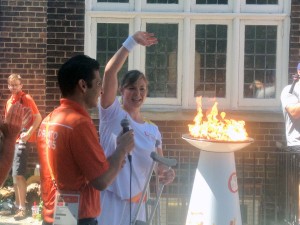
Stephanie Dixon carried the Parapan Am flame on its final journey on Aug. 7 and lit the community cauldron at the Native Canadian Centre of Toronto (16 Spadina Rd.). Dixon is a Paralympic and Parapan Am multi-medallist (swimming) and assistant chef de mission for the Toronto 2015 Parapan Am Games.
BRIAN BURCHELL/GLEANER NEWS
Tags: General
August 28th, 2015 · Comments Off on Mirvish Village sidewalk sale returns Sept. 19
The sidewalk sale event will showcase Mirvish Village merchants and restaurants once again this season on Sept. 19 from 11 a.m. to 4 p.m. Vintage, artisanal, and new merchandise will be found at the sidewalk sale with great deals available. Local restaurants will be offering delicious bites, together with the Re/Max booth, which is giving away free hot dogs. Vivita Spa booth will be handing out cosmetic freebies as well, such as unscented facial cleansers and body and face lotions. Visitors and customers will be able to sample and experience the interesting businesses of Mirvish Village. The performance lineup is packed with an assorted variety of music including funk and blues from Red Hot Trio, throwback melodies from the 1940s, as well as trendy music from saxophonist Love Alley, and fusion from singer-songwriter Mirian Katrib.
—Axile Gerona
Tags: General
August 28th, 2015 · Comments Off on Tory tax credit is a teardown
It’s as though the Conservative Party of Canada is making it up as it goes along. There is very little meat in their policy platform outside of the rhetoric of getting tough on crime, keeping a steady hand on the economy’s tiller, and protecting us from terrorists. The platform plank, the Home Renovation Tax Credit, is something substantial, but it is a bit too tough to chew. This does not represent sound fiscal policy, will result in negligible public good, and is a mere re-election ruse. We see a number of problems with this proposal.
Mr. Harper is offering a permanent tax break for homeowners. Do any work on renovations valued from $1,000 to $5,000 and you get to take 15 per cent of that value off your federal tax obligation. It’s estimated to cost the federal government $1.5 billion a year.
First of all, it’s regressive. Only homeowners are eligible, not renters. It gives money to people who would probably spend it anyhow. It’s consistent with giving money to the Conservatives’ base, homeowners in the suburbs. Arguably it gives their traditional voter base another handout and a reason not to wander at the ballot box. It’s just cementing their constituency, so it’s redeemable at best as a sound re-election strategy.
In the mealy-mouthed announcement, Mr. Harper offered that this tax credit would not take effect, until, as he put it vaguely, “mid-mandate”. And then only if the federal budget is balanced. We should remember that this government has delivered a string of deficit budgets that go back eight years. So, don’t hold your breath that the balanced budget condition will come to fruition. Given that the plan is for delayed gratification, “Re-elect me now and I will give you this (maybe) later”, it could arguably have the opposite effect. “Let’s wait, honey, to reno the kitchen until the tax incentive kicks in.”
Why is Harper not immediately implementing the tax credit? Perhaps that would signal that he acknowledges that we are now in a recession, which, of course, he denies. He also asserts that we are in a balanced budget condition right now. However, the prime minister is increasingly alone in this view. In a July 23 announcement, the Parliamentary Budget Office (PBO) reported, “Using the Bank of Canada’s July projection of real GDP growth, PBO estimates that an updated Budget 2015 outlook would show deficits of $1.5 billion in 2015-16 and $0.1 billion in 2016-17.” So where is this gift money supposed to come from?
Does this sector really need such a boost? Do we really need to be pumping more money into the over-inflated housing sector? According to a July 15 report of the Altus Group, a real estate consultancy, growth in the renovation sector already outpaces the overall economy. In 2015, Canadians spent $68 billion on residential renovations and just $48 billion on new home building. Renovations account for one in five dollars borrowed on home equity lines of credit. Only 25 per cent of the renovations we do are for necessary repair work.
The only plus side is that this measure will help bring the black market into daylight. Homeowners will be demanding receipts in order to apply for the tax credit, and the federal government will get access to information about who is supplying renovation services. According to an Aug. 4 release by the Canadian Home Builders Association’s CEO Kevin Lee, “Tax credits that require homeowners to get receipts also help to protect them from ‘cash’ contractors who leave a trail of bad work and broken promises.”
If this tax credit must go to those who are renovating their houses why not make this more positive? Like home energy reduction (time to replace that 25-year-old refrigerator perhaps?), alternative energy solutions, green building materials, anything at all progressive would contribute more to the greater good.
This plan just blows more smoke into the over-inflated housing bubble, encourages more unhealthy home equity borrowing, and is unabashedly another way for the Conservatives to buy your vote with your own money.
Tags: Annex · Liberty · Editorial
August 28th, 2015 · Comments Off on Bloor “foremost a public space”
In calling for bike lanes on Bloor Street, the Gleaner’s editorial (“It’s really a village, not a freeway”, July 2015) makes an obvious, yet routinely overlooked, point about how transportation planners still rank the movement of (single-occupant) cars far above neighbourhood values.
Bloor Street may be officially a highway, or a “major arterial” under Toronto’s Road Classification System, but in the everyday life of the Annex community it’s a road along which residents stroll to get a coffee, go for dinner, or visit the gym; across which students walk on their way to school; and on which many residents cycle to get to work or to run errands.
Bloor Street is foremost a public space, so how that space is shared is the community’s business, not merely that of a traffic planner whose priority is moving motor vehicles from a distant Point A to a distant Point B.
Indeed, if the street was shared according to shoppers’ mode of transport to get to local businesses then 90 per cent of the streetscape would be dedicated to pedestrians, transit users, and cyclists.
Instead, the greatest part of the public streetscape is today turned over to cars and car parking.
We can do better. A pilot bike lane on Bloor Street beginning in the spring of 2016 is a good start.
Thanks to the Gleaner for standing up for the community.
—Albert Koehl, Vice Chair, Annex Residents’ Association
Tags: Annex · News · Editorial
August 28th, 2015 · Comments Off on Bike parking key to lane success
Thank you for your thoughtful editorial in the July 2015 edition. I think you articulated very well the many reasons for replacing one lane of car traffic with bike lanes on Bloor Street.
You are right to note that if next summer’s pilot project is to succeed, it will be crucial that sufficient parking for cyclists be in place.
When bike lanes on Harbord were re-installed a few years ago, our association and the Harbord Street BIA identified the 50-foot no-parking zones on the residential streets that are adjacent to Harbord as ideal locations for bike racks.
It is my understanding that the Ontario Highway Traffic Act forbids the parking of motorized vehicles within the first 50 feet of an intersection. The presumed intent is that everyone has an unobstructed view as they approach that intersection. If bike racks were placed on side streets adjacent to Bloor Street, this would only partially obstruct anyone’s view and would provide another reason for all vehicle drivers to slow down. Just recently the Bloor-Borden Farmers’ Market coordinators persuaded the city to install a large bike rack on Borden Street, immediately south of Bloor Street, in a no-parking zone. This is a precedent that should open the door to many similar installations on other streets.
If and when the city installs bike racks on side streets immediately north and south of Bloor Street, my own view is that this would also be a good time to remove bike parking rings from already crowded sidewalks. This will discourage cyclists (including myself) from riding on sidewalks to reach the nearest bike ring, and thus improve pedestrian safety. Living in dense downtown neighbourhoods as we do, anything that removes conflict between different users of public spaces is something that should be considered.
As your editorial notes, our association has been supportive of bike lanes on Bloor?Street for a few years. We look forward to next summer’s pilot project.
—Tim Grant,
Chair, Harbord Village Residents’ Association
Tags: Annex · News · Editorial
August 28th, 2015 · Comments Off on What kind of country do we want?
Do voters want another four years of Stephen Harper?
By Jennifer Hollett
This year is a critical year for Canada. With an early federal election call, we are now in an 11-week campaign, one of the longest (and most expensive to taxpayers) in our country’s history.
There are 30 new federal ridings across the country, including University-Rosedale here in the Annex. It is a new riding, with new possibilities. The ballot box question on October 19 is centred around change; do voters want another four years of Stephen Harper or a change in our country’s leadership? While many voters are clear they’re voting against Harper, the question that begs our attention is what are we voting for.
Toronto is Canada’s largest and most important city. Repeating this outside of the GTA is usually met with eye rolls and comedic jabs, but our city is home to 90,000 businesses and produces over 15 per cent of Canada’s GDP. Each year, 80,000 new immigrants come to Toronto in search of opportunity.
Yet Toronto struggles to keep up with this growth. While not a particularly sexy topic, infrastructure is one of the most vital issues at play in our city this federal election. At the Federation of Canadian Municipalities meeting in Edmonton this year, there was a lot of discussion around the need for a forward-thinking federal partner with a long-term commitment to infrastructure. In last year’s municipal election the top issue was public transit. Our buses make sardine cans look spacious, street cars are in constant disrepair, and subway routes haven’t kept up with our city’s population. This has led to congestion, gridlock, and delays becoming a daily norm. The average commute time in Toronto is now over 80 minutes per day, which is longer than New York, Los Angeles, and London.
With the weak Canadian dollar and several economists now pointing to a recession, many Torontonians are struggling to find work. The youth unemployment rate in Toronto is a whopping 17 per cent (compared to the national average of 6.8 per cent). Despite having one or two degrees, when youth do find work, the jobs are often part-time, contract, and precarious. Since 2008, two-thirds of all jobs created in Ontario have been part-time, temporary, or in self-employment. Canada needs to diversify its economy so that it can absorb the shock of falling commodity prices and welcome investment to kick-start new opportunities and create full-time work. We should compete as an innovative, energy-efficient, high tech economy that is a magnet for investment, globally and domestically.
This December in Paris, more than 190 countries will convene at the COP 21: UN climate change conference to explore a new international agreement on climate change. These talks are focused on reducing global greenhouse gas emissions in order to tackle the growing threat of climate change. Canada has won the dubious distinction of the international Fossil award five years in a row. The Climate Action Network hands out this infamous, satirical award to a country doing the most damage to climate talks in a given year. Who our prime minister is will likely determine if we’re on our way to our sixth award.
Locally, in our own community, we remain at risk of another Lac-Mégantic rail disaster. The Canadian Pacific rail line, which runs along Dupont Street, transports dangerous goods through our neighbourhoods every day. Local activists have been advocating for safe, transparent, and regulated rail to prevent such rail accidents by calling on much needed government regulation, enforcement, and transparency for Canadian rail safety.
The two questions we must ask ourselves this election are what kind of Canada do we want to live in? And what kind of Toronto do we want to live in? That’s ultimately what the federal election is about. It’s time to commit to building a strong, healthy, livable city for everyone.
Jennifer Hollett is the federal New Democractic Party candidate for University-Rosedale.
Tags: Annex · News · People
August 28th, 2015 · 1 Comment
Empower families, promote small business, and provide better transit
By Karim Jivraj
I am thrilled to be running to be your next member of Parliament. Over the past three months, our team of young volunteers and I have knocked on over 68,000 doors and I’ve personally met thousands of neighbours and local residents.
Growing up in Toronto
My name is Karim. I was born in Hamilton, and grew up in north Toronto. My parents came to Canada in 1972 from East Africa following their expulsion by the Ugandan strongman Idi Amin. Fleeing a regime that persecuted ethnic minorities, my parents saw in Canada a safe haven for tolerance where they could work hard and start a family. My family has since run a north Toronto menswear store, where my two younger brothers and I used to help out after school and during our summers.
From law to politics
After graduating from the Toronto French School, I moved to Paris to study international law at the Sorbonne. I paid my way through university by teaching English. Although I love my career in international law and arbitration, where I have fought for wronged investors against foreign governments, I want to serve my community and my country.
Promoting small business
I’ve spoken with the owners of convenience stores, restaurants, juice bars, barbershops, and tattoo parlours. Most agree that things have gotten better for their small businesses: less red tape and lower taxes have allowed them to grow their businesses and hire new employees. My upbringing shaped my belief that small business owners are the bedrock of our communities, and I want to make it easier for these courageous people to work hard and succeed.
I want Toronto to be the start-up capital of the world. I want to make it easier for young entrepreneurs and innovators to make their ideas reach the marketplace. The new Canada-EU free trade agreement will enable our local small businesses and entrepreneurs to sell their goods and services to consumers in France, Italy, and 26 other EU countries.
Financially sustainable transit
I started taking the Bayview 11 bus when I was 12, and I’ve been using public transit my entire life. I’ve also lived in or visited cities with truly world-class urban transit, and I know that Toronto can do better. I was immensely proud to attend the announcement that the federal government is providing $2.6 billion to Mayor John Tory’s innovative SmartTrack plan. I’m an urban conservative, and good urban transit means more time to work and to spend with our friends and loved ones.
Helping families raise kids
Meeting hundreds of people every single day has made me realize the true diversity of local residents and families. No two families are alike. The Universal Child Care Benefit has been a huge hit, and gives money to every single family with kids under 18. Some use it for a family camping trip, some for swimming lessons or pottery camp, and many for university tuition. I believe in solutions that empower families to make choices that correspond to their own lifestyles and priorities.
I need your help
For the first time in generations, we have federal spending under control. We’ve avoided the temptation to create new expensive federal programs and we’ve stuck with the basics: keep taxes and government spending low. Let’s focus on making it easier to start a business and a family in University-Rosedale. Let’s make it easier to buy a first home.
It’s no secret – I am the underdog in this race – but with your help we can send an MP to Ottawa who will fight for what matters to us.
Karim Jivraj is the federal Conservative Party of Canada candidate for University-Rosedale.
Tags: Annex · News
August 28th, 2015 · Comments Off on Park marks
This is the second instalment of Grading our Greenspace, The Annex Gleaner’s annual parks review. In this popular feature, we visit local parks and rate them on factors like amenities, cleanliness, and ambience.
To revisit part one, please see our website, www.gleanernews.ca.
Let us know what you think of our assessment by dropping us a line at gleanereditor@ gmail.com.
All reviews and photographs are by Justine Ricketts.
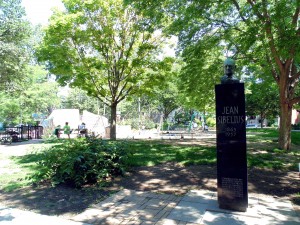
The grounds at Jean Sibelius Square are mostly shaded thanks to the tall lush trees overhead.
Joseph Burr Tyrrell Park
Brunswick Avenue, north of Bloor Street
Time: 12:45 p.m.
Grade: B (last year B-)
Reason to go: It is one of the bigger parks in this year’s review and is a safe play area for children due to its fencing at both entrances. It has a large paved area with lots of mature trees and lush greenery that provide shade in the hot sun. Sadly, the park only has one bench and so does not provide sufficient seating. There is a nicely sized playground with lots of sand, two slides, a swing set, and a climbing wall, but the playground equipment seems sparse and outdated. There is also a grassy area to the side of the playground where people can lie on the grass, and which makes for a great picnic spot.
Overheard: From a person picnicking in the grassy area of the park, “I missed your call? That’s weird.”
Fact: The park is named after Canadian geologist and cartographer Joseph Tyrrell. He discovered Albertosaurus dinosaur bones in Alberta near Drumheller in 1844. The town of Drumheller is often referred to as Dinosaur Valley because of the high concentration of fossils located in that area.
Sally Bird Park
194 Brunswick Ave.
Time: 12:30 p.m.
Grade: B (two years ago B+)
Reason to go: This quaint park is nestled between the homes on Brunswick Avenue and is largely shaded from the sun because of the tall maple trees overhead. It is the perfect place to take a break and cool off in the hot summer months. The lush greenery invites birds and squirrels to roam the area. It is also a scenic route through busy streets as it has a colourful mural on the wall of the park. There is even public exercise equipment and lots of seating.
Overheard: Squirrels scavenging for food.
Fact: The renovation of the former playground to an outdoor gym is part of the Recreational Infrastructure Canada Program, jointly funded by all three levels of government.
Margaret Fairley Park
100 Brunswick Ave.
Time: 12:10 p.m.
Grade: A (last year C)
Reason to go: It is situated in a well-maintained neighbourhood with a convenience store right across the street to quench your thirst and fill your stomach. The park is well-used and has a great atmosphere with log and stone slab benches, as well as a wading pool. There is ample seating provided by benches and four picnic tables located at the south end of the park, right under the trees. It is completely fenced and has lots of playground equipment including swings, slides, a climbing rope ladder, and a jungle gym. The play area also has various toys including plastic houses, building blocks, toy cars, and even shovels and buckets for the sandbox. The park has improved greatly maintenance-wise since last year’s review, which complained of cigarette butts and beer cans that littered the benches and ground.
Overheard: “Don’t you dare push me in the water!”
Fact: The park was named after Margaret Fairley, a Canadian writer, Oxford graduate, educator, and political activist.
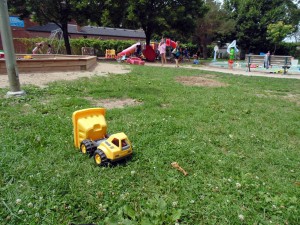
Healey Willan Park is littered with toys from trucks to tricycles, so parents don’t need to bring their own.
Healey Willan Park
504 Euclid Ave.
Time: 1:10 p.m.
Grade: A (last year A)
Reason to go: The park is perfect for children as it is completely fenced and has ample seating. The brightly painted picnic tables are shaded under the trees while various benches surround the wading pool near the north end. There is a lush grassy area perched on a small hill for the best picnicking spot which also provides an excellent look-out for parents watching over their kids. The playground features various slides, swings, a basketball net, and a jungle gym.
Overheard: “So are we going to watch Minions or what?”
Fact: The park is named after long-lived Anglo-Canadian organist and composer Healey Willan. He is best known for his liturgical music, but he also composed more than 800 works including operas, symphonies, chamber music, and a concerto.
Hillcrest Park
950 Davenport Rd.
Time: 11:00 a.m.
Grade: A+ (last year A+)
Reason to go: This is one of the best parks seen in this year’s review. It is located just off Davenport Road and is an all-rounder that features a large wading pool, a lush community garden, a well-maintained tennis court, basketball court, baseball field, and a huge open space big enough for field games. There is even a public washroom that was surprisingly clean (rare for a public park). Ample seating is provided by benches scattered around the area and picnic tables under the trees, and the play area is equipped with all playground necessities including slides, swings, and a jungle gym. The park also features an enclosed off-leash dog park with a doggie fountain and plastic bags available. Sadly the park is unforgiving to anyone on wheels because it is located on top of a steep hill.
Overheard: From a person playing on the tennis court: “Even though my game is off today, you still can’t beat me! Sucks for you.”
Fact: Hillcrest Park’s wading pool is open Monday to Saturday from 12 a.m. to 7 p.m., and on Sundays from 11:30 a.m to 5 p.m.
Sgt. Ryan Russell Parkette
250 Avenue Rd.
Time: 10:50 a.m.
Grade: C (last year C)
Reason to go: Located near a major intersection, the park is a far cry from being peaceful. However, the grass is lush and the trees provide well-needed shade during the hot summer months. There is only one bench, which does not provide adequate seating. There are no fenced areas and the park is near a busy street and because of this it is not ideal for dogs.
Overheard: Cicadas after 17 years underground.
Fact: The park is named in honour of Sgt. Ryan Russell who died in the line of duty only a few blocks away after being hit by a stolen snowplow.
Bickford Park
468 Grace St.
Time: 12:45 p.m.
Grade: A (two years ago A)
Reason to go: It is a very spacious park with a huge soccer field and baseball field open to the public. The grass is well-maintained, tall trees line the sides of the park, and ample seating is provided by the picnic tables in the area. It is an off-leash zone, so is a great place to for dogs to play and romp around. There are even plastic bags available.
Overheard: Said by dog owner, “Come here boy! Come here!”
Fact: Bickford Park is right on the intersection of Harbord and Grace streets. It is less than five minutes away from Koreatown.

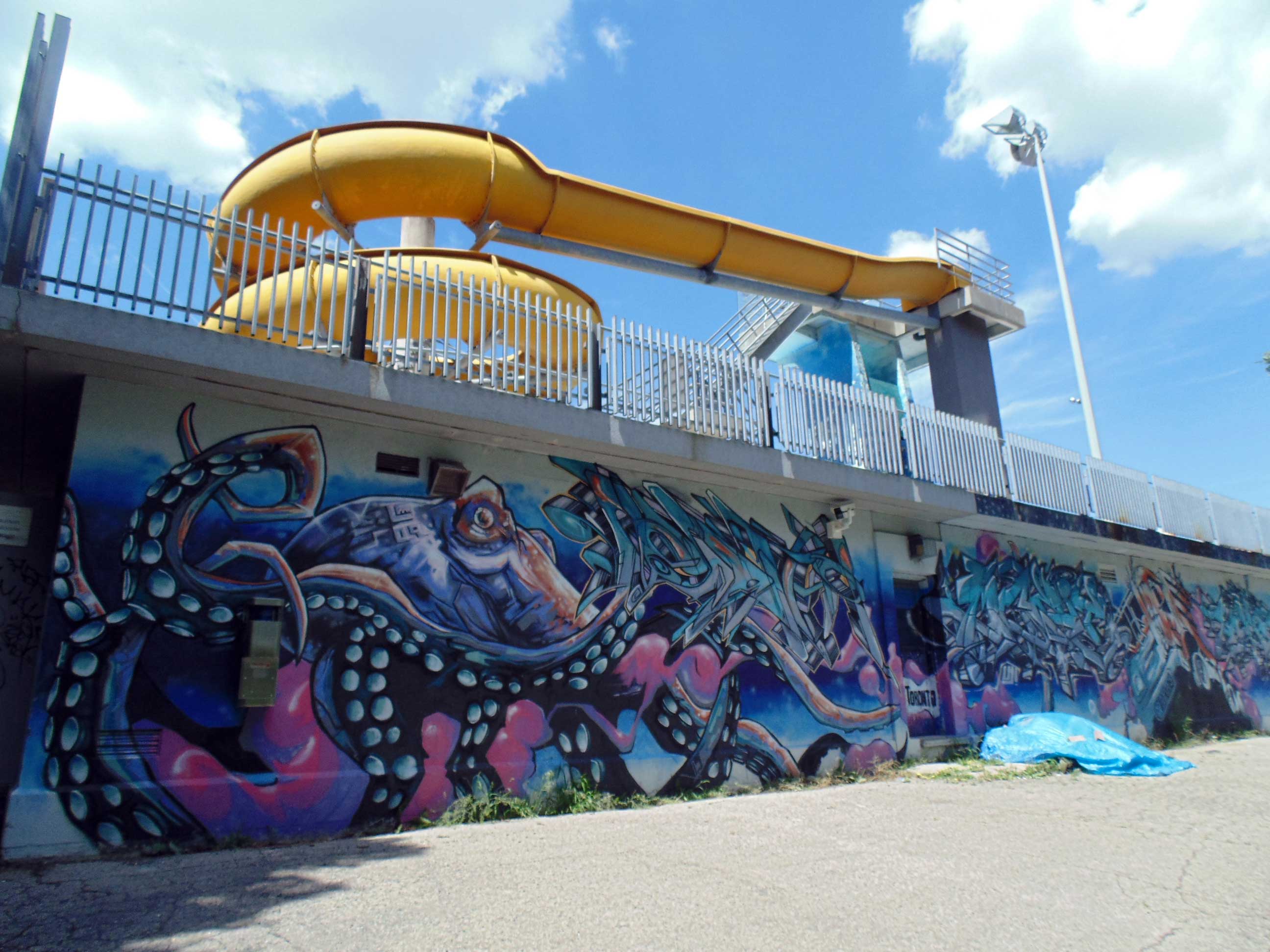
The graffiti behind the outdoor Alex Duff Memorial Pool at Christie Pits Park provides some colour to an otherwise bleak wall.
Christie Pits Park
750 Bloor St. W.
Time: 12:30 p.m.
Grade: A+ (two years ago A)
Reason to go: This 8.9-hectare park caters to everyone’s needs. It is located right beside Koreatown and is a large area with soccer fields, basketball courts, volleyball courts, and baseball fields that the Toronto Maple Leafs Baseball Club calls home. At the northeast corner of the park there is an artificial ice skating rink as well as the outdoor Alex Duff Memorial Pool. The park features a beautifully designed wading pool that is usually very busy in the summer months, and there is also an unofficial sunbathing area on its grassy hills. Right beside the wading pool is Christie Pits playground. The area is packed with playground equipment from swirly slides to brightly coloured spring riders.
Overheard: “Look Mommy! I’m rolling down the hill!”
Fact: Set to get a facelift (see www.gleanernews.ca) that will improve safety and add community enhancements, the park is named after the Christie Sand Pits, which used to be located where the park is now.
Bloor-Bedford Parkette
248 Bloor St. W.
Time: 11:20 a.m.
Grade: B+ (two years ago C)
Reason to go: It is a nice park with a great atmosphere. Most of the benches are arranged in a semi-circle facing a fenced parking lot while the rest of the seating faces busy Bloor Street. There are shaded areas to hide away from the hot sun and, while the park is just off a major street, it is surprisingly clean.
Overheard: “Do you want to check if we can still buy tickets for PanAm?”
Fact: St. George subway station is situated right behind the park, which marks a great spot to rest and brace oneself for the rush of the subway ride below.
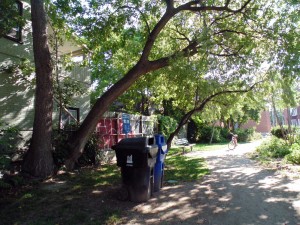
Euclid Parkette is a small green space behind Bloor Street West in Koreatown.
Euclid Parkette
711 Euclid Ave.
Time: 9:50 a.m.
Grade: D- (last year C)
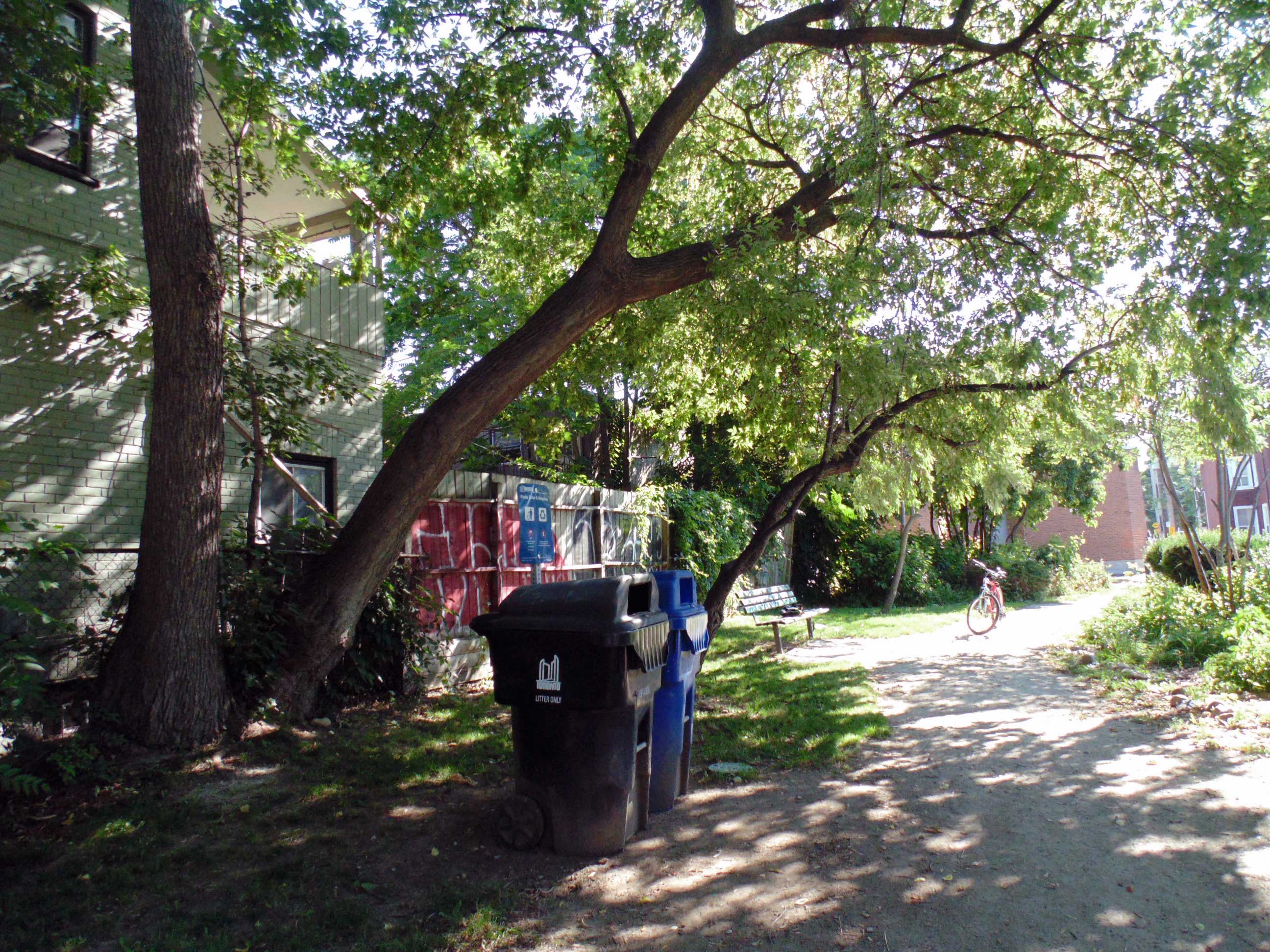
Reason to go: This park doesn’t have much going for it. Located right behind a KFC, it often smells like fried chicken. The area is quite small, which wouldn’t be a bad thing if not for the poor maintenance. The dirt path is littered with wrappers, drink cans, and cigarette butts. There are flies everywhere, as well as a putrid smell coming from the garbage receptacle nearby. The low trees in the park do a good job of blocking out harsh UV rays, and it seems be a good hangout spot for smokers as many were seen on the day of this review.
Overheard: “I love Korean food, it’s just that some things are too spicy.”
Jean Sibelius Square
50 Kendal Ave.
Time: 11:45 a.m.
Grade: A (two years ago A)
Reason to go: The park provides plenty of shade and lots of room for kids to play. There are multiple picnic tables and the grass, which is free of garbage, is a perfect picnic location. The public washroom is clean. The Sibelius Square play zone offers a variety of playground equipment including swings, a rock climbing wall, and a modern jungle gym. It also has a separate area with smaller equipment for younger children.
Overheard: “Si vous voulez manger, allez vous asseoir à la table” (If you want to eat, go sit at the table).
Fact: The park is named after Jean Sibelius, a Finnish violinist and composer of the late-Romantic and early-modern periods.
Ed and Anne Mirvish Parkette
Bathurst and Bloor streets, in front of Bathurst Station
Time: 12:05 p.m.
Grade: C (two years ago C+)
Reason to go: This is a small patch of greenspace in a concrete oriented area. It is clean and well-maintained but, unfortunately, it is in an awkward location. Right in front of Bathurst station and off Bathurst Street, the parkette is always noisy with the sounds of rushing commuters, cars, and streetcars driving by. The area is not fenced off from the street, which may cause trouble for parents with young children. There is also insufficient seating as there is only one bench.
Overheard: “Can I sit here?”
Fact: The park is named in memory of Ed and Anne Mirvish and their contribution to Canadian business and theatre.
Tags: Annex · News
August 28th, 2015 · Comments Off on Who is the greenest of them all?
A platform comparison with an environmental yardstick
The federal riding lines have been redrawn for this election and we are no longer in the old riding of Trinity-Spadina. Instead, the Annex is now situated in the riding of University-Rosedale and we have several strong contenders to be our member of parliament.
Current MP for Toronto Centre, Chrystia Freeland, is running here for the Liberals. She has strong foreign affairs and economic credentials. Jennifer Hollett for the NDP has strong journalism credentials and is a noted advocate for girls and human rights. Nick Wright, running for the Greens, is an environmental lawyer while Karim Jivraj, running for the CPC, has a background in corporate law.
Since the power and influence of individual MPs has been muted over the years, one must look to the national party to get a sense of what might or might not be accomplished on the environmental front (or on any front for that matter). When it comes to government action on the environment, I’m used to being disappointed. Since Stephane Dion got knifed in the front (and the back) for daring to put forth a bold environmental policy, it’s been a political rail. The environment is all but a dead issue federally for all parties with the exception of the Green Party, which has little hope of forming a government. I still want a sense of what the parties might do environmentally. I took an early look at the various party websites (full platforms aren’t out yet) to see who has the greenest.
The Liberals have some loose promises on carbon tax, freshwater protection, and clean tech investment. At this stage, details are scant. There is a promise to work with the provinces to establish a carbon reduction framework. With Canada’s biggest polluting province having recently elected a progressive government, a Canada-wide agenda on carbon reduction might actually have legs this time around. Justin Trudeau has already voiced his support for the Keystone pipeline. While I don’t like the idea in general, it’s better than having oil transported by rail.
The NDP says it will kick-start renewable energy production and “make polluters pay”, but there are not enough details to make much of an analysis, and I would like to see a plan to make consumers pay as well. Without a plan to hit consumers in the wallet, there isn’t enough of an incentive to actually reduce consumption. While it is sympathetic to financial constraints, making polluting equally cheap for the rich and poor will likely not produce the results we are looking for. There are other ways to help out financially constrained families while making carbon intensive purchases pricey.
By virtue of hardly registering with voters, the Greens are forced to create a more comprehensive platform. There is a promise to price carbon through a fee and dividend system (details of which elude me) that promises encouragement of private sector investment in clean tech. Perhaps most exciting to me is the promise to establish a green venture capital fund on the federal level. Canada has been accused of being squeamish on high risk investing, and having a federally supported clean tech fund is something I would love to see happen. Having strong management of the fund, though, is harder than we might expect. There is a promise to ensure no new coal-fired electricity generating stations (given Ontario is already off coal, this might not mean much) and the acceleration of green infrastructure projects. Perhaps the biggest promise that might actually have an impact is the promise to invest in rail infrastructure, as rail is one of the most efficient ways to transport both goods and people. A promise to invest in city infrastructure that includes pedestrians, cycling, and car sharing will do a lot to reduce emissions in urban areas.
The CPC website has no information of any kind on environmental policy for me to analyze whatsoever (or any other kind of policy). In fact, its website features a cartoonish knockoff of the Netflix logo emblazoned with “Tax Hike”. This childish mockery of democracy deserves little mention, so I will stop there. I don’t care for my political leaders to run on “the other guys suck more than I do”.
In terms of policy, I am most impressed with the Green Party’s environmental platform. However, there is more than just the environment to consider when electing our next government. The Greens are also unlikely to form a government and a divided vote does risk re-electing the party most committed to abolishing any sort of environmental protection should we run out of resources.
Neither the NDP nor the Liberals have environmental policies that are well-defined enough to really get excited about yet, but I really do hope the Greens make enough of an impact this election that other parties will start adopting their policies as the campaign continues.
Remember, whomever you decide to vote for, it’s important to get out and vote.
Terri Chu is an engineer committed to practical environmentalism. This column is dedicated to helping the community reduce energy use, and help distinguish environmental truths from myths.
Send questions, comments, and ideas for future columns to Terri at terri.chu@whyshouldicare.ca.
Tags: Annex · Liberty · News
August 28th, 2015 · Comments Off on A sensory experience
Farmers’ market produce attracts shoppers from near and far
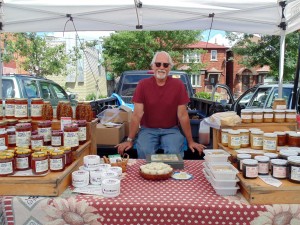
“You have to touch and smell the goods to appreciate them,” says Doug Eiche, beekeeper and honey farmer, pictured above at the Bloor-Borden Farmers’ Market.
By Axile Gerona
The Bloor-Borden Farmers’ Market has returned to the Annex for an eighth season. It provides a complete sensory experience, for shoppers enjoy the vibrant colours and textures of produce as they enjoy music performed by a different musician each week.
“The music has to be the best part of the market,” laughs Murray Powell, one of the guest musicians. “But, in all seriousness, getting to catch up with your own neighbours, as well as meeting foreign or new visitors in the market, is definitely the most thrilling and fun thing to do while at the market.”
“One of the greatest things about living in the Annex is this farmers’ market,” says Judy Keeler, a frequent shopper and visitor at the Bloor-Borden Farmers’ Market. “It’s a very close-knit community and the market presents a good opportunity to sample Ontario’s best produce.”
This year, it has more farmers selling the freshest of vegetables, more choices of prepared food, and more children’s kiosks. Still located in the Green P parking lot at Lippincott and Borden streets, this year’s market features 17 farmers, including familiar vendors like Sun-Ray Orchards and Willo’wind Farm, as well as two new prepared-food vendors who sell pizza and barbecued chicken ribs. New this year is Rancourt Winery, which allows locals to sample the best of Ontario’s wines.
“The market has also added a children’s activity area to provide entertainment to kids, and…even has a masseuse ready with a massage chair,” remarks Helen Goldlist, who chairs the Bloor-Borden Farmers’ Market Advisory Committee.
The offerings attract young and old alike.
Children from a neighbouring summer camp, drawn to the fragrant scent of beeswax candles sold by honey farmer Doug Eiche, ask permission to compose a song mentioning his eponymous honey.
“You have to touch and smell the goods to appreciate them,” says Eiche, who gladly acquiesces to their request. He’s a beekeeper who carefully locates his hives, so that his bees are free of any chemical pollutants.
It’s the type of product that the Bloor-Borden Farmers’ Market prides itself on sourcing. A “MyMarket”, which verifies that local markets feature “real farmers, selling what they grow”, the market is run by dedicated volunteers and is supported by four residents’ associations from the Annex, Huron-Sussex, Spadina-Huron, and Harbord Village.
Joe Santos says the market allows local residents to get more and more excited and participate in events that allow the community to work together towards showcasing the neighbourhood’s best products. He is one of the market’s volunteers who gives one day every week to watch over the market and to cater to any of the vendors’ or the shoppers’ needs.
The market highlights the neighbourly and energetic atmosphere in the Annex as it comes together in this lively gathering.
The Bloor-Borden Farmers’ Market runs in the summer and fall every Wednesday from 3 to 7 p.m., rain or shine. Vendors start selling at 2 p.m. For further information about verified farmers’ markets, please visit www.my market.ca.
Tags: Annex · News · Food
July 31st, 2015 · Comments Off on
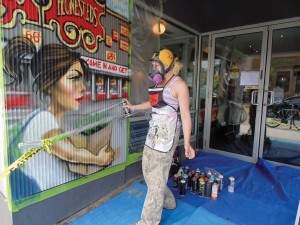
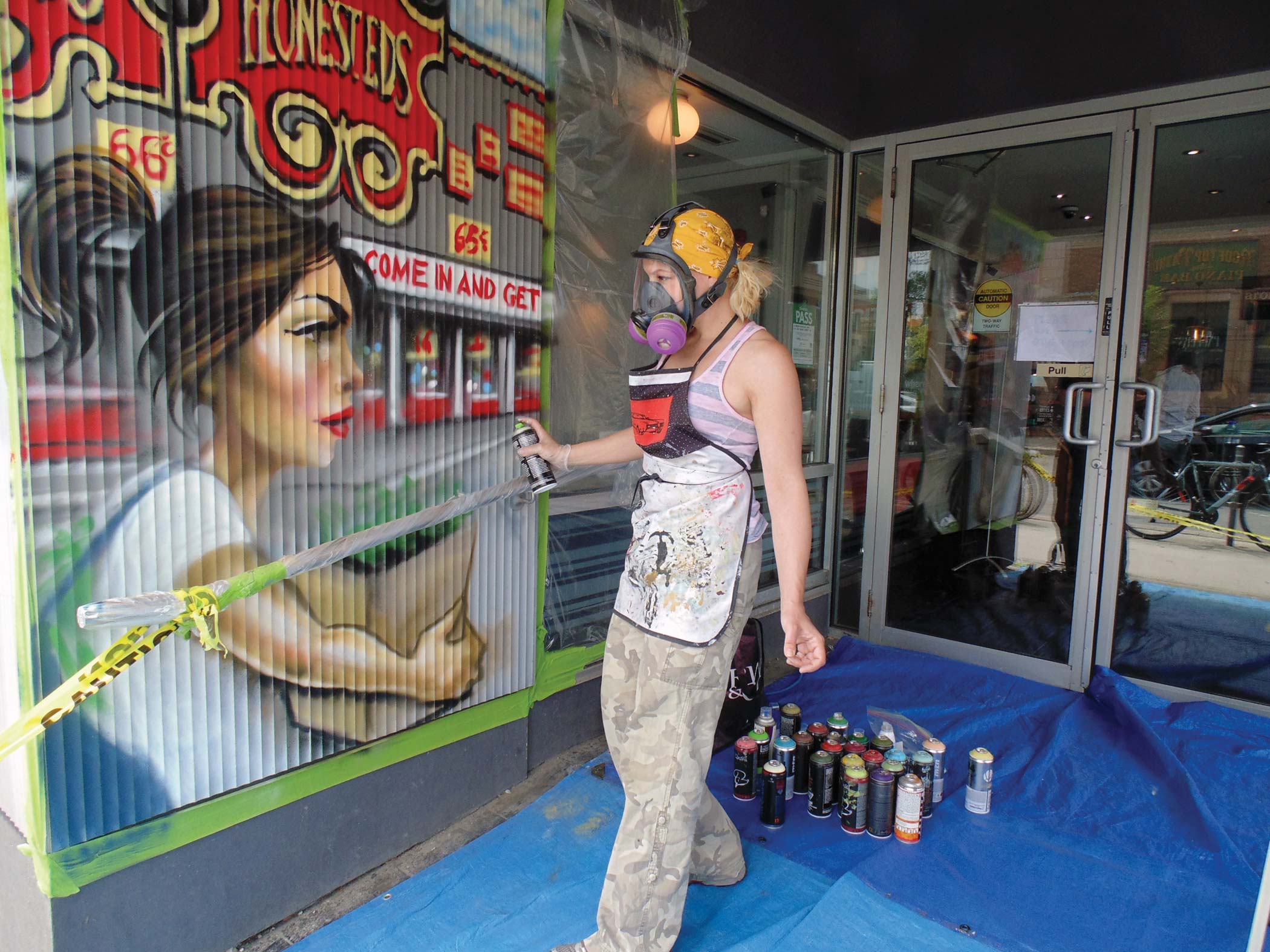
Aroma Cafe (500 Bloor St. W.) has hired Toronto-based graffiti artist Erica Balon to create a mural on its facade that features her signature cartoon-style characters. Balon’s works have appeared in events such as LuminaTO and Manifesto, and were featured in Canada’s first national exhibition of street art at the Royal Ontario Museum and the Art Gallery of Ontario. Many of her murals cover tags and gang-related symbols.
Justine Ricketts/Gleaner News
Tags: General
July 31st, 2015 · Comments Off on Running for the right
Local CPC candidates hope to rehabilitate political brand
By Annemarie Brissenden
The local Conservative Party of Canada (CPC) candidates are hoping to convince Annex residents that their political brand is not at odds with downtown in the upcoming federal election.
“There’s a widespread misconception that conservatives can’t live here,” says Karim Jivraj, the CPC candidate for the new riding of University-Rosedale, who has lived at Bloor and Bathurst streets since January. A self-described “free-thinker who happens to think my values are more aligned with the CPC”, he decided to run after becoming “increasingly concerned about the direction of the country”.
Sabrina Zuniga, who is the CPC candidate for Spadina-Fort York, agrees.
“I live here. This is where I have always lived,” says Zuniga. “I really enjoy the vibrancy, energy, and lifestyle that is found in the downtown core.”
She got into politics because “I love to help people. I had gotten involved in schools, community organizations, and I want to continue to help people, in a very local way. That’s why I got into politics.”
It’s driven her to mount her second campaign in as many years. The former biology and chemistry high school teacher ran for Toronto School Board Trustee in the last municipal election, losing to Ausma Malik. But if anything, that experience has buoyed her outlook for her federal campaign.
“It’s always a difficult route when you decide to put yourself forward; everyone I know wanted to help out with the mayor’s race,” she explains. “But I was energized by the engagement I got from knocking on doors. It energized me to say I can do this.”
Zuniga may have a tough road ahead of her. She’s running against Adam Vaughan, who is currently the member of Parliament for Trinity-Spadina, and rumours abound that Olivia Chow is considering a run on behalf of the New Democratic Party.
The CPC candidate, however, maintains she’s not letting that sway her, saying, “I focus on my race. I don’t focus on the competition.”
Jivraj, on the other hand, is facing a very different landscape in University-Rosedale. At 28 years old, he is a newcomer to politics having been involved previously only on the very local level, even though he’s “always wanted to run. Politics has always been at the back of my mind.”
While he acknowledges the competition is stiff – “we have three strong candidates” – he points out that “the race is wide open. You don’t have an established candidate with name recognition.”
Jivraj has been pleasantly surprised with what he’s encountered while knocking on doors, particularly at small businesses, in the area. “I’m surprised by the number of people who are apolitical, but very receptive to things that have been introduced” by the Harper government, he says, pointing to pro-business initiatives like a reduced tax burden.
Both Jivraj and Zuniga are aware of the unique infrastructure challenges faced by a city like Toronto, and are keen to get to work on fixing those.
“Let’s stop giving up on Toronto,” says Jivraj. “I care about the TTC, because I was taking the bus when I was 10 years old.”
Zuniga points out that since “all the condos went up, streetcars on Queen and King [streets] are bursting”, and says that the Harper government’s mid-June $2.6-billion commitment for SmartTrack funding will go a long way towards allaying some of the city’s transit woes.
She says a major part of her platform is championing research and innovation, which is “near and dear to me because of my background in science” and also a major economic driver in the area.
Jivraj also addresses another major issue in University-Rosedale riding: safe railways.
“I think there is a very real concern about this issue,” he says. “Lac-Mégantic is on our minds. But what actually seems to have occurred is that people broke the rules.”
He highlighted the steps he says the Harper government has taken since the Lac-Mégantic tragedy to increase rail safety across Canada: increasing rail inspectors by 10 per cent, increasing dangerous goods inspectors by 85 per cent, and increasing fines for companies in breach of the Rail Safety Act from $200,000 to $1 million.
For her part, dodging commenting on her stance on the island airport – “people generally have their minds made up” – Zuniga says she loves the lake, and goes down there as often as she can.
“Representing this riding gives me a great excuse to spend all summer by the lake, and I just love that.”
Subsequent to the completion of this article, Olivia Chow announced she will accept the NDP Nomination for Spadina-Fort York. We will follow up in a future issue.
Tags: Annex · News