September 16th, 2015 · Comments Off on Only Green Party offers solution to emerging global crisis
Transition to green economy, stand up for civil liberties, and be fiscally responsible
By Nick Wright
I am running for the Green Party in the upcoming Oct. 19 federal election for University-Rosedale because it is the only party with a plan to solve the emerging global environmental and economic crisis and transition to a sustainable and prosperous way of life while standing up for civil liberties and fiscal responsibility.
Our current economic system was developed at a time when natural resources were thought to be unlimited. It requires continual economic growth to avoid financial and economic collapse. Because economic growth includes the exploitation of natural resources, if unchanged, it will destroy the planet that sustains us and threaten human life.
Global-scale environmental disasters have become increasingly common. The 2010 British Petroleum Deepwater Horizon oil spill has caused untold harm to the Gulf of Mexico. The 2011 Fukushima Daiichi nuclear reactor meltdowns are poisoning the Pacific Ocean. The ongoing mass slaughter of sharks for their fins has reportedly wiped out 90 per cent of some shark species, destabilizing ocean ecosystems.
At home in Canada, east coast cod populations have been decimated, Ontario is proposing the redevelopment of nuclear power reactors, and the old-line political parties are fighting over how best to exploit the Alberta tar sands.
In contrast, the Green Party is standing up for a better quality of life for all Canadians and future generations by opposing the tar sands and related pipelines, promoting renewable energy, opposing dangerous nuclear power, and transitioning to a sustainable and prosperous green economy. The Green Party has a vision for living well without mortgaging our future.
An important part of transitioning to a sustainable economy and society is defending and building upon the values that Canadians hold dear.
Troublingly, the old-line parties have been working to erode the Charter of Rights and Freedoms and our civil liberties by using fear tactics to pass dangerous new laws.
Recently passed Bill C-51, the Anti-terrorism Act, creates new secret police, expands preventative arrest, criminalizes speech, and eliminates important privacy rights. Condemned by Amnesty International and many others, the new act is expected to be used as a tool to silence and intimidate political opponents of the current government, including environmental and aboriginal groups. The Green Party advocates for the immediate repeal of Bill C-51.
The Green Party also seeks to expand our freedoms. We advocate for the legalization of marijuana and decriminalization of other illegal drugs, and for treating drug abuse as a health issue, as Portugal has successfully done since 2001. We will also repeal Bill C-36 (the so-called Protection of Communities and Exploited Persons Act) to legalize sex-work while enhancing the fight against human trafficking.
The Green Party advocates for fiscal responsibility. This means investing in important social programs, but not spending money that we don’t have. We advocate for balanced budgets, paying down the debt, reducing bank leverage ratios, and reinstating the Bank of Canada to a prominent position in the creation of currency and the regulation of credit. These changes will protect our economy and financial institutions while reducing borrowing costs.
The Green Party is the only party with a plan to address the emerging global environmental and economic crisis. We must begin transitioning to a sustainable and prosperous future now, while defending and expanding civil liberties and prudently managing the country’s finances. By voting Green on Oct. 19, you can stand up for a more sustainable, freer, and prosperous Canada.
Nick Wright is the federal Green Party of Canada candidate for University-Rosedale.
Tags: Annex · Liberty · News
September 16th, 2015 · Comments Off on Ensure capitalist democracy delivers for everyone
Only the Liberals have a progressive economic agenda
By Chrystia Freeland
I have a political skeleton in my closet. I was the Liberal member of Parliament for Toronto Centre and am running as the Liberal candidate in University-Rosedale, but the first party I ever canvassed for was the New Democratic Party when my mother, Halyna Freeland, ran under that banner in Edmonton-Strathcona.
My mother was proudly and unequivocally on the left – she described herself as a Ukrainian-Canadian socialist feminist. Sadly, she died a few months short of her sixty-first birthday, but her moral example is what inspired me to run for parliament as a Liberal and guided my work as co-chair of Justin Trudeau’s economic advisory council. That’s because today the Liberals are the only party with a truly progressive economic agenda.
Over the past three decades, middle class incomes in Canada have lagged behind in the growth of the gross domestic product, and jobs for many have become more precarious. Meanwhile, the share of the national income going to the top 1 per cent has surged from 7.5 per cent in 1982 to 10 per cent in 2012. The shift is even starker at the very top, where the share of the national income going to the 0.1 per cent has doubled from 2.5 per cent to 5 per cent.
That’s why the central progressive mission today is to ensure that capitalist democracy delivers for everyone – and not just for those at the top. To do that, the Liberal party is creating a new tax bracket for Canada’s one per cent, and will use the extra $3 billion in revenue that brings in to lower taxes for the middle class – we will cut taxes by 7 per cent for people in the middle, saving families up to $1,350 per year.
We will end income splitting – another policy that disproportionately benefits those at the very top – and use the money generated by that measure to boost financial support for children, especially those in the middle and at the bottom. I am especially proud that our new, enhanced, and targeted child benefit will give the parents of Canada’s poorest children $6,400 per child tax-free – effectively a guaranteed annual income for our kids.
Direct support for the middle class and those striving to join it is the right thing to do for our society – Canada has always been a country of inclusive prosperity. And supporting the middle class will boost overall growth, as families with urgent economic needs have the money to meet them.
We also need a government that will work hard to deliver jobs and encourage economic activity. A pro-growth agenda is particularly urgent today, when the Canadian economy, alone of the G-7 countries, is in recession.
That’s why when Liberals form government, we will launch a transformative, 10-year plan for infrastructure investment that will kick-start Canada’s stagnating economy. Over the next decade, we will nearly double federal infrastructure investment to $120 billion, from $65 billion.
As the outgoing MP for Toronto Centre, I know how urgently my constituents need infrastructure investment – whether it is for better transit so we can get to work, more affordable housing for the more than 78,000 Toronto families on the waiting list, or green infrastructure to protect us from extreme weather.
As the world’s top economists have been arguing, today – a time of historically low long-term interest rates – smart infrastructure investments are the best way to create jobs now and long-term growth in the years to come. David Dodge, the former governor of the Bank of Canada, and Larry Summers, the Harvard economist and former U.S. Secretary of the Treasury, have both welcomed our plan.
Our program takes political guts – Thomas Mulcair, of all people, has railed against our tax increases for the 1 per cent, and our infrastructure plan is in defiance of the austerity ideology of both the Conservatives and Mulcair’s NDP. But we believe in social justice and economic growth, and our plan will deliver both. Sir Wilfrid Laurier predicted the 20th century would belong to Canada. The 21st can be even better, if we have the courage to invest in our people and in our long-term economic potential.
Chrystia Freeland is the federal Liberal Party of Canada candidate for University-Rosedale.
Tags: Annex · News · People
September 16th, 2015 · Comments Off on If buildings are art, should they be altered from their original form?
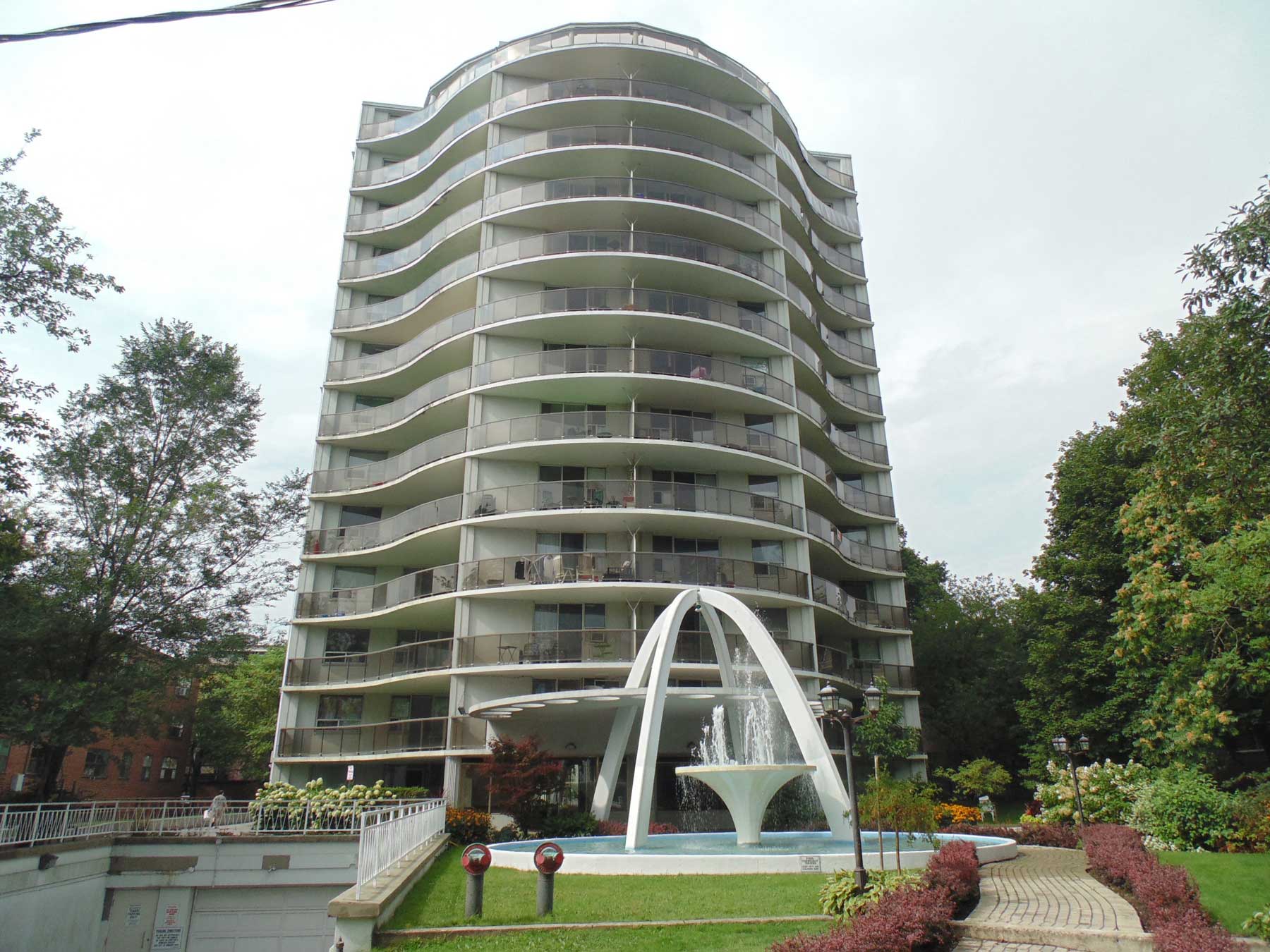
44 Walmer Rd. faced changed to its character in 2001
In his Aug. 24, 2015 column for The Globe and Mail, “A pop art prize”, Dave Leblanc points to Alfred Holden’s May 2001 column in The Annex Gleaner about 44 Walmer Rd., a design by renowned architect Uno Prii. Leblanc reminds us that the questions raised by Mr. Holden in 2001 remain relevant today. Here is a reprint of that Gleaner column.
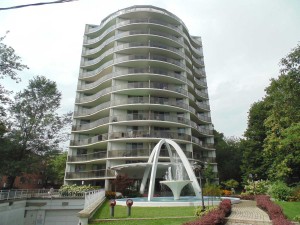
Although diminished by the removal of its curvaceous balcony adornments, architect Uno Prii’s 44 Walmer Rd. – as it stands today – remains an artistic statement in design. Brian Burchell, Gleaner News
By Alfred Holden,
Are buildings art?
The question is seldom posed. But it’s a legitimate one that raises some potentially important legal and ethical issues, in the light of construction work that’s going on right now at the large apartment house at 44 Walmer Rd.
In recent weeks crews have removed the building’s most artful and distinctive feature – the curvilinear, circle-patterned balcony railings that made 44 Walmer something of an icon.
Just last month, in its Icons column, Toronto Life pictured 44 Walmer on a two-page spread. The headline was “Flower tower” – a nice play on the way the sensuous design of 44, like the attitude of youth in the sixties era during which it was built, went against boxed-in ways of thinking.
“Playful whimsy” is how a new book East/West: A Guide to Where People Live in Toronto sums up this design by architect Uno Prii. With its “idiosyncratic quality and lightheartedness”, the building “brings an unexpected lightness and joie de vivre to sometimes staid Toronto”.
Prii died last November and I wrote about him in February’s Gleaner.
The current alteration was undertaken so crews could get at balcony concrete for much needed repairs. Nothing wrong with the repairs, but the building’s owner, Gaetano D’Addario, has said the old railing design is gone for good. “I did not like it,” he told me point blank over the phone. And as he put it emphatically, he owns the place.
Legally perhaps, but does he own it completely?
Some readers may remember the case of the Eaton Centre Canada geese, which may offer legal, and certainly moral, inspiration for those concerned about 44 Walmer Rd., and other buildings of merit.
In 1982, as part of a Christmas marketing campaign, it was decided to tie red ribbons around the necks of the flock of fiberglass geese that hang in the south end of the mall’s galleria. The geese are the creation of noted Canadian artist Michael Snow and he was horrified. Snow took the Eaton Centre to court.
A judge found that under Canadian copyright law artists can sell their work, but retain important residual rights: their artistry isn’t to be distorted or modified in unseemly ways by those who buy it. In December of 1982, the red ribbons flew south.
Typically, buildings are not seen as art. Yet buildings everywhere, from the Parliament buildings to the Toronto Dominion Centre to many midtown homes, clearly are art.
Uno Prii was an artist. When I visited him and his wife a couple of years ago, I found their Bloor Street condominium filled with paintings, sculpture, and pottery by the architect. Instantly, I knew where his sculptural buildings came from.
In Ontario, various rules and protocols exist for protecting historic and significant structures. But as Rosie Horn of the Toronto Preservation Board admitted when I called her about 44 Walmer Rd., the system is gutless, toothless. The free-enterprising freewheeling United States has much tougher rules, and enforceable standards set by the Secretary of the Interior. Compared to Canada, Margaret Thatcher’s Britain was, and is, draconian. In France, the prosperity of the nation is seen to depend, in part, on strategic, intelligent stewardship of the nation’s remarkable store of landmark architecture. Is 2001 the time, and 44 Walmer Rd. the place, for ordinary people to take on the issue, by playing hardball under something like the copyright law? The tenants have a law student working on their behalf, in what’s become a long-standing battle with their landlord.
With the balcony railings already off, it seems too late to do anything about the building, but I am not sure.
D’Addario, judging from his response to my phone call, is certainly feeling the pressure. “Wait until the decision is made,” he said to me, opening the door, later in the interview, at least superficially. “It’s a decision we have to make and I am going to take my time to make it.”
“He keeps the place up,” tenant David Aylward told me in the lobby on April 30, “but he’s a bit fancy in his ideas.” Other recent alterations – a marble floor in the foyer and lobby over original terrazzo, a new stucco-over-foam exterior with classical details – reflect a bid to remake modernist 44 into neo-Casa Loma. D’Addario didn’t mention another fact – that his company, Navy & Jim Investments Ltd., has applied to convert 44 Walmer Rd. into a condominium. That’s something with multiple implications for the lives of the tenants today and tomorrow. A public hearing will be held at City Hall at 10 a.m. on May 15. If I lived there, I’d be sure to go.
Whatever happens, I think the owner, by removing a key architectural feature, is taking the wrong approach to his real estate. The very people to whom the building is marketed – the tenants and ultimately the public – have long noticed 44 is a real designer building. Newspapers, magazines, and books are giving the property unsolicited praise, the kind of publicity that cannot be bought at any price. That reflects more about what people want than faux columns and marble floors.
Larry Richards, Dean of Faculty of Architecture at the University of Toronto, in an April 12 letter to the Toronto Preservation Board chair Catherine Nasmith, wrote: “44 Walmer is a highly sculptural, landmark tower…designed by one of Toronto’s most important 20th century modernist architects.” Referring to the railings which define the building, Richards wrote, “this change will drive our city further toward architectural mediocrity”.
In recent years, not enough has been said about botched renovations and still less is done about it. Apartment buildings, so important to the city fabric, are particularly prone – they are treated by their owners, of all people, like worthless old cars, to be patched up with Bondo and souped up with stick-on accessories from Canadian Tire.
So I urge 44 Walmer tenants and their legal advisers to think art, take action, and make theirs a landmark case. These should kick some teeth into worthless laws that right now allow the willy-nilly destruction of art, architecture, and achievement that is of immense value to the future pride and reputation of the city.
Tags: Annex · Liberty · News
September 16th, 2015 · Comments Off on Urban Elms
A tree that keeps fighting back
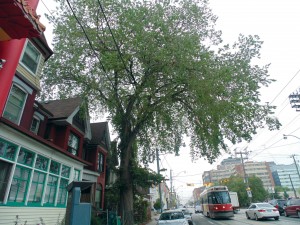
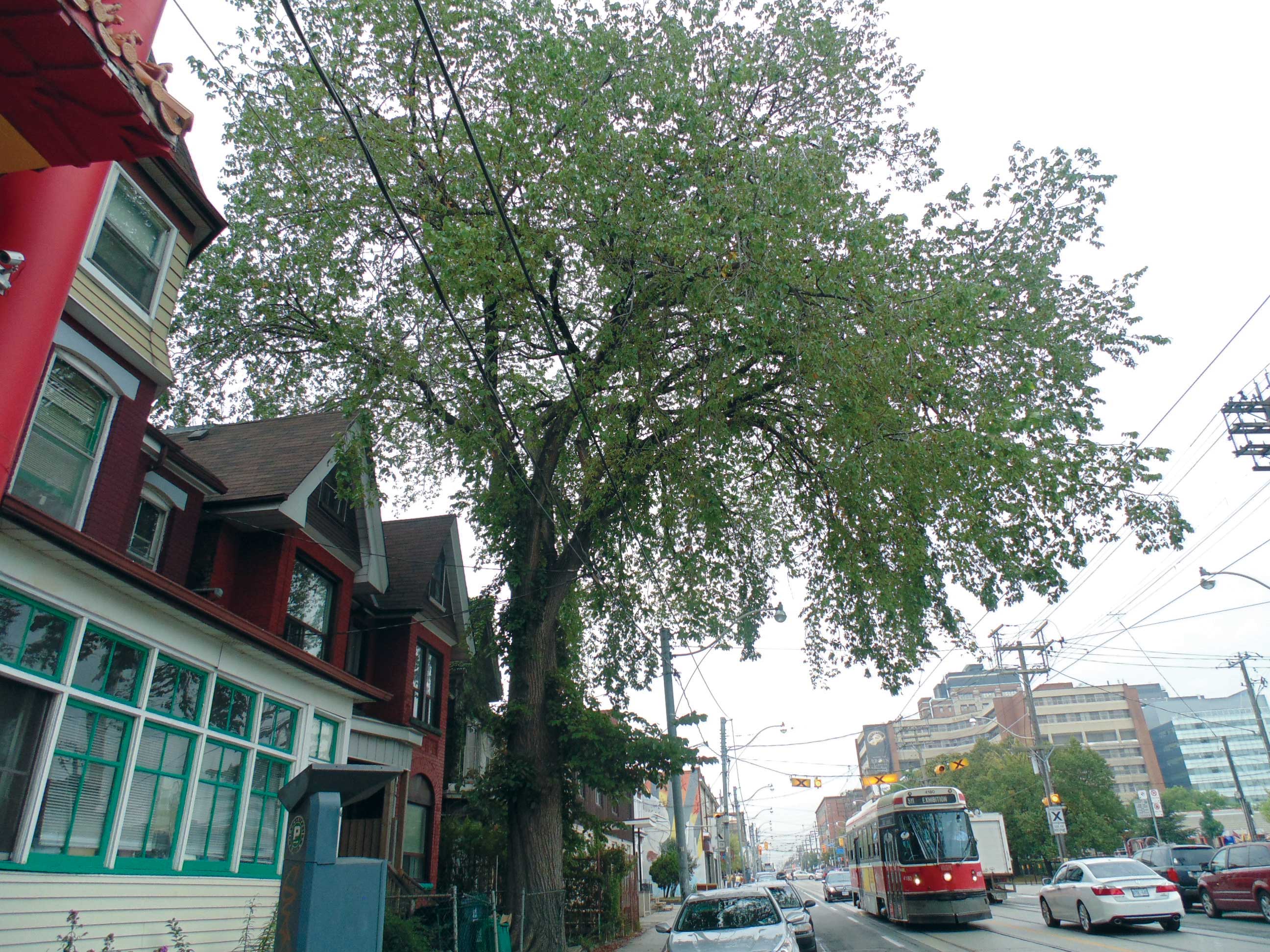
This elm, located on Bathurst Street just south of Dundas Street, thrives in the urban landscape against all odds and despite the continued presence of Dutch elm disease. Brian Burchell, Gleaner News
By Alfred Holden,
Given up for lost, great elms soldier on. Extinction was predicted. I remember the news stories around 1970, so prone were the trees to deadly Dutch elm disease, which is still very much with us. But if you believe in evolution, or if you don’t, pull up a chair. Here’s a case study, survival of the fittest, of resilience in crisis, of biology pulling the rabbit out of the hat.
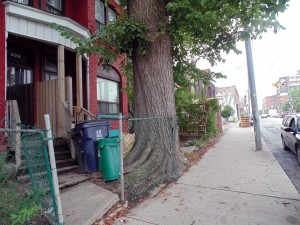
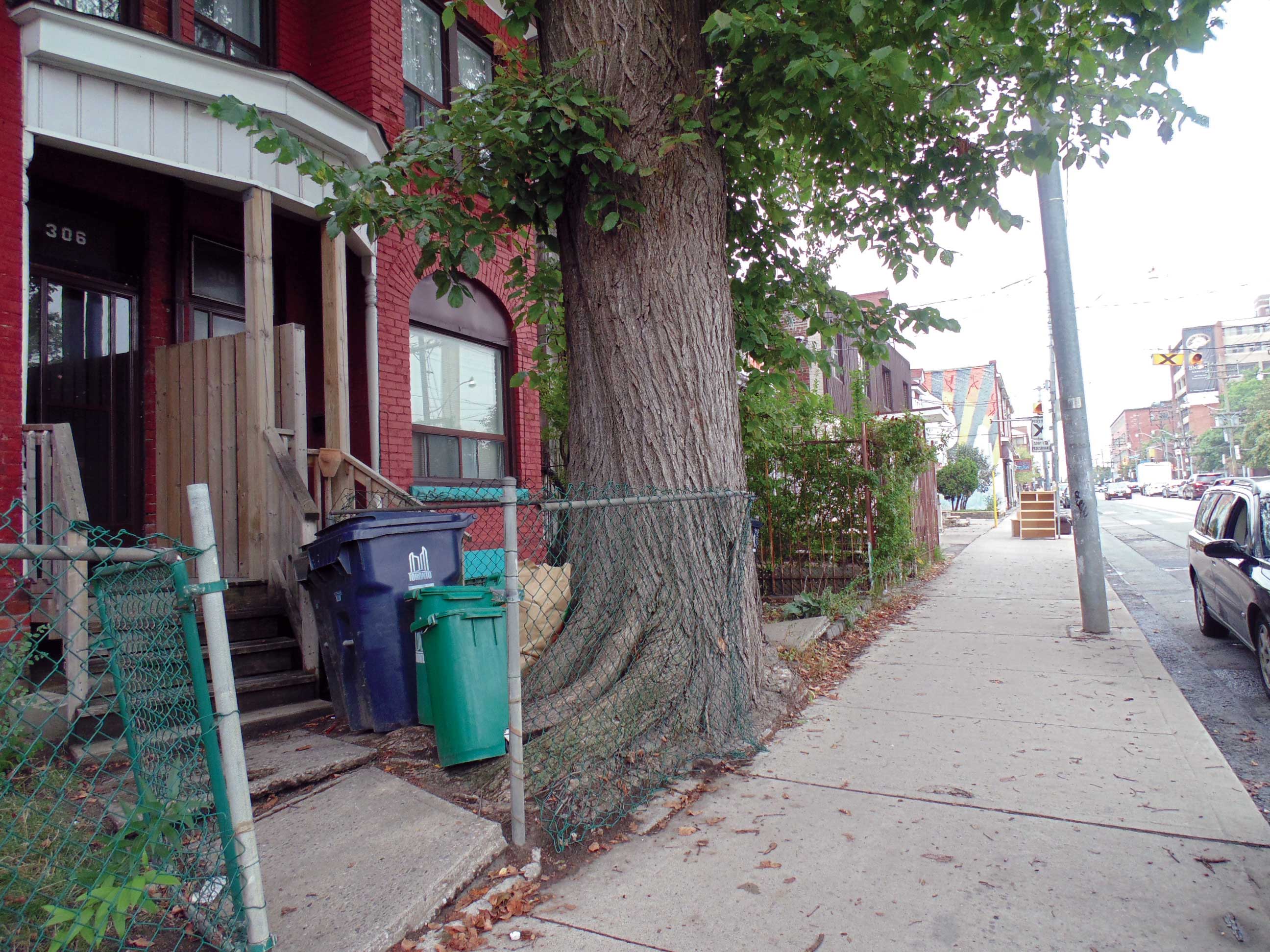
A collar of concrete and the assault of road salt in winter does nothing to deter this elm’s growth. Brian Burchell, Gleaner News
I have long admired this particular tree, a feral American elm that thrives in Toronto’s urban jungle on Bathurst Street, west side south of Dundas. Look around it; this tree speaks to the American elm’s tremendous powers. Neither salt, nor cement, nor hydro wires, nor a competing forest of recycling bins, nor the scourge of Dutch elm disease can keep the elm from growing tall.
On St. George Street, where I live, three or four American elms have outlived almost all the Norway maples, several of the silver maples, and the lindens. In my 33 years living there, the elms have gotten bigger, and not one mature example has died. When I was a boy in Ottawa, the elms were falling all around us (actually, elms seldom fall, their wood is very tough, they had to be cut down and since these are huge trees it was quite an affair). A future for them was hard to fathom. The fungus was accidentally imported from Asia on lumber, and the North American trees did not have the resistance of the Asian varieties. I have written, or assigned, quite a few news stories on this favourite topic for Sarah Barmak, who wrote up the Humewood elm for The Toronto Star.
One of the elm’s greatest friends is Martin Hubbes, a former U of T forestry professor who has schemed to biologically undermine the fungus that kills the trees. He has had mixed success, but all along has pointed out the elm’s persistence and discovered a multitude of ways the tree itself keeps fighting back. (“It’s maybe because they do kung fu,” my spouse pipes up, looking over my shoulder.) Hubbes does deep biology and chemistry; years ago I tried to explain it for readers in a piece in U of T’s Bulletin. One helpful thing the elm does is produce seeds at a young age, and while many trees die young, some don’t. What do you think is happening?
Hubbes pointed out to me that other than Dutch elm disease and very old age, not much kills an elm. They are the perfect urban tree, “elegant and adaptable”, strong as steel, big (giants) but well-behaved, writes Joseph Campanella in his book about the elm, Republic of Shade. Elms thrive to hugeness in unlikely places – not just in Toronto concrete but well north and south of their natural habitats, for instance as still-viable shade trees in deep-freezer prairie cities and in Florida.
When Ottawa’s elms were dying and being cut down, I watched the massacre walking to and from school – on elm-lined Clemow, around our house at Renfrew Avenue and Percy Street, along the parkways. I’d stop at the stumps and count rings. The stumps were four, five, eight feet across, and oozed smelly liquid. Brown streaks of the fungus that caused death could be seen. In the guts and the glory it was the turf version of coming across a dead whale on the beach.
When counting, what was impressive was not the number of rings but the width of them, one or two inches a year. Staggering production of hard matter through mere photosynthesis. As a boy I transplanted one, dug up in a back lane which eventually succumbed, but until then grew shockingly faster than I did. The National Capital Commission, against all advice, continued planting elms, and these count among Ottawa’s survivors today.
Campanella argues too many were planted in North American cities, and that this contributed to their fall, as the fungus, carried on the feet of bark beetles, zoomed from tree to tree. With fewer trees around today, he suggests, the disease hasn’t the hosts it needs to keep killing, hence the survivors. Hubbes might disagree – as I recall he did – pointing out that against all odds, and below the radar, the elm remains one of the most common trees on the landscape, found in numbers in every country hedgerow and neglected urban corner. The young trees quickly make seeds and keep the gene pool vigorous. Various cultivars, real elms that seem to resist, have been found. Hubbes has sought means to empower the trees’ existing, considerable capacity to fight back. As well the seeds of hardy survivors like the one on Bathurst Street (one of many such in Toronto) are blowing in the wind.
Some species planted to replace the elm, such as the ash, have been hit by their own pests, but have not responded with the elm’s resilience. Various scourges are creeping up on oaks, hemlocks, and other grand old types. You could make a doomsday movie. The plot: the elm would be the last one standing. Biologically, it’s got the stuff.
Tags: Annex · Liberty · News
September 16th, 2015 · Comments Off on A grand gesture in the age of thrift
A review from when the Lillian H. Smith Branch was new

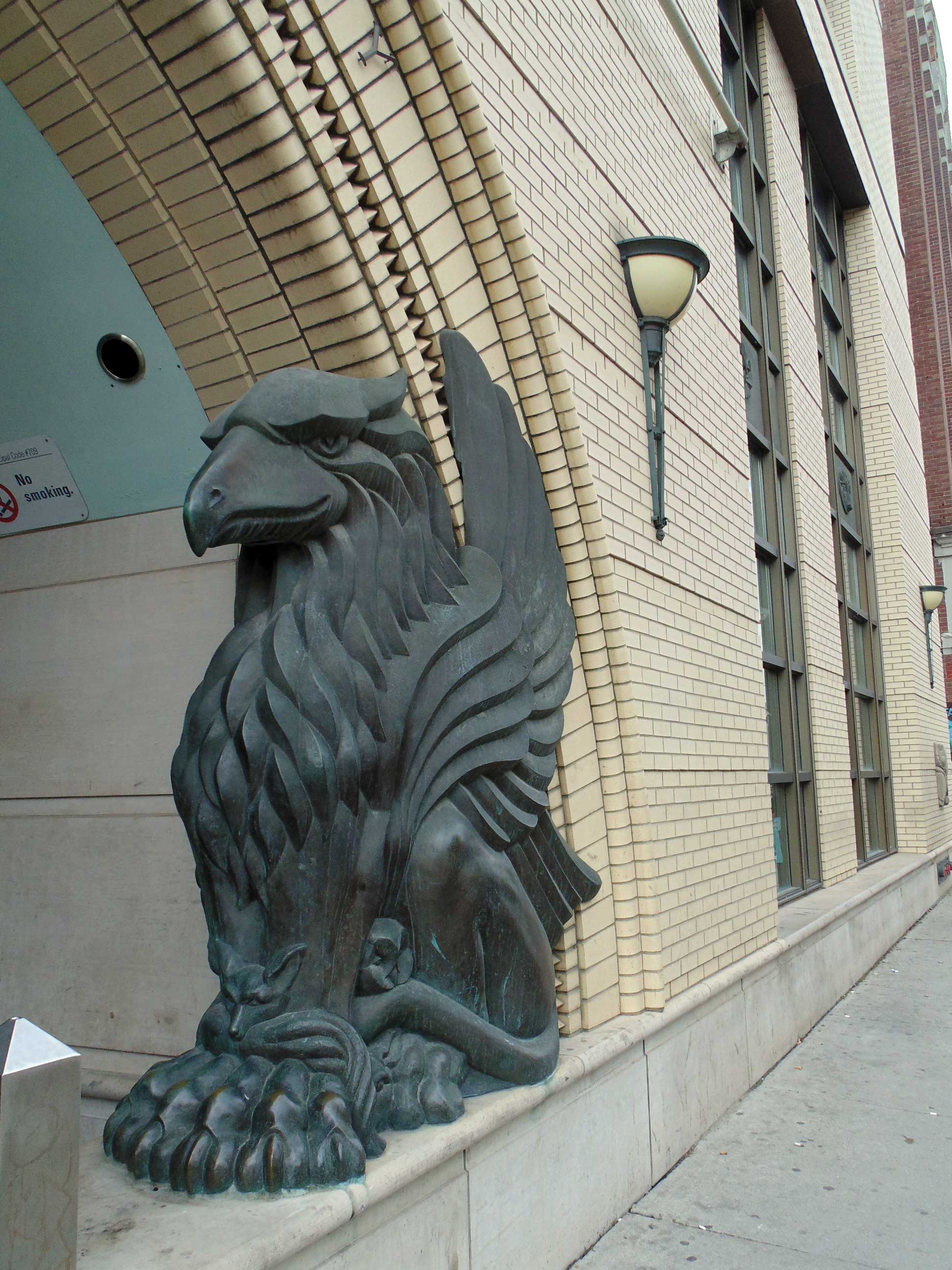
One of Ludzer Vandermolen’s griffins, which guard the entrance to the Lillian H. Smith Branch of the Toronto Public Library. Brian Burchell, Gleaner News
In the October 1995 edition of The Annex Gleaner, Alfred Holden reviewed the then new Lillian H. Smith Branch of the Toronto Public Library. On this, the branch’s twentieth anniversary, we thought we’d take a look back at what we thought then. You be the judge: how has Lillian H. Smith stacked up over time?
By Alfred Holden,
Quick. Find a creative six-year-old, paper, and a box of crayons, and have the youngster draw a library. What does it look like? A box, like a house with a steep hipped roof, maybe with a flag at one end and a chimney on the other?
Perhaps there are a couple of grimacing griffins, like the beasts in fairy tales, guarding the door. There are probably big windows because, as any kid will tell you, it’s nice to have a bright sunny place to read a book.
Dreaming on, wouldn’t it be nice if there were more books for kids; a whole building of them? Why not? Where youngsters – maybe by clicking with a mouse on a squeaky clean new computer – could find some favourites themselves.
On the shelves there would be classics like Goodnight Moon, Mike Mulligan and His Steam Shovel, and Winnie the Pooh – even some historical editions of them. And plenty of fresh copies of the latest books, for everyone wants to meet the kid who lives in the house where trains stop, in Robert Munsch’s Blackberry Subway Jam.
Somewhere in this heaven for imps there would, of course, be a corner for grown-ups, sort of an inverse to the ballroom for kids at Ikea. Over here, to keep them busy, there’d be CD-ROM drives for browsing, and maybe a link-up to the Toronto Free-Net. And over there, a collection of science fiction.
This all sounds like fiction, and surely is a childish fantasy at a time when elected officials insist nothing public – and there are few things more public than a library – is worth investing in. But it’s all coming true, right down to the griffins by sculptor Ludzer Vandermolen over at 239 College St.
That’s where, at the corner of Huron Street, the new “children’s branch” of the Toronto Public Library opens this month. In fact, the new Lillian H. Smith Branch, named for the beloved librarian who organized Canada’s first library for children, is a library for everyone. Its heart will be children’s books, including the famous Osborne Collection of Early Children’s Books. But there will also be, among other things, a reference department, a Chinese collection, and meeting rooms for folks who’d rather chat than read.
I also believe there is, in this building, something less tangible but in the long run even more valuable than well bound volumes and high-powered computers: faith. Not the religious kind, but faith in the future of the city, its neighbourhoods, its people and their public spirit. Standing on College Street, on the opposite corner from the new building, its confidence – ultimately our confidence in ourselves, for we built and own it – positively jumps out at you.
Part of the excitement comes from the design by architect Philip H. Carter, which fittingly for a library draws much from history, lore, and tradition. The griffin, for instance, is the mythological half-eagle half-lion who guarded the gold of the Hyperboreans – in Greek mythology a northern people who were blessed with happiness.
Such creatures will, I am sure, print their images on all young minds that pass our way, irresistible invitations to come and explore the treasures within. “When I was a kid,” they will remember to their own children (and one hopes those children to theirs), going to the library was an event.
Alluring mystery and fantasy notwithstanding, attention has also been paid to giving 239 College St. qualities that are familiar and comforting. Substantialness is one; this is not a giant building by any means, but from any point of view on the sidewalk or across the street it sits like a pointed rock on its stone foundation, with walls that look three feet thick. These walls are fresh of finish (brick, fancifully laid, for example into a ribbon of black diamonds near the roof line, or the great Sullivanesque entrance arch within which the griffins perch), but the effect is classical, and its message, reinforced by pigeon droppings already accumulating on the wide stone windowsills, is performance.
All this brings back memories of the libraries many of us knew in our own youth – those huge, classically-styled Carnegie palaces that dotted cityscapes from Ottawa to San Francisco, or even Toronto’s old central library, which stands across College Street serving as the University of Toronto Bookstore.
Should the griffins let you pass, you’ll step further into the past in the foyer, with its soft light (from one of those hanging bowls of white glass), walls of polished brown marble, and bronze doors (watch your fingers everyone) that are not polished bright but burnished brown as though many a hardcover has already passed this way.
Spanking new, yet familiar too, will be the oak reading tables and the marching chairs (big enough for two to curl up in), icons whose presence ought to relieve such anxiety as might be transmitted by all high tech electronic equipment patrons young and old will be figuring out.
Inside and out, a particularly clever feature of this building is the way ventilation grates have been made into design elements, doing the building’s heating, cooling, and breathing from finely finished strips of metal in one place, great round medallions at another.
Not as satisfying is the dark slate floor in the foyer and round atrium, and wall-to-wall carpet (why not rugs?). These elements seem incongruously dull, dated, and ephemeral in a building so potentially timeless. So do the false ceilings and their fluorescent light fixtures; one expects (but probably cannot afford) a more literate execution, with smooth plaster and softly glowing milk-glass luminaries hanging from chains.
But these faults are mere compared to the larger picture, the appearance of a great urbane public building downtown when many of us were worried about the future of the city. Here is concrete evidence that Toronto lives and thrives yet, and a reason to stick around.
The Lilian H. Smith Branch demonstrates that public gestures undertaken by government agencies for citizens can be grand, beautiful, and inspiring. That’s something we need to see at a time when greed and parsimony, masquerading as business sense and thrift, dominate government policy. Pooh on you, Mike Harris.
Tags: Annex · Liberty · News
September 16th, 2015 · Comments Off on Striking a carbon balance
Pick a plan, the real enemy is inaction
For me, there is very little doubt that carbon needs to be priced. The only question is what mechanism we use as a nation to price it for the most effective carbon reducing strategy. I had the fortune of hosting the “Why Should I Care?” forum on carbon pricing in August. The two guests debated the merits of the carbon tax, the cap and trade, and the fee and dividend systems.
The first time I ever recall a federal party actually proposing a carbon tax was in 2008 when then Liberal leader Stephane Dion brought forth the green shift. The idea was to put a dollar amount on carbon so that the consumer was hit where it hurt the most, in the wallet. The tax would act just like cigarette and alcohol taxes, it would discourage bad behaviour, and those who didn’t engage in it would save money by tax cuts in other areas. The disaster of that election pretty much ensures that no major party will include real climate mitigation measures into their platform for fear of voter retribution in the near future. However, I salute Dion’s courage for having had what I considered the greenest party platform in a western democracy. A carbon tax will send a price signal to producers. An adequate price signal in theory makes an otherwise more expensive, low carbon, option price competitive. The fear with this solution is that the price will be too low, not allowing biofuels and other alternative forms of energy to actually compete.
Fee and dividend is promoted federally by Green Party leader Elizabeth May. The idea here is that an incremental fee is imposed by government on companies emitting pollutants, with the fee increasing steadily each year until the point is reached where clean energy becomes cheaper to employ than fossil fuels. All the money collected through the fee system would be returned to Canadians on an equitable basis, regardless of a household’s carbon footprint, and assistance with increased costs would be passed along by the corporation paying the fees. Households with a large carbon footprint would feel the effects of the fee system, which will exceed the dividend return, thus incentivizing change. Conversely, a family reducing its carbon footprint to less than average will make money from the program, which also benefits from being predictable through employing increasingly higher carbon prices, thereby encouraging entrepreneurs and investors to focus on clean-energy options.
In a cap and trade system (as already adopted in California and Quebec), the government caps carbon emissions from large polluters by setting legal limits, which are lowered over time to reduce the amount of pollutants released into the atmosphere.
If a company is able to reduce its pollution easily and cheaply, it can end up with extra allowances which it can then sell to other companies – generating revenue in the process. The benefits of implementing this type of structure allows companies to plan well in advance as the cap on emissions is gradually and predictably lowered each year.
Additionally, while companies may exchange allowances between each other, the total number of allowances remains the same, thereby achieving hard limits on pollution emitted each year.
Each strategy has its benefits, but from the discussion we hosted, Brian Foody, CEO of Iogen Corporation, said it best. Which method we choose is irrelevant so long as carbon can be priced appropriately. There are advantages to adopting systems already put in place by other jurisdictions such as Europe and California, given how small the Canadian market is.
Regardless of the system, on election day I’m looking for a leader willing to do something!
Terri Chu is an engineer committed to practical environmentalism. This column is dedicated to helping the community reduce energy use, and help distinguish environmental truths from myths.
Send questions, comments, and ideas for future columns to Terri at terri.chu@whyshouldicare.ca.
Tags: Annex · Liberty · News
September 16th, 2015 · Comments Off on Hooked on Language
Seven notorious twentieth-century women come alive in solo show

By Annemarie Brissenden
It turned out that Zelda was most comfortable in the bathtub. For Elizabeth Smart, it was doing dishes in the kitchen. Or so Dora-award winning actress Nicky Guadagni discovered as she rattled around a big, old farmhouse, coming to grips with the seven women in Hooked, Carolyn Smart’s collection of poetry. Together with director Layne Coleman, Guadagni would adapt Smart’s seven poems into a critically-acclaimed one-woman play of the same name, which is being remounted at the Theatre Passe Muraille Backspace this month.
“I was visiting [Carolyn],” recalls the Annex resident, explaining their families are long-time friends, “and she showed me the galley proofs for the book. I took a cursory look and the words just kind of jumped out at me. They were all women I felt a connection to, except Jane Bowles, whom I didn’t know.”
Each of Smart’s poems is narrated in the voice of one of seven notorious women from the twentieth century: Myra Hindley, Unity Mitford, Zelda Fitzgerald, Dora Carrington, Elizabeth Smart, Carson McCullers, and Jane Bowles. The poems provide an intimate glimpse into the inner life of these women, and can be jarring, particularly when told in the voice of England’s Myra Hindley, the Karla Homolka of her time, or Unity Mitford, who idolized Hitler.
“I wanted to choose women that would hold my interest for the full period that I would research and write them,” explains Smart. Hindley – who “loomed large over my childhood” – had just died when the poet began working on the project, so there was lots of coverage in the British press at the time.
“The stories [about Hindley] were so markedly different…. I wondered, who is this woman?”
After Hindley – the most despised woman in British history – Smart moved on to the most hated woman in British history, Unity Mitford, who never smiled in pictures, except in those with Hitler.
“Unity [has] a bad effect on some people,” says Guadagni, admitting that portraying such women can provoke a strong reaction from her audience. “Some people refuse to look at me, they are so filled with hatred.”
“You call tell a lot about a person by the way they interpret history and their own times,” says director Layne Coleman, who recently appeared in the Annex as Sir John A. Macdonald in The Postman. He collaborated with Guadagni on adapting the poems, and says the biggest challenge was finding a way to connect the seven narrative vignettes into a cohesive whole.
“We added a musician, which [provided] accents that made it more of a play,” he says, adding that his primary role was really to give Guadagni the space and confidence to develop the characters as she saw fit.
“Nicky has a real gift for speaking in the tongues of others,” Coleman explains. “I tried to protect [her] instincts.”
Guadagni now recognizes that such approval was just what she needed.
“He never gave me a note, but allowed me the freedom to keep experimenting.”
Of all the women, both Guadagni and Smart feel the strongest affinity with writer Elizabeth Smart (no relation), who grew up in Ottawa, and fell in love with poet Charles Barker, a doomed romance she detailed in By Grand Central Station I Sat Down and Wept.
“Perhaps because, aside from Zelda, she’s the only mother,” reflects Guadagni, who adds that she’s Canadian, and more contemporary than the others.
Smart, who lived in the same house and went to the same school as Elizabeth Smart, says “the ones that I love the most were Elizabeth and Carrington. Elizabeth because I was able to talk about the landscape that I grew up with and loved.”
For his part, Coleman says he likes Guadagni’s portrayal of writer Jane Bowles, describing how the actor transforms herself into a what he calls a “borscht belt comedian”.
“I don’t think I’ve laughed so hard,” he says of Guadagni’s first performance. “I nearly split a gut watching that one.”
After six years of performing Hooked, Guadagni says working from a script adapted from poetry has made her far more attuned to her sensitivity and connection to language.
“I have much more confidence in language and my determination not to interfere with it.”
Hooked runs from Sept. 16 to 26 at the Theatre Passe Muraille Backspace. Tickets are available at www.artsboxoffice.ca.
For further information, please visit www.hookedtheplay.ca. Regular contributor Annemarie Brissenden is also the play’s publicist.
Tags: Annex · Liberty · Arts · People
August 28th, 2015 · Comments Off on Breaking bread with friends
Harbord Bakery marks 70 years
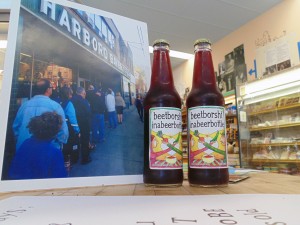
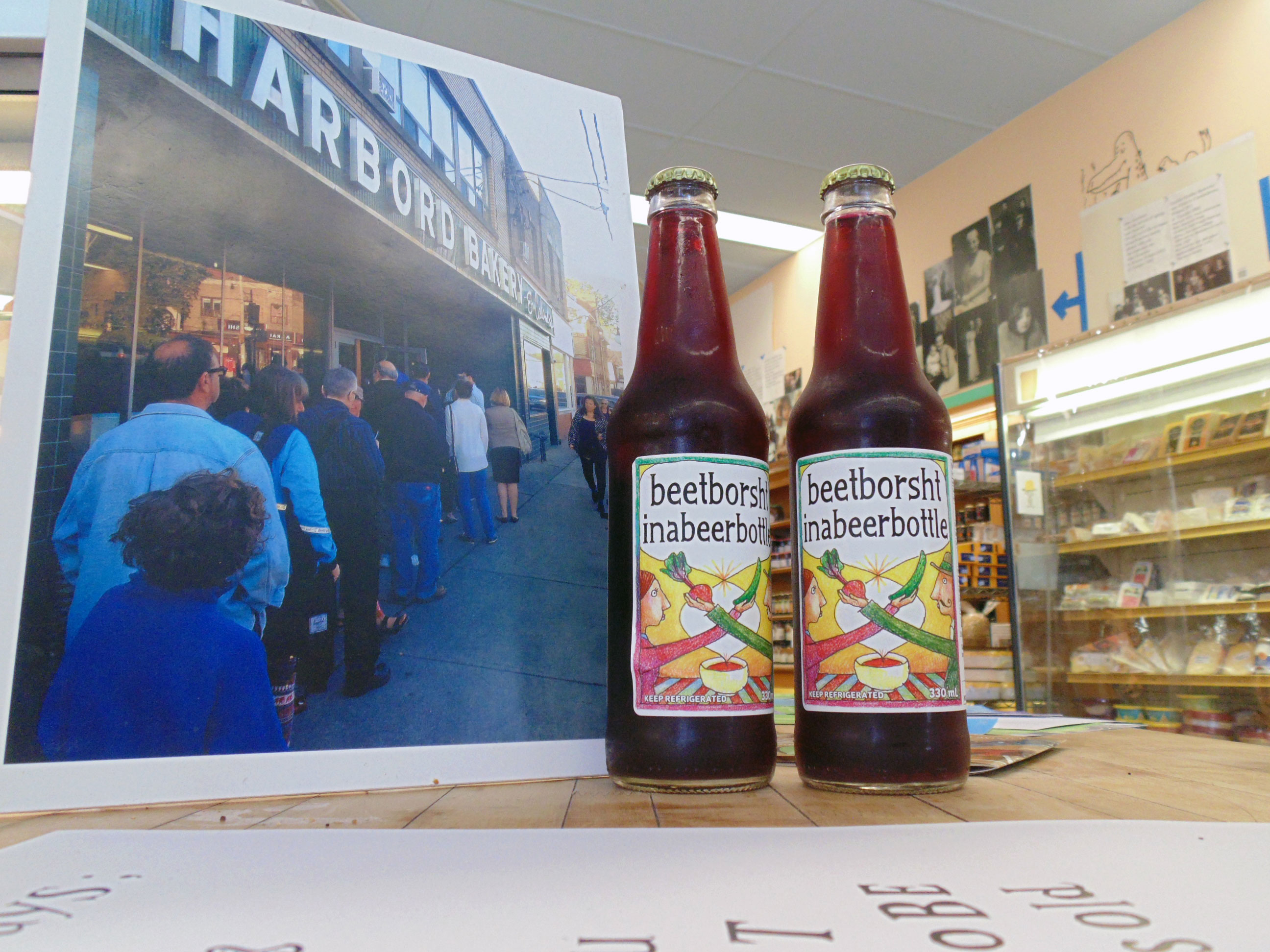
Harbord Bakery’s special beet borscht beverage, developed in honour of its 70th anniversary.
AXILE GERONA/GLEANER?NEWS
By Annemarie Brissenden
For Rafi Kosower, Roslyn Katz, and Susan Wisniewski, VE day will always be a little extra special. Because it was on May 8, 1945, that their parents, Albert and Goldie Kosower, bought “the little bakery next to the fish market [at] the corner of Harbord and Major streets”.
Seventy years later, Harbord Bakery – so much a part of the neighbourhood that there’s a local lane named after the Kosowers – is still going strong.
“We’re the only Jewish bakery left in downtown Toronto,” says Rafi Kosower.
He’s the oldest of the siblings, all of whom co-own and work in the bakery, which, these days, serves clientele – some second and third generation – of all faiths and cultures.
“Everybody likes everything, and it is hard to tell who is Jewish and who isn’t.”
“The neighbourhood has come alive,” says Katz. “It’s really wonderful. It’s art. It’s music. So many different kinds of people now, and everyone is friendly.”
Wisniewski, the youngest of the three, says the family works hard to promote a “nice feeling”, and loves the fact that clients whose “parents used to bring them, now bring their kids here”.
The trio has fond memories of growing up above the store. Basically born into the bakery, they had little choice about working in the family business.
“We couldn’t ever sleep in,” recalls Katz with a laugh. “As we grew, we all worked here. We all had to be a part of it.”
The family’s middle child, Katz remembers how “all my friends would follow me home, because they knew what was at the end of the trip.”
Wisniewski, who “didn’t understand when I got married that one had to eat day-old bread,” says she “used [the bakery] as an excuse if I didn’t want to go out”.
The store’s cash register sparks fond memories for Kosower.
“We didn’t really have an allowance…if you needed money for something, you’d take [it] out of the cash register and leave a note saying how much you took.”
Ovens were rare in the 1940s, 1950s, and 1960s and he also remembers how local families would bring “cakes in pans to [what is now Kosower Lane], and whoever was on duty would bake them for a minimal price, just like in the old country”.
Kosower, who did his master’s thesis on the Jewish baker in Eastern Europe and the Americas, says Harbord Bakery is a model of how Jewish bakeries in the diaspora evolved over time, especially when the end of the Second World War brought waves of immigrants to Toronto, and with them a broader range of baked goods.
“Young Jewish bakers applied for positions and learned how to bake more sophisticated things, like brioche, which were not characteristic of a Jewish bakery,” he explains. “Harbord Bakery became the place for secular Jews who appreciated tradition but were not into observance.”
While the bakery remains steeped in tradition, the family has never shied away from innovation.
“Prepared food is a really big thing now,” says Wisnieski. “We were one of the first people to offer prepared food 25 to 30 years ago.”
And they’ve developed a unique item in honour of the bakery’s seventieth anniversary: a beet borscht beverage, sold, of course, in a beer bottle.
“It’s a big success,” relates Kosower. “The customers are loving it and say it’s the greatest thing since sliced bread.”
The siblings haven’t made a lot of formal plans in honour of the store’s 70 years in business – “We’re kind of a spontaneous group,” admits Wisnieski – but they have sponsored some musicians and commissioned some artwork.
Perhaps the most significant celebration of the bakery’s legacy is that so many customers have become dear friends, a fact highlighted by all three of Albert and Goldie Kosower’s children.
“The many friends who started as customers at the bakery are legion in number,” says Kosower.
Wisnieski agrees, saying “the people that come into the bakery are so appreciative it makes it all worth doing.”
“We’ve made so many friends,” reflects Katz. “We’re still here, and we’re going to be here for quite a few more years hopefully.”
Tags: Annex · News · Food · People
August 28th, 2015 · Comments Off on How nice! Fall migration!
Tags: Annex · Liberty · Editorial · General
August 28th, 2015 · Comments Off on Westbank submits application
Proposal marked by diversity

An artist’s rendering shows the redeveloped Mirvish Village, as envisioned by Westbank in its application to the City of Toronto, from Lennox Street. The proposed development includes purpose-built rental housing, provides accommodations for cycling, and seeks to be as sustainable as possible.
COURTESY HENRIQUEZ Partners architects
By Annemarie Brissenden
The fine-grained retail and eclectic mix of buildings that developed over time along Toronto’s avenues is the inspiration behind Westbank Corp.’s application to redevelop the southwest corner of Bloor and Bathurst streets, which the company submitted to the City of Toronto last month. It’s been two years – two years of public outreach, community consultation, and research – since the company purchased the parcel of land that includes Honest Ed’s and Mirvish Village and is bounded by Bloor, Bathurst, Lennox, and Markham streets.
The application is detailed in a 150-page report that provides the site context, the proposal itself, an urban design analysis, planning policy context, and planning rationale. It is accompanied by draft amendments to the Official Plan and a Zoning By-Law. Both documents detail elements of the future development, named Mirvish Village, and largely cleave to the set of design principles that Westbank previously introduced at its open house in early March.
These 10 principles have been reframed as “benefits to the city” and include arguments for: the creation of a complete community that encompasses “retail, residential, and an array of civic services”; heritage conservation that renews “and extends the site’s history as a vibrant urban space”; an urban market of approximately 30 permanent vendors that recalls “the hustle and bustle of the Honest Ed’s store”; a pedestrian-oriented public realm; and, vibrant local micro and pop-up retail, particularly fine-grained retail along Bloor and Bathurst streets.
The five other principles-cum-benefits are: 1,000 units of purpose-built rental housing, with 50 per cent or more at two bedrooms or more, as well as the introduction of a new daycare; sustainable development that targets LEED Platinum ND certification and Tier 2 of the Toronto Green Standard; development that is transit-oriented and cultivates urban mobility like walking and biking; and, finally, a built form that respects the “site’s unique context, history, [and] surrounding communities” with “slim, vertically oriented building components that together form larger and more dynamic buildings”.
Designed to minimize shadowing and visual impacts on adjacent neighbourhoods, and dubbed micro towers due to their small floor plates that range in size from 500 to 600 metres squared, the application envisages that five of these slim, vertical buildings will range from 15 to 29 storeys.
The application acknowledges that “Bloor Street is predominantly low-rise in this area, [but] it is expected to intensify over time, particularly in the four corners area.” The placement of the towers amongst the lower-rise buildings is meant to mimic the streetwall pattern along Bloor and Bathurst streets, “transitioning down in height as it extends outward from the intersection”. Each tower will have its own style, which is not only a nod to the local built-form, but gives the appearance that the neighbourhood has developed organically and underscores a dedication to diversity.
Although there are common elements that subtly connect the project’s individual components into a cohesive whole, diversity – of building type, residential type, retail type, and even transportation type – is the main driver of this mixed-use development.
It also celebrates eclecticism, honouring the best elements of Mirvish Village and Honest Ed’s, while discounting the worst, such as the way the large format store disrupted “the fine-grained character of retail along Bloor Street”. Westbank proposes to pay homage to Honest Ed’s “iconic, zany signage” by installing “vibrant, eclectic signage” for the retail along Bloor and Bathurst streets, and preserve much of Markham Street’s heritage.
The houses at 588 to 594 Markham St., and 596 to 598, will all be conserved in situ and rehabbed, while 581 to 598, and 593 to 597, will be conserved, rehabbed, and integrated into the new construction. The house at 610 will be relocated to 591 Markham St., and restaurants will be located in conserved historic houses located along the southern portion of the street. A new laneway will provide east/west access for vehicles and pedestrians from Bathurst to Markham streets, while Honest Ed’s lane has been relocated to the west, and designated as an intimate pedestrian space featuring micro retail.
It’s a proposal that values cycling, transit, and pedestrian comfort over cars. It separates vehicles and pedestrians to maximize the public realm, and “all parking and the majority of loading activities have been located below grade”. The application does not specify how many parking spots it will include, but argues that “Mirvish Village strikes a balance between providing adequate parking to address demand and minimize impacts on neighbouring areas while also limiting parking enough to discourage vehicular access as a primary mode of transportation”.
This is part of a series of Gleaner articles on the Westbank development. Upcoming articles will focus on the community’s response to the proposed application, examine specific components of the proposed development, and profile the people involved. For story ideas, or comments, please email gleanereditor@gmail.com.
Tags: Annex · News
August 28th, 2015 · Comments Off on

Connor Lewis of the Toronto Maple Leafs digs in during Intercounty League playoff action this month at Christie Pits. The Leafs’ post-season run took the team all the way to game seven of the semi-finals, before being eliminated by the Barrie Baycats, the defending champions. The Leafs will return for their 48th season of baseball at the Pits next May.
R.S. KONJEK/Gleaner News
Tags: Annex · Sports · General
August 28th, 2015 · Comments Off on Choreographing partnership
Porch View Dances bridges art and audience
By Axile Gerona
Local porches will come alive with dance once again this summer, when Porch View Dances returns for the fourth year to Seaton Village.
“From Aug. 19 to 23, choreographies by real-life professional dance couples Karen Kaeja and Allen Kaeja, Michael Caldwell and Louis Laberge-Côté, and Ofilio Sinbadinho and Apolonia Velasque will be showcased through the stories of participating families told along the streets of Seaton Village,” says publicist Sue Edworthy.
In Porch View Dances, mounted by Kaeja d’Dance, a contemporary dance company, the audience meets at 84 London St. and then promenades from porch to porch to witness stories unfold through dance. The unusual performances also unite professional dancers with amateurs and “non-dancers” alike, many of whom are families and couples who live in the neighbourhood.
Working with inexperienced “non-dancers” brings its own set of challenges.
“As dancers and artists, we are used to working six hours straight in the studio, but that doesn’t happen with the families,” explains producer Jaclyn Rodrigues. “The breaks are very frequent, and choreographers go over the movements a lot. It’s about learning how to adapt and working differently. Families get to see how artists work, while artists see how real, everyday people work.”
It’s a collaboration in which the choreographers draw inspiration and direction straight from the houses and shared stories of the participating families. Also, notes Rodrigues, “the hours spent rehearsing create time for the families to come together and be together in this really special project”.
New this year is “The Wedding Brigade”, choreographed by Karen Kaeja. Featuring “everyday women”, some as young as 10, the female performers – single, divorced, married, never been married, some on their second marriage – all wear white.
“Some of the women are wearing their own wedding dresses. The idea is to show the western culture of wearing a white wedding dress and all the weird baggage that comes with that,” says Rodrigues. Not just an opportunity to comment “on relationships and the stories of women”, developing the piece itself created a space for these women to share and listen to each other’s stories.
Other pieces celebrate the stories of a neighbourhood and engage “real people, in real time, in real spaces”. And in sticking with tradition, the performances will conclude with “Flock Landing”, the finale in Vermont Square Park in which audience members – irrespective of dance skill or experience – are encouraged to participate.
Meant to bridge professional art with the general public, Porch View Dances is designed to be audience-inclusive and encourage spectators to be active participants in the creation of art through dance.
That theme of inclusivity permeates more than just the performances themselves. Porch View Dances depends on volunteers for its success, and it’s not uncommon for entire families to donate their time to the arts enterprise. The volunteers, who manage audiences as large as 400 people per performance, work together as they control transit by making sure the Porch View Dances route is accessible and car free. They also ensure that spectators move smoothly from site to site and successfully follow the flow of the performances in the neighbourhood.
“Events like Porch View Dances are unique and uplifting. Not only do they serve to edify the residents of our? ?neighbourhood, but they inspire and promote community engagement,” says Elden Freeman, president of Freeman Real Estate, which sponsors the event.
After four years, Porch View Dances has become a summer tradition for many Seaton Village families, and has attracted acclaim from the dance community.
The Canadian Dance Assembly has presented Porch View Dances with the I Love Dance Community Award, and nominated it for the I Love Dance Innovation Award.
Join the Porch View Dances as dancers, volunteers, and families celebrate love, partnership, family, and neighbourhood through dance from Seaton Village porches later this month.
Porch View Dances runs Aug. 19 to 23. Performances start at 7 p.m., 4 p.m. on Aug. 23, and are pay what you can.
For further information, or to volunteer, please email outreach@kaeja. org or visit www.kaeja.org.
Tags: Annex · Arts · People