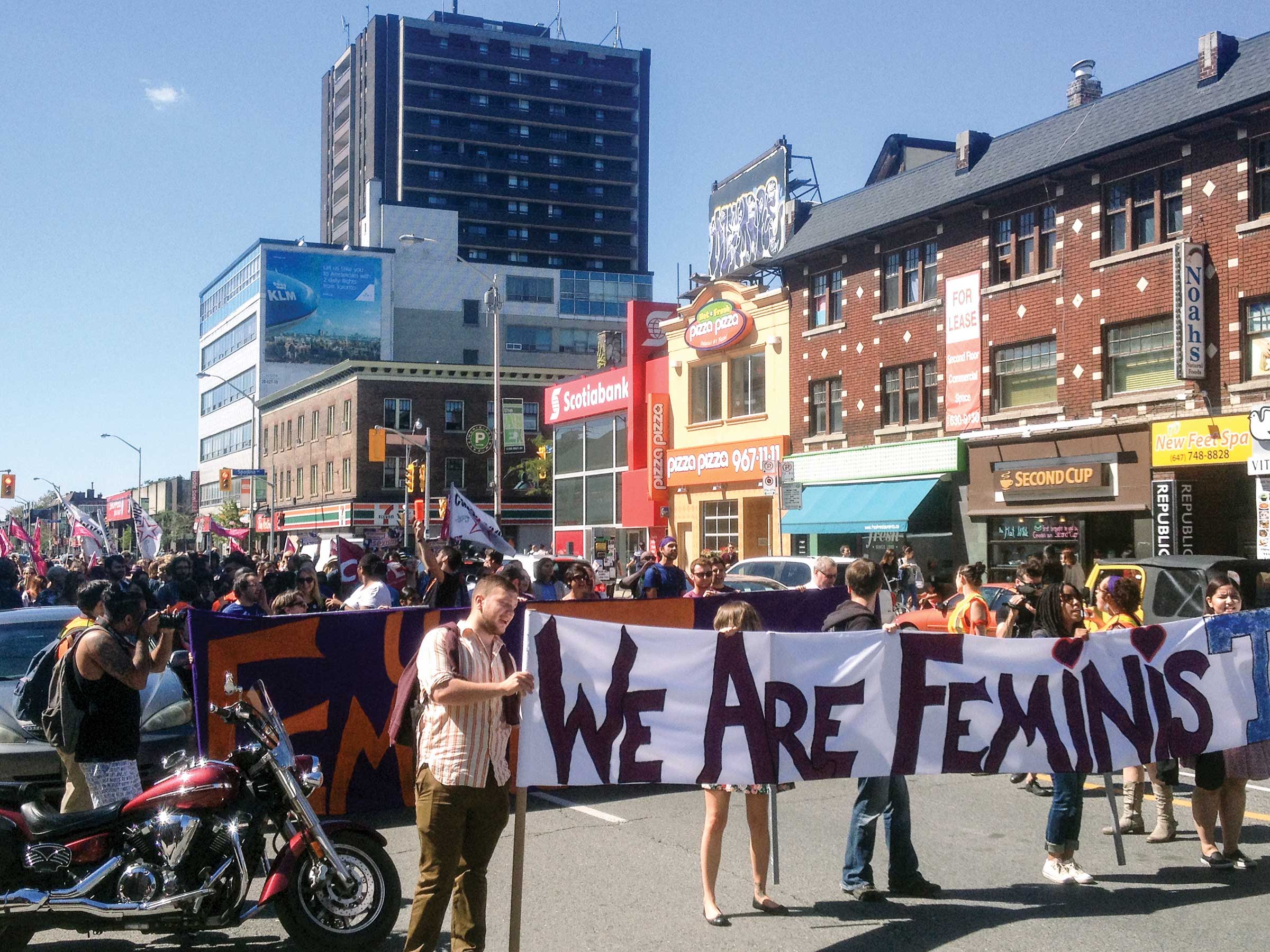
Hundreds of University of Toronto students, faculty, and staff take to Bloor Street just east of Spadina Avenue on Sept. 14 after the university announced that online threats had been made against feminists.
Brian Burchell/Gleaner News

Hundreds of University of Toronto students, faculty, and staff take to Bloor Street just east of Spadina Avenue on Sept. 14 after the university announced that online threats had been made against feminists.
Brian Burchell/Gleaner News
Comments Off on Tags: General
College and Russell streets facilities at risk

Brookfield, which is developing condominiums at the southeast corner of Spadina Avenue and College Street, says its property across the street, leased to CAMH, should be valued on highest and best use. Doing so would increase the hospital’s rent by as much as 333 per cent.
Brian Burchell, Gleaner News
By Brian Burchell
The College Street branch of the Centre for Addiction and Mental Health (CAMH) is facing a whopping 333 per cent rent increase when its lease is renewed for another 20-year term in 2018.
The landlord, a numbered company owned by Brookfield Asset Management, says raising the rent from $1.2 to $4 million a year is justified given the underlying value of the land.
Under the terms of the hospital’s lease, which was signed in 1998 and includes an adjacent state-of-the-art research facility at 33 Russell St., CAMH has the option to renew for two additional 20-year terms, subject to negotiation. At this point, the parties are so far apart that a negotiated settlement seems unlikely.
The crux of the dispute appears to be what yardstick to use when determining the underlying value of the land. Brookfield, which is formerly known as Brascan and has $27.9 billion in assets in Canada (including First Canadian Place), is using the real estate principle of highest and best use to determine value. The appraiser for CAMH pegs the present value of the lands at $24 million, while the appraiser for Brookfield says they are worth $103 million.
“My hope was that Brookfield would negotiate in good faith, instead of what is now an expensive, formal legal process,” said Joe Cressy (Ward 20, Trinity-Spadina). “When the lease was established in 1998, it stipulated that there would be three 20-year terms and that throughout the only use of the space allowed would be a hospital. For Brookfield to take the position that it could be anything else for the purposes of determining valuation is not acting in good faith.”
Not only does the original lease prevent Brookfield from using the site for anything other than a hospital until 2058, any attempt to replace the hospital with a mixed-use condominium development would not be supported by the City of Toronto, argued Cressy, who views the move as “an attempt to strong-arm a mental health hospital to make room for condos”.
Brookfield’s ownership of the land dates to 2004, when the provincial government, sold the property to the company for $16 million.
“This was a foolish decision by the former Harris and then Eves governments which shows you that what happens when you sell off public assets to make a quick buck is you risk future generations,” said Cressy. “Our downtown neighbourhoods are growing in leaps and bounds and the reality is we need more health services to support a growing population.”
CAMH’s College Street location not only serves the area’s growing population, but also treats patients from across Ontario in the province’s only 24-hour mental health emergency station. Approximately 9,000 people were treated in the site’s emergency department alone last year, up from 3,500 just five years ago. And according to Dev Chopra, CAMH’s executive vice president of clinical programs, this number is increasing by 7 to 10 per cent a year.
“The prevalence of mental illness in society is wide, and as celebrities and athletes start to acknowledge their own illnesses, this has an impact on the population,” said Chopra, who attributed the growth in patients in part to “an awareness within society about mental illness, the reduction of stigma related to mental health issues, and the increasing accessibility of CAMH services”.
There’s also an increasing intersection between the Toronto Police Service and the mental health care system in Ontario. As former Supreme Court Justice Frank Iacobucci wrote in a report in the wake of the shooting and killing of Sammy Yatim by a Toronto Police officer, “the system must recognize that the Toronto Police Service is dispatched to approximately 20,000 calls for service annually to persons-in-crisis, and about 8,000 of these events involve apprehensions under the Mental Health Act”.
Most recently, CAMH and Brookfield appeared before superior court in July to settle a dispute over the process for determining a compromise between the parties.
“The lease stipulates that a third party appraiser will appraise the value of the lands in 20 days, should the parties not agree,” explained Chopra. “The court decided in 2006 that the appraisal process should be akin to an arbitration [where the parties can make submissions and cross-examine each other’s submissions]. It was necessary to go back to court recently, because Brookfield felt that the appraiser should decide what the prevailing rent should be within 20 days, notwithstanding the 2006 decision.”
In a judgment released Aug. 11, Justice G. Dow ruled that the lease stipulated that an appraiser would determine the site’s value (and therefore the rent), but with the caveat that the appraiser must conduct the process as an arbitration. The court has also appointed Ken Stroud, who previously appraised the site in 2006 and is taking submissions until Sept. 15. He will then announce a binding decision within 30 days.
Andrew Willis, Brookfield’s senior vice president for communications and media, who was reached just before press time, declined to comment except to say “we are still working things through with CAMH, and we value our relationship with all of our tenants and we are working hard to resolve the issue”.
Comments Off on CAMH rent may skyrocketTags: Annex · Liberty · News
Lillian H. Smith library branch celebrates 20 years
By Annemarie Brissenden
Can you remember the first book you ever read?
Picture cracking open its spine and tracing the letters with your finger, as you try to make sense of the words. Remember your delight at the illustrations, giggling as the brilliant colours leapt off the page. If you discovered that book in your library, at your school, or even in the children’s section of your local bookstore, it was likely thanks to Lillian H. Smith.
A champion of children’s literacy, Smith (1887-1983) was a library science pioneer whose profound influence on generations of librarians had a global reach. She was the first trained children’s librarian in the British Empire, taught children’s literature courses at the University of Toronto’s library school, created a classification system for children’s literature that was used well into the 1970s, and established library branches in public schools. In 1922, Smith founded Toronto’s first free-standing children’s library, the Boys and Girls House, which was located on St. George Street and would become a flagship for children’s library services available in 16 branches, 30 schools, and two settlement houses across the city.
And this October, the Toronto Public Library branch at College Street and Spadina Avenue that bears her name, and – thanks to Smith’s legacy – is home to one of the foremost collections of children’s literature in the world, is celebrating its 20th anniversary. There will be Alice in Wonderland themed events (in honour of the book’s 150th anniversary), the launch of a digital stories project, and a special birthday celebration.
“On Oct. 17, Saturday, there will be a giant book sale from 11 a.m. to 3 p.m. The funds raised will support Toronto Public Library’s literacy programs,” says branch head Sarah Bradley. “We also will have a puppet show, followed by a scavenger hunt, craft making, and refreshments.”
The focus on children’s activities is a fitting tribute to the branch’s heritage and the woman for whom it’s named.
“This is a descendant of the Boys and Girls House, the first freestanding children’s library in the Commonwealth,” explains Leslie McGrath, a senior department head, who has been working at the branch since it opened in 1995. “When [the Boys and Girls House] opened in the 1920s, it was so well loved. The children literally wore the building out…that heritage of being a children’s library, belonging to the children, is quite wonderful.”
Bradley, who has been at the branch since 2009, also highlights the branch’s history: the building “holds a lot of history. [It] is beautiful. Architecturally, it looks like a castle and we have the griffins out front.”
For today’s readers, those griffins may have an added significance. The branch’s unique collections, which include the Osborne Collection of rare, early children’s books and the Merril Collection of Science Fiction, Speculation and Fantasy, not only attract students of all ages but also special guests.
“Aside from our regular visitors, we have authors come in as well. You’d be surprised,” says McGrath, opening a guest book at a page signed by J. K. Rowling, who left a message alongside a drawing of the Hogwarts sorting hat. Leafing through to another page, she points to Empress Michiko of Japan’s signature, a memento of an imperial visit to the Osborne Collection.
The library is a full service branch and its uniqueness extends from its collections to its programming.
“Recently we started our literary speed dating event, [which] went really well,” relates Bradley. “People brought one of their favourite books as something to talk about if they needed to and spent five minutes with each person. They had literary pseudo names like Harry Potter or Jane Eyre.”
As the branch head notes, “It’s a lively space.” Her favourite yearly event is the big lion dance on the ground floor for Chinese New Year. It’s a marked difference from when she first started working there, when “the library was about the physical collections, like the books, that took precedence. But now people [use] this library to gather, study, use the free wi-fi, borrow e-books, and use apps…a lot of our collection development is around the e-services.”
One special on-line initiative launching in conjunction with the branch’s anniversary is the Digital Stories Project, the brainchild of page Christina Wong. She is collecting stories and memories of the library, the Boys and Girls House, and the neighbourhood, which will be collated into an on-line exhibition.
“I want to encourage regular citizens to be local historians,” says Wong, who hopes to develop a toolkit that can be used to create the same exhibition at other branches.
Although she grew up mostly going to the Palmerston branch, she does have vague memories – “mostly I remember the smell of it” – of visiting the Boys and Girls House as a child.
She’s still collecting stories, but her favourite so far is from a newcomer to Canada, who recorded how the branch helped her to adjust to life in Toronto.
“We take for granted what a library is,” reflects Wong. “[The story] affirmed the role that libraries can play in a community.”
The Lillian H. Smith branch (239 College St.) of the Toronto Public Library celebrates its 20th anniversary on Oct. 17 with a birthday party from 2 to 4 p.m. For further information, please visit www.torontopubliclibrary.ca. To share a story with the Digital Stories Project, please contact Christina Wong at cwong@torontopubliclibrary.ca or 416-393-7746.
—with files from Axile Gerona
Comments Off on A haven for children’s literatureTags: Annex · Liberty · News
Dupont Station will soon be fully accessible to all riders, regardless of mobility. It’s currently undergoing an upgrade under the Toronto Transit Commission’s (TTC) Easier Access Program, which aims to increase the accessibility of subway stations across the city. The station improvements – slated for completion in 2019 – include adding three elevators that will access all levels of the station, accessible fare gates, barrier-free paths to the subway platforms, improved signage, and the installation of CCTV security cameras.
Riders and residents are welcome to learn more the progress of the improvements and the impact of construction at Spadina Road and Dupont Street at an open house on Sept. 24 from 6.30 to 8.30 p.m. at the Toronto Archives (255 Spadina Rd.). TTC staff will be on hand to talk about the project, which will also be featured on information displays.
—Brian Burchell
Comments Off on Improving accessibility at Dupont StationTags: Annex · News · General
Construction, lane reductions, and bus diversions are here to stay at Spadina Road and Bloor Street, at least until December, and quite possibly well beyond.
Work is underway to excavate the northbound side of Spadina Road near Spadina Station to make necessary repairs to the roof of the subway below. The entire bus loop roadway is also being removed to expose the subway roof.
Station access is maintained for pedestrians, but the buses will now loop at Spadina Circle (just north of College Street) instead. In its service bulletin the TTC calls the work “structural rehabilitation and repaving of the bus loop”.
This is Phase 2 of the work. Curiously, Phase 1 – excavating the southbound lanes of the west side of Spadina Road – will commence after Phase 2, and the start date and duration of it are yet to be announced.
—Brian Burchell
Comments Off on Spadina Station is a construction junctionTags: General
Hidden treasures, baked goods, food, crafts, books, CDs, and more all return to the fall fair this Oct. 3 (11 a.m. to 7 p.m.) and 4 (10 a.m. to 4 p.m.) at St. Peter’s Church (659 Markham St.).
This annual two-day event – part flea market and part culinary festival – attracts crowds who enjoy the multicultural tastes of the Annex, which have changed over the past century. Mass at the church was originally celebrated in three different languages each weekend, in order to accommodate the diverse ethnic groups attending the church.
The fall fair continues to honour this multicultural heritage with a wide array of food and items for sale, now mostly from the Portuguese, Italian, and Korean communities.
—Brian Burchell
Comments Off on A multicultural fall fair at St. Peter’sTags: Annex · News · General
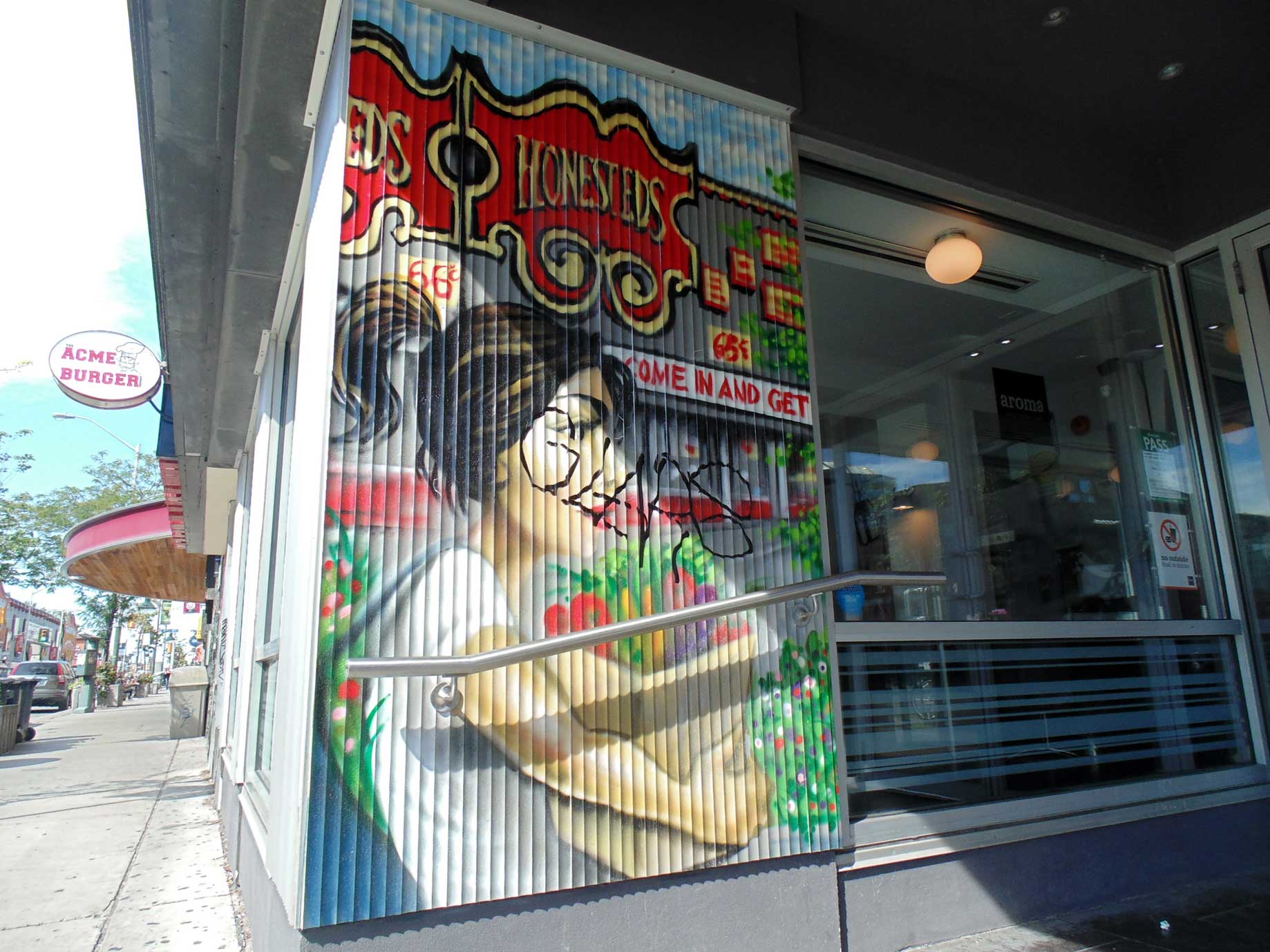
Erica Balon’s mural, featured on the front page of July’s Annex Gleaner, has been tagged as much as five times in recent weeks. Much of her work, including this one at Aroma Café (500 Bloor St. W.), covers tags and other gang-related symbols. The repeated tagging begs the question of whether or not street art – traditionally seen as inviolate to taggers – remains something that vandals will respect. Brian Burchell, Gleaner News
Comments Off on Tags: General
Heritage Toronto plaque honours poets MacEwen and Acorn
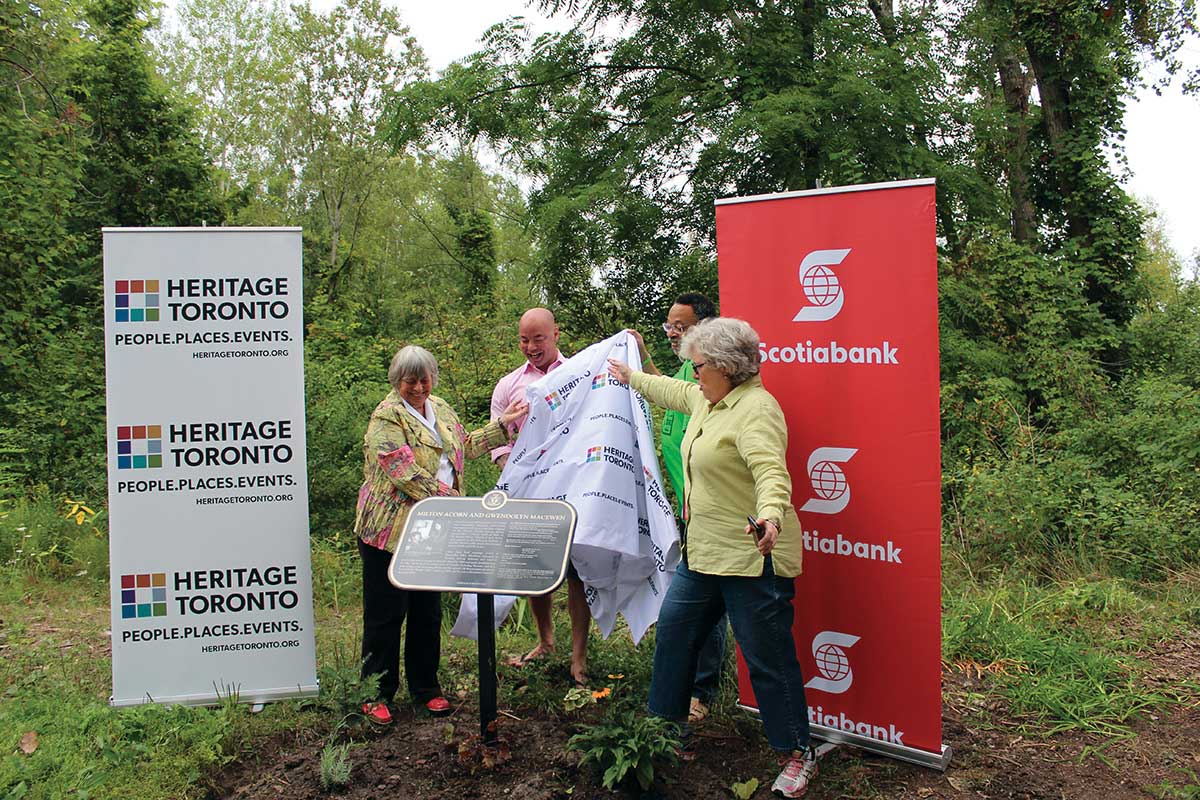
Pam McConnell (Ward 28, Toronto Centre-Rosedale), Christopher Hayes of Scotiabank, poet laureate George Elliott Clarke, and Heritage Toronto board member Kate Marshall unveil a plaque on Ward’s Island commemorating poets Gwendolyn MacEwen and Milton Acorn.
COURTESY HERITAGE TORONTO
By Annemarie Brissenden
He was large, gruff, almost a bully, and an ardent Marxist who used poetry to foment revolution. Equally passionate, she was a fey little thing who decided in her teenage years that she would live for poetry. And for a brief, explosive time, Milton Acorn and Gwendolyn MacEwen were married and living on Ward’s Island at 10 Second St. All that stands there now is a vacant lot – the house they lived in was demolished in the 1970s – but a Heritage Toronto plaque unveiled late last month will ensure that the poets and their legacy are not forgotten.
“They were an important couple for the flowering of Canadian poetry that took place in the 1960s, particularly in Toronto,” explains George Elliott Clarke, the City of Toronto’s poet laureate and the E. J. Pratt Professor of Canadian Literature at the University of Toronto.
Having worked previously with Heritage Toronto to install a plaque honouring poet Raymond Souster, Clarke – long captivated by the couple’s story – thought one focused on MacEwen and Acorn would be equally successful. Yet, he’d never even been to the island before the bitter cold day in November when the team came over to look for a suitable site.
“For a guy from PEI, living on the island had to have been for [Acorn] a little bit of homesickness being remedied,” reflects Clarke, who likes the spot at the intersection of Second Street and Lakeshore Avenue. He wasn’t sure that MacEwen found it quite so bucolic.
But for the residents of Ward’s Island who turned up at the plaque’s unveiling, MacEwen’s presence seems to have left a permanent stamp on the landscape.
“You move in and you hear about her right away,” says Barbara Klunder, who has lived on the island for 30 years. “It’s in the air.”
Her friend, painter Pat Jeffries, also an island resident, concurs.
“There’s a lot of poets over here; they owe her everything.”
There are so many stories of MacEwen to tell. One tale is of her regular walks with a man everyone dubbed Merlin because of his tendency to wear a turban and cape when out and about. He believed he was in contact with extraterrestrial beings, and wrapped their house in tinfoil to ward off evil rays.
MacEwen had decided early on that she would be a poet and never had any interest in doing anything else. She was a mystical poet, relates Clarke, and “one of a few Canadian poets to achieve greatness without having acquired a university education. Language systems inspired her, and her poetry tends to be as mystical and cryptic as her understanding of language systems.”
Yet her poetry still resonates with many people.
“I always think of her as a passionate woman,” says Joanna Poblocka of the League of Canadian Poets.
Henry Martinuk, also at the unveiling, remembers meeting MacEwen at the Harbourfront Reading Series.
“She was incredibly generous, kind, and patient with the hundreds of people who wanted to meet her and have her sign a book,” he recalls. It’s quite a contrast to his encounter with Milton Acorn, whom he met at the Kress Grill when he about 16.
“He called me a little shit.” It was a better response than he expected.
“Acorn was probably the most important political poet of the 1960s. He wrote in a very insistent fashion. He was a revolutionary dude,” says Clarke. He believes, though, that “the poems by [Acorn] that people are likely to remember best are the ones that deal with nature and are very romantic”.
Both poets were innovating in Canadian poetry from the island, adds Clarke, which is what the plaque celebrates. It includes a picture of MacEwen and Acorn, and quotes from poems they wrote for each other.
Heritage Toronto board member Kate Marshall said she liked the plaque because it honours not just a historic site or location but people, two “very accomplished Canadian literary figures” who “both made important contributions to Canadian literary culture”.
“We don’t often think of the island and its great heritage,” says Pam McConnell (Ward 28, Toronto Centre-Rosedale). “Babe Ruth knocked his first homer out of [Hanlan’s Point Stadium] on the island [for the Toronto Maple Leafs].”
The local councillor characterizes the island as “one of the first great artists’ colonies in the city” and highlights “the spirit of individualism and creativity embedded in the spirit of its residents”.
Effusive and almost rushing into rhyme – “sorry for speaking so fast, I come from Halifax” – Clarke admits that the couple didn’t have the happiest of marriages, “but the happiest part of it was probably their stay in this community”.
Both poets would go on to live in the Annex, where Acorn famously lived in the Waverley Hotel, and there is a park named for MacEwen at Walmer Road and Lowther Avenue. Acorn won the Governor General’s Award for poetry in 1976 for The Island Means Minago, while MacEwen won in 1969 for The Shadow Maker, and again in 1987 for Afterworlds. They passed away within a year of each other in 1986 and 1987 respectively.
Comments Off on Unveiling literary historyTags: Annex · Liberty · Arts
Just as the stigma surrounding mental illness has started to dissipate, the College Street location of the Centre for Addiction and Mental Health (CAMH) is facing a crisis of its own.
Its landlord, a numbered company owned by Brookfield Asset Management, is playing hardball during a scheduled negotiation in which it is seeking to increase the rent from $1.3 to $4 million, representing a whopping 333 per cent per annum. That amount also represents approximately 34 staff positions at a time when the hospital’s revenue is frozen – like that of all hospitals across the province – as Ontario experiences a fiscal crisis of its own.
CAMH served 31,000 patients last year, 9,000 of whom visited their emergency department, the province’s only 24-hour mental health emergency station. The Toronto Police Service relies heavily upon this facility to deal with members of the public whom it apprehends under the Mental Health Act. Also subject to the rent dispute is the adjacent building at 33 Russell St., which houses state-of-the-art reasearch facilities.
Moving that facility would cost more than the rent increase, a vulnerability that the landlord seems eager to capitalize on, as it squeezes the public health provider for all it can get.
Brookfield’s reps justify the rent increase by arguing that the land value is worth more for condominiums (because apparently we don’t have enough of those). There is a lease, and it stipulates that CAMH can expect three 20-year terms, the first of which began in 1998. The rent is subject to renegotiation at each renewal, with the next renewal slated for 2018.
It’s not the only thing the lease states. It reiterates that the site – zoned for institutional use – may only be used for a hospital. Any other use, such as a mixed-use condominium development, would require approval from the City of Toronto. Neighbouring University of Toronto, the city’s own planning department, and local city councillor Joe Cressy (Ward 20, Trinity-Spadina) have all signalled that they would vigorously oppose any application to change the site use designation.
The lease itself is a bit of a muddle insofar as it does not expressly say that the rent should be determined by a valuation of the lands for the permissible use. Brookfield takes the position that the rent should follow from the best possible use. Their interpretation is at best opportunistic but is really more of a robber baron approach from another era, and only relevant if the site were a strip mall and not a hospital serving the public interest. As Cressy says, the landlord is acting in bad faith.
In 2014 the Supreme Court of Canada sought to codify what “acting in good faith” means in a commercial common law sense. The court held that the rule of honest performance must prevail and parties must not knowingly mislead each other about matters directly linked to the performance of a contract. For Brookfied to instruct an appraiser to value the lands for a use that they are not permitted to apply is dishonest and self-serving.
How is it that such an important health provider finds itself in the crosshairs of an aggressive landlord?
In 2004, the Province of Ontario sold the properties to Brookfield for a mere $16.3 million in a liquidation of assets that was the bright idea of the Mike Harris-Ernie Eves government. Given that the province is the primary funder of CAMH, they essentially took a quick buck, permanently ceded the ownership of the lands, and forced the hospital to issue rent cheques instead of services.
Brookfield, which has nearly $30 billion in Canadian assets alone, claims on their website that it “remains focused on the creation of sustainable, growing streams of cash flow”. One might hope that a landlord with such scale and dominance could see a bigger picture and be sensitized to who its tenants are and what they doing for the greater good.
Comments Off on It’s a hospital, not a strip mallTags: Annex · Liberty · News · Editorial
RE: Bloor “foremost a public space”?(July)
Thank you for your editorial “It’s really a village not a freeway” in the July edition of The Annex Gleaner. I can’t agree more!
The case for bike lanes on Bloor is strong: the route is flat and unencumbered by streetcar tracks, and many people continue to cycle along it, despite the absence of cycling safety measures.
In a 2013-14 study by Toronto Public Health as part of its “Healthy Canada by Design” initiative, Annex residents identified bike lanes on Bloor as their top “active transportation” priority. An earlier study by the Clean Air Partnership found that motorists bring only 10 per cent of the business to local shops, and that parking in Green P lots could make up for most of the loss of parking on Bloor Street.
The gist of these studies, reports, and observations is that our community would see countless safety, health, environmental, and economic benefits with a bike lane on Bloor.
I am pleased to be working with community members from across our northern neighbourhoods towards a pilot bike lane on Bloor Street for April 2016.
—Joe Cressy
City Councillor
Ward 20
Comments Off on Bike lanes a “top priority”Tags: Annex · News
RE: Bloor “foremost a public space” (July)
As someone who’s been pushing improvement in Bloor bike safety for at least a decade now, I’m glad that the Gleaner has kept up its coverage. And while I am in total agreement that improvements to bike safety are quite overdue in the Annex, I’m less certain that the proposed trials of bike lanes are in the right place or with the right timing.
The dire need for Bloor bike lanes is west of Ossington to Lansdowne, and far less in the Annex area where we have an upgraded Harbord Street, plus Barton and Lowther, and other side streets and alleyways. We have options here, but as one goes west, the options for east-west travel dwindle to a few main roads, including Harbord at Ossington, but then what?
If we wish to have a bikeway ease transit, we need to have the large hole in the west end filled and start with Bloor, as it has no streetcar tracks that dictate lane positions. Here in the Annex, especially the narrow Bloor Annex, having a wider curb lane with a small centre median and copious sharrows might be enough for the time being, given how much of a red flag bike lanes can be.
The major issue for bike lane installation usually tends to be on-street parking, and a wider curb lane would require removal of one side of car parking and a reduction in through-car lanes to one each way, whilst still letting a bit of flexibility occur for deliveries as some of the Bloor blocks don’t have back alleyways.
Also, the feel of Harbord Street now that it’s upgraded to the higher levels of bike lane, is far less of a place, and more of a corridor, albeit for bikes. On a bike, it’s not a big deal to drop down to Harbord, and that might mean Bloor can become even more of an urban place than it already is. Nuance is difficult with City Wall, and while I agree totally that bike safety is overdue for Bloor for finally providing a single east-west route to function as a transit relief, we need a few other segments of Bloor to be changed first ahead of the Annex, so let’s try changing the paint where it’s really needed, as difficult as that seems to be. Trials should also be done on rough pavement, not fresh asphalt, so given how rough parts of Annex Bloor are right now, this needs to be done this year.
As parts of Bloor are too nasty to be safely riding on now, a repainting to adjust travel locations for bikes might actually let the road be rough for another year, while improving bike safety and allowing for good redesign with an ability to see if bike safety changes harm businesses too much. They shouldn’t: the Annex area is quite well served with off-street parking.
—Hamish Wilson
Comments Off on Keep pushing bike safetyTags: Annex · Liberty · News
Opining on rail safety, daycare, development, health care, and Bill C-51
When residents in The Annex Gleaner coverage area go to the polls on Oct. 19, it will have been less than 18 months since they voted in a federal by-election to replace member of Parliament Olivia Chow, who had stepped down to run for mayor. Since then, the riding of Trinity-Spadina has been largely redistributed into two new ridings: University-Rosedale and Spadina-Fort York. With most Gleaner residents voting in the former, we asked candidates running for all four major parties in the riding to answer a series of questions on policy and their neighbourhood. However, for the first time in the Gleaner’s history, one candidate, Karim Jivraj of the Conservative Party of Canada, declined – at the last minute – to participate in this popular feature.
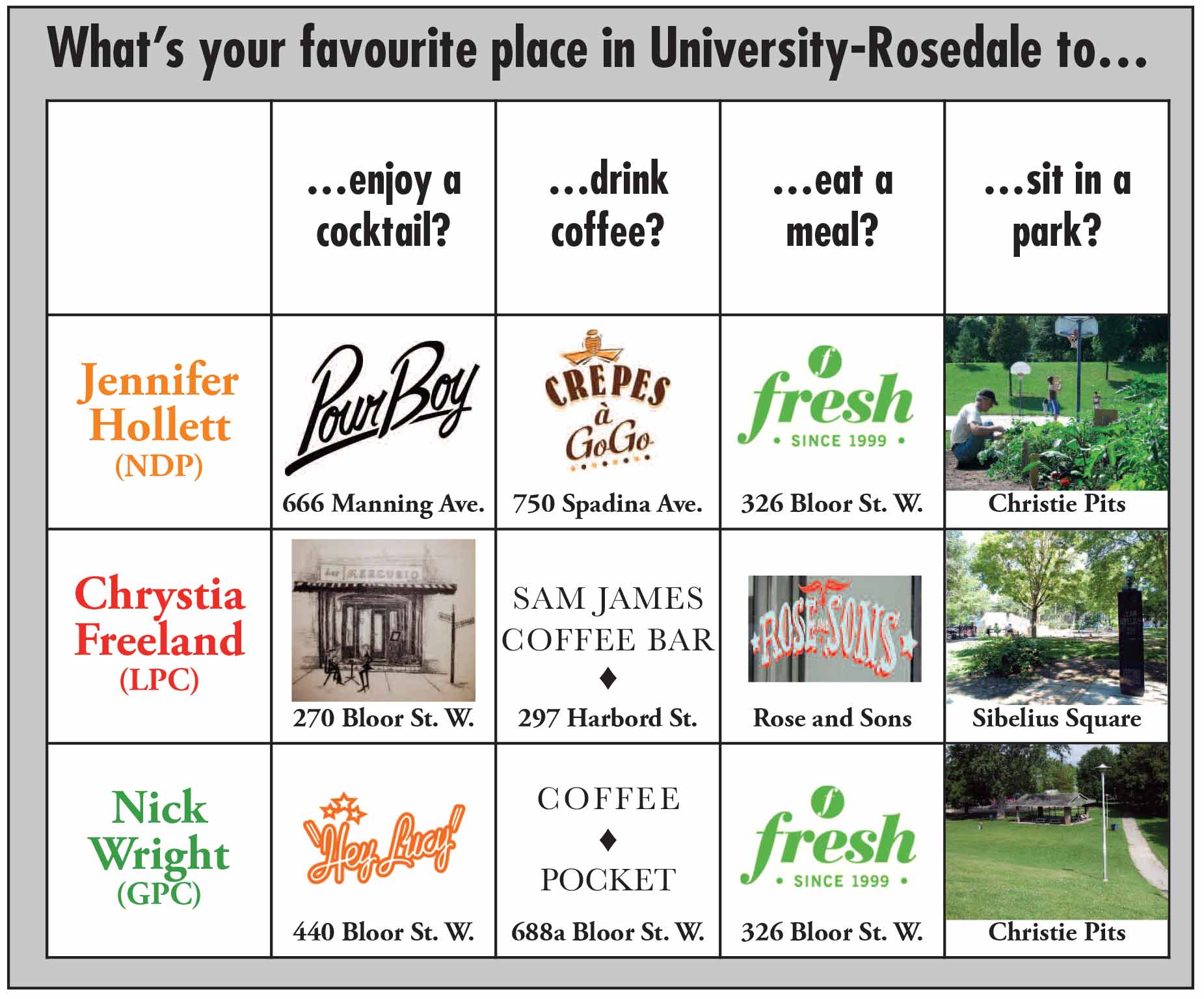
Compiled by Annemarie Brissenden
Are you satisfied that the major rail corridors in University-Rosedale are safe, particularly for transporting hazardous materials?
Freeland: Absolutely not. As the MP for Toronto Centre and as a local resident who lives next to the train tracks, I have been energetically involved in the rail safety issue.
This is an accident waiting to happen. It is something the federal government can fix – although Stephen Harper’s Conservatives have been missing in action. There are immediate steps we can take: we need more transparency about the dangerous goods which are being shipped, safer train cars, lower speed limits, better braking systems, and better controls on the volatility of the goods that are being shipped. In the medium term, we need to work on rerouting these dangerous goods so they are not travelling through the heart of our city.
Hollett: I am not satisfied that the major rail corridors are safe. I’ve attended the last four rail safety meetings in our community, and the deregulation of our rail industry by both the Liberals and Conservatives have led us to a very dangerous situation. The experts and the NDP agree, rail needs to be safe, regulated, and transparent. Otherwise we could still face a Lac-Mégantic here in University-Rosedale.
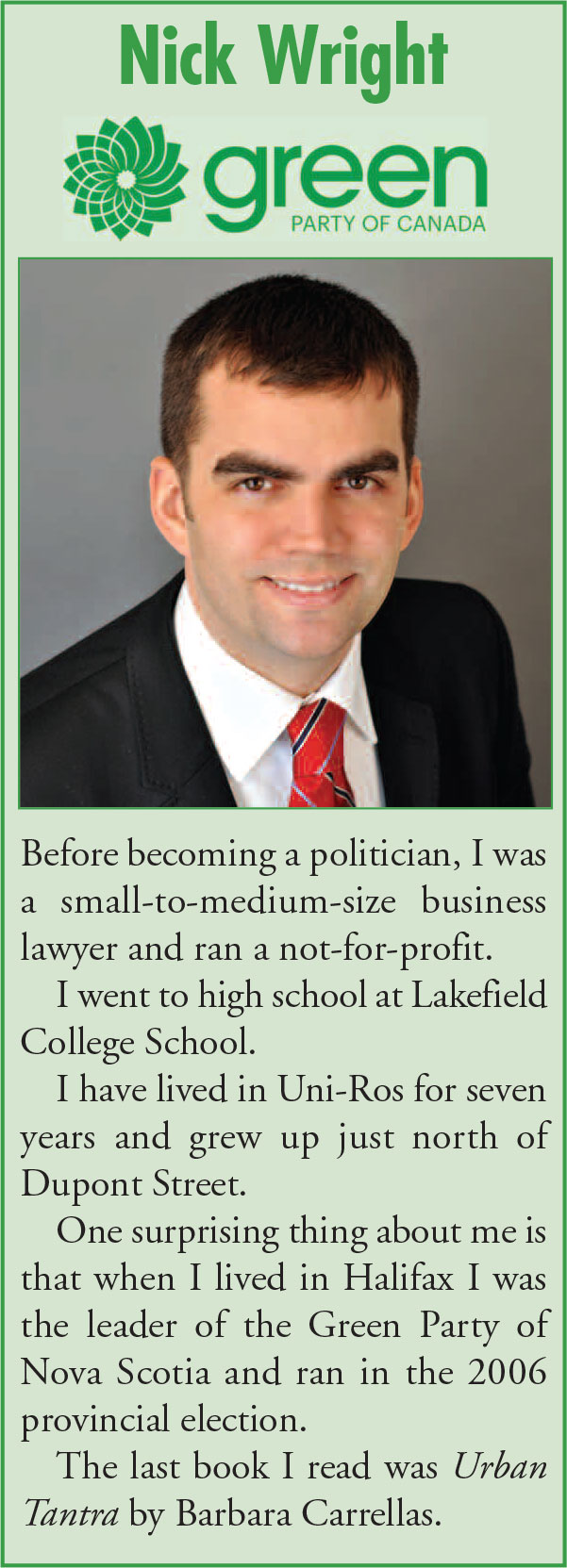
Wright: No, dangerous and volatile substances should not be transported through the riding. They must be stabilized prior to transportation, local first responders need to be given real-time information, and we should initiate community and industry consultations on transitioning the Dupont line to passenger rail integrated with our public transit network.
What do you think of Westbank’s proposal for Mirvish Village? What can you do federally to ensure that development and increased density don’t harm the area?
Hollett: I’ve spoken with many community members and resident associations about Westbank’s proposal for Mirvish Village. There is great interest in the rental units, mixed-use space, day care, and working with the community. Many details remain to be seen, but of all the proposed developments in our community, this has the most potential.
As a federal candidate and hopefully MP, I will continue to attend these meetings, working with our city councillors to make sure both housing and infrastructure needs are met. The municipalities can’t do it alone, federal support for affordable housing and public transit is key as our city continues to grow.
Wright: Westbank’s proposal for Mirvish Village includes innovative and exciting additions to the neighbourhood and community, though some issues regarding tower height and density still need to be addressed. As MP for University-Rosedale I will work closely with other levels of government to promote responsible development that adds to our community.
Freeland: It isn’t the federal government’s job to make decisions about local developments in University-Rosedale, and as someone who believes strongly in grassroots democracy I think it is important that decision-making powers always be vested as locally as possible. Decisions need to be taken as close as possible to the people they affect.
Having said that, it is essential that the federal government increase funding to cities so that they can build the infrastructure they need to support growing populations, including more affordable housing. These needs are particularly acute in Toronto, because our city is growing so swiftly.
A Liberal government would do precisely this, with the most ambitious infrastructure plan of any Canadian political party – an additional $60 billion over 10 years, including $10 billion a year for the next two years. This would have a huge impact on jobs, economic growth, and quality of life in University-Rosedale.
Westbank’s proposal for Mirvish Village is a concern for many of the local residents I have been speaking with on my canvasses. As MP I would work with Westbank and local residents to ensure the development is responsive to community input and conscious of the responsibility of all new projects in our historic neighbourhood to enhance the existing community. Including arts spaces, room for small, locally-owned businesses, and green sustainability is essential.
Do you support Bill C-51, aimed at reforming national security through modifications to the criminal code?
Wright: Absolutely not. Bill C-51 is an affront to the Charter of Rights and Freedoms and civil liberties. It is shameful that the Conservatives and Liberals supported this dangerous legislation and that the NDP was so slow to oppose it. We need to repeal the bill immediately, maintain the divide between domestic intelligence gathering and enforcement, respect the rights of citizens to express political opposition to government policies, and maintain privacy protections on personal information provided to government.
Freeland: The Liberal Party’s commitment will always be to defend the rights and freedoms of Canadians and to protect their safety. Mr. Harper doesn’t think we need to do anything more to defend our rights and freedoms, and the NDP doesn’t think we need to do anything more to protect our security. We need to do both.
There are understandable concerns with Bill C-51, and we’re committed to repealing and overhauling the parts that are problematic for many, including me. We’ll fix the bill to ensure adequate parliamentary oversight and mandatory legislative review, and to prevent misuse. Canadians should know that the NDP voted against Liberal amendments that proposed these changes.
When it comes to civil liberties and security, Canadians deserve serious and level-headed debate. Instead the NDP is joining Stephen Harper in resorting to the politics of fear.
Hollett: I do not support Bill C-51. The NDP voted against the bill, which has been criticized by the United Nations and is now in court. We don’t have to choose between security and our rights. It’s a false choice – we must protect both. We are committed to repealing Bill C-51. I’m proud to stand with Tom Mulcair and his principled approach on the issue. A lot of people in University-Rosedale tell me they are voting for the NDP for the very first time over Bill C-51.
Should the federal government fund childcare?
Freeland: The Liberal Party understands that Canadian families need support immediately, which is why our expanded child benefit plan would come into force as soon as a Liberal government takes office. It would lift 315,000 Canadian children out of poverty by supporting Canada’s poorest children with a tax-free $6,400 a year. A typical two-parent family, with two children, earning $90,000 a year would get a tax-free benefit of $5,875 a year.
As part of our broader infrastructure plan, we will boost investment in social infrastructure by nearly $6 billion over the next four years, and almost $20 billion over 10 years, including investments in early learning and child care. We will also fund the creation of thousands of new childcare spaces, enhance their quality, and ensure that affordable childcare spaces are available to more families who need them.

Hollett: The NDP is committed to affordable/accessible childcare at no more than $15/day, based on the model in Quebec where Tom is from. Parents in University-Rosedale are concerned about the high price of daycare in Toronto as well as the long waiting lists. $15/day childcare is a game changer. It’s long overdue. The NDP has also received support from chambers of commerce and boards of trade because employers realize our childcare plan is also good for the economy.
Wright: Yes. The federal government should help fund affordable childcare for those in need including working with business and industry to normalize on-site day care in the workplace.
Do you support the federal government’s new funding formula for health care? (Starting in 2016-17, the federal government will base its health care contributions to the provinces on economic growth.)
Hollett: Health care is a key issue in this campaign, and I’m proud to have so many doctors and health care workers volunteering on our campaign in University-Rosedale. Working in collaboration with the provinces and territories, the NDP will bring medicare into the 21st century. We’ll revoke the Conservatives’ unilateral decision to take $36 billion in anticipated funding out of health care, and engage with the provinces in a discussion of real needs. We support the development of new agreements that ensure improved health outcomes. We recognize the jurisdiction of all provinces over health care delivery, but want to work together to improve our public and universal health care system.
Wright: I am a strong proponent of high-quality publicly funded universal health care and oppose policies that are not based on medical need. I am deeply concerned that changes to health care contributions may lower the quality of care provided in some areas.

Freeland: Liberals believe that it is the federal government’s responsibility to work collaboratively with the provinces, territories, and indigenous communities to tackle health issues such as reducing wait times and strengthening community-based care, senior care, mental health, and prescription drug coverage.
Since coming to power, the Conservatives have made changes to how provincial health transfers are paid out that have resulted in steep cuts to important programs, including those administering drug treatment, mental health treatment, and suicide prevention. Further, the Harper government has announced unilateral reductions to health transfers after the Liberal Health Accord expires in 2017 that will completely cut funding for reducing wait times – at a time when Canada ranks last among OECD-country family doctor wait times and has shown no improvement in wait times since 2004.
→ 1 CommentTags: Annex · Liberty · News