October 8th, 2015 · Comments Off on Jet plan dead under Liberals or NDP
The Liberal and New Democratic Party (NDP) candidates for Spadina-Fort York (the southern half of what was formerly Trinity-Spadina) have come out strongly against any plan to expand the Billy Bishop Toronto City Airport. Sitting member of Parliament (MP) Adam Vaughan, and former MP Olivia Chow, who are running in Spadina-Fort York, have both said the plan to bring jets to Billy Bishop would be grounded should either of their parties form a federal government after the election Oct. 19.
“The Liberal Party will not reopen the Tripartite Agreement. No Jets. No Expansion. Period,” wrote Vaughan in a letter to Community Air, a local advocacy group that opposes the expansion of the island airport.
Chow was equally opposed to reopening the agreement in her letter, which like Vaughan’s was written in September, to the Clean Air Partnership.
“Porter Airlines and the Toronto Port Authority have to honour the existing Tripartite Agreement from 1983,” she wrote. “An NDP government will not amend the Tripartite Agreement to permit a runway extension for jets, or for any other purpose.”
The agreement, which governs the operation of the airport, is between PortsToronto (previously the Toronto Port Authority), the federal government, and the City of Toronto. However, many believe that the federal government controls PortsToronto, as it appoints its chief executive officer and board members.
The City of Toronto continues to study Porter Airlines’ request to bring jets to the airport.
—Brian Burchell
Tags: Annex · Liberty · News · General
October 8th, 2015 · Comments Off on Crime down except for localized gun incidents
Although gun crime is high in the entertainment district, neighbourhood crime and crime incidents related to gang activity is down, reported Staff Superintendent Francis Bergen of the Toronto Police Service at a 14 Division Community Police Liaison Committee (CPLC) meeting on Sept. 14.
Bergen said that gun crime has been “off the charts in the past three months with 19 shooting incidents resulting in five homicides”, but cautioned that the shootings, while alarming, were for the most part localized to the entertainment district of clubs and bars that has migrated west of Spadina Avenue.
Most of the incidents occur, explained Detective Sergeant Brian Kelly, when the 720 licensed establishments in the division shut down and patrons are lingering outside in summer conditions.
In its first meeting since June, the CPLC viewed reports spanning the three months period from June to September that showed residential break-and-enters down 55 per cent and commercial break-and-enters down 25 per cent, each over the same period one year ago. Robberies, such as cell phone theft, purse snatchings, and hold-ups, are at the same rate as last year, and represent a total number of 45 reports over the three-month period. Theft-of-autos is up 10 per cent from last year, but includes a spike in motorcycle thefts from parking garages in the south end of the division.
The division polices the area from the lakeshore to the south to the CPR tracks near Dupont Street to the north, and from Spadina Avenue in the east to Dufferin Street to the west.
—Brian Burchell
Tags: Annex · Liberty · News
October 8th, 2015 · Comments Off on Capturing the Ward
A jumble of stories about an area lost to time
By Annemarie Brissenden
Before there was Ed Mirvish and his free turkey giveaways, there was Merle Foster and her annual Christmas trees; parties the sculptor would throw in St. John’s Ward for children who would have little other pleasure during the holiday season.
Foster’s story is just one of many delightful snippets to be discovered in The Ward: The Life and Loss of Toronto’s First Immigrant Neighbourhood. Edited by John Lorinc, Michael McClelland, Ellen Scheinberg, and Tatum Taylor, it’s a ragtag collection of essays, photographs, and narrative memorabilia about the area bounded by University Avenue, and College, Queen, and Yonge streets. Now known for Nathan Phillips Square, City Hall, high rises of office towers and condominiums, for many years the rectangular swath of city blocks was part slum, part artist colony, and part way-station for the thousands of people who lived and worked there. Toronto’s first Chinatown sprang up there, the first synagogue was built there, and the first novel of Toronto — Morley Callaghan’s Strange Fugitive — was set there. It was where Black men and women escaping slavery prospered alongside refugees of Europe’s pogroms. For many, it was simply home.
The book does not attempt to be an exhaustive history of the Ward, but is — rather like the area it memorializes — a patchwork quilt of stories that aims to echo its jumble. Chronology is eschewed in favour of randomness, and each random patch has its own tone. One entry traces William Lyon Mackenzie King’s summer investigating the sweatshops of the Ward for The Mail and Empire, while another examines city directories for clues on one street’s evolution. There are reminiscences of the V-J Day celebrations in Chinatown, a story about a Sai Woo condiment dish — “a genuine Ward artifact” — and tales of bootleggers, sex-workers, and strikes at Eaton’s.
This purposeful randomness is not without some frustrations, however. Readers grapple with abrupt changes in tone, and can be startled from a dry historical tract into a rollicking tale about “my grandmother the bootlegger” with the flip of a page. It’s also not clear how or why each entry was chosen, or what, if anything, wasn’t included. A brief biography of each contributor is included at the back of the book (placing them alongside each entry might have made more sense), but there’s no discussion of why each writer was chosen. It almost feels as though everything were thrown together accidentally, or haphazardly. A little more formality would not have been amiss.
Neither would some exploration of the themes that provide a common thread between entries, particularly the notion that no matter how much we evolve as a city, we can’t seem to shake certain obsessions.
Consider that Charles Hastings, Toronto’s medical officer of health in 1911, “vehemently opposed the development of modern apartment buildings as a solution to downtown housing needs, claiming they’d degenerate into tenements”. Or that from about 1870 — when the “pace of urbanization in Toronto had become the subject of public interest” — the “city’s newspapers began to publish annual reports about building activity in each ward”.
Or that as early as 1896, King was proposing to improve living conditions in the Ward through improved transit, cycling, and mixed social-class housing. While writing about tuberculosis, Cathy Crowe notes, “As a street nurse, I was always drawn to Goss’s photos because they mirrored what I had witnessed in the flophouses, shelters and streets of contemporary Toronto”.
And a 1918 report released by the Bureau of Municipal Research, a non-profit advocacy group, recommended that “public schools should be open for community use after school hours”, and “any new housing developments should include adequate municipal services and employment opportunities for residents”.
Did you know?
- Several blocks of Toronto’s first Chinatown were razed to make way for Nathan Phillips Square
- The Hospital for Sick Children sits on land that in 1947 was a trailer park for people who couldn’t find alternate housing
- The Ward’s bootleggers were often older women who relied on the trade to survive; one of the Ward’s most notorious bootleggers, Bessie Starkman, was assassinated by an Al Capone henchman in 1930
- Before the formation of the Group of Seven, Lawren Harris did many paintings of the Ward; his first known painting of the area was titled In the Ward and exhibited in 1912
- America’s sweetheart, Mary Pickford, was from the Ward, and grew up in a brick home on University Avenue north of Gerrard Street
- The colourful houses on Gerrard Street, home to many artists and writers, inspired the creation of Mirvish Village
It seems ironic that the real story of the Ward, then, in a book that attempts to resurrect the memory of the area, is left out. The challenges faced by the Ward are as present as they ever were, and remain unresolved today. Our city has become one great ward, and as contradictory as the Ward itself once was. Let’s hope, though, that our future will not be limited to a random collection of essays in a book.
Tags: Annex · Liberty · News
October 8th, 2015 · Comments Off on Ignore the dog whistle, but know it exists
It’s a myth that only the Conservatives can be trusted with managing the economy.
Under their “stewardship” we are the only G7 country in a recession, and while Mr. Harper argues how “risky” it is to trust either opposition party with managing the balance sheet, his government has run successive deficit budgets and our economic outlook is far from glowing. The relatively weak Canadian dollar has yet to spur a silver lining moment for the manufacturing sector. While the Conservatives pretend to want to focus the debate on the welfare of the economy, it’s really the last thing they want. There is more political ground to be gained on the low road: practising the politics of division and fear while sabre-rattling abroad and highlighting their management of the terror file.
In the first French-language debate of the federal campaign, Harper steered a familiar “us versus others” tack when discussing his government’s move to strip health care away from refugee applicants.
“We have not taken away health care from immigrants and refugees,” he said. The only place we have refused it is for bogus refugee claimants who have been refused and turned down; we do not offer them a better health care plan than the ordinary Canadian can receive. I think that’s something that both new and existing and old-stock Canadians can agree with.”
There is an inherent dishonesty and underlying racism in Harper’s comments.
Refugee claimants are applicants pure and simple, so his use of the word “bogus” is wilfully inaccurate and unnecessarily disparaging.
The Annex is full of “old stock” in the sense that Mr. Harper intends, but it’s also in the middle of a richly diverse city, and a university town in itself. We wonder what indigenous peoples think of the “old stock” reference; surely after over 10,000 years, their length of tenure in this country should trump the constituency to which Harper refers.
The federal government cast a wide net here when they withdrew basic medical coverage from all applicants, whether or not they are accepted as a result of their hearing. Under the limited policy, refugees claimants are eligible for care only when they pose a threat to public health. That means no coverage, for example, for heart problems, pregnancy, infant vaccinations, diabetes, or any other ailments that threaten the health of the refugee but aren’t a demonstrable risk to public health.
The meanness of the 2012 modifications to the Interim Federal Health Program is underscored by a 2014 decision that found the cuts unconstitutional after they were challenged in federal court.
“The 2012 modifications to the Interim Federal Health Program potentially jeopardize the health, the safety and indeed the very lives of these innocent and vulnerable children in a manner that shocks the conscience and outrages our standards of decency. They violate section 12 of the Charter,” wrote Federal Court Justice Anne Mctavish in her decision.
It’s the only time Section 12 of the Charter of Rights and Freedoms — which protects against cruel and unusual punishment — has ever been used successfully outside of a criminal proceeding.
The federal government, which was denied a stay pending an appeal, has subsequently revoked the modifications to the program, but only under protest. Having spent $1.4 million in legal fees on the matter thus far, the Harper government intends to continue its appeal of the ruling should it be elected.
It’s time to stop falling for the “old stock” references — really a dog whistle call designed to be heard by only the voters Mr. Harper figures he needs to keep and those he can sway — and call his bluff.
Let’s talk about the economy: successive Liberal governments before Mr. Harper ran budget surpluses while managing to reduce the overall debt. Perhaps the Harper Conservatives are neither true conservatives nor the appropriate spokespeople for Canadian values.
Tags: Annex · Liberty · Editorial
October 8th, 2015 · Comments Off on
Tags: General
October 8th, 2015 · Comments Off on Thanks for reviving fond memories
I read the September Gleaner article “A haven for children’s literature”, on the 20th anniversary of the Lillian H. Smith library, and I was instantly brought home to my old neighbourhood in Toronto. I remember fondly afternoons spent reading a book in the garden behind the library. Or wintry afternoons spent roaming through the stacks, looking for something of interest. Of particular interest to me was the mention that this library was a descendant of the first free-standing library in the Commonwealth. Living as I do in the UK right now, where we have seen swaths of libraries closed and boarded up due to cutbacks, it was especially delightful to note that Lillian H. Smith is doing so well. Congratulations to the dedicated staff who have created such a welcoming, warm space in Toronto.
Dr. Gillian Best
Former Gleaner contributor
Tags: Annex · Liberty · News · Editorial · General
October 8th, 2015 · Comments Off on Mazel tov to Harbord Bakery
Thank you for your article in the August 2015 edition “Breaking bread with friends, Harbord Bakery marks 70 years”. It was a joy to be reminded of the rich history of the Harbord Bakery and how intertwined
it is with the neighbourhood.
Raffi Kosower, Roslyn Katz, Susan Wisnewski, their families, and the incredibly friendly bakery staff are the leading lights of Harbord Street. Without this family and the dynasty of the Harbord Bakery we would not have the vibrant Harbord Street we have today.
Best regards,
Neil Wright
Chair, Harbord Street BIA
Tags: Annex · News · Editorial · General
October 8th, 2015 · Comments Off on Thank you for the trip back!
I lived above the Harbord Bakery (“Breaking bread with friends”, August 2015) in the early ‘60s. A newcomer to Toronto, I initially saw only space (furnished one-bedroom) and location (close to the U of T) that were right for me; however, I was soon to learn what a legendary roof I had found.
The Kosowers were ideal landlords – there when you needed them – who surprised me shortly after my arrival with a wonderfully decorated and personally inscribed birthday cake! The children were very much on the scene, mirroring the many family friends among the regular customers.
I cooked my first Thanksgiving turkey there (mixed reviews), soothed weekend guests startled by early-morning church bells, and – TV sets then still a rare bonus in such rentals – shared my screen with friends for the Kennedy/Nixon debates and Sunday night’s “Bonanza”. In time I acquired roommates and a bigger apartment, but never again an address that was so widely recognized with so much warmth.
The Gleaner article caught the place I remember. Thank you for the trip back!
Lois Reimer, Toronto
Tags: Annex · News · Editorial · General
October 8th, 2015 · 1 Comment
The problem is that the function of arterials is still seen only as moving cars and trucks
By Joe Cressy and Albert Koehl
Residents of downtown Toronto will soon start to notice an important change on their streets — a change that is going to make life safer for all our neighbourhoods. In the coming months, the speed limit on every single residential street in downtown Toronto will be lowered to 30 km/h.
The road towards this change hasn’t been quick or easy, but it is long overdue.
In 2012, when Dr. David Mc-Keown, Toronto’s Medical Officer of Health, recommended lower speed limits on Toronto roads it quickly became clear that the well-researched position, focused on health and safety, only increased support for lower speed limits.
Rob Ford, Toronto’s mayor at the time, infamously responded “nuts, nuts, nuts”, while the chair of the Public Works Committee suggested Dr. McKeown “should stick to his knitting”. It was not a proud moment for public debate in our city.
That same year, Ontario’s Chief Coroner, after studying dozens of pedestrian and cycling deaths, recommended a similar speed reduction. Health and safety recommendations for lower limits continued to grow, aimed at making our roads safer (and therefore more attractive) for pedestrians and cyclists.
Both the Coroner and the Medical Officer of Health noted that a pedestrian’s odds of surviving a collision at just over 50 km/h were slim, while the odds at 30 km/h were overwhelmingly on the side of the pedestrian.
In other words, by lowering the speed limit, we reduce the likelihood of a fatal collision.
In June of this year, the Toronto and East York Community Council voted unanimously to implement lower speed limits on all residential roads in its area, which encompasses much of the pre-amalgamation city.
Last month the city began posting some of the new 30 km/h signs, with complete roll-out scheduled to take place over the next year or so.
Lower speed limits on residential streets is an important action, but it is only a first step.
Toronto’s most dangerous roads are actually arterial streets where speed limits are 50 km/h and 60 km/h. Not surprisingly, it is on these streets where the majority of road deaths occur. The problem is that the function of arterials is still seen only as moving cars and trucks, while the residential feature of such streets, including the housing of significant populations (particularly in apartment towers), is often overlooked.
The momentum for lower speed limits is continuing to grow; most people when faced with the choice for their own neighbourhood will want a speed that focuses on protecting the health of safety of their friends, family, and neighbours. It’s a simple issue: lower speeds save lives.
For this reason, it’s realistic to believe that lower speed limits will eventually become the norm across the city, including on many arterials where 40 km/h speed limits were recommended by the Coroner and Chief Medical Officer.
Unfortunately, the delay in implementing lower speed limits will be measured not only in days…but also in lives. In the years 2013 and 2014, a total of 78 pedestrians and cyclists were killed on Toronto roads. This year, the death toll is again high. Lower speeds would have prevented many of these deaths..
Our city is growing. Over the next 25 years our city’s population will increase by one million people and the Golden Horseshoe region by six million. We don’t have room to accommodate this growth if we try to move everyone by car so we must make options like walking and cycling (along with public transit) more attractive by making our roads safer.
Simply put, the faster the city implements lower speed limits, the more lives will be saved.
Joe Cressy is the councillor for Ward 20. Albert Koehl served as an expert on the Coroner’s 2012 road safety reviews.
Tags: Annex · Liberty · Editorial
October 8th, 2015 · Comments Off on Residents’ associations share concerns for Mirvish Village
Greenspace, heritage, and integration at top of list as Westbank opens Markham House
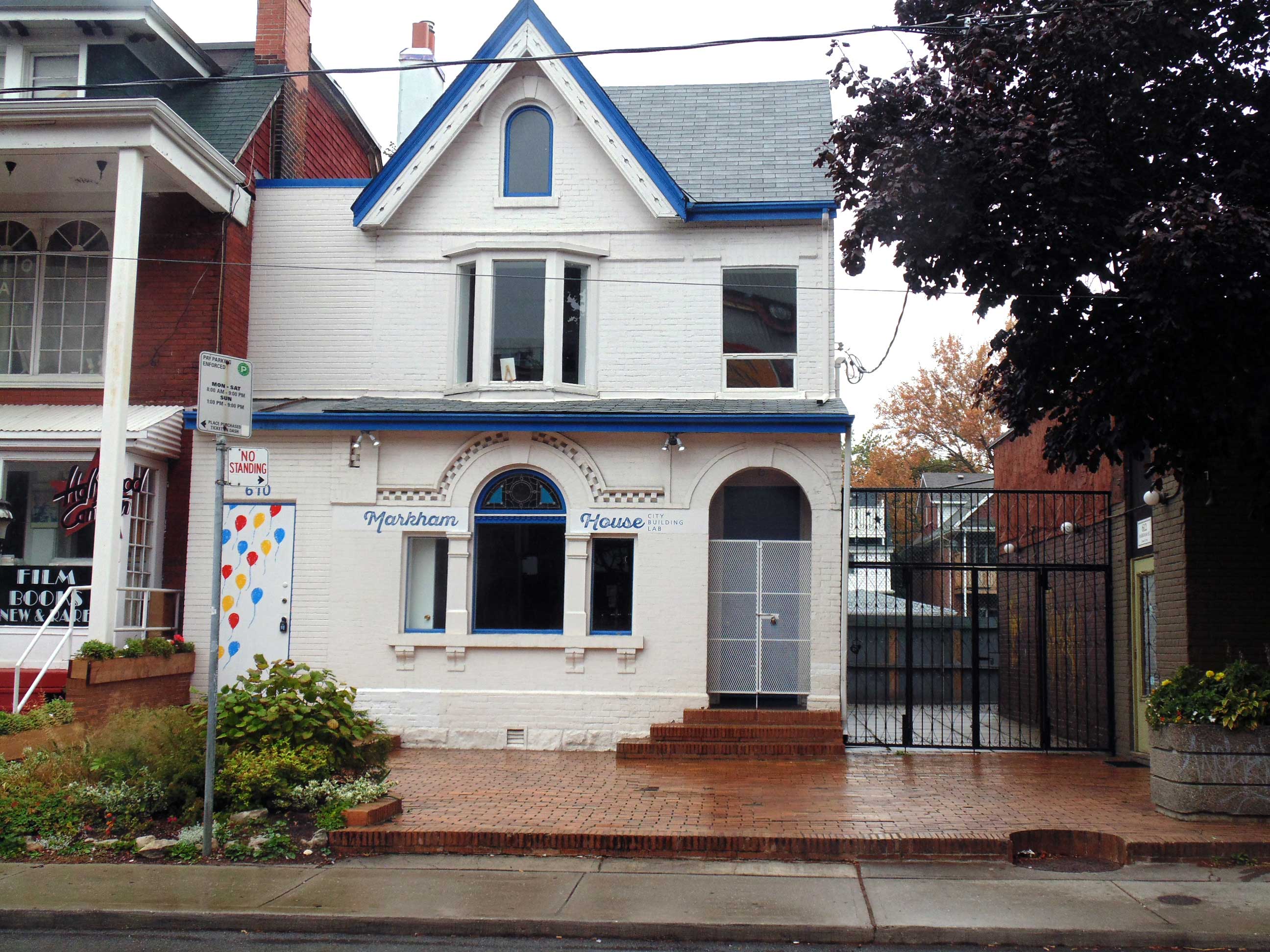
Westbank opened its Markham House Citybuilding Lab (610 Markham St.) on Sept. 19. Not only a space for providing information on and answering questions about its proposed Mirvish Village redevelopment, Markham House is envisioned as a community hub that will feature rotating exhibits and art installations. Summer Reid, Gleaner News
Westbank opened its Markham House Citybuilding Lab to great fanfare during the Mirvish Village Sidewalk Sale on Sept. 19. Featuring a model of its proposed redevelopment for the site including Honest Ed’s and Mirvish Village, Markham House (610 Markham St.) will be open Tuesdays to Saturdays from noon to 7 p.m., and be staffed with representatives who will provide information and answer questions about the future of Mirvish Village.
Envisioned as a community hub, Markham House will also feature rotating installations and local exhibits. It’s currently home to a Spacing magazine kiosk, a Curbside Cycle installation, and Mirvish Village People, a photo series by Gerald Pisarzowski, shown previously at the Charlotte Hale & Associates gallery during the Scotiabank Contact Photography Festival in June.
With Westbank’s application under review at City Planning and another round of community consultations underway, we thought it time to canvass the residents’ associations that abut the four corners at Bloor and Bathurst streets for their thoughts on the plans for Mirvish Village. Three of them, the Harbord Village Residents’ Association, the Palmerston Area Residents Association, and the Seaton Village Residents’ Association, provided op-eds, all of which are printed below.
Compiled by Annemarie Brissenden
HVRA: Protect and restore the urban forest
“The proposed construction at the subject site will require applications to remove 25 city owned trees and 6 privately owned trees,” states an arborist report to Westbank development’s Mirvish Village project dated June 26, 2015.
In clinical language, an arborist outlines the front-end impact of a huge property development. That describes the start. What will be the finish?
We would like to imagine the creation of a thriving element in our urban forest between Bathurst, Bloor, Markham, and Lennox streets, in concert with the massive Westbank property development.
You think it is impossible?
We don’t.
The Westbank Mirvish Village project is easily the most complex property development proposal our part of the city has ever seen.
It has been the most promoted project in our history.
It has 2,000- to 2,500-plus new residents, with businesses and startups and a market — and no green space. Indeed, the community will lose the trees that it presently has, including two large silver maples that have been studied for their contribution to migratory bird biodiversity.
Without a completed application, residents, City of Toronto officials, and councillors cannot be sure of the details of the proposal. However, the broad outlines have remained consistent and raise general concerns and challenges for us all.
Already City Planning and the City’s Design Review Panel have stated major concerns about the complete lack of greenspace on the development plans.
- In all meetings, Markham Street has been a hard-surfaced landscape for social events, movies, pub seating, and the like.
- A Westbank arborist report precisely identifies 31 trees on the property that will have to be cut down.
With a site so large, so dense, and requiring massive excavation and protective hoarding onsite for lengthy periods of time, the future of any green on the development is in question unless its restoration and enhancement become part of the plans. It is especially critical because the neighbourhoods immediately around the project are already short of parks and open spaces.
We know from the experience of the south end of Ward 20 that, if left to site by site planning rules, an entire new neighbourhood can spring up with no green infrastructure, no place for kids to toss a ball. We hope it is time for Westbank not only to sit down with its neighbouring communities to actually plan the site to meet some of our needs, as well as its own, but also to build on work we are already doing.
With Joe Cressy (Trinity-Spadina, Ward 20), Harbord Village is working on a Green Master Plan for our neighbourhood, including possible parkspace, and street and lane plantings. Of all the adjacent neighbourhood associations, we are the most deficient in greenspace, particularly with the loss of community access to the grassy field at Central Technical School (our erstwhile informal “park”). We are looking at a nooks and crannies opportunity for planting, to facilitate biodiversity, to reduce the heat island, and to improve the downtown record on climate change. We are hoping to reclaim the urban forest, one little site at a time. We are also looking for a park.
So imagine the possibilities of the Mirvish Village development.
What can we save? What trees might be moved?
What can we lose?
What can we regenerate?
What plants and trees do we need for species diversity?
What wood could be salvaged for craftsmen?
Where do we want our kids to play?
Where is the park to support the population?
Harbord Village would like to change the channel and to begin talking not about Westbank’s ideas, but about the community’s opportunities the proposal, or one based on it, would provide to future renters, visitors to its businesses, and its neighbours.
Is it not possible to design a site that both responds to housing, entertainment, and business needs and also to the identified needs of people for open space, trees, plants, and a healthy ecosystem?
Let’s plan things differently in the city. We need to replace a mentality of either/or with both/and.
We need to change a potential loss to the community to a win for our neighbourhoods and for biodiversity.
We are ready to talk. Is Westbank ready to enter into this conversation?
Sue Dexter on behalf of the board of the Harbord Village Residents’ Association. Harbord Village is the area bordered by Bloor and College streets on the north and south, with Spadina Avenue on the east, and Bathurst Street on the west.
PARA: Integration challenge not yet met
Jane Jacobs, possibly the most influential urban thinker of this century, lived in our area. She championed community-based approaches to planning. What would she have thought of the Westbank proposal?
Here she writes in The Death and Life of American Cities (1961):
“Cities need old buildings so badly it is impossible for vigorous streets and districts to grow without them. By old buildings I mean…a good lot of plain, ordinary, low-value old buildings…. Hundreds of ordinary enterprises, necessary to the safety and public life of streets and neighbourhoods, and appreciated for their convenience and personal quality, can make out successfully in old buildings, but are inexorably slain by the high overhead of new construction.”
This quote is now 54 years old but a study conducted last year in San Francisco, Seattle, and Washington D.C. for the National Trust for Historic Preservation confirms it is still valid.
The Westbank development is well funded, massive, and complex. While residents welcome a number of their initiatives — bicycle parking and storage, a small daycare, apartment units large enough to accommodate families, independent retail, and a market — we are unsettled about other aspects.
Westbank was proposing to “save” 16 houses on Markham Street; however on Oct. 6 of this year, the Community Council passed a motion to list 35 properties in Mirvish Village and along Bathurst Street as heritage buildings. The Toronto Preservation Board also recommends positioning Westbank’s towers further away from the street to preserve the authentic and meaningful context that creates the “village feel” of the street. Whether it’s the warmth of material, the human scale, or the craftsmanship of bygone eras, old buildings attract people and are good for small business. Preserving more of the heritage architecture of Mirvish Village is crucial to any possible integration of Westbank’s new buildings into our century-old neighbourhood.
In August of 2014 the four residents’ associations that abut the intersection of Bloor and Bathurst streets conducted a survey of residents’ “wish lists” for the site. Publicly accessible green space scored highest on the list, yet Westbank is providing scant park space, far below what city policy demands.
Markham Street, Westbank seems to suggest, will be their contribution to the public realm, a place where they might program vibrant street festivals, live music, and outdoor movies. Let’s not forget that the street already belongs to us as do the two alleyways Westbank intends to reconfigure.
In the past, the Honest Ed’s parking lot hosted the highly successful Toronto Fringe Festival and the Stop’s Night Market. The Palmerston Area Residents Association worked with these festivals to mitigate noise and disruption to the nearby residents in win-win partnerships. Will such partnerships with residents continue? Westbank’s streetscape design is all cold, hard surfaces without noise-muffling elements.
On the aforementioned survey residents overwhelmingly stated that the new development should not exceed 30 metres, or nine storeys. The site is currently zoned for a maximum of six storeys. At its highest point, Westbank has proposed 29 storeys. A shadow study by City Planning reveals that long swaths of Bloor and Bathurst streets will have insufficient sunlight from September to March.
Not surprisingly, residents have questions about the increase in traffic the Westbank development will cause. With residential streets at capacity with permit parking and highly congested with drop-offs for Randolph’s classes, where will all the people attracted to the market park? (They won’t all come by bike and subway.) Where will the market and retail service trucks queue up? Will trucks be rumbling down our streets at dawn? Will there be more CO2 in the air? How will the reconfiguration of the alleyways affect residents’ access to their own property? No answers yet.
The density envisaged by this proposal of 1,017 units, half of which are larger than two bedrooms, is reminiscent of St. James Town — easily 2,500 people in a single city block. The development will set the standard for the other three corners and for our area in general. How much increase in population can our infrastructure support?
The challenge in creating a future healthy urban environment in this neighbourhood is to integrate new, innovative development into our existing and historic urban fabric. Westbank’s proposal does not yet meet this challenge.
Donna McFarlane, Paul MacLean, and Leo Panitch on behalf of the Palmerston Area Residents Association. The Palmerston area is bounded by Bloor, College, Clinton, and Bathurst streets.
SVRA: Preserve heritage in all its forms
The entire site of Honest Ed’s and Mirvish Village is being redeveloped as a mixture of extensive retail on the ground floor with approximately six residential towers, one of which is proposed to be 29 storeys tall.
The proposal is presently being reviewed by City Planning, which along with city councillors have asked the four residents’ associations that represent the four corners of Bathurst and Bloor streets to comment on the development proposal.
This article deals with the architectural heritage of the site.
Architectural heritage can be looked at in many ways. The first is that new buildings can respond to the surrounding context with a similar scale and similar materials. With the Westbank proposal, the first four floors could be masonry that would follow the street line and the upper towers could step back.
A second way of carrying out heritage preservation is to retain portions of existing buildings as artifacts. A common way is to retain just the facade of a building. This would be most appropriate for some of the buildings along Bathurst Street.
A third way is to consider an entire group of buildings that are supporting a functional community heritage that requires all of those buildings to remain so that those cultural activities can continue.
For the residents living in our neighbourhood, we experience this every day in how much the pattern of our houses and streets influences our lives and our connections with our community. If we lived in another setting, such as the towers on the railway lands, the residential districts of Mississauga, or the farmland around Barrie, how we live our lives would be substantially different. Being conservation-minded includes more than preserving the buildings on the development site — it includes the public environment in and around the site, the way people are accommodated on streets and sidewalks for blocks around, and the way transportation linkages work and don’t work around these intersections, now and afterwards.
Of special interest with the redevelopment of the site is Mirvish Village, the houses on both sides of Markham Street, on the southern half of the block between Bloor and Lennox streets. This was a street that the Mirvish family took special pride in preserving and where they fostered an arts community that continues today. It not only gives our district an identity for the local neighbours, but it is also a unique street that is known throughout Toronto. People come from other parts of the city specifically to visit Mirvish Village. Here, one can still afford to make and buy something handcrafted.
The Westbank proposal plans to preserve the west side of the street. But, on the east side, they intend to drastically alter the existing buildings by incorporating (only) the facades into the base of a 16-storey tower and dropping the entrances of the old houses to be level with the street. There is no change of use being proposed — it will remain commercial. The existing culture and community “benefit,” they say, can be replicated with events and festivals parachuted into the neighbourhood.
The working committee made up of residents’ associations believes that to preserve Mirvish Village, the existing houses on both sides of Markham Street need to be preserved and the large residential towers (height to be determined) should be pushed to the perimeter of Bloor and Bathurst streets.
All of the residents of these surrounding neighbourhoods understand how the scale of older buildings, the diversity of their forms, and their relationship to the street are vital to continuing the rich urban life that we enjoy. It supports both the cultural and economic diversity in our community.
Mirvish Village is an early example of the adaptive reuse of buildings that was done by the Mirvish family, who helped the architectural heritage movement in Toronto with the preservation of the Royal Alexandra Theatre and adjacent warehouses.
The proposed heritage designations stand in the face of developer proposals and even of some reasonably tolerant attitudes among all of us about how much building the site can take without causing harm. The residents’ associations would like to hear from people in the neighbourhood about their concerns in relation to the heritage aspects of the Honest Ed’s and Mirvish Village site.
Written by the Seaton Village Residents’ Association executive in collaboration with Jennifer Hunter. Seaton Village is bounded by Bloor, Dupont, Christie, and Bathurst streets.
Tags: Annex · News · Editorial
October 8th, 2015 · Comments Off on Politicians are slaves to our whims
Let’s lead so they will follow
By Terri Chu,
The federal election has been lack lustre on the environmental front to put it mildly. In fact, finding an environmental platform from the three major parties to write about for this final piece before election day is akin to searching through Kim Kardashian’s twitter feed for words of wisdom. I decided a more enjoyable pastime would be sticking my head into the tailpipe of a “clean diesel” Volkswagen.
My bones will have long turned to unrefined crude oil before we see any real environmental leadership from the three major parties. It’s hard to blame them too when the reality of sustainability means that the old (unsustainable) way of life will have to cost more by necessity. That is never a popular political plank to run on. No matter how we slice and dice it, filling an SUV full of gas would (and should) cost more if we want to do more than simply pay lip service to the environment. This is something that I find even my most left-leaning friends have a hard time wrapping their heads around. On one hand there’s a lot of bandwagon partying come Earth Hour; on the other hand, when electricity rate hikes get announced, it’s the only time I see any political activism in the form of “get rid of the inept government that makes electricity so expensive”.
Without higher resource prices, it is nearly impossible to make clean technologies pay off. I’ve done work for companies looking to sink millions into being more energy efficient, but because of our low rates, economic payback simply isn’t there. Unless we accept that being green necessitates the old way of life costing more, we don’t have any chance of moving forward. This isn’t to say our standards of living will drop, but the capital investments to be less polluting must also pay off economically.
A friend once gave me policy papers from the Liberal party to read on the environment. I nodded my head as I went through them, thinking that most of the policies made good environmental (and economic) sense. Something about the print quality and font prompted me to search for a publication date. These policies that made such great sense were from the early eighties! For thirty years, we have been saying “we must do” while taking action on slightly above zero of them.
Politicians are slaves to our whims. As the French politician Ledru-Rollin said, “There go my people, I must find out where they are going so I can lead them.” Short of wagging the dog, I’ve lost faith that real action will be taken. As citizens and consumers, there is only so much we can do. Power has been concentrated in those with the monetary means, and the rest of us are left signing online petitions and clicking “like”. Even when we try to do the right things we find out the companies we trusted passed EPA testing by fraudulent means. The situation is disheartening.
If we want the dog to wag the tail, enough of us have to make purchasing decisions that hurt high polluting industries, even if it costs us a bit more. Rather than complaining about rate hikes, we need to demand that electricity and gas prices go higher if we truly want to see a change to traditional industries. Certainly there will be short-term pain, but there will also be long-term gains on the whole.
We can no longer expect political leadership on the environmental front, so let’s lead so they will follow.
Tags: Annex · Liberty · News
October 8th, 2015 · Comments Off on A creeping horror of the mind
Frankenstein Live emphasizes language over spectacle
By Annemarie Brissenden
How does one reckon with the horror of one’s own creation?
It’s a question posed by Mary Shelley’s Frankenstein; or, The Modern Prometheus, and one asked of the audience in Frankenstein Live premiering this month at the Walmer Centre Theatre.
“[Frankenstein] was so obsessed with creating life. He achieved it, but abandoned it out of fear. That’s at the core of a lot of the troubles we create in society,” explains Dora-nominated Tom Carson, who has previously directed 2000 Candles, The Ghosts of Mariposa, and a touring production of The Lion, The Witch and The Wardrobe.
It’s one of the themes the director hopes to explore through the performance, which he characterizes as an immersive reading that emphasizes the richness of Shelley’s language over the lurid spectacle found in other adaptations of the nineteenth-century gothic novel.
“Other versions really abandon the language and go for the sensational aspects of the story,” says Carson. “We’re more interested in embracing the language of…and getting at the core ideas of the novel.”
So they’ve not only stayed faithful to the novel, but truthful to the way Shelley laid out the plot. Yet condensing such a big novel with a lot of ideas was a daunting task for playwright Warren MacDonald.
“There’s little to no dialogue in the book,” relates MacDonald. “The challenge was imagining the dialogue, how the characters would speak to each other.”
The production centres on the three main characters of the novel: Robert Walton, an Arctic explorer pursuing scientific discovery in the North Pole; Victor Frankenstein, a Prometheus-like figure pursuing the being he created; and Elizabeth, the woman he fell in love with.
(“I’m not saying whether there’s a monster,” says Carson.)
Set amidst the creaking ice and blustery gales of the north, Frankenstein finds Walton about to sacrifice his entire crew in pursuit of discovery, and says, notes Carson, “I have a warning for you”.
It’s a warning that the audience is also urged to heed.
“We ask people to listen to what’s going on in the story,” says Carson. With the action stripped away, the audience has to use their imagination to get into the tale, and that’s where the horror lies.
MacDonald describes it as a “psychological horror: it’s the terror in [Frankenstein’s] mind of what he’s done”.
The intimate space of Walmer Centre Theatre is an ideal setting for creating that horror, say both MacDonald and Carson, with the latter adding that the theatre’s architecture is pretty close to a neo-gothic style, which “adds an interesting aspect”.
They are also relying on an original score composed by Douglas Romanow to amplify the creepy atmosphere.
Romanow, who jumped at the opportunity to create the soundscapes and music for the show, says Shelley was “one of the first writers who exposed me to the tension between humanity and technology”.
He’s fascinated by how “to juxtapose human elements in music against technological elements”, and in the play uses that juxtaposition to create tension. He also uses the sounds of the far north — sounds of frost and cold and the rigid creaking of the boat — to add to what Carson describes as “the kind of scary that creeps up on you and gets into your mind”.
“The music is nice and eerie and creaky and atmospheric,” adds MacDonald.
While the “horrific story” is about what happens when you pursue an obsession without a moral framework, says Carson, the production is also about “trying to get into language concepts that are fundamentally very frightening”.
For MacDonald, “it’s a very human story…. The main emphasis is on the personal relationship between the monster and Victor. The monster wants his creator to…fulfill his responsibility to him and provide him with a suitable mate. All of us share that longing, like the monster.”
He thinks “it’s a relevant story that people need to hear and think about in a very different context”, but if the play “drives people to read the book and think about a great piece of literature”, that’s good too.
Frankenstein Live runs from Oct. 22 to Nov. 8 at the Walmer Centre Theatre (188 Lowther Ave.). Tickets are $25. For further information or to buy tickets, please visit www.frankensteinlive.ca.
Tags: Annex · Liberty · Arts