November 17th, 2015 · Comments Off on

A patch of orange pitched up on the picnic tables in front of Harbord Fish & Chips beside Albert Jackson Lane for the popular Pumpkin Festival on Nov. 1. Sponsored by Wright Real Estate Brokerage, this annual event is presented through a partnership of the Habord Street BIA and the Harbord Village Residents’ Association. Courtesy Graham Rempe
Tags: General
November 17th, 2015 · Comments Off on
Tags: Annex · Liberty · Editorial · General
November 17th, 2015 · Comments Off on
Tags: General
November 17th, 2015 · Comments Off on Freeland new MP for University-Rosedale
Campaign marked by strong candidates
By Annemarie Brissenden
Take a moment and indulge in a thought experiment.
Imagine a room filled with people engaged in the business of politics. It could be in Parliament during question period, a human rights hearing at the United Nations, or a G8 meeting. Do you have the image? Now, take away the men.
How many people are left?
Launched last month, #MoreWomen is a social media campaign that does the work for you. Designed to demonstrate the scarcity of women in political leadership roles, it takes iconic pictures of political gatherings and removes the men. The resulting images are unsettling: women barely able stretch their arms from one to another in a cavernous House of Commons, a seated woman surrounded by emptiness, and still another woman standing alone in a board room.
It illustrates a stark reality: there aren’t enough women in politics. And in University-Rosedale, where two very accomplished women were the front-runners in a highly competitive race, that reality had many voters wishing they could cast their ballots for more than one candidate.
In the end, the Liberal Party of Canada’s Chrystia Freeland took the seat over Jennifer Hollett, who ran for the New Democratic Party (NDP). Freeland was previously the member of Parliament for the old riding of Toronto-Centre.
“Chrystia Freeland brings knowledge and experience that will put Canada on the map internationally in terms of being compassionate and engaged,” said Jo-Ann Davis, Toronto Catholic District School Board trustee (Ward 9, St. Paul’s/Toronto-Centre/Trinity-Spadina). “I really like [Jennifer Hollett] as well. She’s a wonderful candidate. It’s unfortunate that they couldn’t win in different ridings.”
Sarah Armstrong, a Freeland supporter, echoed the sentiment.
She described Hollett as an “amazing candidate”, and said she wished the women had run in different ridings so “I could vote for both of them. I hope it says something about women in politics generally.”
“A lot of people are ready for a woman in office,” said Aliya Bhatia. The NDP volunteer — who conceded that if Hollett couldn’t take the riding, “I’m glad [University-Rosedale] got Chrystia Freeland” — was shocked by the enormity of the Liberal win.
“By the end, I knew the Liberals had momentum,” said Hollett, admitting she was also surprised by the results, “but I don’t think I expected a majority. I am disappointed for my loss, [and] devastated that we have lost so many great MPs.”
Although Freeland wasn’t expecting such a victory, she said she was “cautiously optimistic from the very beginning”.
“Some people forgot that three new downtown ridings had been carved out of two ridings held by Liberal MPs elected in recent by-elections,” she explained, lauding the riding’s field of candidates, which included Karim Jivraj for the Conservative Party and the Green Party’s Nick Wright.
“I really respect them; it was an honour to run in the same contest,” said Freeland, noting that University-Rosedale chose from a “strong, smart, [and] committed group of candidates”.
Hollett agreed, describing the race as exciting and highly competitive.
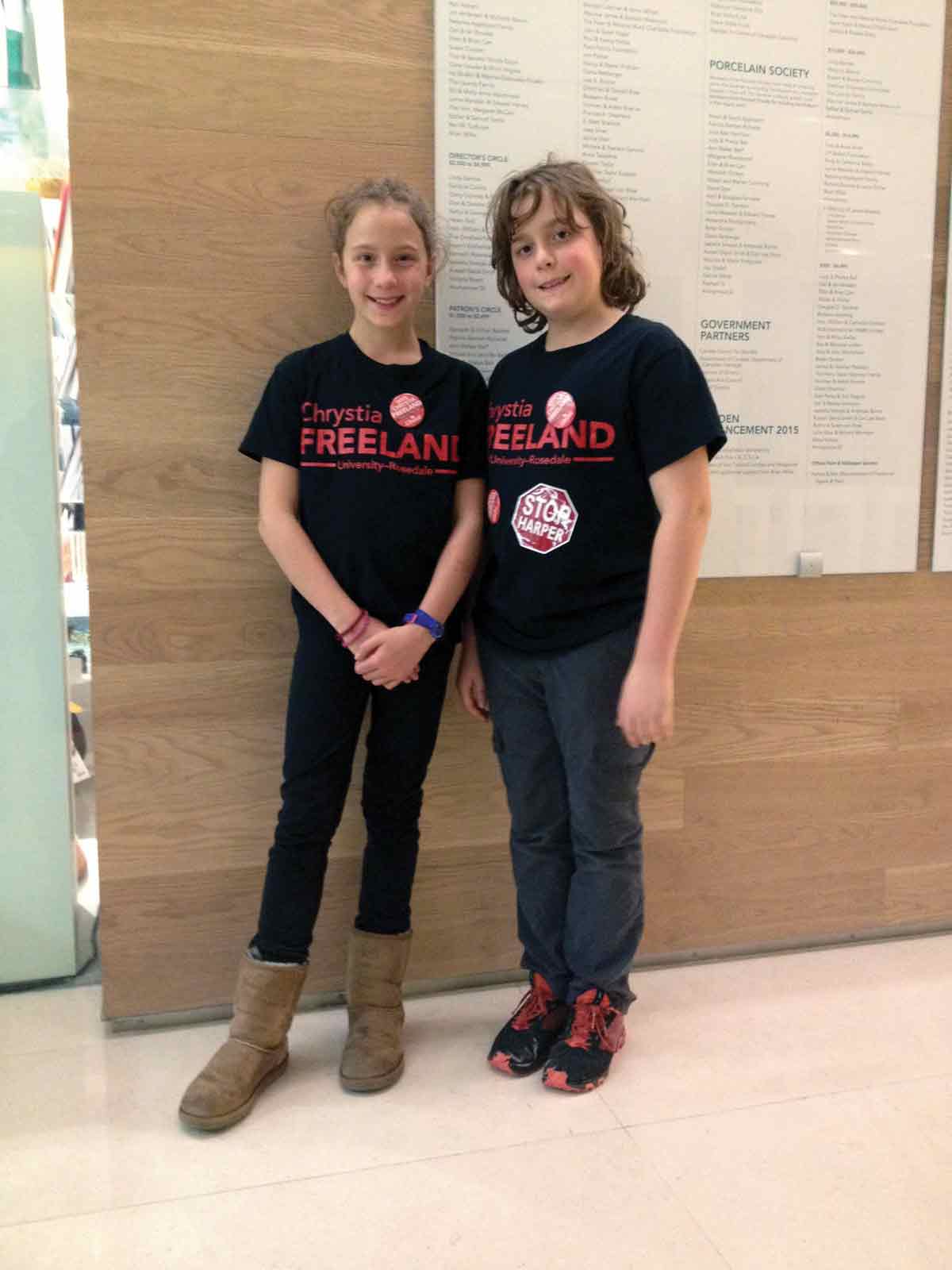
Ten-year old twins Felixe and Julian Pellizzari celebrated Chrystia Freeland’s win at the Liberal candidate’s election night party at the Gardiner Museum on Oct. 23. Annemarie Brissenden, Gleaner News
“It was an honour to run against Chrystia,” she said. “One of the reasons we got into politics is to see more women in office. I see a future where this is the norm, where impressive women are running against each other.”
With this election, Canadians have sent 88 women out of a possible 338 to the House of Commons. At 26 per cent, that’s up slightly from 24.6 per cent in the last general election, and behind at least 50 other nation-states when it comes to the number of women represented in national assemblies. Among them are the United Kingdom, with 29.4 per cent, Mexico (42.4 per cent), and Sweden (43.6 per cent).
“We do need more women running,” said Davis.
As Freeland puts it, “half of our population are women, [so] half of our politicians should be women.”
Despite her disappointment at the outcome for her party, Hollett is excited about the newly-elected prime minister’s promise for gender parity in the cabinet.
“We have to invite women to the table,” said Hollett. “We have to make space for women and make sure there is room for women in other roles.”
Freeland is rumoured to be up for consideration for a cabinet position, and if chosen, she’d bring a lot of experience to the role.
“Chrystia Freeland is an international figure, a national figure, as well as a local figure,” said Bill Graham, who represented Toronto-Centre from 1993 to 2007, during which time he served as the foreign affairs minister and minister of defence. “She has a big brain and a big capacity to be important in our country.”
Scott Dullen, a Justin Trudeau staffer who came to Toronto to work on Freeland’s campaign, added that “she’s one of the better MPs on the Hill: she cares about her constituents, has accolades after her name. She’s incredible.”
For now, Freeland — who said one of her immediate priorities is rail safety — is concentrating on getting to know her new riding, and connecting with University-Rosdale’s other elected representatives.
She hopes the Liberals’ congenial “sunny ways” approach, with its focus on “what we can build together, rather than tear down”, will get more people engaged, including women and young people.
Freeland also has a special message for all women and girls who are contemplating entering politics.
“Do it!”
Subsequent to this writing, Chrystia Freeland was sworn in as the Minister of Internatinoal Trade.
Tags: Annex · Liberty · News · People
November 17th, 2015 · Comments Off on Churches raise funds for refugees
Project Hope hits home for Bathurst Street parish
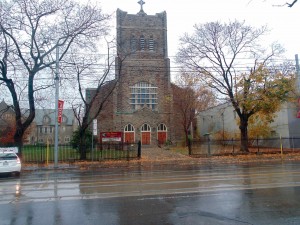
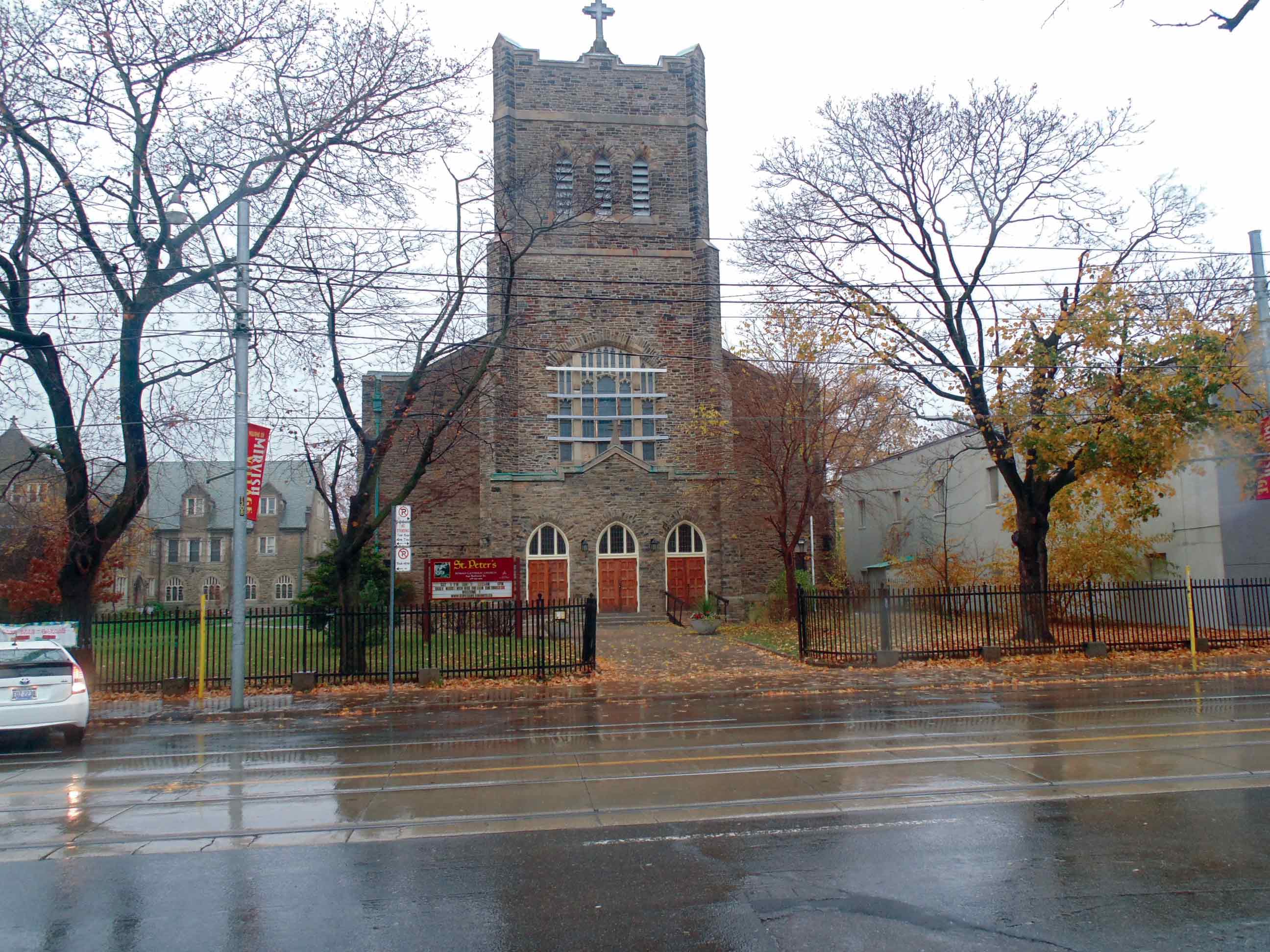
St. Peter’s Church (shown above) parishioners have to date raised $10,000 towards sponsoring a refugee family to come to Canada. Summer Reid, Gleaner News
By Summer Reid
Local Roman Catholics are answering Pope Francis’s September call to European parishes in which he asked them to open their doors to Syrian refugees fleeing war-torn homes. Shortly after the Pope’s call, the Archbishop of Toronto, Cardinal Thomas Collins, launched Project Hope, a refugee resettlement campaign that aims to raise $3 million in 100 days to bring 100 families to Canada and to settle them within the region of the Archdiocese of Toronto.
“All we want to do is help people get out of Syria,” said Reverend Michael McGourty, the pastor of St. Peter’s Church on Bathurst Street, north of Bloor Street West. “It does not matter what religion they are, we just want to keep them safe.”
“We figure it costs about $30,000 to sponsor a family for one year,” he added, explaining that the 220 parishes across the archdiocese are working together to address the crisis. “If a church such as St. Peter’s, which is in a great neighbourhood and in a perfect position to get refugees set up with health benefits and language classes, does not have the financial resources to sponsor a family, they can partner with another parish that may not have these benefits and pool their funds with one another.”
McGourty said his parish is working with the Office of Refugees for the Archdiocese of Toronto (ORAT), which, according to an ORAT press release, is prioritizing “families coming from war-torn countries. These include Syria and Iraq where we have set up hundreds of families to date.”
“We can’t send people into Syria because it’s too dangerous,” said McGourty. “[But ORAT] has sent a team of people to Jordan, to one of the refugee camps, where there are families that are already out of Syria, but unfortunately they are trapped in refugee camps and they have nowhere to go. So the teams have gone over to try and identify families that we can help and bring them over as quickly as we can. We’re hoping that the process will be sped up by the fact that we’ve made contact with them directly.”
The term “refugee” has been muddled for a very long time; a lot of people assume that an immigrant and a refugee are the same thing. However, the 1951 Refugee Convention defines a refugee as someone who, “owing to a well-founded fear of being persecuted for reasons of race, religion, nationality, membership of a particular social group or political opinion, is outside the country of his nationality, and is unable to, or owing to such fear, is unwilling to, avail himself of the protection of that country.”
So far, St. Peter’s alone has raised around $10,000 to sponsor just such a family.
Local parishioner Sheila Conlin is part of the 12-member committee that is working with the local parish to help sponsor a family. She explained that the committee is just getting started, but they are looking forward to helping those in need.
“I think we’ve been given so much here in Canada, our parishioners want to be able to reach out and to help people who are in need,” said McGourty. “[The call] came around Thanksgiving, and this was a way that we could show our own thanks for all that we’ve been given.”
St. Thomas’s Anglican Church on Huron Street, which sponsored a family during the Vietnamese refugee crisis in the 1970s, is also raising funds to help sponsor a refugee family. On Nov. 20, it will host Voices of Refuge, a concert featuring six choirs that will be followed by a reception featuring soups from Soups for Syria, a fundraising cookbook raising money for the United Nations High Commission on Refugees that collects soup recipes from international chefs and food writers.
Voices of Refuge will be held on Nov. 20 at St. Thomas’s Church at 383 Huron St. at 7:30 pm; admission is free with donation. For further information on Project Hope, or to make a donation, please visit www.archtoronto.org.
Tags: Annex · News
November 17th, 2015 · Comments Off on U of T professor wins $625,000 grant
A 40-year-old archaeology professor at the University of Toronto has been awarded a MacArthur “genius grant”. Dimitri Nakassis, who studies Late Bronze Age (Mycenaean) Greek society, will receive $625,000 over five years to spend however he chooses, but is still not sure how he will use the grant.
“My interpretation of the award is that the foundation thinks that the work I’ve done so far is productive, interesting, and innovative, and the money gives me the opportunity to continue to do that kind of work,” said Nakassis in an email. “But I only have one shot at getting this right, so I need to proceed carefully and thoughtfully.”
Nakassis added that there is still so much to be found and studied in Greece.
“Greece is a country that’s been the focus of a lot of archaeological exploration, for sure, but amazing new discoveries are being made all the time — a new Mycenaean palace was recently found near Sparta, for instance — and scholars studying ancient Greece are increasing our understanding of it constantly,” he said. “It’s a really exciting field, and I hope that my award can bring some much-needed attention to it.”
Although the professor spent most of his childhood vacationing in Greece and was fascinated by it at a young age, it wasn’t until he got to university that he became convinced that he wanted to study Greek archaeology.
An initiative of the American independent John D. and Catherine T. MacArthur Foundation, the MacArthur Fellows Program awards no-strings-attached grants that “celebrate and empower the creative potential of individuals”. Grant winners, called “fellows”, come from a broad range of professions.
—Summer Reid/Gleaner News
Tags: General
November 17th, 2015 · Comments Off on City hosts first Mirvish Village community consultation
The community had its first formal opportunity to review Westbank Corp.’s plans for Mirvish Village at a public consultation at the Bickford Centre Cafeteria hosted by the City of Toronto on Oct. 7. The area includes Markham Street, Honest Ed’s, and the adjacent properties on Bathurst Street. Many of those in attendance expressed concerns about adding density to the neighbourhood, and the project’s lack of green space.
“I don’t see any green space around and I see the entire site covered by buildings,” said a Euclid Street resident. “We’ve got a few things here: we’re talking transportation, we’re talking massive density, and we’re talking lack of green space.”
Paul Unterman, who has been on Markham Street for over 30 years, believes the project is “way, way too dense for the neighbourhood”.
“I hope that some of the heritage properties, if not all of them, are kept,” he added. “And I’m very concerned about the parkland. We have so little in our area as it is, and to add a thousand units with God knows how many people is concerning for us.”
“The issue is not the fact that they are modernizing,” agreed Brunswick Avenue’s Kevin Lim. “The issue is this: you’re bringing congestion into an area that’s already congested.”
Other residents are trying to remain open to the proposal, even as they express their reservations.
“I don’t like how big it is. The size seems kind of out of place,” said Toni Papa of Spadina Road. “But I like the concept, and I like how it looks in the renderings. But renderings is one thing, what it actually is in reality is another.”
City Planning received Westbank’s proposal on July 10, and presented its preliminary report on the application at the Oct. 6 meeting of the Toronto and East York community council. It has developed a detailed website that includes the application and its accompanying materials: www.toronto.ca/planning/mirvishvillage.
—Annemarie Brissenden with files from Summer Reid/Gleaner News
Tags: Annex · Liberty · News
November 17th, 2015 · Comments Off on Suspects sought in two stabbings
An argument between two men in the College Street and Spadina Avenue area escalated to a stabbing Oct. 27 at 12:16 pm. The men were seen arguing, with one attempting to walk into a store when the other stabbed him in the back and fled the scene. The suspect is described as white, approximately six feet, with a medium build and a black beard. He was wearing a dark toque and winter coat, as well as a grey hooded top.
In an unrelated incident on Sept. 18 at 12:45 am, two unknown men approached a victim and attempted to rip a gold chain off his neck in the Brunswick House bar on Bloor Street West. The 20-year-old victim was stabbed when he tried to retrieve the chain. The Toronto Police Service has released security footage of the suspects from outside the bar: one man is black, tall, and slim, and was wearing glasses, a grey zip-up sweater, and a plain white T-shirt. The second man is black, tall, and slim, has a goatee, and was wearing a grey and white baseball-style graphic T-shirt and cargo shorts.
Anyone with information about these or any other crimes is urged to contact the police at 416-808-1400, or anonymously via Crime Stoppers at 416-222-8477.
—Summer Reid/Gleaner News
Tags: General
November 17th, 2015 · Comments Off on Bloor Street study launched
Research measures economic impact of pilot bike lanes
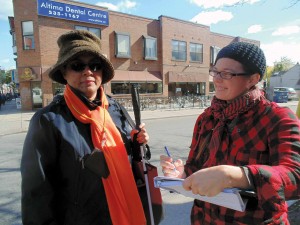
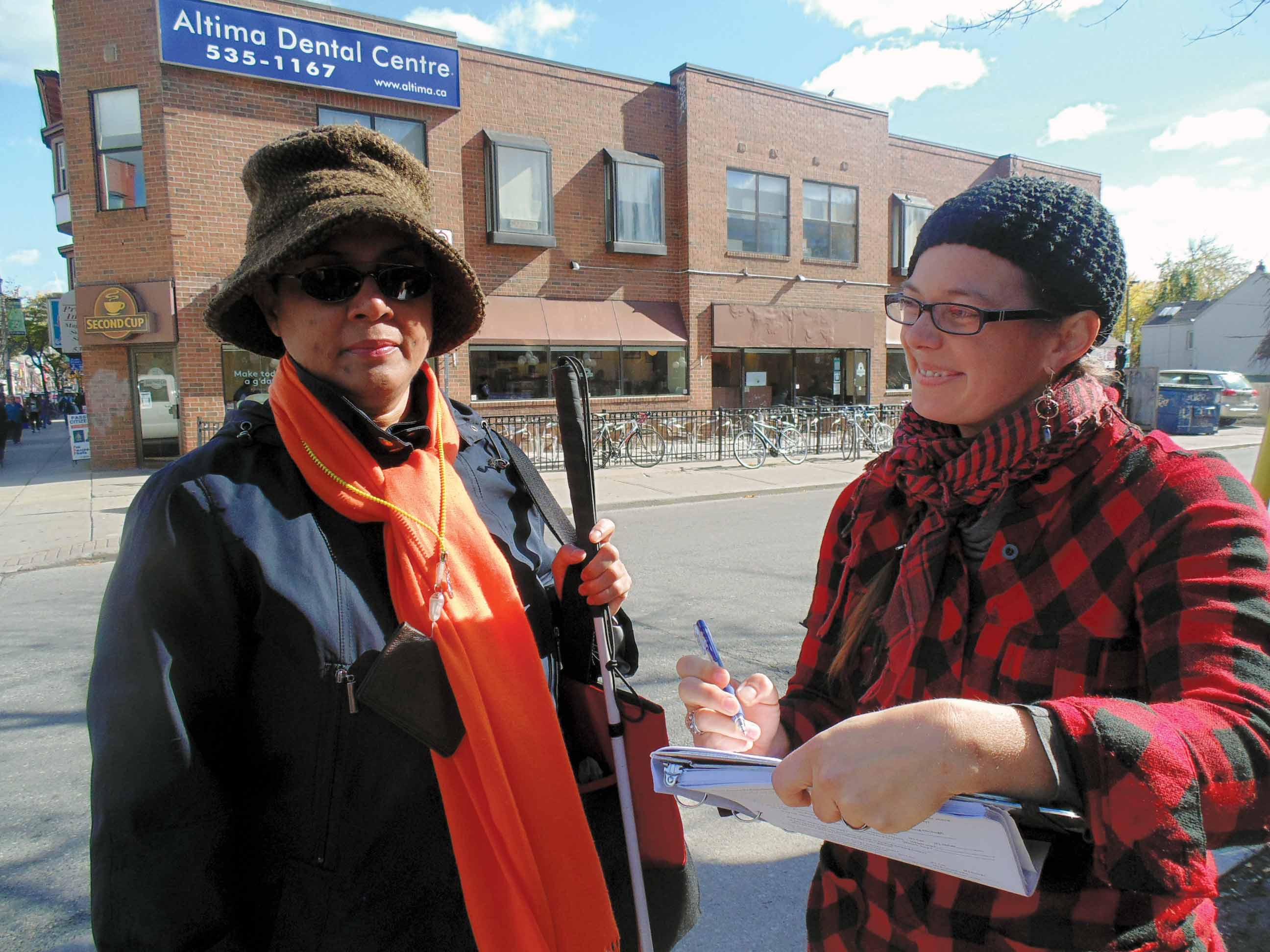
Kelsey Carriere (right) interviews a legally-blind member of a tandem bicycling club that travels along Harbord Street. Carriere is part of the team studying the demographics of Bloor Street West between Shaw and St. George streets before and after the installation of a pilot bike lane in April 2016. Summer Reid, Gleaner News
By Summer Reid
A study investigating the demographics of Bloor Street began last month in the Annex. Aimed at understanding how people travel to and from the area, and what business they conduct along the street, it will also measure what impact, if any, the April 2016 installation of a pilot bike lane on Bloor Street West between Shaw and St. George streets will have on the area’s businesses.
The University of Toronto will conduct the study in partnership with the Toronto Centre for Active Transportation (TCAT). It will cost $22,500, and is being paid for by the Bloor-Annex and Korea Town business improvement areas (BIAs), which have committed $6,500 and $4,000 respectively, with the Metcalf Foundation, a local charitable organization, contributing the balance.
“The idea is to get an overall demographic of who uses Bloor Street and how they get there, by what modes of transportation, what degree of regular customers these people are, how far they come from,” related Kelsey Carriere, a member of the crew conducting the study from the University of Toronto. “Right now we’re doing customer surveys, merchant surveys, and cyclist counts. Then after the bike lane pilot project is installed by the City of Toronto next year, we’ll come back in a year’s time and we’ll do the same study.”
She said that six people are conducting the surveys, with three pairs each going to the Annex, Korea Town, and the Danforth.
“Since the City of Toronto is looking at putting in the pilot project on the stretch of Bloor Street including both the Annex and Korea Town BIAs, that’s our study group,” he explained. “And then the Danforth is our control group, so we can see if there are any overall changes in demographics in cycling, for example, throughout the city in general. And then we can pull out if there’s anything that we can specifically relate to the bike lane pilot project.”
The bike lane pilot project is part of a 10-year cycling plan that Toronto City Council approved on Sept. 30. The trial may necessitate a 50 per cent reduction in parking along Bloor Street, and the BIAs would like to measure the economic impact of the bike lanes on their members throughout the trial period.
“Research shows that over 70 per cent of Torontonians would cycle more often if infrastructure were improved,” said Andre Vallillee, the director of the Environment Program for the Metcalf Foundation. “We think [this is] a great opportunity for Metcalf to partner with two local BIAs to support timely research by a well-respected organization. As an Annex-based organization, we value the vibrancy of this neighbourhood, and are drawn to the fact that the study will explore the local economic impacts of bike lanes along a corridor we frequent often by bike and by foot.”
“The need for a study is clear in my mind,” said Bloor-Annex BIA board member Jonathan DaSilva of Hot Docs Cinema. “Getting answers as to what the impact would be directly on businesses is something that we need to know to move forward on the issue.”
Although the study is moving forward, not all of the members of the Bloor-Annex BIA board were in agreement. One objected to having the study conducted through U of T and TCAT, while another wondered if spending money on a study was actually necessary.
“Is it worth it to really study the obvious that we’re going to know anyway?” asked Sumit Kapur of Future Bakery. “I just can’t see the value in something like that, [because] if we’re going to have a pilot project, we’re going to know the impact through the merchants.”
“[We] need to know, locally, what the impact is,” said Joe Cressy (Ward 20, Trinity-Spadina). “We don’t normally do this as a city. Normally you have councillors who say ‘we support bike lanes, our residents want bike lanes so, we’re going to put in bike lanes’ and then we hear anecdotally whether it’s good or bad.”
Carriere said the study is also researching what people think about the idea of a bike lane pilot project, and is finding that “it’s actually incredibly inspiring how much people have thought about it”.
Brian Burchell, the publisher of this newspaper, is also the chair of the Bloor-Annex BIA
Tags: Annex · Liberty · News
November 17th, 2015 · Comments Off on The wedge issue that backfired
After the Federal Court ruled in February that Zunera Ishaq, the woman at the centre of a now pivotal controversy, could wear her niqab while taking her oath of Canadian citizenship, Steven Harper’s federal government sought a stay of the ruling pending an appeal. For many, it appeared like an attempt to keep discriminating against Ishaq until the government got its day in court. But during the federal election, the Federal Court of Appeal denied its application, and Ishaq swore her oath, so that only days later she was able to cast her vote, one that would hold greater weight than Mr. Harper could have imagined.
Ultimately, the Conservatives’ mid-campaign decision to keep this issue alive would prove to be their undoing.
Mr. Harper pressed the niqab issue because he believed most of the Quebec population, and his own base across the country, supported him. The niqab issue was a perfect example of how he unapologetically ignored court rulings asserting the government’s responsibility to protect the rights of its citizens under the Charter of Rights and Freedoms, and continued to propose legislation that the courts would never uphold.
Focusing on such divisive issues was part of an overall Conservative strategy that sought to elicit fear in the electorate, and suggest to voters that they could only trust Mr. Harper to helm the tiller. Indeed, the ad hominem attacks on Justin Trudeau spoke volumes about how worried Conservative strategists were that the Liberals, who began the election in third place, would displace them.
A solid 15 per cent of voters were not swayed by these tactics, and wanted to evict Mr. Harper from the prime minister’s office. How to achieve this end remained unclear until the end, and these Anybody But Harper (ABH) voters found themselves straddling the wedge in Liberal and NDP camps.
By keeping those ABH voters divided, Mr. Harper could hold onto power with a minority government. But the Conservatives needed to ensure that no issue would bridge the electorate.
It was a strategy that initially seemed to work until Mr. Harper himself gave ABH voters a signal. In order to score critical Quebec votes, he continued to press the niqab issue, and even proposed a Zero Tolerance for Barbaric Cultural Practices Act, the evil twin to his government’s assault on the niqab. Zero tolerance indeed.
Meanwhile, the NDP’s Tom Mulcair strongly defended the right of women to wear the veil. With a significant number of Quebec seats, his party had the most to lose, and it became clear after a late September French-language debate that support for the NDP had softened enough to make it unlikely that they would form a government.
“There’s a deep irony here,” wrote Thomas Homer-Dixon, the Centre for International Governance Innovation Chair of Global Systems at the Balsillie School of International Affairs, recently in The Globe and Mail. “It was the very receptivity of a portion of the population, in Quebec, to the Conservatives’ divisive strategy on the niqab that generated the signal that progressive ABH voters elsewhere in the country needed to coordinate their behaviour.”
ABH voters were no longer divided.
In just two weeks, in our own University-Rosedale riding, polls went from a neck and neck race between the Liberals and NDP to a two-to-one victory for the Liberals. This shift was not a result of anything that happened locally. Both Jennifer Hollett and Chrystia Freeland were smart capable candidates who ran good campaigns, and either one would have made an excellent MP. Many voters were torn over whom to choose, but the forces of the ABH movement hovered above them like a collective unconscious, and Mr. Harper pointed the way with his wedge.
It’s fitting really.
Tags: Annex · Liberty · News · Editorial
November 17th, 2015 · Comments Off on What do we want for Toronto?
Opportunity for positive, visionary change
By Mike Layton
In the last term of City Council we were up against Rob Ford and Stephen Harper. We found ourselves saying “no” and simply fighting to hold on to our public services.
We lost some battles. We watched our waste collection get handed over to the lowest private bidder and witnessed the carving up of Transit City (the light rail expansion plan that reached into our most marginalized communities). The deep cuts to our social service budgets now mean our shelter systems are over capacity and our state of good repair backlog in Toronto Community Housing is so great that we have thousands of people living in unfair conditions.
We won some battles too. Tens of thousands came together across the city and stopped a downtown mega casino proposed for my ward. Just as many more came together to fight against cuts to our public library system — and won. We fought proposed budget cuts to city services — and won. Locally we fought back against a parasitic Walmart and big box next to Kensington Market —and won.
But each of these battles were fights to maintain a status quo and existing programs. That was the position we found ourselves in. We haven’t had an opportunity to fight for anything new and visionary.
Today we have an opportunity to fight for what we want for Toronto. Today the people in charge are very different. Gone are the days of Ford as mayor. We can finally put the days of Stephen Harper behind us. We have a new majority government federally and a majority government in Ontario. It will be a few years before our next election and with their majority, if the government is convinced they can get almost anything through, let’s make sure it’s what we want.
There are at least two ideas that depend on the federal and provincial governments that I’d like to see implemented.
First is a national childcare strategy that will bring us $15/day child care. This would significantly change the lives of many families in Toronto and improve the lives of tens of thousands of women. We have close to 20,000 children on a waiting list for a subsidized space in Toronto. When you don’t have a subsidized space, you pay $107 a day to have a 17-month-old in care in the city. That’s upwards of $24,000 a year. The Universal Child Care Benefit (cheques of just over $100 a month that the Harper government sent to families in place of providing child care) barely covers a single day of child care.
Second is a living wage for Toronto. It costs more to live in Toronto than many other cities. The cost of childcare, groceries, food, household expenses, and rent are simply higher in Toronto. The Canadian Centre for Policy Alternatives estimates that you need to earn $18.52 an hour in Toronto to make ends meet. If we really want to help move families out of poverty and make sure our kids aren’t going to school on empty stomachs then Toronto needs the ability to set its own minimum wage.
I have some more ideas for our city, but I’m curious what you’re thinking.
What is it that you want for Toronto?
We have a lot of work to do to reinvest in what we have lost, but what is it that we want to build? What is a bold idea for a better city that you’d love to advocate for? Let me know. Email me at councillor_layton@toronto.ca or send a note on Twitter @m_layton. It’s time we started talking again about the city we want to build.
Mike Layton is the city councillor for Ward 19, Trinity-Spadina.
Tags: Annex · Liberty · News · Editorial
November 17th, 2015 · Comments Off on Speed not at issue
Distracted drivers, riders, walkers most vulnerable at intersections
By Scotty Robinson
Speed is not behind the numerous car accidents, injuries, or pedestrian and cyclist deaths that occur. Our system of too many red lights and stop signs has dumbed down the majority of us, including pedestrians and bikers. It’s like zombie land out there, and then once you add in all the cell phones and other distractions, you have super zombies.
Intersections on arterial roads are by far the most dangerous places. Cars in our society are inherently selfish. This is seen by the rampant red light running going on. This is where the vast majority of pedestrians cross a road and puts pedestrians, cyclists, and cars turning left all in a dangerous position. Slower speed limits do not stop making drivers selfish. Add in the zombie factor of way too many pedestrians at intersections and you have a bad situation.
Where are the police?
They are too busy setting speed traps at one of the billions of stop signs, or at the bottom of small hills where nobody is getting killed. Intersections are where they should be and I will bet pedestrian deaths go down once drivers realize they will get a ticket.
Red light cameras at all intersections would solve this too, but they are not provided.
Add in that the lights are not synced, which increases traffic jams and dumbs down drivers more, adding to their frustration. If you synced the lights to where cars were doing no more than 40 or 50 km/hr, they would hit all the lights and would solve much of the problem. A car flowing more often means a calmer driver and thus a safer driver. Our system is red, green, red, green etc., on almost all our roads. It is beyond stupid and makes zero sense.
I found last month’s editorial cartoon perfect timing. The average pedestrian now stares straight ahead and never looks left or right; they see a red hand and they stop, they see a white hand and they go. There could be zero cars on the road, but they will still hit the button and stare straight ahead. They step off the curb not looking left or right. The old adage of look both ways before you cross the street is nowhere to be found. That button has zero effect at most intersections and only on small side roads but they will hit it anyway.
But the average driver does the same; they stare at the space in front of their car and never look way ahead. They don’t check their mirror every four to five seconds, or even their signal lights. It’s a deadly combination.
We need a system more like that in Vietnam: it has almost no lights and no crosswalks. Everyone drives like a pod of fish, without any hurry. It’s not selfish, not one car versus the other, as everyone hurries to beat the next red light.
The “pod” works together, and works with pedestrian and traffic flows. It’s beautiful. It has been proven that if you take the lights out of an intersection, remove the curbs on sidewalks at the intersection, and paint a traffic circle, collisions and pedestrian accidents go way down. It teaches people to think and pay attention again and keeps traffic flowing.
Several cities around the world have done this. Toronto has thought about testing it and has not done so.
Recently Japan made all accidents equal responsibility no matter what, and guess what happened? There was an 80 per cent reduction in traffic accidents, because it taught people to drive defensively and think again.
When I grew up we had more yield signs than stop signs; this taught you to slow down and look way before you got to the end of the street so you were ready to make the decision to stop or go as needed.
We need to create a system that makes us, all think again.
Scotty Robinson is a Gleaner reader and Robert Street resident.
Tags: Annex · Liberty · News · Editorial