February 2nd, 2016 · Comments Off on Spadina club sues police
The Comfort Zone has filed a $23-million lawsuit against the Toronto Police Service (TPS) and former police chief Bill Blair, alleging the parties abused their powers to put the Spadina Avenue after-hours club out of business. After discovering that a 26-year-old man had been seen at the club just hours before his death as a result of a drug overdose, the TPS launched Project White Rabbit, an undercover raid that resulted in the seizure of $35,000 and various drugs valued at $33,000, as well as charges against 33 patrons and five staff. The lawsuit claims that police destroyed video surveillance equipment, and kept patrons and staff handcuffed for up to five hours. Since then, the lawsuit claims, the TPS has raided the club over 50 times, harassing staff and patrons. None of these allegations have been proven in court. It’s the second time the Comfort Zone has pursued a legal claim of this nature; in 2009, it launched a similar lawsuit against then councillor Adam Vaughan, claiming it had been the victim of a systematic harassment campaign aimed at shutting the club down.
—Summer Reid/Gleaner News
Tags: Annex · News
February 2nd, 2016 · Comments Off on City seeking street greening opportunities
Harbord Village plan targets laneways, parkettes
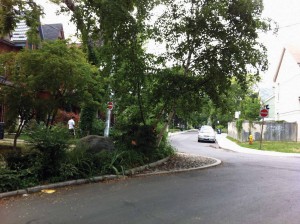
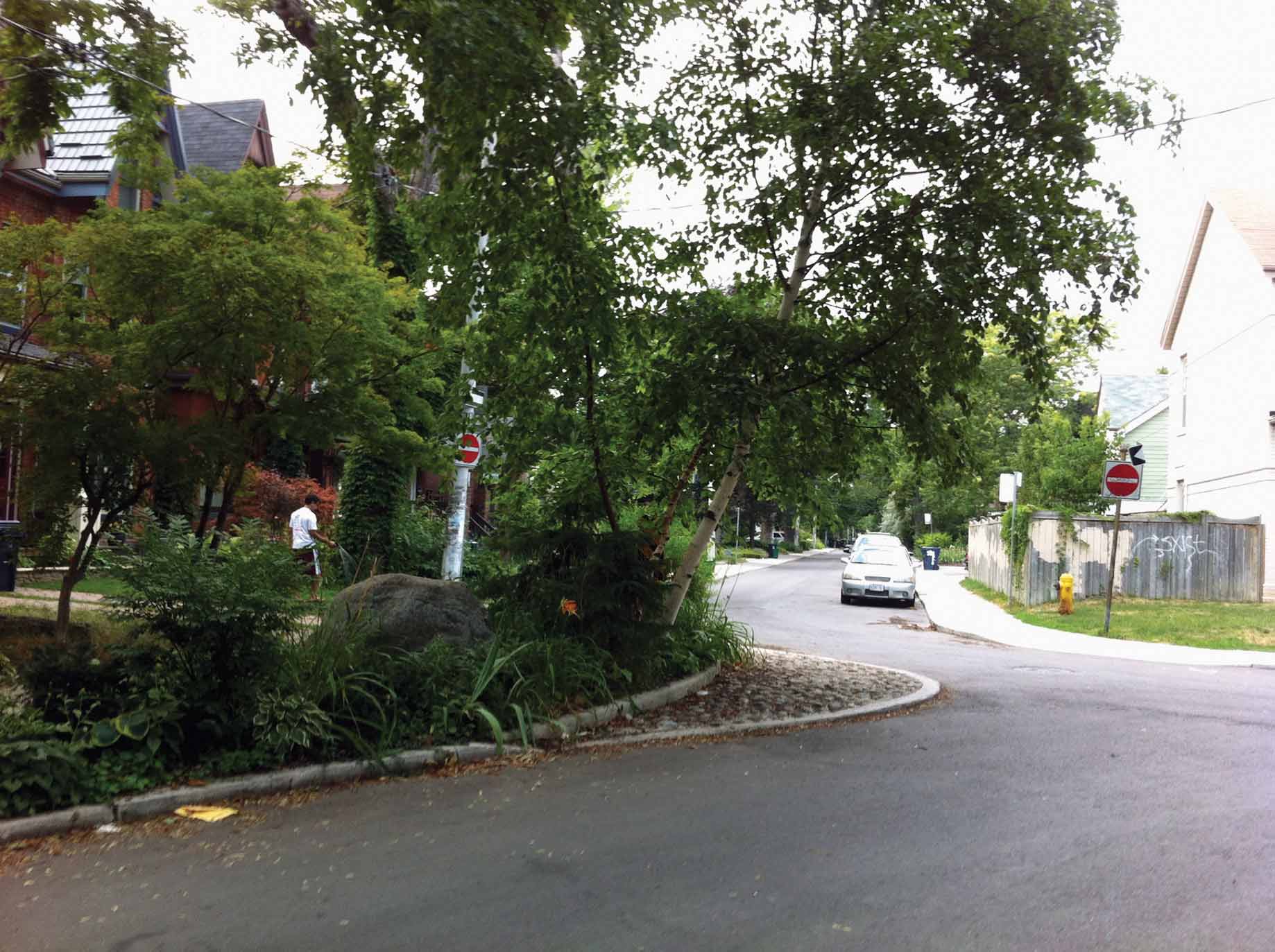
In-ground pinchpoint planters, like the one on Robert Street shown above, act as a curb extension, provide an immovable barrier that discourages drivers from making illegal manoeuvres, and are not subject to the graffiti found on their above-ground counterparts.
COURTESY SUSAN DEXTER
By Marielle Torrefranca
Harbord Village is aiming to get a whole lot greener.
Joe Cressy (Ward 20, Trinity-Spadina) and the Harbord Village Residents’ Association (HVRA), a community-led volunteer organization, have released a joint Green Master Plan, which outlines a series of actions to create urban green spaces in the public realm.
The 16-page document identifies five greening opportunities: using unoccupied paved flankings and corners for trees, bike parking, or seating; encouraging residents to introduce plants into their laneways; opting for in-ground pinchpoint planters instead of above-ground concrete planters; securing under-used neighbourhood space for parkettes; and improving tree planting and maintenance.
“The general philosophy of the plan is easy,” said Susan Dexter, an HVRA board member. “When you look out of your window and you see concrete, could it be planted? Is it wasted space?”
The plan is two-fold, explained Cressy. On one hand, there are the initiatives that have a longer timeline due to bureaucratic procedures, such as greening city-owned flankings and obtaining park space. On the other hand, community-led projects can begin right away.
“We’re seeking to seize the opportunity for greening immediately,” said Cressy.
An example of this is the endeavour to turn laneways into corridors of greenery. Currently, Croft Laneway (just east of Bathurst Street) and Sussex Mews (just west of Spadina Avenue) have been selected as pilot projects.
The HVRA plans to encourage neighbours to bring plants into their laneways, whether that be through placing plant containers along building walls, hanging flowering baskets, or introducing vining along fences and walls.
“[People] want our laneways to feel safe and comfortable and have some identity and character,” said Jane Perdue, who sits on a three-person committee overseeing the laneway project.
According to the report, Harbord Village has more than 25 laneways that can be used as alternative routes for pedestrians and cyclists. However, popular routes are targets for graffiti and vandalism.
To avoid drawing the attention of vandals in the future, the greening style will be kept “rustic”, said Perdue.
“We’re looking at a lot of found material — urns, or containers made out of bricks or fragmented stone,” she said. “We don’t want to make it too precious…we don’t want to be a target [for vandalism].”
Pinchpoint planters (concrete plant containers that perform traffic functions) are also subject to graffiti, so one of the HVRA’s initiatives is to use in-ground pinchpoints instead. According to the report, above-ground pinchpoint planters do not sufficiently slow motorists, as drivers can still dodge around them, and while most of them carry traffic signage, some of them face the incorrect direction on the street.
Their in-ground counterparts act more as a curb extension, and provide an immovable barrier — discouraging drivers from making illegal manoeuvres, while still allowing space for emergency services. The absence of the concrete container also means the absence of surfaces to vandalize.
This is not solely a community-run initiative, however, so the HVRA would need to coordinate with the city for roadwork and construction.
Similarly, the endeavours to green city-owned flankings and corners, improve tree planting and maintenance on main streets, and acquire more public park space, also require coordination with the city.
The HVRA is looking to secure under-used, vacant, or derelict spots in the neighbourhood and turn them into green community parkettes.
“The Bloor Street BIA, independent of us, had located many of the same corners as being potential green space,” said Dexter. “It seems like the constellations have all just lined up, and we’re in a position where we can make transformational change in the neighbourhood.”
This transformational change may not be limited to the planting of trees and scenic landscapes. The HVRA aims to cultivate the ecosystem health within an urban development through its greening initiatives.
Planting trees can also benefit the climate by mitigating the Urban Heat Island Effect; vegetation can absorb the sun’s energy, therefore making areas cooler and reducing power demand, said Dexter, who even performed her own experiment with a household thermometer.
“There [can be] a 10-degree difference,” she said. “From Harbord and Robert streets, I walked south, and by the time I got a little way into the houses, there was a marked difference in temperature.”
However, the association’s self-starting moxie may not be enough to pay the bills on its own.
“In some cases we won’t need additional funding,” said Cressy. “In other cases, we’re having early conversations with community foundations for support.”
While there is no certain timeline yet, Dexter said their next steps include going through council processes.
The link to the Harbord Village Green Plan is available through the HVRA’s website, www.harbordvillage.com.
READ MORE:
Untapped potential: Animating our local laneways (February 2016) by Joe Cressy
Incubating micro-retail: Laneways untapped realm of urban design (December 2015) by Annemarie Brissenden
Tags: Annex · General
February 2nd, 2016 · Comments Off on FORUM: Untapped potential
Animating our local laneways
By Joe Cressy
Downtown communities like ours face unique challenges and countless opportunities. Almost every day, in conversations at our local coffee shops, in public meetings, and as we connect with our neighbours, we look for ways to work together to build our communities. We look for opportunities to enhance our parks, support our neighbours, and to create new public spaces.
Tucked away near the places we live, work, and play are spaces that can often be forgotten. Places that we can, together, creatively transform to help us enhance our vibrant neighbourhoods: laneways.
[pullquote]We can turn a barrier into a gateway, create new fronts from old backs, and make liability into an asset[/pullquote]
Our laneways offer opportunities at every turn. Some are owned by the City of Toronto, others are private — often, however, they are concrete, dark, and characterized by very little greenery and activity. In downtown alone, we have kilometres and kilometres of space that can be transformed to enhance livability in our neighbourhoods.
Together with local communities, we have been working on three exciting projects to transform these forgotten landscapes. We are looking to enhance our green space, increase housing affordability, and increase the public art and animation of our streets.
In collaboration with the Harbord Village Residents’ Association (HVRA), we have created the Harbord Village Green Plan — a local, comprehensive vision to transform the laneways in the community. The resident-driven plan identifies opportunities to expand and enhance green spaces throughout the neighbourhood, but zeroes in on laneways as a key priority to enhance our green space. Thanks to hard-working community volunteers, there is a solid foundation from which to grow green infrastructure. Croft Laneway has already been the subject of a pilot project by the HVRA to formalize laneway greening. Moving forward, we will work hard on laneway planting, adding green elements, introducing vining, and creating other opportunities to restore and foster ecosystem health.
In the Huron-Sussex neighbourhood, Evergreen and the University of Toronto are working on a pilot project to explore laneway housing in Toronto. The Huron-Sussex Neighbourhood Plan, developed with the Huron Sussex Residents’ Organization and the University of Toronto, envisions dozens of new laneway houses over the coming decades. It’s a vision to provide family-size housing opportunities as part of a plan for broader intensification. Infill development like laneway housing can add density and a more diverse population to the neighbourhood, while the creation of a “living laneway” will connect streets, blocks, and open spaces with a shared street focused on promoting pedestrian priority and green spaces.
A central hub for homegrown arts and culture within our city, Queen West has a distinct reputation for innovation and creative production. Rush Lane, which runs parallel to Queen Street, is a veritable art gallery of street art, murals, and graffiti. You likely already know the lane as the backdrop for Rick Mercer’s weekly ‘rant’. This stretch of Queen Street West itself is included in a designated Heritage Conservation District, yet the surrounding areas continue to change. As the broader neighbourhood evolves, new opportunities to build on the area’s defining creative identity must be recognized and supported. In collaboration with local stakeholders, we are pursuing opportunities to increase the functional capacity of this public right of way beyond simple garbage collection and deliveries. We can turn a barrier into a gateway, create new fronts from old backs, and make liability into an asset. By working together in the community, we can enhance pedestrian-oriented public space, drawing even more visitors to local business, and increase much-needed community amenities and connections in the heart of downtown.
As we grow as a city, we need to ensure that we are building neighbourhoods, and laneways certainly have a role to play in helping this along. Through our partnerships on exciting laneway projects, and our work to invest in all our social infrastructure, we continue to march forward to doing just that.
Joe Cressy is the councillor for Ward 20, Trinity-Spadina.
READ MORE:
City seeking street greening opportunities: Harbord Village plan targets laneways, parkettes (February 2016) by Marielle Torrefranca
Incubating micro-retail: Laneways untapped realm of urban design (December 2015) by Annemarie Brissenden
Tags: Annex · Columns · Opinion
February 2nd, 2016 · Comments Off on Celebrate Black History in the Annex
Book launches, dance festivals, and fashion mark month

#FNLROM returns Feb. 5 with Encore: One Love, a celebration of Bob Marley. The evening includes music, great food, and an art exhibition.
Courtesy ElectriCITY Events
By Dilara Kurtaran
It’s been a little over two decades since Canada officially recognized February as Black History Month, and this year, the wide range of events aimed at honouring the legacy of Black Canadians includes book launches, lectures, and fashion installations.
Local independent A Different Booklist (746 Bathurst St.), which specializes in books from the African and Caribbean Diaspora, will host the launch of Snowball: Brothers 4 Life by former Toronto District School Board director of education Christoper M. Spence at Fuse Restaurant (366 Queen St. E.) on Feb. 11 at 6 p.m. The following night at 7 p.m., the bookstore presents Lauren Francis-Sharma and her novel ’Til the Well Runs Dry, which opens with a young seamstress raising two boys in a village in Trinidad.

Later in the month, University of Toronto graduate Robert A. Hill, a historian of Black Radicalism, will present “And Still We Rise: A New Generation Arises for a New Time” on Feb. 26 at 6 p.m. at the Earth Sciences Centre (22 Russell St.), as part of the Munk School’s Centre for United States Studies and F. Ross Johnson Distinguished Speaker Series. Hill is currently Research Professor of History at UCLA and Editor in Chief of the multi-volume edition of The Marcus Garvey & Universal Negro Improvement Association Papers, a multi-volume long-term research project of the James S. Coleman African Studies Center at UCLA.
#FNLROM — Friday Night Live at the Royal Ontario Museum (100 Queen’s Park) — returns Feb. 5 with One Love, a special tribute to Bob Marley. DJ K.I. will play on the Currelly Gallery Mainstage with his hottest reggae, jazz, and R&B tracks, while Toronto natives Feeling the One Drop will showcase their reggae fusion sound from 9.30 to 10 p.m.
In Bronfman Hall, Wan and Chi with DJ Revy B will host an Afrofusion dance class in which attendees will learn the latest dance moves from Africa and the West Indies, as choreographed by Pulga Muchochoma and Esie Mensah.
And don’t miss the Glass Room for Water Carry Me Go, a fashion-art installation featuring Afrodiasporic designers from around the world. Curated by Toronto-based designer Chinedu Ukaba, the designers have each created a garment inspired by water.
For a different kind of art show, consider Black Future Month 3016, OCAD University’s fourth annual exhibition showcasing work from students, alumni, staff, faculty, and the Black community that explores themes of Afrofuturism, Black identity, and culture. The exhibition will open on Feb. 3 at 6 p.m. with a reception at the Graduate Gallery (205 Richmond St. W.), and will run until Feb. 20 at the Graduate Gallery and the Ada Slaight Student Gallery (100 McCaul St., 2nd Floor).
Tags: Annex · Arts · General · History
February 2nd, 2016 · 1 Comment
The energy lost in the pretense of plastic recycling
“Why can’t they take black plastic?” asked my partner, staring at the City of Toronto recycling poster. I didn’t have an answer.
The ad, which helpfully reminds Torontonians what goes in which bin, notes that all black plastics are relegated to municipal solid waste. Turns out, black plastic isn’t very valuable. It isn’t accepted into recycling because it is difficult to sort and once dyed black, it can’t be turned back clear. In short, it would cost the city more to accept black plastics than it would get for them. So black plastics in this city are relegated to the landfill.
[pullquote]The ocean is only so big and can be our waste bin for only so long.[/pullquote]
Every time I research plastic recycling, I come to suspect that we should rid ourselves of these programs altogether. Perhaps if people weren’t fooled into thinking plastic was “recycled”, consumption of it would actually go down. Make no mistake; the plastic industry spends a lot of money on “recycling” ads for a reason. Not for one minute do they want you to second-guess your purchasing decision.
What still burns me up (no pun intended) is the refusal of both the city and the province to even put recovering energy from waste on the table. After the Oakville fiasco, I fully understand the power of NIMBYism but landfilling tons of high energy plastic a year, and, worse, allowing it to eventually make its way into our oceans, is an absolute disgrace.
Few things made me more embarrassed than listening to former Premier McGuinty stand in front of a microphone and describe the decision to locate the power plant in Oakville a “mistake”. While cheers of joy sounded off in the west end, my ears only heard “politics now trumps science, professional advice, and efficiency”. This was only for a gas plant, a fuel source that is already in virtually every home in Oakville. Media focused a lot on the political fallout, but few stories have been written about whether or not siting the plant there was the right decision, and it absolutely was from an environmental and efficiency standpoint. Cancelling it was the mistake whose after-effects we will be seeing in the future.
Premier Wynne has promised a new era of politics.
Recovering energy from waste will be highly politically unpopular but a necessary part of our waste management strategy.
Europe, Asia, and the Middle East have been recovering energy from waste for decades now. While there are emissions associated with it, long-term, these generate far less pollution than low level smolders. One landfill fire at a low temperature burn will more than justify recovering the plastic waste. New technologies that allow for very clean and efficient recovery are becoming available all the time. It would mean less natural gas, which is transported at great distance and cost, and it would also mean less plastic finding its way into our oceans.
Over five trillion pieces of plastic are floating somewhere in the oceans. That number is going up every day. Animals often get ensnarled in our plastic waste leading to devastating consequences. The ocean is only so big and can be our waste bin for only so long. Until we get our plastic consumption down to zero, we need to be responsible for breaking it back down into smaller, less harmful parts.
While there are many valid arguments against recovering energy from waste (such as cost, and that it encourages more waste), there are many valid reasons to start using it as part of our overall environmental stewardship solutions. How many more turtles tangled in plastic do we have to see before we accept that sending our “recycled” plastics onto boats bound for China isn’t the greatest of ideas? That’s the reality of what happens to much of what gets thrown in the blue box. Shipping containers are notorious for getting lost at sea. It doesn’t take much of a rogue wave to slosh a few containers overboard. I have very little doubt that some of the plastic waste is what we thought was bound for recycling.
We cannot ignore our environmental responsibilities because they prove politically unpopular. REDUCE, reuse, and then recycle. Until we have the reduce part down, we need a better solution than relying on the latter.
Terri Chu is an engineer committed to practical environmentalism. This column is dedicated to helping the community reduce energy and distinguish environmental truths from myths. Send comments to terri.chu@whyshouldIcare.ca.
Tags: Annex · Columns · Opinion
February 2nd, 2016 · Comments Off on Drink L’Elixir d’Amore on Bloor
Toronto City Opera’s performances are approachable and fun
By Annemarie Brissenden
What could possibly go wrong when a poor peasant who only has eyes for a beautiful landowner buys a magical love potion from an itinerant doctor? Discover the hilarity that ensues in Gaetano Donizetti’s L’Elisir d’Amore, performed by the Toronto City Opera (TCO) this month at the Bickford Centre.
[pullquote]
“Donizetti’s music is so beautiful”—Beatrice Carpino, artistic director, TCO
[/pullquote]
“I really enjoy doing comedies, and Donizetti’s music is so beautiful,” says Beatrice Carpino, the company’s artistic director. One of her tasks is picking what the company will perform each season, and due to the TCO’s unique nature, she typically faces some unusual challenges.
“The chorus [is] not auditioned, so everyone has a different background in music and music reading,” she explains.
The TCO is affiliated with the Toronto District School Board’s continuing education general interest program. The company’s backbone, the chorus, consists of students who have signed up to learn about opera by being in one that is performed on stage. Although soloists have to audition, the only prerequisite for the chorus is that the students know how to read music, and sign up for both the fall and winter programs.
“Chorus members don’t always know what they are getting into,” admits Carpino. “If they can musically handle the experience, they are invited to be in performances.”
It’s the only amateur company in Toronto that stages a full costumed opera, so it’s an opportunity for singers who want to perform for a living to get some experience. For others who have full-time jobs in other worlds, it’s simply a chance to indulge their love of singing on stage.
Carpino, whose affiliation with the company began almost 25 years ago as a soloist, says that “we’re able to bring opera to the general public for a great price, and it doesn’t feel like a hoity-toity experience.”
Now in its 49th season, the company has gained a reputation for being inclusive and approachable for audience members and performers alike.
“The fact of the environment — open, friendly, loving — and the camaraderie we all have with each other” is a large part of the company’s appeal for soloist Tammy Short, who had stopped singing for nine years before returning to join the TCO four years ago.
Fellow soloist Gerald Hannon agrees.
“There’s no sense of superiority, no distinction between the soloists and the chorus,” says Hannon. “I like the democratization [of the company].”
Hannon is a retired journalist who has been with the company for 15 years. He joined as a chorus member, but was asked to audition for a solo part almost immediately because of his speaking voice.
“The secret of singing opera is that it really helps if you’re a man,” says Hannon, explaining that there just aren’t enough men for the parts. “At the audition, the room will be full of women all lined up.”
He has since built a portfolio of comic roles, where he feels most at home.
And L’Elisir d’Amore is right in his wheelhouse.
In what he characterizes as a “sweet love story” of a “simple boy in love with a girl beyond his station”, Hannon sings the role of Dulca Mara, whom he calls the “quack doctor”.
“It’s difficult, but not quite beyond me. I’m signing at breakneck speed, spouting off Italian like there is no tomorrow,” he relates.
Similarly Short — who graduated from university with a bachelor of music — is very excited to be singing the role of landowner Adina.
“I’ve always thought this opera would be so fun to do staged,” she says. “It’s in my comfort zone, and I love singing his music…I love singing the runs.”
Hannon says the opera is hard not to like.
“It’s very melodic, and it’s got a lot of good tunes.”
Or as Short puts it, “when you leave the theatre you’ll be humming the melodies. They stick with you.”
The Toronto City Opera will perform L’Elisir d’Amore on Feb. 26, March 3, and March 5 at 7:30 p.m., and Feb. 28 at 2:00 p.m. The company’s season also includes performances of Die Fledermaus on Feb. 25, Feb. 27, and March 4 at 7:30 p.m., and March 6 at 2:00 p.m. All performances are at the Bickford Centre (777 Bloor St. W.), and cost $28 ($20 for seniors, $15 for students). For further information, or to buy tickets, please visit www.torontocityopera.com.
Tags: Annex · Arts
January 15th, 2016 · Comments Off on
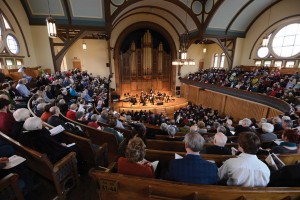
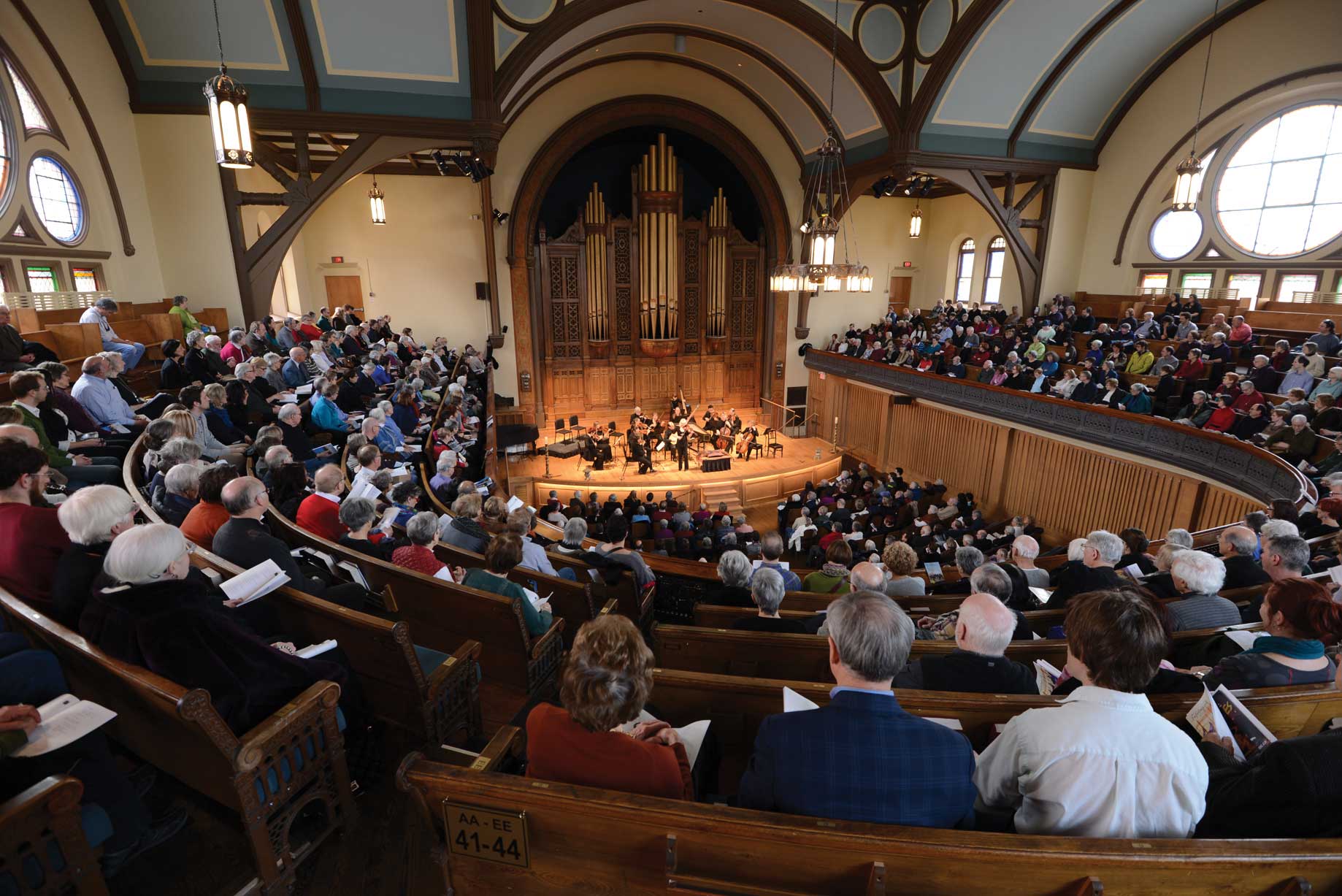
Tafelmusik Baroque Orchestra and Chamber Choir is set to hit a milestone when it completes its cycle of Beethoven symphonies by recording Beethoven’s 9th next month during its Feb. 4 to 7 concert series at Koerner Hall. The period instrument orchestra will launch a crowd-funding campaign Jan. 20 to raise funds to pay for the recording. Please visit www.tafelmusik.org for more information. Courtesy Royal Conservatory of Music
Tags: General
January 15th, 2016 · Comments Off on Bike lane plan up for debate
Design options released for tentative Bloor Street project
By Marielle Torrefranca
The City of Toronto has released a series of bike lane designs for its proposed pilot project on Bloor Street between Shaw Street and Avenue Road.
There are three main options: the removal of all on-street parking on Bloor Street for bike lanes (this design was not carried forward due to lack of parking and loading); buffered bike lanes between curbside parking and traffic lanes; and curbside bike lanes protected by buffers or bollards. The latter two options both retain car parking on one side of the street or the other.
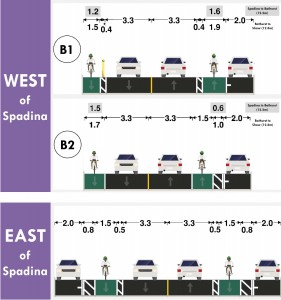
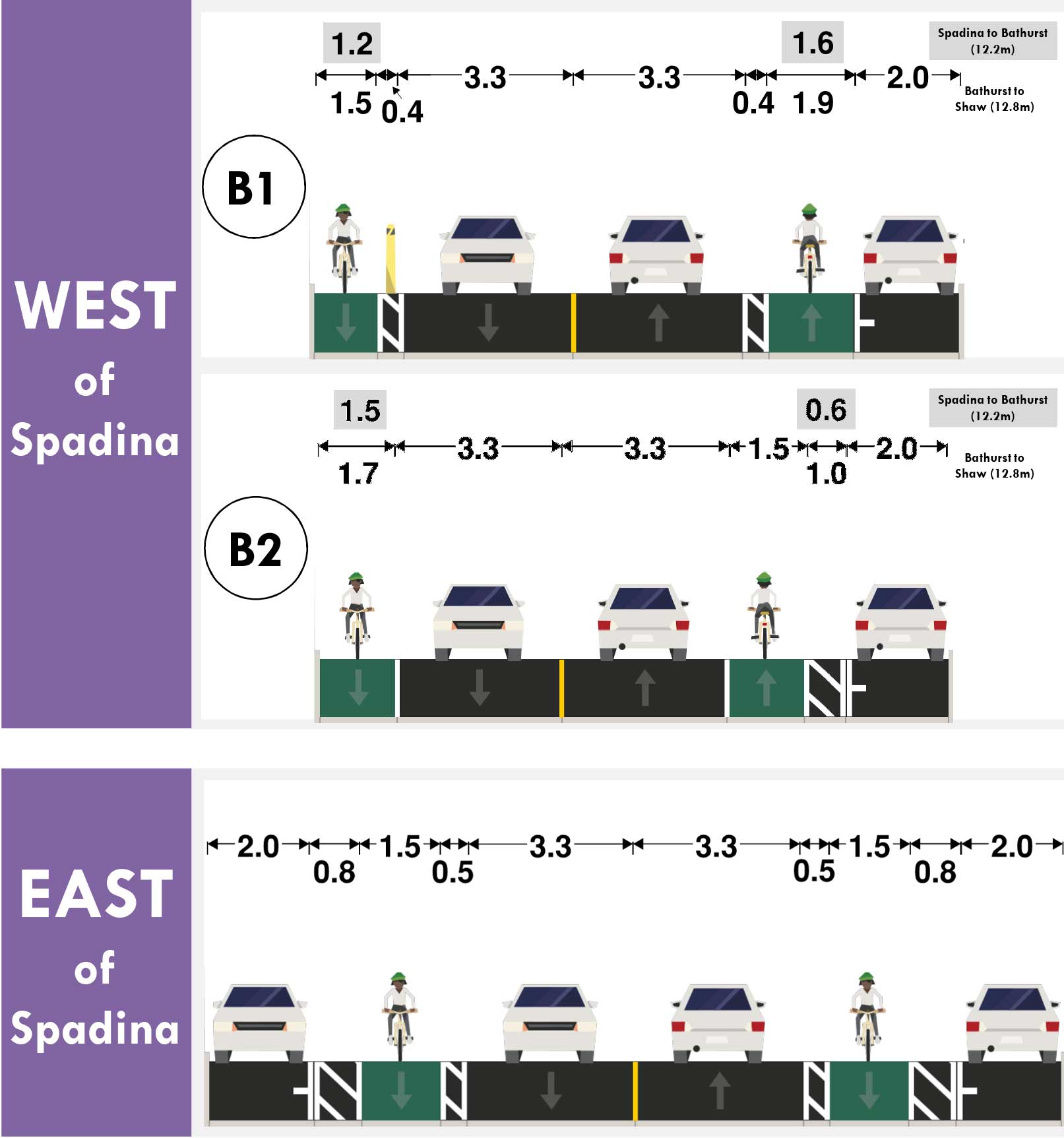
Option B, version 1: Bicycle lanes are separated from the roadway by
narrow buffers in both directions. Buffers can consist of bollards in one direction where feasible. However, as there is no buffer between the bike lane and on-street parking, cyclists would have to watch for opening
vehicle doors, and vehicles merging into traffic or exiting traffic.
Option B, version 2: Bicycle lanes in both directions with a buffer between cyclists and parked motor vehicles. This allows for room between cyclists and open vehicle doors. East of Spadina Road: Larger road east of Spadina Road allow for buffered bike lanes in both directions, buffered from both traffic lanes and motor vehicle door zones. Courtesy City of Toronto
The designs include optional variations, as the roadways differ along the corridor. For instance, the roadways are larger by about three metres in width east of Spadina Road. Other constraints include limited roadway space and competing uses, reduced parking, and possible motor vehicle traffic delay. The designs are available on the city’s website and open to feedback from the public until Jan. 15.
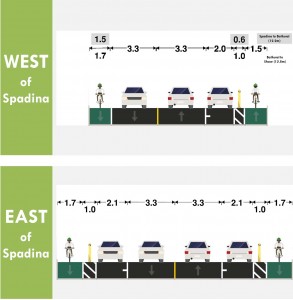
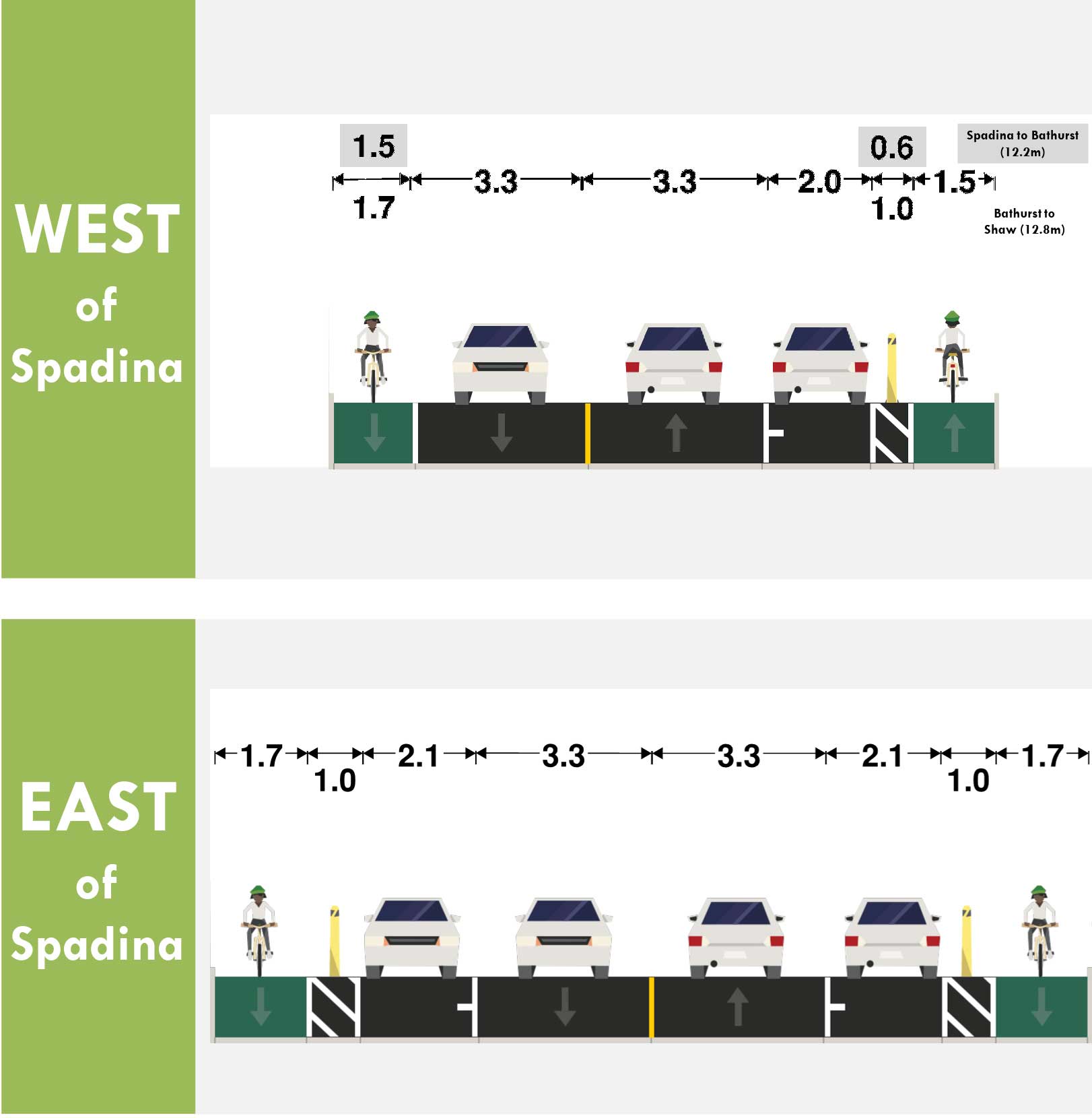
Option C: Bicycle lanes are separated from the roadway by motor vehicle
parking. One parking lane could be on the same side of the street
for the entire corridor or alternate between both sides of the street.
The door zone would be buffered, with bollards where feasible. East of
Spadina Road, bike lanes in both directions would be separated from
the roadway, with buffers in the door zone. Courtesy City of Toronto
The city’s goal is to choose the safest option that is still harmonious with surrounding businesses and motor vehicles.
“Seventy-three per cent of Torontonians say lack of cycling infrastructure is holding them back from riding more often,” said Jared Kolb, executive director of Cycle Toronto, one of the stakeholders of the project.
Currently, there are no dedicated bicycle lanes on Bloor Street.
“Ultimately our number one priority is creating a safe connected network in Toronto, and Bloor Street can be a real backbone,” said Kolb.
“I don’t ride on Bloor [Street]. It’s too dangerous,” said cyclist Dave Cronsilver, who has had his fair share of collisions with motor vehicles. Although the avid cyclist is nursing an injured arm from his most recent tangle, he said he is still keen to get back on his two wheels — if it were safer.
Staff Sergeant James Hogan is the manager of the community response unit for Toronto Police Division 14, where he also runs the bike crew. After cycling downtown for more than 20 years, he said bike traffic is changing on Bloor Street.
“From my observation, it’s a challenge for cyclists and motorists to coexist there,” said Hogan. “Like other streets, there seems to be more and more cycling activity, and I certainly see that where there’s almost bike traffic jams.”
Hogan said the chosen bike lane design should aim to provide better safety, clarity, and continuity.
“It’s just not clear what the best and safest place for the cyclist to be is,” he added.
The pilot project, still subject to council approval, has been more than 20 years in the making. City council has been commissioning studies on Bloor Street bike lanes since 1992.
Kolb said he hopes there’s enough of a critical mass to give the proposal an extra push this time around, as they’ve been working to create a stronger community voice through local residents, schools, and businesses. And, the David Suzuki Foundation has also recently become involved.
As the trial may result in a 50 per cent reduction in parking along Bloor Street, the Bloor-Annex and Korea Town business improvement areas (BIAs) are looking to measure the economic impact of the bike lanes on their members. New bike lanes can especially have an impact on parking and loading for businesses.
The University of Toronto, in partnership with the Toronto Centre for Active Transportation, is conducting an economic study on what impact, if any, bike lanes on Bloor Street will have on the area’s businesses. Research began in October and will cost $22,500. The BIAs and the Metcalf Foundation have contributed to the funding.
As for next steps, the city will pick a design option this winter and develop detailed design and costs. In the spring, a second public consultation event will be held, accompanied with another online survey. Should council approve the pilot project proposal in the spring, the bike lanes could be installed by the summer.
Upon approval, of course.
Tags: Annex · News
January 15th, 2016 · Comments Off on Westbank towers over 4 Corners
Application to be reviewed in context of study
By Annemarie Brissenden
Residents attending an open house dedicated to the Bathurst Bloor 4 Corners Study Area were keen to focus on Westbank Corp.’s proposed Mirvish Village development instead of commenting on Toronto City Planning’s draft policies for the City of Toronto’s Official Plan.
So much so, in fact, that Liora Freedman, the planner overseeing the process and leading the meeting, had to keep redirecting the audience’s attention to the task at hand: commenting on the proposals that, if approved, will govern future development at Bathurst and Bloor streets.
“This is not a meeting on Honest Ed’s, this is a 4 Corners meeting,” Freedman patiently kept replying to questions regarding the height and density of the Westbank development.
That said, City Planning’s presentation — posted online — includes a draft policy direction summary that states, “Development applications within the Study Area, including the current one for the SW quadrant, will be reviewed in the context of the Bathurst-Bloor 4 Corners Study principles and policy.”
It also notes that, “The south-west quadrant has a larger Mixed Use area which is large enough to accommodate a built form beyond mid-rise in some of the area, with potential for taller buildings, and also achieve other planning objectives including appropriate transition to Neighbourhoods.”
For some in attendance, though, it was difficult to reconcile those two statements with what had been discussed in earlier community consultations.
“Twenty-nine-storey towers doesn’t meet the design principles from previous meetings,” said an audience member. “There is a disconnect between what was talked about in the early days and the exhibits presented here today.”
The November open house was only the latest in a series of community consultations that have contributed to the development of area-specific policy amendments to the Official Plan.
The culmination of the first stage was when Toronto City Council endorsed a policy objective characterizing Bathurst-Bloor as “a diverse, historic, and walkable hub of activity”, and emphasizing the fine grain, small-scale character of this gathering place at the heart of four neighbourhoods. In the second stage, council endorsed a series of principles relating to public realm, movement, heritage, land use, and built form. The focus of this third stage is to develop policy direction for each of those five categories, which will ultimately become an Official Plan amendment.
The draft policies under consideration include coordinating unified streetscaping, acquiring new park land, improved pedestrian crossings and new mid-block connections, sufficient stepbacks for new developments on the main street buildings, no residential uses allowed on ground floors, as well as the encouragement of cultural and office uses.
Some Markham Street specific policies include the preservation of the volume of house-form buildings (including historic roof forms), discouraging cantilevering or balcony projection above buildings, and reinforcing the house-form scale and character south of Bloor Street to maintain the street’s special character and sense of place.
The draft policies for built form, particularly on the main streets, directs that base buildings should ensure a minimum of five hours of continuous sunlight over midday from spring to fall, that taller buildings should minimize the duration of shadowing on public streets, and that taller elements should be designed to be consistent with the smaller scaled, fine-grained built context of Bloor and Bathurst streets.
These draft policies are based on a series of principles that “emerged from a year of meetings”, explained Joe Cressy (Ward 20, Trinity-Spadina), “and will guide any changes at these four corners”.
“We can all be involved in how our city grows, really how our neighbourhood grows,” added Mike Layton (Ward 19, Trinity-Spadina).
Cressy stressed that the 4 Corners study doesn’t just reflect the importance of the intersection — “anything that changes at this corner will change the neighbourhood” — but is aimed at ensuring “we are not just adding density, but creating a livable neighbourhood”.
Despite the focus on the 4 Corners study, many in the audience kept returning to the Westbank proposal, raising concerns about the potential increased traffic such a development would bring, the impact construction would have on the surrounding area, and whether the city’s physical infrastructure would still function with the added pressure of the increased density.
But many of these questions went unanswered, as the meeting was not about the proposed development, which would — planning officials at the meeting reminded the audience — be the subject of many future community consultations.
The comment period for the draft policies ends Jan. 15, after which the planning department will finalize the Official Plan amendment and present its report to community council, followed by a public community council meeting. City council will then render its decision on the proposed amendment, and third parties will have a period of time to appeal any decision to the Ontario Municipal Board, after which the amendment will be in effect.
To follow the study, please visit www.toronto.ca/planning/bathurst.htm.
Tags: Annex · News
January 15th, 2016 · Comments Off on Arbitrator rules in favour of CAMH
An arbitrator has sided with the Centre for Addiction and Mental Health (CAMH) ruling that the rent the mental health hospital and research facility pays to the landlord of its College Street location be based on its value as an institution.
Its landlord, Brookfield Asset Management, had notified CAMH during a lease renewal process that it had valued the land at $100 million based on the highest possible use, and would increase the institution’s rent considerably. However, the arbitrator, Ken Stroud, pegged the institutional value at $55 million.
Much was at stake in the arbitration. CAMH would not have been able to afford such a significant increase in rent, threatening the institution’s ability to deliver critical medical care. Its College Street location is home to the province’s only 24-hour mental health emergency department, which treated 9,000 people last year, up from 3,500 just five years ago.
Joe Cressy (Ward 20, Trinity-Spadina), who organized a petition to support CAMH, suggested the City of Toronto would not support any application to change the site’s zoning, and accused Brookfield of acting in bad faith. Several neighbouring residents’ associations — including the Grange Community, Huron-Sussex, and Harbord Village — also actively opposed the facility’s potential displacement due to a crippling rent increase.
—Corrina King and Brian Burchell/Gleaner News
Tags: General
January 15th, 2016 · Comments Off on Celebrate a local icon
Celebrate the life and times of Anne Mirvish at the Anne Mirvish Gala at University College at the University of Toronto on Jan. 24. The gala is a fundraiser for the Anne Mirvish Performing Arts Scholarships, which support students who are studying the performing arts at the University of Toronto.
Organized by two of Mirvish’s closest friends, Professor Pia Kleber, who ran the drama program at U of T for many decades, and artist and scenic designer Astrid Janson, the gala will highlight her eclectic style through an exhibit of 100 outfits accompanied by archival photos, film, and music. U of T drama students past — including Maev Beaty, Yanna McIntosh, and Lisa Ryder — and present will model the clothes, and all garments and accessories will be available for sale by live and silent auctions.
Mirvish, who died at the age of 94 in 2013, was, along with her husband “Honest” Ed Mirvish, a much-loved Torontonian who left a lasting impact on the greater Annex neighbourhood. An artist herself, she was the driving force behind the creation of Mirvish Village, a haven for artists and small business owners inspired by a similar block on Gerard Street East.
To learn more about the gala, buy tickets, or get a sneak peak of the outfits on parade, please visit annemirvishgala.weebly.com.
—Annemarie Brissenden/Gleaner News
Tags: Annex · News · People
January 15th, 2016 · Comments Off on Recognition for Harbord Street BIA
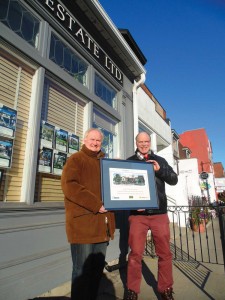
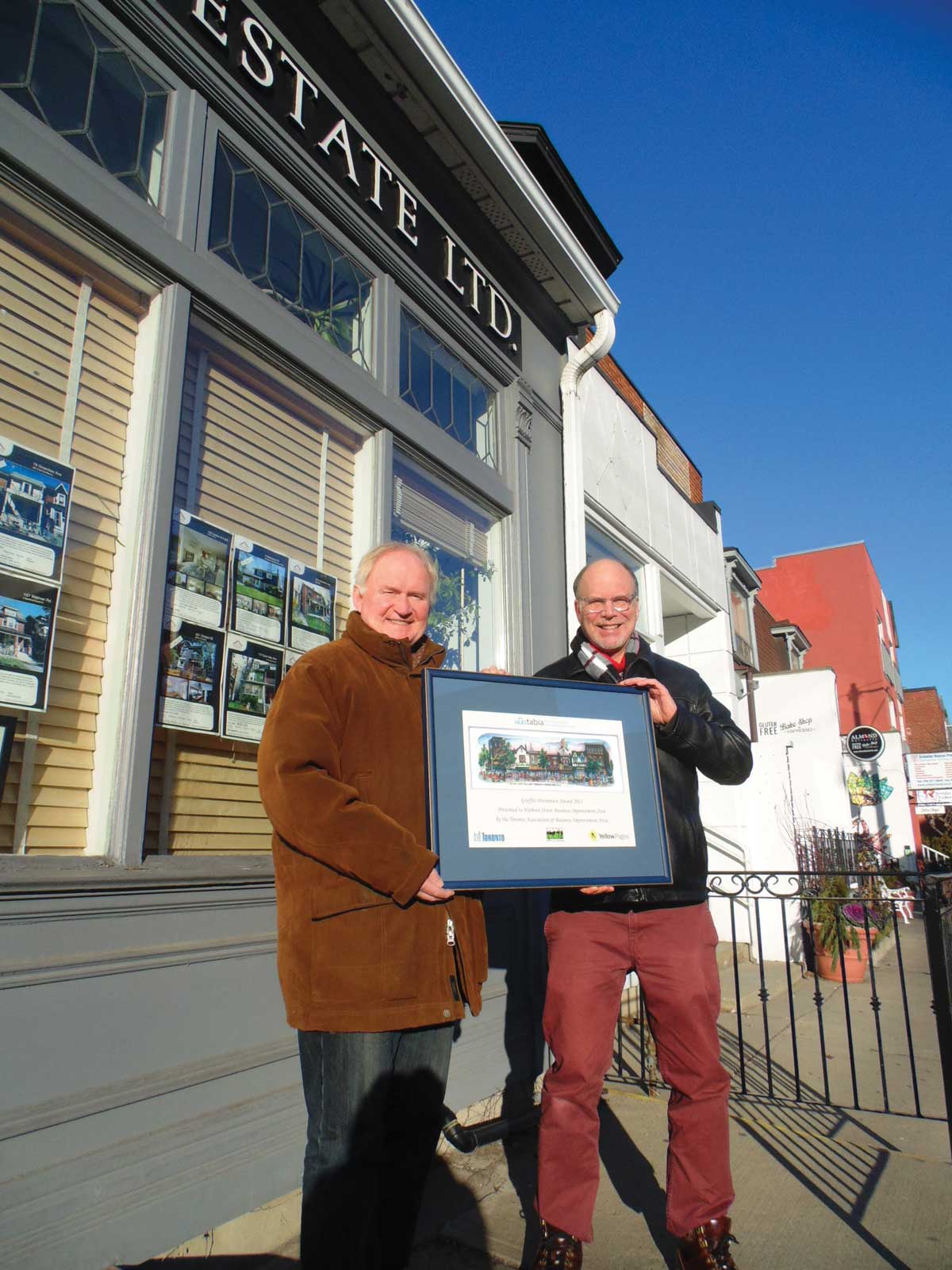
Neil Wright, chair, and Joe Caversham, treasurer, both of the Harbord Street Business Improvement Area (BIA), pose with a graffiti prevention award, presented to the BIA by the Toronto Association of Business Improvement Areas for its work in improving the streetscape. Brian Burchell, Gleaner News
Tags: General