March 9th, 2016 · Comments Off on LETTERS: HVRA still on board for CTS plan
Past chair responds to February editorial
Re “Ship to wreck” (Editorial, February 2016): you claim that former opponents of the dome at Central Technical School continued to work actively against the construction of the dome even after they had signed on to the Minutes of Settlement. That settlement was the result of successful mediation at the Ontario Municipal Board (OMB) between Razor Management Inc., the Toronto District School Board (TDSB), and five other parties. You name the former opponents as the City of Toronto and the Harbord Village Residents’ Association (HVRA). It would appear that the trigger for the editorial was the news that Razor Management had ceased work because it was being assessed $600,000 in tax arrears on a similar dome at Monarch Park Collegiate Institute.
[pullquote]The whole tenor of the editorial is to paint the HVRA as subverting the agreement reached at the OMB[/pullquote]
The following sentence from your editorial sets the overall tone:
“It appears, however, that opponents of the deal, after conceding the battle, never gave up the war.”
The whole tenor of the editorial is to paint the HVRA as subverting the agreement reached at the OMB. That is a terrible accusation and it stings, especially as there is not one bit of truth to the notion. The record shows that we at the HVRA have fought diligently for the implementation of the Minutes of Settlement, including construction of the dome, the track, and the community public space at the corner of Harbord and Bathurst streets.
We are mystified by this assertion for one thing, but also find it particularly pernicious because if what you said were true, we would be in breach of our written commitment at the OMB to support the Minutes of Settlement.
For the record:
- We (and everyone else) have to abide by the two-level court decision to declare the dome a commercial use, but these decisions were made well before the mediation at the OMB;
- Far from conducting a war against the dome, the HVRA has actively supported Razor Management post Minutes of Settlement, including negotiating dimensional and design changes in a shared use parkette and supporting an upgrade to a more expensive and less toxic cork field material;
- HVRA provided the baseline Terms of Reference for the Facilities Management Committee that would provide advisory assistance in the operation of the dome;
- Razor and the HVRA have been in constant and collaborative contact since the Minutes of Settlement were signed;
- Razor Management’s responsibility for taxes was in its contract with the TDSB from the beginning and has nothing to do with us. That notwithstanding, HVRA wrote to the TDSB in support of the TDSB assisting in providing some level of tax relief to Razor, recognizing a part of its operation included community benefit; and,
- We speak regularly to the proprietor of Razor. He understands our interest is seeing that the agreements made at the OMB are carried out, as they are the legal requirements for him to build and operate, just as HVRA is legally required to support them and ensure they are respected.
This manifestly is not the behaviour of an organization that was continuing some kind of “war” against the dome or “someone [who] would prefer to see Razor fail under the weight of the tax burden”.
In short, after the Minutes of Settlement were reached, there was no war that the HVRA continued — period, full stop. HVRA was committed, and still is, to the solution offered by the Minutes of Settlement. The February 2016 editorial screams duplicity and bad-dealing on the part of the HVRA, and the record must be set straight.
Rory “Gus” Sinclair, Past chair, HVRA
READ MORE ABOUT CENTRAL TECH FIELD:
Construction halted at Central Tech: Student athletes launch online petition by Marielle Torrefranca (February 2016)
Agreement reached for Central Tech field (April 2015) by Annemarie Brissenden
To dome or not to dome, that is the question (February 2015) by Terri Chu
Editorial: Mobs don’t rule, nor do pawns (February 2015)
Dome plan inches closer (February 2015) by Brian Burchell
School board appeals ruling and loses, again (October 2014) by Brian Burchell
Editorial: A strategy run amok (September 2014)
Dome plan quashed by courts (September 2014) by Brian Burchell
Raucous meeting on CTS field (April 2014) by Annemarie Brissenden
READ MORE ABOUT CENTRAL TECH:
Central Tech alumni return to mark school’s centennial (November 2015) by Annemarie Brissenden
Central Tech celebrates 100 years (July 2015) by Annemarie Brissenden
Aircraft program grounded in 2004 (July 2015) by Annemarie Brissenden
Tags: Annex · Opinion
March 9th, 2016 · Comments Off on EDITORIAL: The many shades of stimulus
The key to any stimulus plan that the Liberals adopt is to realize two objectives at the same time — immediacy and economic sustainability.
The previous Conservative government ran repeated deficits though it liked to pretend it didn’t, and the federal Liberals now inherit not only that fiscal reality but also an economy in recession, and something must be done. The relative price of the Canadian dollar does nothing to assuage one’s worry. Notwithstanding the overheated residential real estate market in Toronto and Vancouver, the economy is stalled.
The Liberals are poised to make significant investments in infrastructure projects as a way of stimulating the economy in the short term and raising productivity, such as in Mayor John Tory’s Smart Track transit investments, in the long term. This will require deficit spending, that part is not news. But what form the spending takes is important to consider and the Liberals seem intent on getting it right, though the right path is by no means clear.
Stimulus spending is not a new government tool in response to sputtering economic conditions. And since the Liberals campaigned quite openly on their spending plan they can take these steps with considerable democratic approval. Let’s hope it bears no resemblance to a specific one previously enacted by their predecessors. It’s worth recalling that then Industry Minister Tony Clement commanded a $50 million stimulus program which he sold to Parliament as a infrastructure fund to reduce border congestion, but which instead was used to spruce up his Muskoka riding including, infamously, a $100,000 gazebo in Orrville (about 300 km from the U.S. border).
As far as we know, there are no gazebos in the Liberal plan, but Mr. Clement, who now sits as an opposition MP and critic of the government, will be able to recognize any lack of spending integrity with some personal authority.
Rookie Liberal MP Ahmed Hussen will introduce a private member’s bill at the beginning of March aimed at coupling community-benefit agreements (CBA) with public works contracts. This, if approved, would require contractors carrying out federally funded building or maintenance work to hire local workers and to run training and apprenticeship programs. CBAs were pioneered south of the border and also set targets around procurement and the improvement of public spaces. This caveat to spending might be difficult to bring to fruition since rarely does the federal government fund that many infrastructure projects directly. Acceptance of this strings-attached offer to other levels of government would be necessary. Also, negotiating these agreements with contractors would prove time consuming at a moment when time is the most precious commodity. On the other hand, just about any project will require approvals and local support, and with the CBA element bringing direct local benefit that support may come more quickly. Hussen’s bill is a trial balloon, and the government may just let it die, but then co-opt elements of it for its overall strategy.
At a recent town hall meeting, Carolyn Bennett (MP, Toronto-St. Paul’s) tested some waters of her own. She reminded attendees of the Liberal campaign platform that broadly defined infrastructure spending was not only for things like subways and bridges, but also for green and social initiatives. According to Bennett, green infrastructure projects may include freshwater protection through spending on watershed improvements and improved waste water treatment. Social infrastructure could involve investing in affordable housing and facilities for seniors, as well as enhancing child care facilities.
The key to any stimulus plan that the Liberals adopt is to realize two objectives at the same time — immediacy and economic sustainability. Investment is needed in projects now that produce an immediate economic benefit but only those projects that also have a sustainable economic benefit in terms of productivity. Increasing the gross domestic product, relative to overall debt, is within the government’s sights. Realizing community, green, and social benefits too are laudable aspirations that will pay broad dividends.
Tags: General
March 9th, 2016 · Comments Off on FORUM: Large problem, small solution
Time to break up with your large garbage bin
COURTESY HOLLY THOMSON/TORONTO ENVIRONMENTAL ALLIANCE
The city has a plethora of handy services to help you redirect waste from your garbage bin.
By Mike Layton
Despite a higher cost and growing list of recyclable and compostable items that you can put in the blue and green bins, some households are holding onto their super-sized garbage bins and continue to throw away stuff they could recycle, reuse, compost, and keep out of Toronto’s landfill.
[pullquote]Downsizing your bin will help you save hundreds of dollars a year.[/pullquote]
I consider myself a recycler. In our household, my wife and I had a large recycling bin and a medium garbage bin. But last year when the garbage rates went up, I took a look in my garbage bin and discovered at least half the stuff should have been recycled or put in the green bin. Composting used tissue paper alone almost entirely eliminated garbage in my bathroom. Feeling a little ashamed and embarrassed, I called to order a smaller garbage bin.
After a year, we have never overflowed the small bin even with the addition of another member to our household (diapers go in the green bin). Our family of three easily fits two weeks of garbage into a small bin, with room to spare.
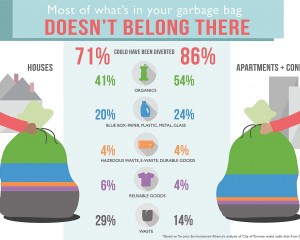
The City of Toronto has found that on average 38 per cent of the garbage in our bins is actually garbage — meanwhile 38 per cent could have gone in the green bin, 15 per cent in the blue bin, and the rest diverted through other city collection programs.
For those with extra large garbage bins, 77 per cent of the stuff in their bins could have been diverted away from landfill; even those with small and medium bins could be putting more into their blue and green bins.
According to the Toronto Environmental Alliance’s analysis of the city’s own waste audit numbers, we are sending 182,000 tonnes of organics to our landfill every year that could be going into the green bin. We are also sending 84,000 tonnes of recyclable resources to the landfill each year, never to be seen or used again.
There are many reasons to move to a smaller garbage bin and one of them is hundreds and hundreds of dollars. Moving to a smaller garbage bin will save you a lot of money and upgrading to large recycling and green bins is free.
A small garbage bin will cost you $17.76 per year for garbage collection. A medium bin is a lot more at $115.38 per year, a large bin is $295.14 per year, and an extra-large garbage bin $411.23 per year. Downsizing your bin will help you save hundreds of dollars a year.
Another reason to put more into your green and blue bins is to help create jobs in the city. Our recycling, composting, and diversion programs create jobs: 10 times more jobs than disposal to landfill because we need people to process the materials and work in the waste depots.
The last reason is to save space in our landfill. Right now our city’s landfill is filling up. Green Lane landfill will be full in just over 10 years if we don’t recycle and compost more. Finding a new landfill is not an easy task, is very expensive, and is bad for the environment. Most importantly, landfills aren’t good things. They take up beautiful land, and trap materials we could be reusing, including some toxic hazardous materials we should be disposing of properly.
It’s really easy to move to a small bin and increase the size of your blue and green bins. Simply email311@toronto.ca, or call 311 to make the request. The city also has the Waste Wizard available for you online so you can find out whether something can go into your blue or green bin, instead of your garbage. If we simply used our green and blue bins more we could reduce how much we send to landfill by more than 300,000 tonnes per year. This could add almost 20 years to the life of our landfill. Do your part today by switching to a smaller bin and then encourage your neighbours to join you.
Mike Layton is the councillor for Ward 19, Trinity-Spadina.
Also by Mike Layton:
Happy New Year from a new Dad with a new perspective (January 2016)
Tags: General
March 9th, 2016 · Comments Off on GREENINGS: Don’t fall prey to marketing
Make informed choices when buying green
By Terri Chu
One great thing about living in the Annex is that there are lots of places to buy green products. (Though losing Grassroots means there are not a lot of places to refill shampoo bottles.) I find myself taking this for granted and not always carefully reading the labels on products I buy, trusting that they have been sourced by stores that share the same ethical values that I do.
[pullquote]Global demand for palm oil is the leading cause of rainforest deforestation in Indonesia and Malaysia.[/pullquote]
Accommodating a friend’s dietary choices, I bought a vegan baking block made by Earth Balance to make pastry. I didn’t look carefully, and the word vegan satisfied me at the time as a low impact product with an environmentally sounding company name. When I got the product home, I realized it was made with mostly palm oil. I was immediately sick to my stomach. If my friend was choosing to go vegan for ethical rather than health reasons, well, I would have done less damage to the environment and harmed fewer animals by baking with a stick of lard. At least that way, only one animal would have died in the process, and if it was lard from my friend’s organic farm, it was an animal that was treated well while it lived.
According to the United Nations Environment Programme, global demand for palm oil is the leading cause of rainforest deforestation in Indonesia and Malaysia, home to the critically endangered orangutan. A quick Google search for “orangutan” and “palm oil” will lead to images of orangutans burned alive in a bid to clear land for plantations. The slash and burn method of land clearing contributed to last year’s Indonesian forest fire crisis that saw 19 people killed and half a million people treated for respiratory illnesses (though it did not receive a lot of media coverage).
Orangutan habitat is disappearing at a rate of about 300 soccer fields every hour thanks to the demand for plantations.
Indonesia is doing what it can to curb the slash and burn practice but policing is near impossible for a stretched government where corruption is high. With palm oil so cheap to produce and the trees so lucrative to grow, most people take their chances in bettering their own situations rather than thinking about the climate as a whole. It’s hard to blame the subsistence farmer. For our part, we can at least decrease the demand and by extension the profitability of burning rainforest land in favour of palm oil plantations.
To add insult to injury, the fires last year cost the Indonesian government about $16 billion while the value of the palm oil plantations is estimated to be $8 billion. The Indonesian public is subsidizing hefty profits for a few, thanks to the demand we place on an unsustainable product.
Palm oil lurks in so many products. It is often called just plain old vegetable oil, although sterate, stearyl, sodium lauryl sulphate, and sodium laureth sulphate are among its many other monikers. It won’t be possible to bring our consumption to zero, but making a point to read the ingredient list or even writing to manufacturers of your favourite products could alleviate demand even that little bit.
The lesson for me out of this was not just to accept a pretty green label as being green. The products we choose to buy (or not to buy) have an impact on the environment. Everything from the obvious (Keurig coffee pods anyone?) to the more completely green washed Fiji water has environmental consequences.
Those of us lucky enough to be able to afford to make purchasing decisions based on environmental or ethical reasons shouldn’t be duped by good marketing.
We have to think about the entire life cycle of the products we buy, and not be fooled by the green packaging.
Terri Chu is an engineer committed to practical environmentalism. This column is dedicated to helping the community reduce energy, and help distinguish environmental truths from myths. Send questions, comments, and ideas for future columns to terri.chu@whyshouldIcare.ca.
Also by Terri Chu:
Reduce, reuse, then recycle (February 2016)
The power of labelling (January 2016)
Tags: Annex · Opinion
February 2nd, 2016 · 1 Comment
Student athletes launch online petition
By Marielle Torrefranca
In the latest of a saga of hurdles, construction of Central Technical School’s $7-million sports facility has been stopped until further notice, said Razor Management Inc. (RMI).
According to a Razor news release, the work stoppage comes after the company received a three-year retroactive tax bill of $505,000 for its stadium at Monarch Park Collegiate Institute, plus approximately $200,000 a year moving forward for each of its facilities. The bill was allegedly received 38 days before its due date at the end of January.
[pullquote]“We are being bullied by the city on the tax issue”—Matthew Raizenne, Razor[/pullquote]
The Monarch Park Stadium and unfinished Central Tech sports facility are projects resulting from Razor’s partnership with the Toronto District School Board (TDSB). With the tax bills, Razor said it’s unable to support the funding of both locations.
“We let the TDSB know in October that we had serious concerns about what was happening at Monarch Park,” said Matthew Raizenne, president of Razor Management.
According to a news release from Razor, TDSB trustees ignored a senior staff report recommending a tax exemption for its affiliated championship field partners, since the projects primarily benefit TDSB students.
The news release states that similar tax exemptions have been granted to city partners, such as Maple Leaf Sports and Entertainment’s Lamport Stadium, and Field Recreation Inc.’s field at Lakeshore Collegiate.
“It’s politically targeted in our beliefs,” said Raizenne. “We’re trying to get to the bottom of it.”
However, the TDSB said the tax bill shouldn’t have come as a surprise.
“It’s important to note the agreement between the TDSB and Razor Management states that RMI is responsible for payment of any of taxes assessed by the property,” said Ryan Bird, media relations for the TDSB.
The Municipal Property Assessment Corporation (MPAC), which administers property assessments in Ontario, emailed Monarch Park Stadium in February, saying the City of Toronto had asked MPAC to update its records and review the tax status on the new structures at Monarch Park. This included Monarch Park Stadium.
“It’s just normal procedure,” said Darlene Rich, media relations specialist for MPAC of assessment. “That’s not anything other than normal.”
“You can’t automatically compare other properties that appear to be similar,” she said. “They all have their individual agreements with the property owner, for instance, with the TDSB. Agreements that one company has could be completely different than the other.”
The cost of the bill is set by the city, however. Razor has the option to request an appeal for a property reassessment through MPAC, but the company has not done so, said Rich.
The TDSB is also willing to provide Razor with non-monetary support in a reassessment appeal, said Bird.
“We’re trying to figure out who from the city has the impact to assess us,” said Raizenne, adding Razor filed Freedom of Information requests in mid-January, but has yet to receive the information it had requested.
The company also reached out to the mayor’s office late last month, requesting clarity on the city’s alleged assessment request and the tax bill.
“We believe we are being bullied by the City of Toronto on the tax issue,” Raizenne wrote in an email to the mayor’s office. “The city has come down on only us and there is no justified reason for this.”
A representative from the Mayor’s office responded, saying MPAC is a corporation independent from the City of Toronto whose role is to assess the value of all property in the province, and that there is “no picking and choosing.”
“It was always agreed and understood from the beginning that Razor Management was responsible for paying any commercial taxes that would apply to the site,” said Joe Cressy (Ward 20, Trinity-Spadina). “It’s the TDSB’s land and it’s up to the TDSB whether to exempt those taxes.”
“In our city, businesses should pay commercial taxes. I think that’s fair and only fair for all businesses, but that amount of tax should be fair and taken into account the implied services of the project.”
While the crux of this issue is commercial tax, this project has now seen years of obstacles since its proposal in the spring of 2013.
After mediation by the Ontario Municipal Board last spring, the original construction plan was scaled back due to opposition from residents. The compromise included a smaller dome covering only the field during winter months and allowing community use of the turf during evenings and weekends.
“That resolution and that agreement is what I am committed to honouring and making sure it goes forward,” said Cressy.
However, with construction at a standstill, the field will not be open in time for Central Tech’s spring athletics season, much to the dismay of students and the school’s athletic teams.
A group of student athletes have started an online petition that includes a letter to TDSB trustees and Education Minister Liz Sandals.
“We are asking you, after nearly three years, to please get on with it,” reads the letter, “and if you don’t want to have a great facility at Central Tech and you do not want to be our ‘champions’ to get the project through the finish line, and would prefer to let the site sit empty, just do us all a favour and let us know now, so that we can transfer to other schools or other school boards [that] value sport and athletics and are willing to stand up for their students’ interests and well-being.”
At press time, the petition had received over 600 signatures.
“We appreciate that both students and staff and the community want this field finished,” said Bird. “And we don’t want them to wait any longer either…. We want to see this field finished.”
Both the Mayor’s office and Cressy expressed concern over students having access to recreational space. While Razor shared the same sentiment, it was adamant about its cause.
“We are 100 per cent committed to the project,” said Raizenne. “We just asked the school board for assistance and to be treated equally and not to be discriminated against. But we’re 100 per cent committed and we’re hopeful that a resolution can be found imminently.”
READ MORE ABOUT CENTRAL TECH FIELD:
Editorial: Ship to wreck (February 2016)
Agreement reached for Central Tech field (April 2015) by Annemarie Brissenden
To dome or not to dome, that is the question (February 2015) by Terri Chu
Editorial: Mobs don’t rule, nor do pawns (February 2015)
Dome plan inches closer (February 2015) by Brian Burchell
School board appeals ruling and loses, again (October 2014) by Brian Burchell
Editorial: A strategy run amok (September 2014)
Dome plan quashed by courts (September 2014) by Brian Burchell
Raucous meeting on CTS field (April 2014) by Annemarie Brissenden
READ MORE ABOUT CENTRAL TECH:
Central Tech alumni return to mark school’s centennial (November 2015) by Annemarie Brissenden
Central Tech celebrates 100 years (July 2015) by Annemarie Brissenden
Aircraft program grounded in 2004 (July 2015) by Annemarie Brissenden
Tags: Annex · News · General
February 2nd, 2016 · Comments Off on Sprott House opens new home for LGBTQ2S youth
Specialized facility meets urgent need
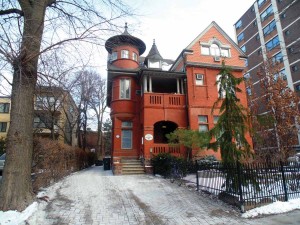
YMCA Sprott House provides transitional housing for 25 LGBTQ2S youth.
CORRINA KING/GLEANER?NEWS
By Summer Reid
Homeless lesbian, gay, bisexual, transgender, queer, and two-spirited (LGBTQ2S) youth finally have a place to sleep without intimidation and harassment.
YMCA Sprott House (21 Walmer Rd.) this month began providing transitional housing for 25 homeless LGBTQ2S youth, aged 16 to 24.
“It’s another step forward for us as a city, as we pursue greater equality — not tolerance, not acceptance — but real equality,” said Joe Cressy (Ward 20, Trinity-Spadina) at the facility’s opening on Jan. 14.
Cressy explained that Sprott House will not, on its own, be able to tackle the challenges that these populations in Toronto face, but it will provide them with a safe haven. Approximately 2,000 homeless youth sleep on Toronto’s streets on any given night, and of these, one in five identify as LGBTQ2S.
“Those statistics are simply unacceptable,” said Diane Sinhuber, chair of the board of directors at the YMCA of Greater Toronto. “The YMCA of Greater Toronto has long understood that there is a pressing need for transitional housing facilities dedicated to serving LGBTQ2S young people.”
LGBTQ2S youth are more vulnerable to mental health concerns, an elevated risk of physical and sexual exploitation, substance use, and suicide, explained Dr. Alex Abramovich, a post-doctoral researcher at the Centre for Addiction and Mental Health. And without specialized programs, LGBTQ2S youth have nowhere to go.
“Focused responses including specialized housing programs, like the YMCA Sprott House, are absolutely critical to meeting this population’s needs and to providing inclusive, affirming, and safe spaces,” said Abramovich.
That’s why the YMCA is dedicated to providing youth with a positive and safe space to live. The facility’s staff will all be very accepting and provide a wide range of support to help these youth transition into adulthood.
“The YMCA believes, with great conviction, that all young people deserve a chance to live healthy and prosperous lives,” said Sinhuber.
Sprott House’s director, Kate Miller, said that LGBTQ2S youth have been asking for a specialized facility for a long time.“These youth are experts on their own lives, and we are responding to something that they have clearly identified as a need.”
Mayor John Tory, who also attended the opening, vowed that this facility would stand as a symbol of how the city works together for the greater good, and said he was proud of how open and accepting of the facility the Annex community has been.
“Not only did the neighbours in this area react without a sense of apprehension, or any other kind of thing,” he said, “they came forward to say they wanted to help make this happen. They wanted to make friends with people here; they wanted to be partners and real neighbours; that is the true spirit of Toronto.”
That openness is in direct contrast to the reception facing the Yonge Street Mission (YSM), which announced last November that it would be moving to a newly renovated 24,000-square-foot space on Spadina Avenue just north of Dundas Street West. Many members of the Chinatown Business Improvement Area have said they believe that the YSM would increase the presence of street youth in the area, and intimidate their customers, especially the elderly. Business owners and residents of Chinatown signed a petition to send to Tory asking him to stop the YSM’s move into the area.
“Annexians are often and quite wrongly accused of being the archetypical NIMBYists, resistant to change and obstructive to new developments either physical or social,” said David Harrison, chair of the Annex Residents’ Association. “However, we firmly believe that there should be a home and a place for everyone. And, in this way, the Annex is inclusive, creative, caring, and generous.
Tags: Annex · News · General
February 2nd, 2016 · Comments Off on FORUM: Province tables sexual assault act
Legislation aimed at being more responsive to survivors
By Han Dong
Recently, the Select Committee on Sexual Violence and Harassment submitted its final report to the Legislative Assembly of Ontario. I am privileged to have been a member of this all-party, non-partisan committee of the Legislature. The recommendations that came out of this committee were developed through the testimonies of those who came forward with personal stories and firsthand experiences. These will help establish a foundation for future action.
[pullquote]The government recently announced a $2.25-million fund to challenge rape culture through artistic projects.[/pullquote]
I am proud of the leadership of Premier Wynne on ending the culture of sexual violence. I also want to thank the Honourable Tracy MacCharles, the Minister Responsible for Women’s Issues, for her tireless work on the Sexual Violence Action Plan.
The legislation, if passed, would help deliver on commitments in “It’s Never Okay”, the government’s groundbreaking action plan to stop sexual violence and harassment.
If passed, the Sexual Violence and Harassment Action Plan Act would make workplaces, campuses, and communities safer and more responsive to the needs of survivors and complaints about sexual violence and harassment.
The act would:
- Require every publicly assisted college and university and private career college to have a stand-alone sexual violence policy and to review it — with student involvement — at least once every three years;
- Enhance requirements for sexual harassment prevention programs and create specific employer duties to protect workers, including a duty to ensure that incidents and complaints are appropriately investigated;
- Remove the limitation period for all civil proceedings based on sexual assault — and, in certain cases, sexual misconduct or assault — so that survivors can bring their civil claims forward whenever they choose to do so;
- Eliminate the limitation period for survivors of sexual assault and domestic violence to make a compensation application to the Criminal Injuries Compensation Board; and,
- Shorten the time it takes to end a tenancy agreement for people experiencing sexual or domestic violence, to make it easier for survivors to flee abuse.
The Ontario government is supporting these priorities through a broad action plan that includes increased and stabilized funding to community-based sexual assault centres and hospital-based sexual assault and domestic violence treatment centres.
The government is also running a province-wide public education campaign to promote a shift in attitudes and behaviours, and recently announced a $2.25-million Creative Engagement Fund to challenge rape culture through artistic projects.
As your MPP, I would like to hear your comments and suggestions regarding the Sexual Violence Action Plan, or the work of the Select Committee on Sexual Violence and Harassment. I welcome you to visit my website for more information on the Action Plan, and other provincial programs and services.
Han Dong is the Member of Provincial Parliament for Trinity-Spadina. He can be contacted via 416.603.9664 or hdong.mpp.co@liberal.ola.org. His website is www.handong.onmpp.ca.
Tags: General
February 2nd, 2016 · Comments Off on EDITORIAL: Ship to wreck
Razor Management Inc., which operates the existing athletic facility at Monarch Park Collegiate Institute and is installing a similar field at Central Technical School, announced this month that it had received an unexpected retroactive municipal tax bill of $505,000 relating to the Monarch Park facility. It has also been informed that it will face similar levies at Central Tech once that field is up and running.
It’s a bill that will make operating the site untenable for Razor, and as a result, Razor has said it will cease construction at Central Tech, be forced to eliminate youth programming at Monarch Park, and increase the rates for private users by 78 per cent.
In a January news release, Razor claims that the Toronto District School Board (TDSB) has ignored a senior staff report recommending a tax exemption for all “championship field partners as the projects were built primarily for the benefit of students”. The company further claims that no other private operator currently providing services to the school board has ever received a tax bill. Yet, the school board has not come to Razor’s defence, and seems prepared to let them wither.
The TDSB’s plan to contract the operation of the field to a private operator has long been a contentious one. The previous condition of the field and track at Central Tech was poor, and soil tests suggest that the field was contaminated. There’s little room in the TDSB budget for site maintenance, and nothing whatsoever for soil remediation.
And so the TDSB touted its partnership with Razor as a panacea: the tainted soil would be removed, the track rebuilt, low maintenance artificial turf installed, and an inflatable dome puffed up during the winter months. The school board has access to the entire facility during school hours, the community gets some free access during the weekends (as well as sponsorship of a community swim program), and the space is available for rent during the rest of the time. The TDSB would be on the hook for $0 and only has to give away access to the site in the off-season and after-hours periods.
However, the City of Toronto and the Harbord Village Residents’ Association (HVRA) opposed the plan. Although they had a philosophical beef with the proposal — arguing what they claimed was public land being effectively ceded to a private party — they also were not content with the level of community access, as well as concerned about the visual impact of the giant dome, the merits of artificial turf, and the impact on parking and traffic from new users coming from outside the community.
However, the interested parties — including the TDSB, the HVRA, the city, and Razor — reached a mediated settlement at the Ontario Municipal Board. The terms included a smaller dome, increased community access, and setting up a working group that would address any local concerns on a case-by-case basis.
It appears, however, that opponents of the deal, after conceding the battle, never gave up the war.
A city official (it’s not clear who) appears to have requested a property tax review of Razor’s operations at Monarch Park and Central Tech, leading to the assessment and tax bill. It seems someone would prefer to see Razor fail under the weight of the tax burden, and the TDSB hasn’t yet stepped up to the plate with a ringing endorsement of its partner in delivering a state-of-the-art athletics facility to its students.
To say that this is a cutthroat strategy is an understatement: the opponents of this plan seem intent on ensuring that everybody loses if they can’t win. It’s a scorched earth policy whose biggest victims are the ones the board is supposed to serve: the students. After three years without a field at Central Tech, it looks like they won’t get one anytime soon. And it looks like some will graduate never even having seen anything but a locked fence.
READ MORE ABOUT CENTRAL TECH FIELD:
Construction halted at Central Tech: Student athletes launch online petition by Marielle Torrefranca (February 2016)
Agreement reached for Central Tech field (April 2015) by Annemarie Brissenden
To dome or not to dome, that is the question (February 2015) by Terri Chu
Editorial: Mobs don’t rule, nor do pawns (February 2015)
Dome plan inches closer (February 2015) by Brian Burchell
School board appeals ruling and loses, again (October 2014) by Brian Burchell
Editorial: A strategy run amok (September 2014)
Dome plan quashed by courts (September 2014) by Brian Burchell
Raucous meeting on CTS field (April 2014) by Annemarie Brissenden
READ MORE ABOUT CENTRAL TECH:
Central Tech alumni return to mark school’s centennial (November 2015) by Annemarie Brissenden
Central Tech celebrates 100 years (July 2015) by Annemarie Brissenden
Aircraft program grounded in 2004 (July 2015) by Annemarie Brissenden
Tags: General
February 2nd, 2016 · Comments Off on Operating budget $67 million short
Cancelled car tax could have made up difference for Toronto
By Annemarie Brissenden
The City of Toronto’s proposed tax-supported operating budget for 2016 rings in at just over $10 billion, but what’s remarkable is what it doesn’t include.
Among the things it doesn’t include are much-needed Toronto Community Housing Corporation (TCHC) money, $25 per capita for the arts (a target set in 2003 that has yet to be met; it was to bring Toronto’s cultural spending in line with Montreal’s, which now spends $55 per capita on the arts), funding for an additional 57 paramedics, money for early Sunday morning service on the Toronto Transit Commission (TTC), funding to increase the number of long-term care nurses who are dedicated to helping people stay in their homes, and money to enhance the Toronto Public Library service offerings with youth hubs, WiFi expansion, and digital innovation.
And all that’s before tackling the city’s capital projects that remain unfunded to the tune of $22.3 billion: the TCHC state of good repair backlog, the George Street revitalization, Lower Don flood protection, and a downtown relief line for the TTC.
Taken together, it’s a basket of necessary items that would not only enhance municipal programming, but also haul Toronto into the 21st century.
“We don’t have the resources to maintain the city we have, let alone the resources to build the city we want,” said Joe Cressy (Ward 20, Trinity-Spadina) at a budget consultation he co-sponsored with Mike Layton (Ward 19, Trinity-Spadina) at the Centre for Social Innovation on Jan. 25. “We have $22 billion in projects we need that aren’t funded, and $67 million in programs we need that aren’t in the budget.”
The shortfalls also highlight just how much impact the city and its services has on our daily lives.
“Municipal governments are probably the most important governments that you deal with in your daily life,” said Layton. “Just about every part of your life is touched by the budget.”
“It is critical,” agreed Cressy. “The context of our city is that we are a growing city…with an increasing demand on infrastructure and services, and our budget is not keeping pace.”
Josie La Vita, the executive director for financial planning for the City of Toronto, explained that unlike previous years, city staff delivered a budget without recommending a property tax rate increase, choosing instead to highlight budget pressures and ask for direction on strategic priorities and “where we should put our limited resources”.
She noted the “goal is not to impact [current] service levels”, and, except for the TTC and the Toronto Police Service (TPS), “almost all city operations came in lower than last year”.
At just over $1.8 and $1.1 billion respectively, the TTC and the TPS represent the largest line items in the budget, something that many in attendance at the meeting questioned.
“Why do police come out every time a paramedic does,” wondered one person, suggesting that first responders might be better coordinated.
Another suggested that police, transportation, and technology are three areas where money is not being spent in ways that we want, and asked, “do we want these three sectors to be as big as they are?”
As to transit, a meeting attendee argued that “we have massively reduced what’s going into the TTC, and haven’t yet met a single monthly ridership target.”
Cressy explained that transit is a particularly pernicious challenge for the city.
“We are the only city in the world that doesn’t get national or state/provincial funding [for transit] on a consistent basis,” he said. “That’s not just a quality of life issue or an environmental issue; it’s an economic issue. We lose $6 billion annually in productivity in the Greater Toronto Area because of gridlock.”
Layton and Cressy believe the city needs to consider a higher property tax increase, pointing out that Toronto property owners pay an average of $3,170, the least amount in property tax compared to the average of $4,182 for the Greater Toronto and Hamilton Area and Ottawa municipalities.
The councillors also suggested that it’s time to explore additional sources of revenue, including adding a sales and/or income tax, which they say is done in other world-class cities. A sales tax in particular would reduce the reliance on people who live in Toronto, and broaden it to include people who visit and work in the city, but live elsewhere.
Cressy added that the much-lamented Vehicle Registration Tax, which was cancelled under the Ford administration, would have brought in $67 million, and made up the shortfall in the operating budget.
READ MORE:
Happy New Year from a new Dad with a new perspective (January 2016) by Mike Layton
Tags: General
February 2nd, 2016 · Comments Off on How nice! How to meet your quota!
Tags: General
February 2nd, 2016 · Comments Off on U of T art museums unite under new name
Two of the University of Toronto’s distinguished art galleries have merged to create one of the largest university-based art museums in the country. The Art Museum at the University of Toronto — previously the Justina M. Barnicke Gallery and the University of Toronto Art Centre — is also the second-largest museum-standard visual art museum and collection in the city, and will continue to occupy two close physical spaces at Hart House and University College. Sarah Robayo Sheridan has curated the art museum’s inaugural exhibition Showroom, which will showcase a diverse range of work from 48 artists all portraying the influence of lifestyle marketing on the cityscape.

Skyline (2013) by Lauren Woodcock is one of the works featured in Showroom, the inaugural exhibition of the newly launched Art Museum at the University of Toronto.
COURTESY LAURA WOODCOCK AND MKG127
The museum will also host public programs, including two performance series on Feb. 6 and March 5, a curatorial tour on Feb. 11, and a panel discussion featuring Toronto artists on Feb. 24.
—Summer Reid/Gleaner News
Tags: Annex · News · Arts · General
February 2nd, 2016 · Comments Off on Police seek help identifying sexual assault suspects
A 23-year-old woman was walking in the Spadina Avenue and College Street area on Dec. 30, 2015, around 3 p.m. when a man pulled her into an alcove and sexually assaulted her. The Toronto Police Service (TPS) is seeking assistance in identifying the late 20s to early 30s suspect, who is described as approximately five feet seven inches tall weighing 140 pounds with an olive complexion, black hair, brown eyes, and dark features. On the afternoon of the assault, the suspect was wearing a blue track jacket with wide white stripes down the sleeves and a blue symbol on the left chest area. He wore two rings on his right hand and a ring on his left pinky finger.
The Toronto Police Service has also requested assistance in identifying a man involved in an early morning sexual assault on Jan. 9, 2016. A woman was walking through an alley near Harbord and Bathurst streets when an unknown man approached her from behind and sexually assaulted her. She escaped from her attacker. The assailant is described as between 20 and 30 years old, approximately five feet nine inches to five feet ten inches tall with a slim build. He was unshaven, had short brown hair, and was wearing a dark hooded jacket or sweater.

A composite sketch of the man alleged to have been involved in a sexual assault at Harbord and Bathurst streets on Jan. 9.
COURTESY?TORONTO?POLICE?SERVICE
If you have any information regarding these assaults or any other crimes, please contact the TPS at 416-808-7474, or leave an anonymous tip at 416-222-8477.
—Summer Reid/Gleaner News
Tags: Annex · News