May 13th, 2016 · Comments Off on NEWS: Rail safety focus of town hall
Minister of Transport questioned on diverting dangerous goods
By Annemarie Brissenden
If residents at the well-attended town hall on rail safety were looking for the federal government to commit to diverting railway tracks out of dense urban neighbourhoods, they came away disappointed.
[pullquote]
“We are not actively looking at relocating rail outside of Toronto”—Marc Garneau, Minister of Transport
[/pullquote]
“We are not actively looking at relocating rail outside of Toronto,” said Marc Garneau, the federal Minister of Transport, at the Walmer Road Baptist Church on April 27. “Railways go through all major urban centres. Moving railways must be done in such a way that there is no cost to the railways…[we are dealing with] a very complex reality.”
Organized by Carolyn Bennett (MP, Toronto-St. Paul’s) and Chrystia Freeland (MP, University-Rosedale), the meeting coincided with Rail Safety Week and was moderated by Josh Matlow (Ward 22, St. Paul’s). It drew a veritable who’s who of local politicians including Mayor John Tory, Arif Virani (MP, Parkdale-High Park), Mike Layton (Ward 19, Trinity-Spadina), and Adam Vaughan (MP, Spadina-Fort York), along with Kate Young (MP, London West).
With rail lines running along Dupont Street, also the northern edge of University-Rosedale, rail safety — always top of mind for residents in the riding — came under greater scrutiny after the devastating rail accident in Lac-Mégantic. Both Bennett and Freeland campaigned on pushing rail safety during the election, and hosting the Minister of Transport at a community meeting appears to be a crucial first step in keeping this promise.
Speakers at the town hall wasted no time in putting the minister on the hot seat, questioning him on everything from speed, the type of materials transported, the type of rail cars used, communication with first responders, security considerations, and the potential for controlling rogue trains remotely.
In all of his answers, Garneau emphasized that “rail safety is just about my number one priority”.
But for representatives of Rail Safety First, the best way to guarantee a community’s safety is to stop transporting dangerous goods by rail.
“Visions of Lac-Mégantic are very clearly in our mind,” said one, noting that the train that instigated the Quebec disaster travelled through midtown Toronto before its untimely end. “One kilometre of devastation [in the Annex] would mean 100,000 lives lost.”
In response, Garneau emphasized that Lac-Mégantic was the result of “a perfect storm of unfortunate circumstances that led to a major catastrophe”. He explained that research is being done into the classification of dangerous products to gain a better understanding of the volatility of certain materials, and that the rail industry is on schedule for replacing old tanker cars that were not designed to carry shale oil.
“There are over 40,000 kilometres of rail in this country,” said Garneau, noting that the materials that are transported are used in our daily lives and include chlorine, propane, and sulfuric acid, as well as grain, lumber, and potash.
The rail tracks that the materials travel along are another cause of concern.
One questioner suggested that “a lot of the railroad is poorly maintained” as “indicated by noise from the trains and rails”. He added that some of the structures and bridges were built over a century ago.
It’s Transport Canada’s responsibility to inspect the tracks, said Garneau, pointing out that the government has increased the number of inspectors since Lac-Mégantic as well as the number of inspectors for dangerous goods. There are clear requirements for structure maintenance, and “we do inspect [the railways], and they must conform to certain standards regarding safety.
“I can assure you that we ensure that [the railway companies] must satisfy that requirement.”
Communication between first responders and the railway companies was another issue raised at the meeting. Emergency services and community leaders, under current regulations, are not given advance warning if dangerous goods are going to be transported through a neighbourhood. Should a disaster occur, that information would be critical to an effective response.
While Garneau admitted they are not providing as much information as they could, he did argue that it is a big improvement on the past.
“I personally believe that we have a great onus about sharing information whilst respecting security,” he said.
It was an exchange that brought renewed calls from the floor to push for diverting the transportation of dangerous goods to non-urban areas. But Garneau remained focused on his main point: that rail safety is achievable.
“My vision is that every Canadian who goes to bed at night is able to sleep peacefully even if there is a train in their neighbourhood.”
READ MORE:
Where do your LPC, NDP, and GPC candidates stand? (September 2015) Compiled by Annemarie Brissenden
Inaction frustrates residents (May 2015) By Arthur White
Risky Rails? (February 2015) by Madeline Smith
Tags: Annex · News
May 13th, 2016 · Comments Off on NEWS: Celebrating pink at Harbord Collegiate Institute

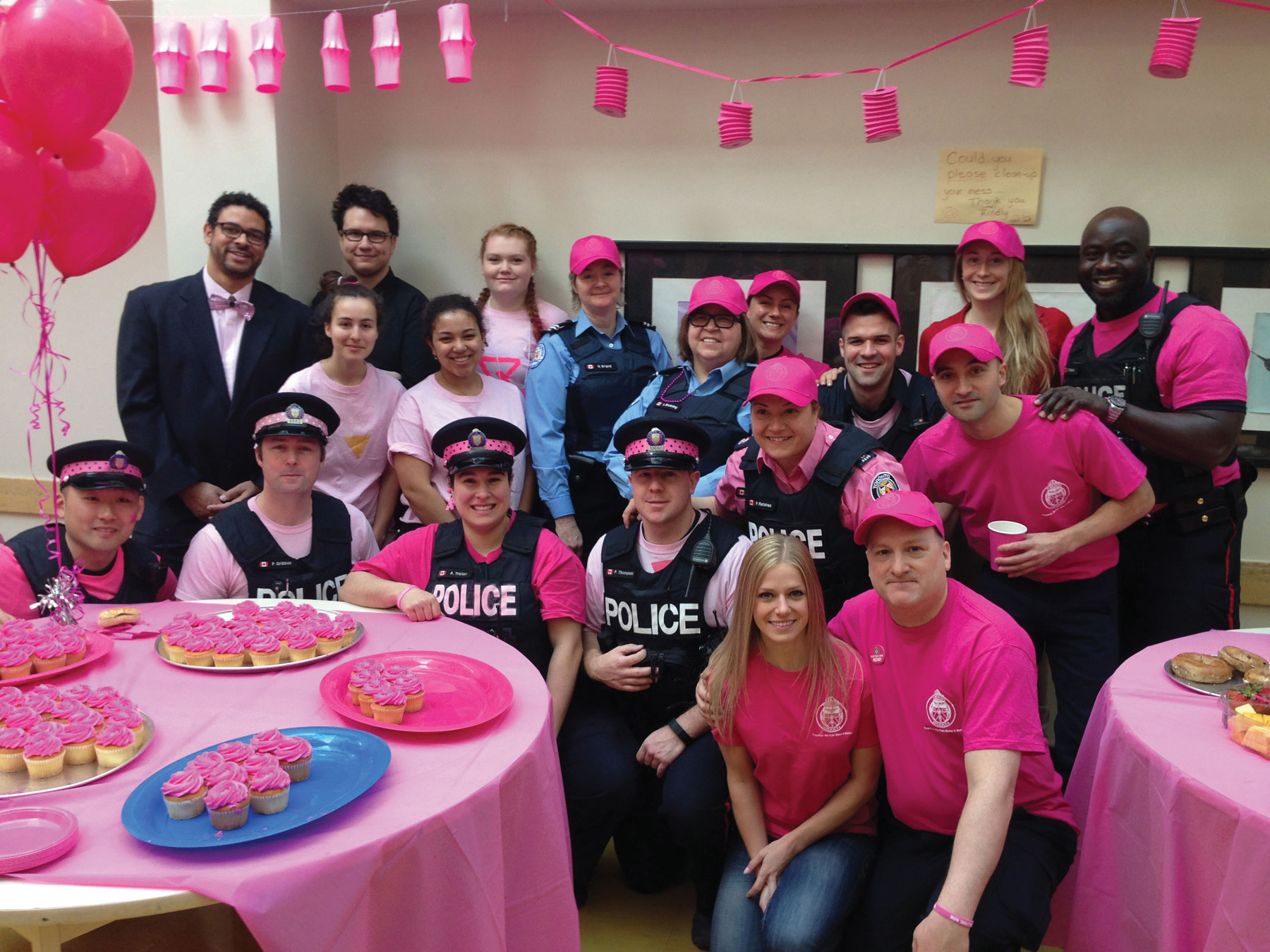
PHOTO COURTESY JESSICA LEE/TDSB: Toronto District School Board (TDSB) staff and students joined with the Toronto Police Service at Harbord Collegiate Institute to celebrate International Day of Pink on April 13, which raises awareness to stop discrimination, gender-based bullying, homophobia, and transphobia. Special guests included Canadian Olympian and rhythmic gymnast Rose Cossar and Eugene Melnyk, owner of the Ottawa Senators.
READ MORE:
NEWS: Break out the pink on April 13 (April 2016) By Brian Burchell
UTS goes pink, students unite (April 2015) By Brian Burchell
Tags: Annex · News
May 13th, 2016 · Comments Off on EDITORIAL (May 2016): It just makes census
Canadians are rejoicing at the return of the census, after the mandatory long-form census was axed by the former Conservative government. The widespread enthusiasm for participating in the count is serving both as a declaration of the importance of evidence-based decision-making and as a guilty verdict on how wrong-headed the Harper regime was for cancelling it in the first place.
One of the things the Conservatives did for the 2011 census was remove the mandatory requirement to complete the survey. Doing so let Canadians off the hook for any penalties (which included a fine of up to $500 and a possible jail term of up to three months) for not filing.
The 2006 census, which was mandatory, garnered a 94 per cent participation rate, whereas the 2011 voluntary household survey got a response rate of just 69 per cent, which Statistics Canada called a “low resolution” portrait. At the time, then Industry Minister Tony Clement argued the long-form census was intrusive and that it was wrong to put people in jail for not answering private questions. Clement, however, was unable to identify a single case where anyone had in fact been jailed, so it was not clear what problem he thought needed solving. The volunteer approach commissioned by the Conservatives ended up costing $22 million more than the mandatory one. The only dividend the federal government reaped, and it’s a dubious one, was acquiring fewer facts to contend with at the end of the day.
The 2011 cut of the mandatory long-form census, Canada’s most robust and consistent point of data collection on the economy, society, and the environment, left governments and businesses at all levels with far less comprehensive data, a less reliable transparent way to monitor government itself, a diminished capacity for measuring democratic accountability, and fewer factual inputs from which to craft legislation, regulations, and policy decisions that make sense for tax-payers.
Munir Sheikh, then chief statistician, resigned in protest over the decision to kill the long-form census. Wayne Smith, born in Chilliwack, B.C., took his place. Smith has 35 years of experience at Statistics Canada and holds a number of international positions including that of chair of the Conference of European Statisticians.
The now governing Liberals, who came to office in the fall of 2015, made good on a campaign promise and quickly restored the mandatory census, in fact the day after being sworn in. Innovation, Science, and Economic Development Minister Navdeep Bains claimed at the time that the Conservatives were basing decision-making more on ideology than on facts.
“We’re focused on sound, evidence-based policies. We want to make sure we’re driving good policies based on good evidence and quality data,” Bains was quoted as saying.
Smith reported that the volunteer census had a very detrimental impact on municipalities and that Statistics Canada chose not to publish data for roughly 25 per cent of municipalities as the data was not of sufficient quality. With the mandatory census back on track, Smith makes the case that “while good data does not always guarantee good decisions, having no data or bad data is like stumbling in the dark in a windowless room and it’s a pretty good probability that you are going to make bad decisions”.
Internationally, Canada is considered a leader for including the environment as the third pillar of the census, which also includes economic and societal demographics, as well as measuring how the three pillars interrelate. It’s perhaps a testament to our leadership in this field that our chief statistician leads the European Union’s conference of his peers.
Our census-taking is even more popular at home; with so many thousands of Canadians trying to enter their personal info on line it recently crashed the Statistics Canada website. It turns out it’s part of our DNA to want to participate in this and, for the Conservatives to have taken it away, was, well, rather un-Canadian.
Tags: Annex · Editorial
May 13th, 2016 · Comments Off on LETTERS
Beware the corporatization of Bloor Street
Re “Rexall replaces Brunswick House” (April 2016):
Anyone who sees Rexall’s move into the Brunswick location as a good thing or as a positive addition to the neighbourhood is sorrily mistaken. I am not sentimental regarding the loss of the Brunswick House itself, but sad to see a large American company move into this location. They will add nothing to the neighbourhood and take their profits out of Canada.
To those and in this I include Mr. Cressy (Ward 20, Trinity-Spadina) who saw the previous tenant as “problematic”: please pack up your belongings and move out. You should have been aware of the long-standing Brunswick House (40 plus years?). This part of Bloor Street has always been a destination for revellers and those out to enjoy some nightlife. The continual gentrification/corporatization of our neighbourhoods and Bloor Street in particular detracts from the city.
Want peace and quiet? I hear Elliot Lake is nice.
—John de Vries
Manning Avenue
A brighter park at night
Re Matt Cohen Park: Coming out of the Spadina subway station one night recently I noticed that dark, deserted, and out of place looking corner: the north paved part of Matt Cohen Park at the southeast Bloor Street/Spadina Avenue corner.
During daylight hours people get together there to chat and spend some time in the sun, read, count the number of cars that go through red lights, play cards or dominos, play musical instruments and dance some evenings.
At night, the place is dark, pitch black, empty, and somewhat dangerous looking.
It would only take two pole lamps, four metal benches (expanded metal benches last longer and do not absorb fat from discarded food and food containers), and slight rearrangement of the existing obsidian blocks, perhaps to form a stage, etc. Voila, we have a park that people can enjoy 24 hours. It could be a mini Dundas Square, with coffee and donuts close by.
If nothing else the corner would look part of the city, part of Bloor Street and Spadina Avenue and not a back alley in Marrakesh.
—Rudolf Manook
Tags: Annex · Letters
May 13th, 2016 · Comments Off on FORUM: Bike lanes on Bloor Street
The arrival of cycling in Toronto
By Joe Cressy
For too long, discussions of bike lanes have been divisive in our city. They shouldn’t be. When we do it right, cycling infrastructure can be a win-win for everyone.
After more than 40 years of discussion, debate, and community advocacy, an overwhelming majority of city councillors — from east to west and north to south — recently voted for a bike lane pilot project on Bloor Street. Indeed, cycling has arrived in our city, and it is long overdue!
[pullquote]
Bike lanes will improve local business by bringing more customers into the neighbourhood.
[/pullquote]
Over the past year and a half, we worked together — residents, businesses, local institutions, schools — on this exciting and long-awaited project for our community. We knocked on doors, met at local coffee shops and community events, and more. We came together to build a twenty-first-century city, and we won. But, this was only the latest push in a project that began decades ago, a project championed by community advocates like Tooker Gomberg, Albert Koehl, Cycle Toronto, Bells on Bloor, and countless others.
Protected bike lanes on Bloor Street will make it safer for drivers, cyclists, and pedestrians. They will also improve local business by bringing more customers into the neighbourhood; and ultimately, they will help to reduce congestion by moving people out of cars and into more active modes of transportation.
[pullquote]
Bloor Street was first identified as an ideal east-west cycling route in the city’s 2001 Bike Plan.
[/pullquote]
Bloor Street was first identified as an ideal east-west cycling route in the city’s 2001 Bike Plan: it is flat, unencumbered by streetcar tracks, and already heavily used by cyclists travelling east or west throughout the city.
In 2009, the Toronto Centre for Active Transportation completed a study on the potential impacts on local business of a bike lane on Bloor Street and found that 90 per cent of survey respondents used some form of active transportation to arrive in the Bloor-Annex neighbourhood.
The call for bike lanes only grew louder as the years passed. Many students called for bike lanes for a safer ride to school. Many residents called for bike lanes to alleviate congestion and support healthy living. And many businesses asked for bike lanes because we’ve seen in many other contexts that they are good for business.
The pilot project will involve the installation of a 2.4-kilometre bike lane from Shaw Street to Avenue Road that will begin this August. As part of the pilot, the City of Toronto has committed to measuring everything: the impact on cyclists and pedestrians, the impact on vehicular movement, including on adjacent streets, and the impact on local business.
The pilot will give us the data to help make better decisions in our city. To quote Michael Bloomberg, “In God we trust, to all others bring data.”
The recent Toronto City Council vote may have been overwhelming in support (the final vote was 38 to 3), but it is the result of years of hard work in our community.
The project was supported by all six local residents’ associations along the corridor, the University of Toronto, cultural institutions like HotDocs and the Bloor Street Cultural Corridor, and the local BIA. I want to thank all of you for your hard work and support: this result wouldn’t have been possible without it!
If we are committed to alleviating congestion and building a more active, healthy, and liveable city, we must invest in cycling infrastructure. As more and more people choose active modes of transportation, we must invest to ensure residents can access these modes safely.
After years of old-style divisive political debates framed as cars versus bikes, we’re moving forward as a city. It is very good news and I can’t wait to ride Bloor Street together, safely, later this summer.
Joe Cressy is the councillor for Ward 20, Trinity-Spadina.
READ MORE:
LETTERS: Annex cyclists already well served (April 2016)
NEWS: Once-seedy theatre renewed as climbing venue (March 2016) by Michael Chachura
Bike lane plan up for debate (January 2016) by Marielle Torrefranca
Bloor Street study launched (November 2015) by Summer Reid
A pilot bike lane for Bloor Street (May 2015) By Joe Cressy and Albert Koehl
Tags: Annex · Columns · Opinion
Supporters aim to protect neighbourhood’s unique character
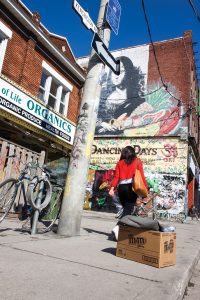
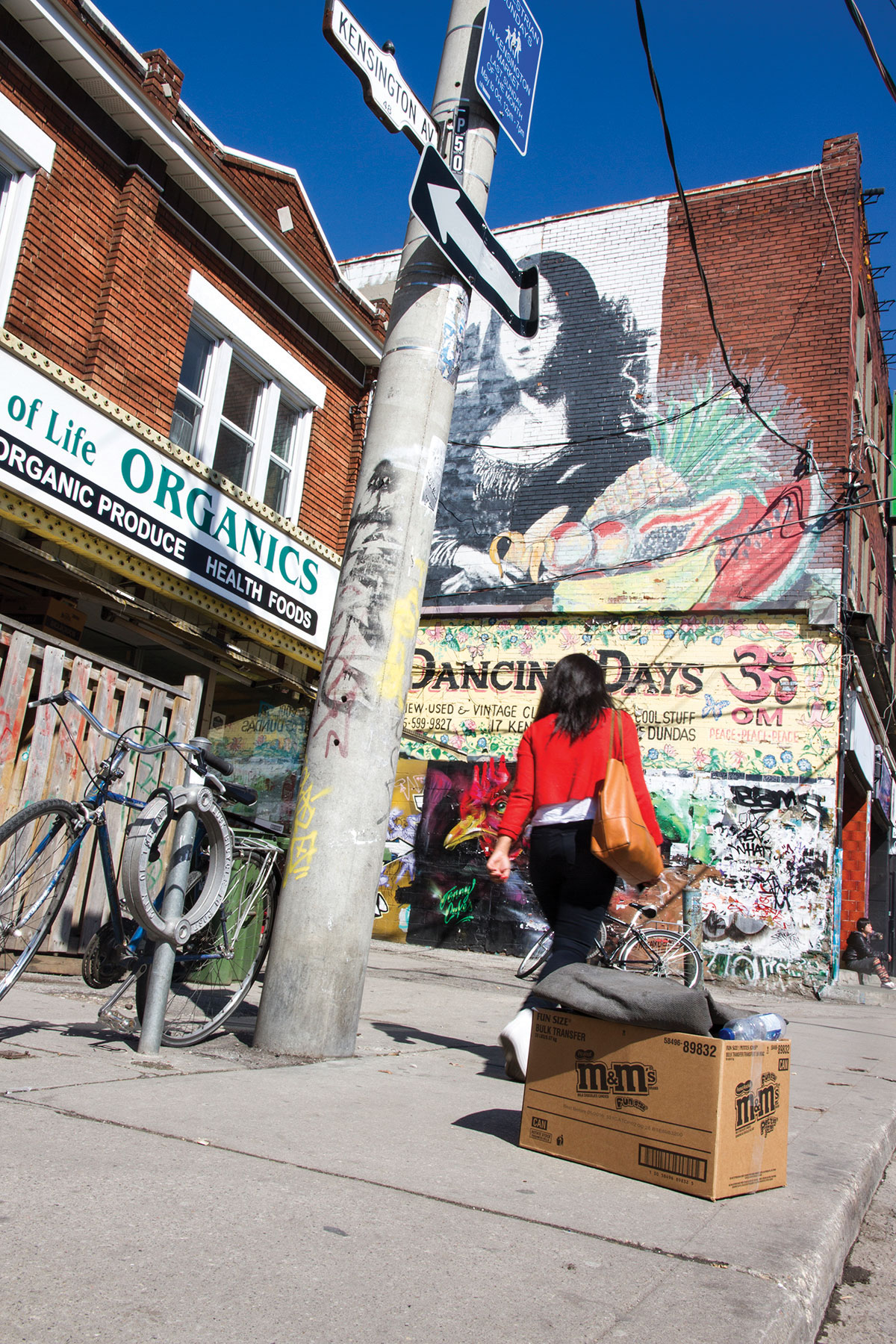
PHOTO BY GEREMY BORDONARO: A Mona Lisa mural surveys the scene on Kensington Avenue. The market is undergoing a study to determine whether it should become a Heritage Conservation District.
By Geremy Bordonaro
Even in a city known for its distinctive neighbourhoods, it remains unique.
In this bustling centre, small shops, from grocery and thrift stores to restaurants, line the streets alongside hip boutiques that cater to the savviest of customers. Nary a car drives down the street, for pedestrians own the passages in this bohemian sanctuary of Kensington Market.
[pullquote]
“We thought it was the best way to not lose the character of the community”—Su Alexanian, chair, Kensington Market Action Committee
[/pullquote]
But with the market increasingly under threat from encroaching development, the city has embarked on a study that will determine whether the area should be designated a Heritage Conservation District (HCD).
The Kensington Market BIA first proposed the approach in 2013, and those who support the designation argue that it would ensure the area’s protection for a long time to come.
“We thought it was the best way to not lose the character of the community,” said Su Alexanian, chair of the Kensington Market Action Committee (KMAC). “It’s going to be pretty unique, because unlike say Harbord [Street] (north of us), which is also a heritage district, it’s not really about the architecture in Kensington. It’s about trying to maintain a market. It’s about trying to maintain a mix of various income levels, so it doesn’t become completely and utterly gentrified. We want it to include the things that make us wonderfully and uniquely Kensington.”
Alexanian has seen the effects of not having protection over the area and some of the “ridiculous proposals” that come along.
“There’s two different owners of projects who want to rip out beautiful Victorian housing and put up a five-storey rooming house,” she said. “While we don’t mind having rooming houses, we have a lot of them, and we want people to develop things in Kensington that are respectful of the neighbourhood.”
Pouria Lotfi, a board member of the Kensington Market BIA, echoes this sentiment.
“I don’t think anyone is against new buildings,” he said in regard to the possibility of new construction in the area. “We don’t want to see mid-sized buildings here. I think it would change the structure of the neighbourhood.”
Pouria has his concerns about being able to define just what makes Kensington tick and how an HCD would cover it.
“It’s not quite clear yet. After council has approved it the city hires a consultant to conduct the study. The study determines what the shape of the HCD will be,” he said. “It could be anything. It could be based on historical value, architectural value, or social value, even the tiny little things, which I think is where the market will fall in. Somewhere like Cabbagetown, you have a lot of architectural value there…. The consultant [will have to] find out just what the heritage of Kensington is. I think it will be something less tangible.”
But Joe Cressy (Ward 20, Trinity-Spadina) believes the study will help define and protect that less tangible aspect for Kensington.
“[Kensington] is a historic neighbourhood that given the pace and scale and pressure of development in downtown Toronto is under threat,” he said. “An HCD in Kensington Market doesn’t freeze the neighbourhood in time; it doesn’t prevent change. That’s not the intention. What it does is allow us to manage and guide change so that we preserve the basic historical character of a neighbourhood. And that character can be cultural just as it can be architectural.”
The city allows for certain provisions to be made around an HCD, including restrictions to building permits and height, under the borders of the district. Depending on what is determined for Kensington Market there will be rules in place to protect the area.
“Heritage Conservation Districts are an important tool that the city has to better guide and manage change while protecting the historical character of neighbourhoods,” Cressy explained. “In Ward 20, we have six heritage conservation districts. These are HCDs because these affect the local historical context.”
READ MORE:
Kensington Market ready for action (July 2015) By Annemarie Brissenden
Community council approves Madison Avenue HCD (October 2015) By Brian Burchell and Annemarie Brissenden
Preserving a historic street (May 2015) By Annemarie Brissenden
Tags: Annex · News · History
May 13th, 2016 · Comments Off on NEWS: HVRA recognized for historical achievements
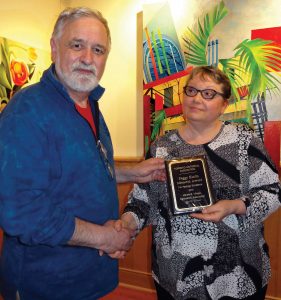
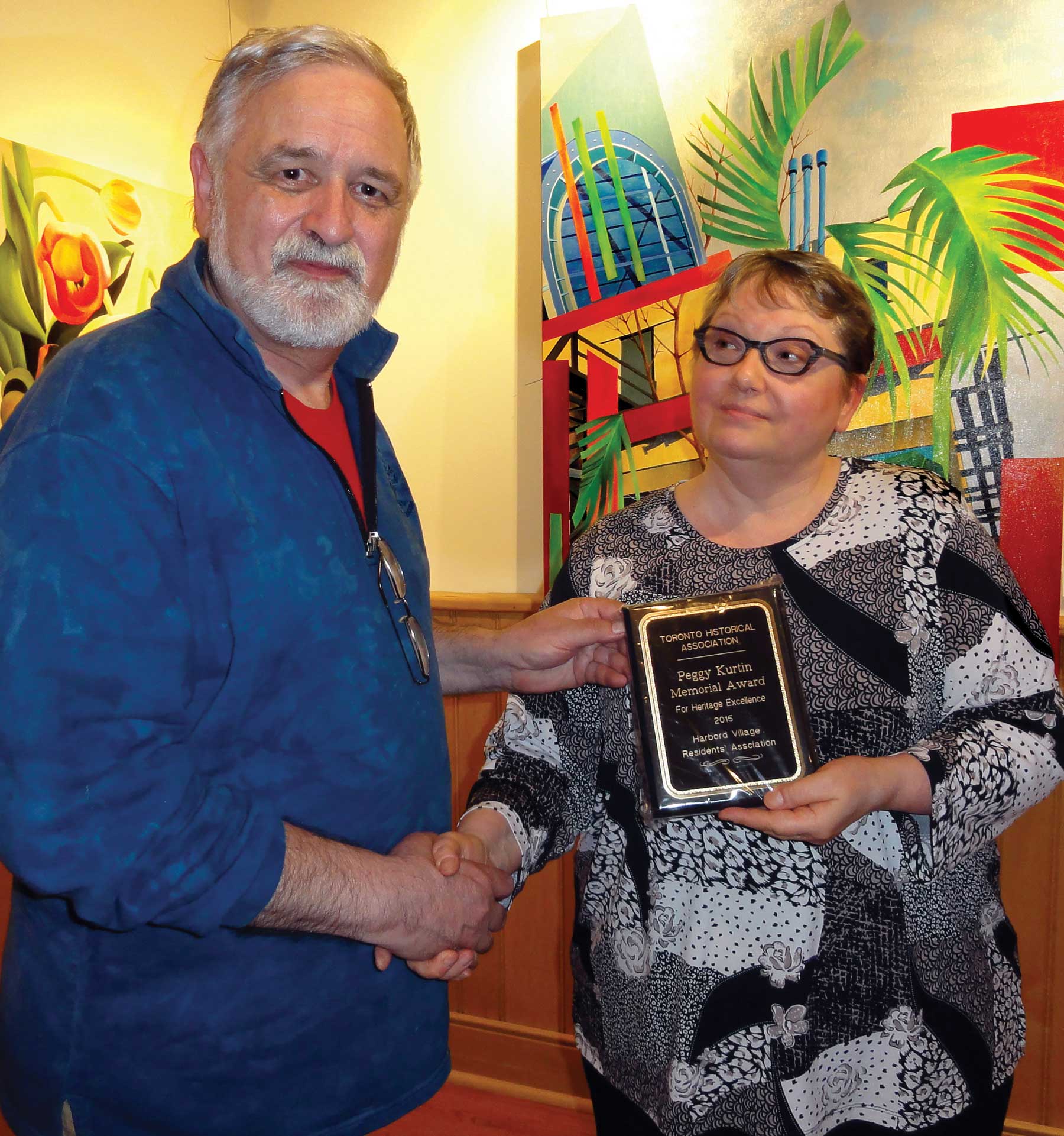
PHOTO COURTESY HVRA: Wendy Smith accepts the 2015 Peggy Kurtin Memorial Award on behalf of the Harbord Village Residents’ Association (HVRA). Presented annually by the Toronto Historical Association, the award recognized the HVRA’s oral history project, as well as its website.
READ MORE:
Harbord’s history a mystery (January 2016) By Annemarie Brissenden
Alive with history (October 2016) By Annemarie Brissenden
Tags: Annex · News · History
May 13th, 2016 · Comments Off on NEWS: Second phase of park revitalization to begin
Christie Pits to get new playground equipment

PHOTO BY GEREMY BORDONARO: Phase two of Christie Pits park’s revitalization continues as old playground equipment is removed from a fenced-in area. In the first phase, completed last fall, paths were replaced, lookouts were installed, and safety enhancements added.
By Geremy Bordonaro
The second phase of the Christie Pits renewal is set to begin. New playground equipment will be installed, the two basketball courts will be merged, and the park will be made more accessible. The work comes on the heels of the first phase — completed in the fall — during which paths were replaced and lookouts added, as well as elements enhancing the general safety of the park.
[pullquote]
“There’s a role to create more space in the park that is functional community space”—Jode Roberts, Friends of Christie Pits
[/pullquote]
“We’ve taken a step towards making the park more enjoyable for everyone,” said Mike Layton (Ward 19, Trinity-Spadina).
Many of the improvements are the result of community consultation during which park staff canvassed local residents on how to improve the state of the park. Though not all recommendations could be implemented, Layton said he believes that people will be happy with how everything is progressing.
“Obviously we’re not doing everyone’s top pick,” explained the councillor. “We’re not doing all the work everyone wants to see, but we’re trying to make sure we get some important projects done.
“I think, overall, people are pleased to see that we’re fixing some of the well-used amenities.”
There are some people, however, who argue that more should be done to improve the park and its facilities.
“There wasn’t a lot of bells and whistles that come with a full renovation of a park,” said Jode Roberts, a member of the Friends of Christie Pits. “It was a modest amount quite frankly for a park that size and the majority of that was in paths and regrading and things like that.”
He said the community shouldn’t have to be consulted on major changes, if the sole aim of the work was simply to make repairs and address maintenance issues.
“We asked what the grander things were we could do for Christie Pits, like put in institutions like farmers’ markets or other such things. Things that have been invested in [at] other parks.”
But Layton responded that maintenance and repairs — despite how minor seeming — were absolutely necessary if Christie Pits were to remain useable.
“State of good repair was high on the list of what needed to be done,” Layton said. “Sadly, the city doesn’t budget on a regular basis enough money to really keep our parks in very good states of repair. We let pathways crumble more than they should. We let buildings degrade more than they should. Maybe we could be putting on coats of paint faster. We really looked to what we need to have fixed anyhow in the next five to 10 years and what we can do to improve the amenity while getting good value for our money.”
Yet Roberts suggests that there was an opportunity to expand the function of the space and to do some community building.
“There’s a role to create more space in the park that is functional community space,” Jode said. “But there’s also a need for more folks to step up, get energized, and help draw more of those groups into the park.”
He points to Dufferin Grove as an example of a dynamic park that Christie Pits should emulate.
“They’ve got community pizza night that you can count on every Friday, [and …] a lot of different events. They’ve really drawn in the community by having all these active events.”
While Roberts added that he hopes the renewed public interest in the park will spur future initiatives at Christie Pits, Layton said he is optimistic about the park now that there’s an end in sight for the revitalization. “I’m hoping that when the work gets done we can enjoy the park this summer.”
READ MORE:
Christie Pits renewal set to begin (July 2015) By Brian Burchell and Annemarie Brissenden
Tags: Annex · News · Life
May 13th, 2016 · Comments Off on SPORTS: The bats are back at Christie Pits

PHOTO COURTESY OF DAN HAMILTON/VANTAGE POINT STUDIOS: Toronto Maple Leafs baseball returned to Dominico Field at Christie Pits with a bang on May 8. First baseman Jon Waltenbury blasted one of the Leafs’ four home runs on opening day, powering the club to a 13 to 2 victory over the Guelph Royals. Next game is 2 p.m. on May 15 versus the Burlington Bandits. This summer, the Gleaner will feature a monthly Maple Leafs Baseball column by R.S. Konjek.
Tags: Annex · Sports
May 13th, 2016 · Comments Off on GREENINGS (MAY 2016): Cloth diapers have gone from burden of the poor to luxury of the rich in one generation
By Terri Chu
Having a kid is expensive, anybody can tell you that. What nobody told me though was how expensive raising a child can be when you try to stay low on environmental impact. Cloth diapers are a huge capital outlay and I’m not convinced they are used long enough to break even against disposables. Using a diapering service costs around $25 per week while disposables are about $0.30 each, which even at 10 per day comes in at $21.
[pullquote]
Using, and throwing out, one of these marvels of engineering is cheaper than buying and washing pieces of cloth.
[/pullquote]
My mother often talks about my own childhood when she had to wash our cloth diapers, back before fancy Velcro diaper covers when safety pins reigned supreme.
“Disposable diapers were invented already but they were just too expensive. We were too poor for that,” she told me.
How is it that in a single generation, cloth diapers went from the burden of the poor to the luxury of the hipster rich parents?
Choosing products that are of low(er) environmental impact should not be an economically punitive decision. In the span of a single generation, manufacturing has become so automated, labour so cheap, and resources so disrespected that using things once and throwing them out has become cheaper than buying something that can be reused.
A diaper is nothing short of an engineering marvel.
Petrochemicals brilliantly absorb pee, synthetic materials whisk moisture away from the skin (key to preventing diaper rashes), and a wetness indicator tells us when it’s time for a change.
Using, and throwing out, one of these marvels of engineering is cheaper than buying and washing pieces of cloth.
If we are to get serious about meeting our environmental goals, we have to stop making low-impact purchasing decisions so economically punitive.
My apologies to the men reading this, but let’s take a look at some more numbers.
Everyone is familiar with tampons. Though the cost varies depending on where you buy them and in what quantities, a good average estimated unit cost is about $0.20 each.
You use these little cylinders of cotton once, after which you discard the plastic inserter along with its wrapper.
On the market is a slightly more environmentally friendly product called the Diva Cup that retails for $40.
Assuming that it replaces one heavy flow tampon per day, and an average four-day cycle, the Diva Cup pays for itself after four years.
This is all fine and dandy if not for the fact that the manufacturer recommends replacing the Diva Cup after a year.
For those who choose washable cloth diapers, an all-in-one diaper costs about $30.
Compared to a $0.30 disposable diaper, you would have to use the cloth diaper 100 times to break even (to say nothing of the labour and energy to wash it).
Owning enough diapers to do laundry once every three days means breaking even after 300 days. For anyone new to the world of infants, babies grow out of things after about three months, or 90 days, well before the diaper will break even on cost.
Is it really a wonder that cash-strapped parents and women choose single-use disposable products?
It is high time for a sin tax on single-use disposable items, whether these are diapers, tampons, or paper plates. If people want the luxury of being able to throw something out without washing it, it should be treated as that, a luxury.
While people are tightening their belts, it’s impossible to blame them for making decisions based on their wallets.
If we are to transition to a society that’s sustainable, we need good public policy that creates economic incentives for low-impact decisions.
Terri Chu is an engineer committed to practical environmentalism. This column is dedicated to helping the community reduce energy, and help distinguish environmental truths from myths.
READ MORE BY TERRI CHU:
Provide help or stand aside (April 2016)
Don’t fall prey to marketing (March 2016)
Reduce, reuse, then recycle (February 2016)
The power of labelling (January 2016)
Tags: Annex · Columns · Life · Opinion
Open Tuning festival returns to Seaton Village June 11
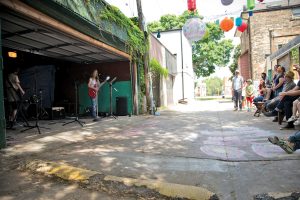
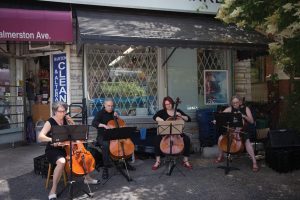
PHOTOS COURTESY OF KYM WATTS: Laneways, porches, and garages come alive with music during Seaton Village’s Open Tuning festival. Musicians of all ages, genres, and abilities are welcome to perform during this community celebration, which is modelled on La Fête de la Musique in Paris.
By Annemarie Brissenden
It’s only been six months since Samantha Wynter got her instrument, but she’s already playing her first music festival.
“I got a guitar this Christmas, and Amelia taught me how to play,” explains Wynter, who together with Amelia Murphy-Beaudoin will perform as Heart Sass in Seaton Village this June.
Now in its third year, Open Tuning is a daylong celebration of music that welcomes professionals and hobbyists of all ages to the myriad of makeshift stages on porches, in backyards, alleyways, garages, parks, and on street corners. Inspired by La Fête de la Musique in Paris, the festival opens with a parade in which children clang pots and sound noisemakers as they march through the neighbourhood to Vermont Square park.
“There’s a completely different tone to this festival,” says Ian Sinclair, a co-organizer of Open Tuning. “We get full-time musicians, some-time musicians. It doesn’t matter about age, genre, or skill: all are welcome to come play in the festival.”
“You go down some alley at Open Tuning, and there’s that guy that you know from the grocery store, and he is playing a wicked bass,” says Jennifer Hunter, president of the Seaton Village Residents’ Association, a strong supporter of the festival.
Sinclair anticipates that there will be approximately 90 acts performing from 15 official venues, and stresses the independent nature of the festival. Open Tuning is free of corporate sponsorship, volunteer run, and doesn’t cost a cent for the participants. The organizers treat all the performers, who are also volunteering their time, equally, no matter their background.
That grassroots community atmosphere is part of what attracts professional musicians, which in the past have included Jane Siberry, Charles Spearin, and Feist (both from Broken Social Scene) to participate in the festival.
“We had a little girl singing a song by Feist as around the corner Feist was performing,” recalls Sinclair.
For Tim Odacre, a co-organizer who runs a stage dedicated to younger performers on his front porch, it illustrates how the festival breaks down all kinds of barriers and “makes performing music not a strange thing”.
He says that while some kids are quite nervous — “a violinist stood up last year with two friends on either side” — most of the young performers “have quite a bit of fun with it”.
Also appearing on Odacre’s stage are student bands from the King Edward Jr. and Sr. Public School rock band club.
Music teacher Adam Platek says the festival gives the musicians aged 12 to 14 the experience of playing outside of a school function, as well as a little visibility in their neighbourhood.
Last year Platek led a very popular open ukulele jam in the afternoon.
“I loaded up my Honda Civic with all the school ukuleles,” laughs Platek. “I looked like such an oddball when I showed up.”
“It was such a hit; kids wanted their own instrument after that,” recalls Odacre.
Platek, who says he loves the community-driven nature of the festival, adds that “there is something special about playing outdoors; the whole neighbourhood just comes alive with music. You can’t not get absorbed into the good vibes.”
“It’s old school. It’s like playing fiddles in the kitchen,” says Derek Christie, a self-described semi-pro singer/songwriter. He used to live in the neighbourhood, and comes from Richmond Hill every year to perform. “It’s people of all ages getting together to play music.”
He emphasizes how valuable the festival is for the community.
“It’s connecting with neighbours through music,” which is one more way that Open Tuning breaks barriers: it brings together people who wouldn’t otherwise interact.
As Spearin notes, “sometimes you need an excuse to meet your neighbours, and music is a really great reason,” though he admits that “I like anything that celebrates local talent, arts, community, and the neighbourhood”.
His favourite aspect of the festival is “when the kids dance. There’s nothing more uplifting than that, and it makes them feel like there’s something alive in the city, that the city has a spirit of its own.”
It’s a sentiment that Christie shares.
He remembers how last year’s festival closed with musicians “just connecting and jamming while 200 people were crammed into a garage having the biggest dance party I’ve ever seen.”
Open Tuning returns to Seaton Village on Saturday, June 11. The organizers, who pay for the festival out of their own pockets, have created a crowd-funding page to help raise money to offset the costs.
Tags: Annex · Arts · People
April 7th, 2016 · Comments Off on ON THE COVER (April 2016): Tracking history in the Annex
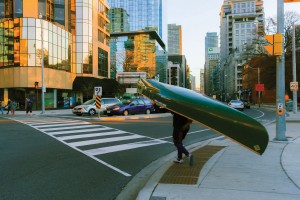
Photo Courtesy Philip Desjardins
A canoeist portages across Bay Street on Davenport Road during last year’s Davenportage, an annual trek made by history buffs along Gete-Onigaming, an old Aboriginal trail that links the Humber and Don rivers. “Portage” by Philip Desjardins is one of 15 photographs that comprise Solitaire, curated by Becky Parsons for QSQ Giclee Boutique (845 College St.). This solo exhibition, which is part of the Scotiabank Contact Photography Festival 2016, explores translations of the 18th century card game through 15 photographs presented alongside captions that suggest a range of interpretations.
READ MORE:
ARTS: Scotiabank Contact Photography Festival celebrates its 20th year (April 2016) by Annemarie Brissenden with files from Neiland Brissenden
ARTS: Discover Mirvish Village’s artistic diversity (April 2016) by Annemarie Brissenden
ARTS: Bringing art to the people (April 2016) by Annemarie Brissenden
Tags: Annex · Arts