June 14th, 2016 · Comments Off on FORUM (JUNE 2016): A tribute to a friend
Meet a neighbour this weekend
By Mike Layton
Several years ago my wife and I moved into a new, small, two-bedroom second floor walk-up flat on Beatrice Street in Little Italy. The community was a changing one: young adults from a wide range of backgrounds were supplanting the aging Italian neighbours. My wife and I belonged to the former group, our new neighbour to the latter.
Walking past my neighbour’s house one day shortly after we moved in, I exchanged a brief ciao with my new neighbour, who, while short in stature, was clearly large in personality. A couple of days later, I introduced myself. We spoke briefly, the sort of pleasantries you exchange with someone you sit next to on a plane.
Clearly he hadn’t had a great relationship with the previous inhabitants of our unit, or with our new landlords who had renovated to split the house into rentals. But despite the negative impression left by our predecessors and our landlords (who still lived on the main floor), he was clearly willing to give my partner and me a chance.
[pullquote]It puts a smile on my face to see the organized bocce league in Fred Hamilton Park where Italian seniors share their wisdom with eager young students.”[/pullquote]
It didn’t occur to me at the time, but that simple gesture of introducing myself and learning a bit about my neighbour would change the way I look at our city. It also made me an unlikely friend with whom I would continue a relationship well after I moved out.
Over the years we lived on Beatrice Street, my relationship with my new neighbour Tony Maneli grew stronger. He was an avid urban farmer, a brewer of homemade spirits, and full of history of our street and Toronto politics.
About two years later I decided to run for Toronto City Council. I set out to talk to as many people as possible in my community. My street seemed like a good place to start. On day one of the campaign I walked over to my neighbours and made my pitch. The welcoming demeanour that Tony showed me, his neighbour, was not one shared with most politicians. But in his friendly way he heard me out. He questioned the motives of all politicians, as some cynics do, but our conversation ended well and I went to the next door to meet another neighbour.
As the election proceeded, clearly I had gained a supporter in Tony, who now not only had a sign on his lawn, but also came down to my campaign office opening and made a donation. For a senior on a pension, I knew this meant I had earned his trust, at least as a friend.
After I moved to a new place, Tony and I stayed in close touch. We exchanged panettone and wine at Christmas. He frequently brought neighbours to my community office hours at the CHIN building.
After Tony was diagnosed with cancer, I started seeing him with less frequency. I would still visit him at home and he’d share stories about City Hall’s current and previous mayors. He would often urge me and my wife to have children and ask us what we were waiting for. We have since had our now five-month-old Phoebe.
Now, when I walk down the street, it puts a smile on my face to see the organized bocce league in Fred Hamilton Park where Italian seniors share their wisdom with eager young students, little Italy’s newest inhabitants; when I meet a foodie who has learnt the art of tomato sauce canning from the nonna next door who shared their family recipe; when I see neighbours cleaning snow or cutting lawns for each other.
All of this speaks to the people who help make Toronto a small town in a big city. We are the largest city in Canada, but we are still a place where we know our neighbours. Our city depends on this sense of community if we are to grow sustainably and inclusively.
When I get phone calls from residents in decade-long feuds with their neighbours over often trivial matters, it saddens me to think that we are spending so much of our time battling one another and what a toll that takes on ourselves and our communities.
My old neighbour Tony died last month. I mourned with his close friends and family at our loss, but felt joy in having stepped a bit outside my small daily routine and made a new friend. I hope you can find some time this weekend to do the same. We are all stronger for it.
Mike Layton is the councillor for Ward 19, Trinity-Spadina.
READ MORE BY MIKE LAYTON:
FORUM: Large problem, small solution (March 2016)
Happy New Year from a new Dad with a new perspective (January 2016)
Tags: General
June 14th, 2016 · Comments Off on FOCUS (JUNE 2016): An early advocate for bike lanes
Did James Lochrie install a cyclist path in 1896?
By Albert Koehl
On May 4, 2016, Toronto City Council approved pilot bike lanes on Bloor Street. Like many community initiatives, the vote was the culmination of work by individuals and groups that stretched over many years, in this case at least four decades. In fact, there is some evidence that the push for Bloor Street bike lanes goes back even farther — all the way to 1896 when businessman James Lochrie planned to install a cinder path for cyclists on Bloor Street West.
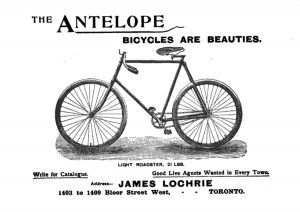
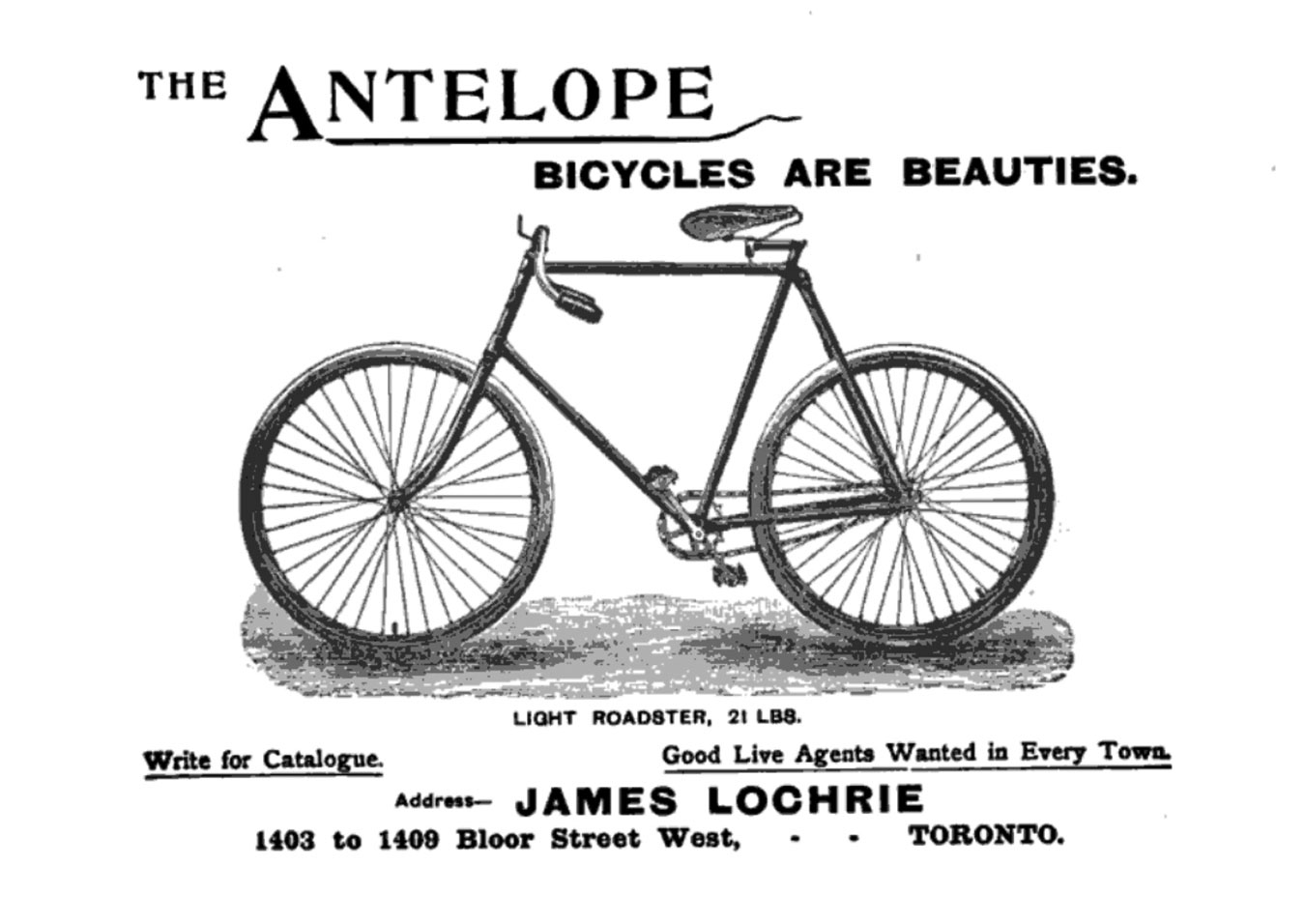
Picture Courtesy the Canada Lancet and Practitioner (1895): James Lochrie advertised his Antelope bicycles, which he began manufacturing in 1895, in a medical newsletter.
In the so-called bicycle craze of the 1890s, Toronto cyclists shared the road with horse-drawn wagons and buggies as well as horse cars, which soon became electric streetcars. The safety bicycle with its equal-sized wheels, chain drive, and pneumatic tires had replaced the perilous high-wheeler. A major obstacle for cyclists, aside from the high price of a bicycle, was the poor quality of roads. In the city’s central area, roads were being improved, sometimes with asphalt, but for Lochrie whose business and home were at 1403-11 Bloor St. W. — west of Lansdowne Avenue near the rail tracks — road improvements probably seemed a long way off.
On Feb. 17, 1896, The Globe reported that Lochrie intended to install, at his own expense, a cinder path on Bloor Street West. No specific area of the street is mentioned although the obvious candidate would be in the Junction, where Lochrie had his factory and home.
At the time, some cyclists considered cinder paths a good solution, although there was a lively debate between these cyclists and other cyclists who advocated for better roads all around. One problem with cinder paths was that heavier vehicles could be drawn to them to escape the poor quality of the rest of the road. The solution in Winnipeg, for example, was to prohibit conveyances other than bicycles from using these paths.
A case against the Grand Trunk Railway suggests that a cinder path on Bloor Street near Lansdowne Avenue was actually built. The court noted that the plaintiff Alexander Sims, an 18-year-old cabin maker, was cycling home from work in July 1903 along a “narrow pathway or bicycle track” on the south side of Bloor Street.
Sims was hit by a freight train and lost his leg. A jury awarded him $2,200 but the decision was overturned on appeal. “Death crossings”, as a December 1922 article in The Globe referred to level crossings, were replaced by overpasses in the area in 1925, partly due to advocacy by Lochrie’s son, David Alexander (or “D.A.”).
A photo in about 1900 from the City Engineer’s Office shows Bloor Street looking east across the tracks. The image includes a wooden sidewalk, the wide roadway, and what might be a cycle track on the south side.
Lochrie wasn’t a neutral bystander when it came to cycling.
In 1893 he filed for a patent for a treadle-like device to replace the pedals, crank, and chain. Around 1895 he began manufacturing Antelope Bicycles (without his new contraption), which he displayed at his showroom on Yonge Street or sold through agents in other towns. Ads for Antelope Bicycles, which embodied “the most significant improvements known in the art of Cycle building”, could be found in upscale publications, like The Dominion Medical Monthly.
Lochrie continued his bicycle-making business even after the dramatic fall in demand that began around 1899, a decline partly due to the falling out of fashion of bicycles among society’s upper crust. The major Canadian bicycle manufacturers at the time combined into a single company that became the Canada Cycle & Motor Company. The Canadian National Exhibition still listed Lochrie as a bicycle exhibitor in 1905. Lochrie also operated a bicycle livery and sold used bikes from his Bloor Street location until about 1908.
James Lochrie died in March 1930 at age 81. His residence was still shown as 1411 Bloor St. W.
Lochrie would likely have been pleased to hear about the new Bloor Street bike lanes, but surprised that it took so long.
Albert Koehl is an environmental lawyer, writer, and co-founder of Bells on Bloor. He is writing a book on climate change and sustainable transportation.
READ MORE:
NEWS: Bike lanes for Bloor Street (May 2016)
The faster we lower speeds, the more lives we save (October 2015)
Early brewer the basis for Bloor Street’s name (May 2015)
Tags: General
June 14th, 2016 · Comments Off on SPORTS (JUNE 2016): Leafs ahead 3-1 after first four games of the season
Team has solid squad of batsmen, rotation of pitchers
By R.S. Konjek
Sunday afternoon on the Victoria Day long weekend, the Pits are alive.
The sounds of baseball ring around Dominico Field, restoring life to the old hollow. Cleats crunch the dirt, balls pop in gloves, and ballplayers resume their steady stream of jocular banter.
The announcer welcomes the gathering crowd — one that will swell to approximately a thousand people on this day — and it’s time to play ball.
It’s the third week of the season, and the Toronto Maple Leafs are hosting the Brantford Red Sox at Christie Pits.
[pullquote]Through the first four games of the season, the Leafs have shown that they can score runs in singles or in bunches.[/pullquote]
Early wins bring the promise of a bright summer, and the Leafs have gotten off to their usual good start to the season, winning two and losing one. Today they face the team they eliminated during their surprise post-season run last year. The Sox are looking to gain a measure of revenge.
The crack of the bat, then again, then a third time, and the Sox jump out to an early lead. The Leafs grab one back in the bottom of the first. The fans settle in on their blankets and lawn chairs; still lots of game to go.
The Intercounty Baseball League is a hitters’ league, and Toronto has a solid squad of batsmen. Jon Waltenbury, Johnathan Solazzo, and Sean Mattson are the club’s three big boppers. They accounted for over half of the Leafs’ home runs last year, and the trio is back for 2016.
It’s 3-1 Brantford in the second inning when Mattson launches a solo home run over the left field fence. The Leafs add another run to tie the game, but the Sox retake a 4-3 lead in the fourth.
Certain voices rise above the thousand others. Baseball voices.
There’s an old man at almost every game, someone who must be a former player, or coach, or maybe he’s just an eagle-eyed observer. From his plastic chair perched high above the field, he shouts advice and instructions to the players throughout the game, like a well-meaning parent eternally embarrassing his kids.
Dozy or distracted fans are protected by one of the club’s staff, a kind of watchman who yells warnings of foul balls in flight. He also chases the balls down and returns them to the field of play. No souvenir balls — one of the quirks of Maple Leafs baseball.
The team’s owner, Jack Dominico, has the most thunderous voice at the park. It rumbles down from the press box at intervals, usually urging his players to “WAKE UP!” when things go awry. Dominico has owned the Leafs for almost five decades, and after all this time he still won’t put up with lollygagging on the field that bears his name.
Waltenbury steps up to the plate in the bottom of the fourth. He sees his pitch and blasts one high to centre field. The sound of his bat connecting is followed by a brief hush, as all eyes follow the ball. It rises higher, clears the outfield fence, and the crowd erupts. Hands clap, voices cheer, dogs bark. Waltenbury has hit a three-run homer, and put the Leafs ahead for good.
The Leafs’ starting pitcher, Justin Cicatello, works through the seventh inning, and the bullpen hangs on for an 8-6 Toronto win. Sun-kissed and satisfied, the crowd rises, gives a final round of applause for the home side, and packs up to go. Post-game conversations fade as the last hangers-on drift out of the park.
Through the first four games of the season, the Leafs (now 3-1) have shown that they can score runs in singles or in bunches, an ability that will serve them well as the summer unfolds.
Not to be left out is the club’s solid rotation of pitchers, who have kept games close and given the offence a chance to win games. Dillan Mulholland has been a standout so far, pitching a complete game victory in Guelph in mid-May.
The Maple Leafs play ball at Christie Pits every Sunday at 2:00 p.m., with a handful of Wednesday night games, in June and July. As always, admission to Leafs games at Christie Pits is free.
READ MORE:
NEWS: Second phase of park revitalization to begin (May 2016)
SPORTS: The bats are back at Christie Pits (May 2016)
NEWS: Christie Pits renewal set to begin (July 2015)
Tags: General
June 14th, 2016 · Comments Off on GREENINGS (JUNE 2016): Taking action on climate change
Leaked provincial plan contains good ideas for the long-term
By Terri Chu
In mid May, The Globe and Mail leaked the Government of Ontario’s plan to address climate change. Adrian Morrow and Greg Keenan reported in a May 16, 2016, article that the newspaper had obtained a draft version of the plan, and that “Ontario will begin phasing out natural gas for heating, provide incentives to retrofit buildings, and give rebates to drivers who buy electric vehicles. It will also require that gasoline sold in the province contain less carbon, bring in building code rules requiring all new homes by 2030 to be heated with electricity or geothermal systems, and set a target for 12 per cent of all new vehicle sales to be electric by 2025.”
The leaked plan has been met with both praise and condemnation, largely depending on which economical and political interests are in play.
[pullquote]Phasing out individual buildings from being heated directly with natural gas opens the door for district energy systems to be built across the province.[/pullquote]
As an engineer in the energy sector, I welcome many of the initiatives, particularly the ones relating to reducing fossil fuel consumption and building district energy systems.
For the uninitiated, district energy systems rely on massive networks of underground water pipes that deliver hot and cold water to heat or cool spaces. District energy generally uses natural gas as its primary heat source, but can also make use of ground source heat pumps, solar thermal heating, absorption chilling, or, as in the crown of Toronto’s energy system, deep lake water cooling.
Deep lake water cooling is particularly important because our city’s massive condominium boom is stretching the capacity of Toronto’s two existing lines for transmitting its energy needs. During the hottest days of the year when everyone is running an air conditioner, the grid is so overloaded that line loss can be as much as a quarter of all electricity transmitted. Not only are “hot” lines inefficient, they physically sag, something that led to the power failure that precipitated the blackout of 2003. The ability to reduce electricity demand would seem like a prudent long-term investment but future costs (and blackouts) are seldom the problem of those currently sitting in office.
District energy systems are expensive and the ability to attract private investment is limited since it is notoriously difficult to retrofit old buildings to be district energy compatible. Without an existing stock of potential customers, investments in underground pipes aren’t the best use of monetary resources. Some cities address this by requiring that all new buildings be compatible for future district energy connections, a scenario that doesn’t fly in this province since compelling developers to go above and beyond building code is just asking for an Ontario Municipal Board challenge. Further, builders seldom retain ownership of the buildings; once a building is developed, a builder simply walks away, without really caring about operating costs.
Phasing out individual buildings from being heated directly with natural gas opens the door for district energy systems to be built all across the province. Individually, homeowners can’t efficiently make use of geothermal systems, biomass sources, or thermal storage. Inside a big system, it suddenly makes sense to invest in solar thermal arrays when the costs can be shared over many users. Building these systems will create jobs in the province and reduce our dependency on natural gas. It would build a skilled trade labour force without draining our pockets to transfer funds out of the province to pay for resources we aren’t producing ourselves. So while fossil fuels companies will get a kick in the pants, trades, clean tech firms, and our secondary economy will get a boost.
While some market segments will inevitably be hurt, I have little doubt there will be fantastic growth in other sectors. Yes, in the snapshot of today’s economy, there will be changes, but that doesn’t mean all those changes will result in us living in destitution. We don’t know how those changes will shape the future economy but what I do know though is that to do nothing will also do little to help us pay for the reconstruction of places already affected by climate change. Alberta is smouldering while we bicker. It’s time to take action.
The Governement of Ontario released its climate change action plan just as the Gleaner went to press.
Terri Chu is an engineer committed to practical environmentalism. This column is dedicated to helping the community reduce energy, and help distinguish environmental truths from myths.
READ MORE BY TERRI CHU:
Cloth diapers have gone from burden of the poor to luxury of the rich in one generation (May 2016)
Provide help or stand aside (April 2016)
Don’t fall prey to marketing (March 2016)
Tags: General
June 14th, 2016 · Comments Off on LIFE: How I have made my community better
Award-winning essays highlight volunteerism
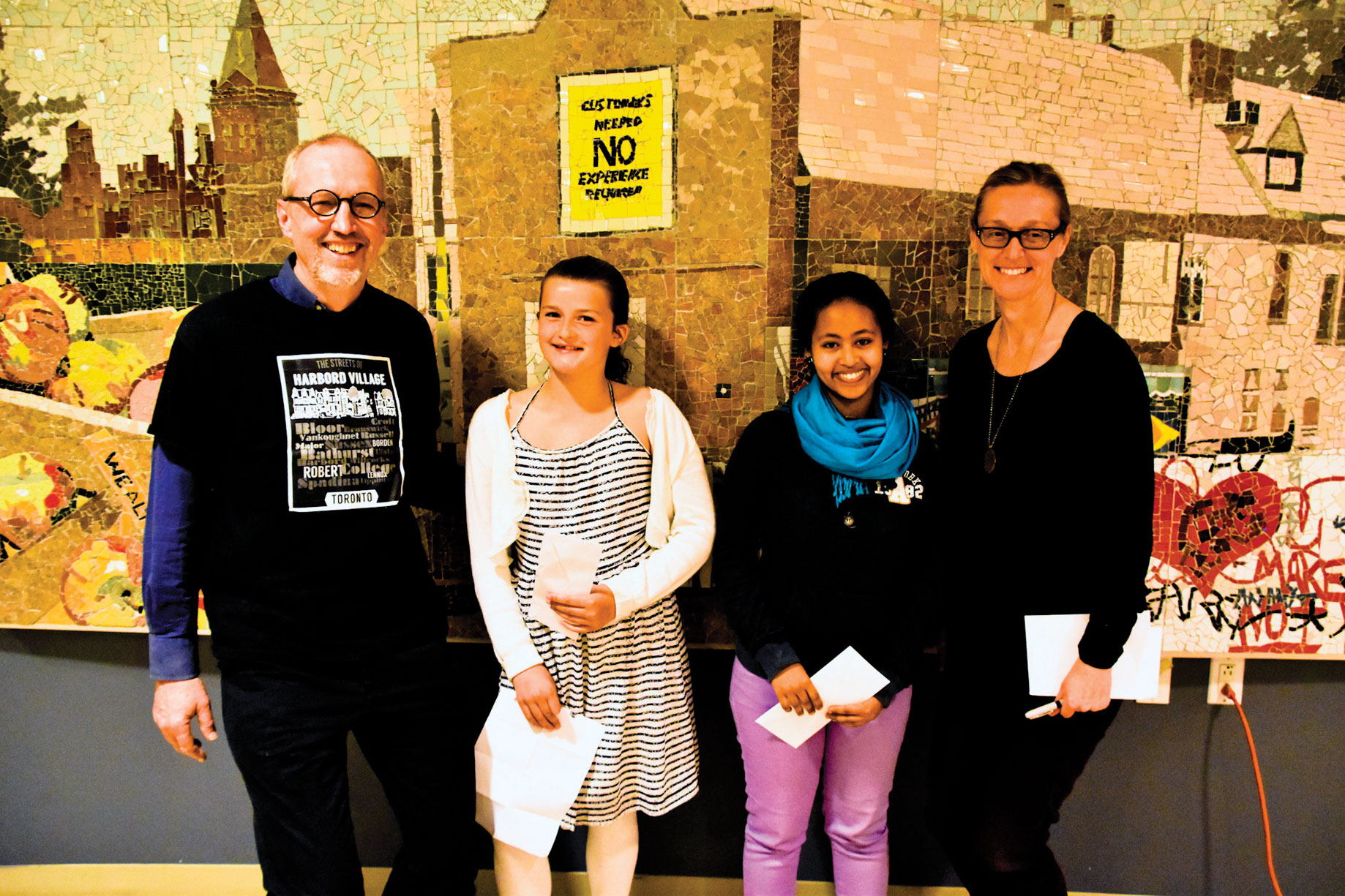
Providing a helping hand and supporting newcomers to the neighbourhood were the themes of this year’s winning entries in the fourth annual Harbord Village Residents’ Association essay contest. Open to students enrolled in Lord Landsdowne and King Edward junior and senior public schools, Kensington Community School, and Central Technical School, the essay contest asks writers “how I have made my community better”, and gives cash prizes to winners in the elementary and secondary categories. This year’s winners are 9-year-old Maya Retzleff, a grade four student at Lord Landsdowne, and Liya Tadesse, an 18-year-old grade 12 student at Central Tech.
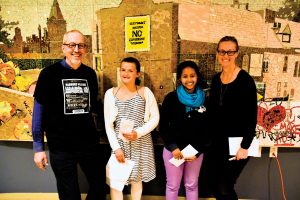
PHOTO COURTESY RICHARD LONGLEY/HVRA: Harbord Village Residents’ Association (HVRA) chair Tim Grant, contest winners Maya Retzleff and Liya Tadesse, and HVRA’s essay contest coordinator Paula Gallo pose at the association’s spring meeting.
Raising money for SickKids
“Instead of keeping the money, I gave the money to SickKids hospital.”
By Maya Retzleff
Hi, my name is Maya.
I help my community in a lot of ways, like I help my mom do part of her fundraiser for the bake sale for the school.
We raised $700 for books or field trips for the whole school. I am very impressed and I think making a fundraiser was a good idea to get money for Lord Lansdowne.
I also help my neighbours. I help Maria who lives next door and Rebecca. Maria is old, so I decided to shovel her pathway in the winter and in the fall I rake the path and because Maria does really nice things for me and I appreciate it so it was my turn.
I help my babysitter Elizabeth shovel and they paid me $20 but instead of keeping the money, I gave the money to SickKids hospital and the money that I got when I did my other neighbour’s yard.
In the same time I did a lemonade stand and it went really great. I raised $133 and half of the money went to SickKids and the other half went to the Salvation Army.
I also help my mom do the spring clean-up for the community. I help with passing the gloves for the clean-up and the garbage bags and I passed out the maps to where to clean up. And when you are done you go and put it in a pile and the garbage truck comes and takes it away.
I helped Scott Mission when my class did candles that we sold at a concert and we donated all of the money to Scott Mission. In fact we went to the Scott Mission and it was a cool experience. I like it when I think of it. It is a sad experience, but it is cool at the same time.
And that is what I did to help my community.
Supporting multiculturalism
“I got to learn a few hellos and goodbyes in different languages”
By Liya Tadesse
Toronto is one of the most known multicultural cities in the world.
This is the reason why there are lots of choices on how to make communities better.
I have made my community better by volunteering. I have previously volunteered at Scadding Court Community Centre with children, the Newcomers Orientation Week (NOW) program, and the Youth Advisory Group (YAG) program at Sanderson Library.
What I always like to do before volunteering is to let everyone know each other because people have to know each other to feel comfortable.
At Scadding Court, I plan and organize events in the summer and spring for kids. Sometimes I invite the parents to attend these events. In the NOW program, I helped newcomers to Canada with language translations and showing them places to visit. These experiences helped me to receive my leadership certificate.
During my time in the YAG program, I plan and organize seasonal games and parties, for example, celebrating different country’s New Years, holidays, and watching movies. During these times, I got to learn a few hellos and goodbyes in different languages, tried foods from different cultures, and learned new things.
By the end of my volunteering experiences, all these people that were shy to talk to each other became good friends with one another. It makes me happy to see my community get along with each other.
Tags: General
May 13th, 2016 · Comments Off on ON THE COVER (May 2016): Alive with music
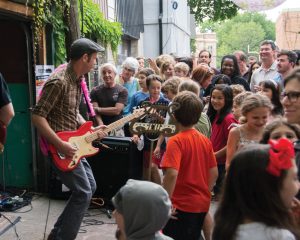
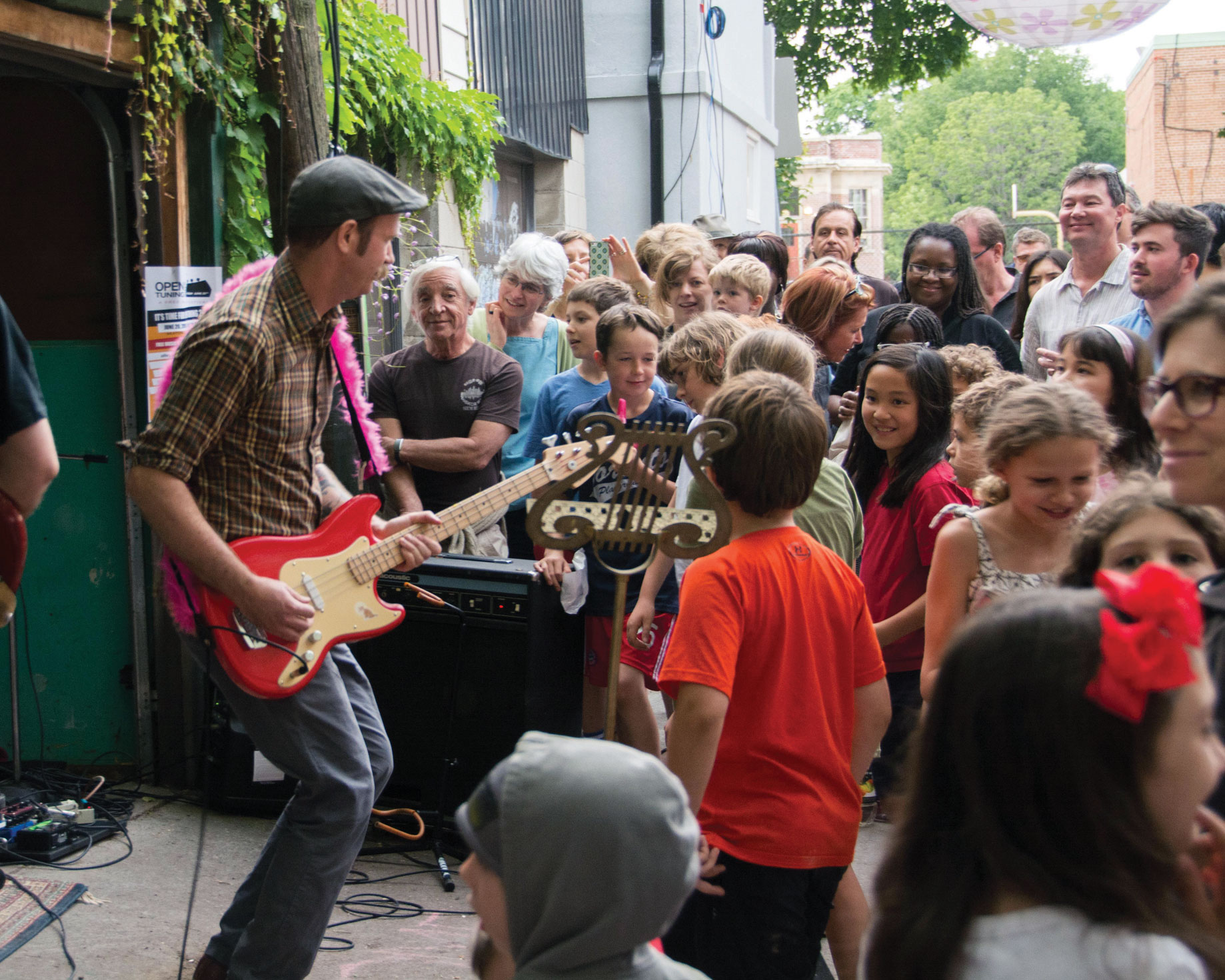
PHOTO COURTESY NEIL MUSCOTT: Seaton Village resident Charles Spearin of Broken Social Scene performs at last year’s Open Tuning festival, which returns June 11.
Read more: ARTS: Connecting neighbours through music
Tags: Annex · News
May 13th, 2016 · Comments Off on NEWS: Bike lanes for Bloor Street
Council votes in favour of pilot project
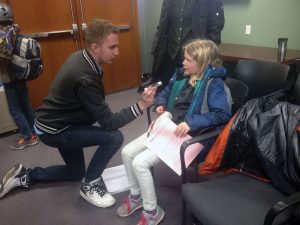
PHOTO BY BRIAN BURCHELL/GLEANER NEWS: Gleaner intern Geremy Bordonaro interviews eight-year-old Malina Fritz-Schwartz after her deputation at the Public Works and Infrastructure Committee on April 25.
By Geremy Bordonaro
At long last, bike lanes are coming to Bloor Street.
On May 4, Toronto City Council voted 38 to 3 approving a pilot project to install separated bike lanes on Bloor Street from Avenue Road to Shaw Street.
[pullquote]
“Bike lanes on Bloor [Street] is a 40-year-long concept that is long overdue”—Joe Cressy (Ward 20, Trinity-Spadina)
[/pullquote]
It was only the latest hurdle facing the pilot project, which was previously considered during six hours of hearings before the Public Works and Infrastructure Committee on April 25. In the end, councillors on that committee passed the Bloor Street Design Feasibility Study and Bike Lane Pilot Project without recommendation.
“Bike lanes on Bloor [Street] is a 40-year-long concept that is long overdue,” said Joe Cressy (Ward 20, Trinity-Spadina), who has been helping to spearhead the pilot. “It’s overdue because bike lanes on Bloor [Street] will make it safer for cyclists, pedestrians, and drivers. It’s going to make it better for local businesses by bringing more customers into the area. Ultimately, it’s going to reduce congestion in our city by moving people out of cars and into more active modes of transportation.”
Although the bike lanes have been a long time coming, that lengthy wait may be instrumental to the pilot project’s success, noted Cressy, who said the community is ready to embrace the lanes.
“We have all six local residents’ associations who have endorsed this pilot project,” he said. “Ten to 20 years ago you would not have seen that type of support…. What we see here now is a real overwhelming movement in our city amongst our businesses and residents, cultural institutions and schools, of the benefits of bicycling infrastructure.”
It was an overwhelming movement reflected among the diversity of those who spoke to the committee in favour of the bike lanes.
“When there [are] bike lanes you’re not allowed to pass the lines. It’s [safer] for everyone and the kids can actually talk to their parents,” said Malina Fritz-Schwartz, perhaps one of the day’s youngest speakers, who gave a deputation alongside her mother. “Usually when you’re on a busy road when you’re riding your bike you have to put your head backwards if you want to talk to someone, because you have to be in a single file line. But if there were bike lanes, that gives you more space to talk, ride, and have more fun.”
While Fritz-Schwartz emphasized the boon to families the bike lanes would bring, Matthew Languay spoke of the potential boost to business.
“Walk-by traffic is really what drives our business. Bike lanes will not only help in terms of allowing more people to see the gym and be able to drive by the gym,” said Languay, who owns Basecamp, a rock climbing facility that is now open on the site of the old Metro Theatre. “But let’s say you’re driving by in a car and you notice a place and you’re interested, now all of a sudden you have to find a parking space, which outside of rush hour might be possible but anywhere between 5 p.m. to 7 p.m. you’re going to have to try and circle around the blocks. It’s a large deterrent to looking into our climbing gym.”
Not all business owners are in support of the plan, however.
“I don’t see survival for my business on Bloor Street with bicycle lanes and one single lane of traffic,” said Michael Remenyi in his deputation to the committee. His music store has been in his family for generations, and he argued that the proposed removal of 135 parking spots to accommodate the plan would hurt his lifeblood.
“Being unapproachable and being perceived by the general populace as generally unreachable will change my entire business model.”
Cressy, however, maintains that the only true way to see the impact of the pilot project is to let it through.
“What’s critical in terms of how we’re approaching this, and what our professional transportation staff have recommended here, is to do it in a pilot so that we can measure everything,” he said. “I believe bike lanes on Bloor [Street] will be good for business, will be good for safety, will be good for alleviating congestion. Don’t just take my word for it. We’re going to measure and study it so that we can demonstrate the positive impact.”
READ MORE:
LETTERS: Annex cyclists already well served (April 2016)
NEWS: Once-seedy theatre renewed as climbing venue (March 2016) by Michael Chachura
Bike lane plan up for debate (January 2016) by Marielle Torrefranca
Bloor Street study launched (November 2015) by Summer Reid
A pilot bike lane for Bloor Street (May 2015) By Joe Cressy and Albert Koehl
Tags: Annex · News · General
May 13th, 2016 · Comments Off on NEWS: Planning for the future
U of T to present latest vision for St. George campus
By Marielle Torrefranca
The University of Toronto will hold a public open house on May 17 to discuss its latest development plans for its St. George campus.
These development plans are not new but rather an ongoing evaluation of the university’s needs and how they’re changing over time, said Pino Di Mascio of Urban Strategies, the firm U of T has contracted to lead its development planning, consultations, and applications.
[pullquote]
A specific area of change will be around King’s College Circle at the heart of the campus.
[/pullquote]
Urban Strategies will be present at the open house to assist with explaining what the proposed developments are, its guidelines, and where growth is intended by executing mini presentations and holding public consultations.
Currently, the plan is in its early stages, and it will take shape through a vision and policy document called the University of Toronto Secondary Plan. According to Di Mascio, Urban Strategies has been working on the plan’s revisions for almost a year, fusing amendments of existing projects from 1997 and 1993 to craft guidelines that reflect expected changes in the next 20 to 25 years.
Some changes are predictable.
As some of U of T’s buildings are reaching their end of life, a specific area of change will be around King’s College Circle at the heart of the campus, said Di Mascio. New additions are likely to be renovations to existing buildings, and it’s expected that heritage buildings will keep their heritage core. The firm also has its eye on the area west of St. George Street and east of Spadina Avenue, an area that features 1960s modernist buildings, but lacks good public open spaces. According to Di Mascio, there’s an opportunity for growth there.
However, this growth does not extend to the student population. At a community briefing of the secondary plan in February, it was explained that student numbers are expected to stay static at 58,000 through to 2030. The expected shift is in ratios. The percentage of graduate students, who require different kinds of buildings and infrastructure, is expected to increase from 25 to 40 per cent.
“The university is in a puzzling position because it’s not taking on new students,” said Sue Dexter, the U of T Liaison at the Harbord Village Residents’ Association. “And yet they’re seeking to expand their build sites on campus, saying that they’re going toward graduate students [who] need more space.
“The problem is that if you start getting the kinds of densities — uncontrolled densities — or density that doesn’t have effective control, you change the nature of the campus and the neighbourhood,” said Dexter, who noted a possible loss of green space as one of her chief concerns.
Di Mascio said he hasn’t ignored these issues.
As Urban Strategies tries to cater to the needs of what he calls a “dynamic university” and “one of the most diverse, broad, and large universities in the world”, he said bridging the needs of the school and the community are on his to-do list.
“It’s all kind of a tricky balance,” said Dexter. “So when the university is going forward with their plans, we say, ‘What are you contributing to us other than your university?’ We’re all part of the same community. The relationship should be very tight.”
As for what exactly the new secondary plan entails, it’s still a watercolour sketch, said Dexter, who also noted the document is only “aspirational” at this point.
“We need more hard information about what their intentions are,” she said. “What we’re asking for is some precision.”
The public open house meeting will take place on May 17 in the University of Toronto’s Medical Sciences Building at 1 King’s College Circle from 5:30 p.m. to 7:30 p.m.
READ MORE:
U of T art museums unite under new name (February 2016) by Summer Reid
Tags: General
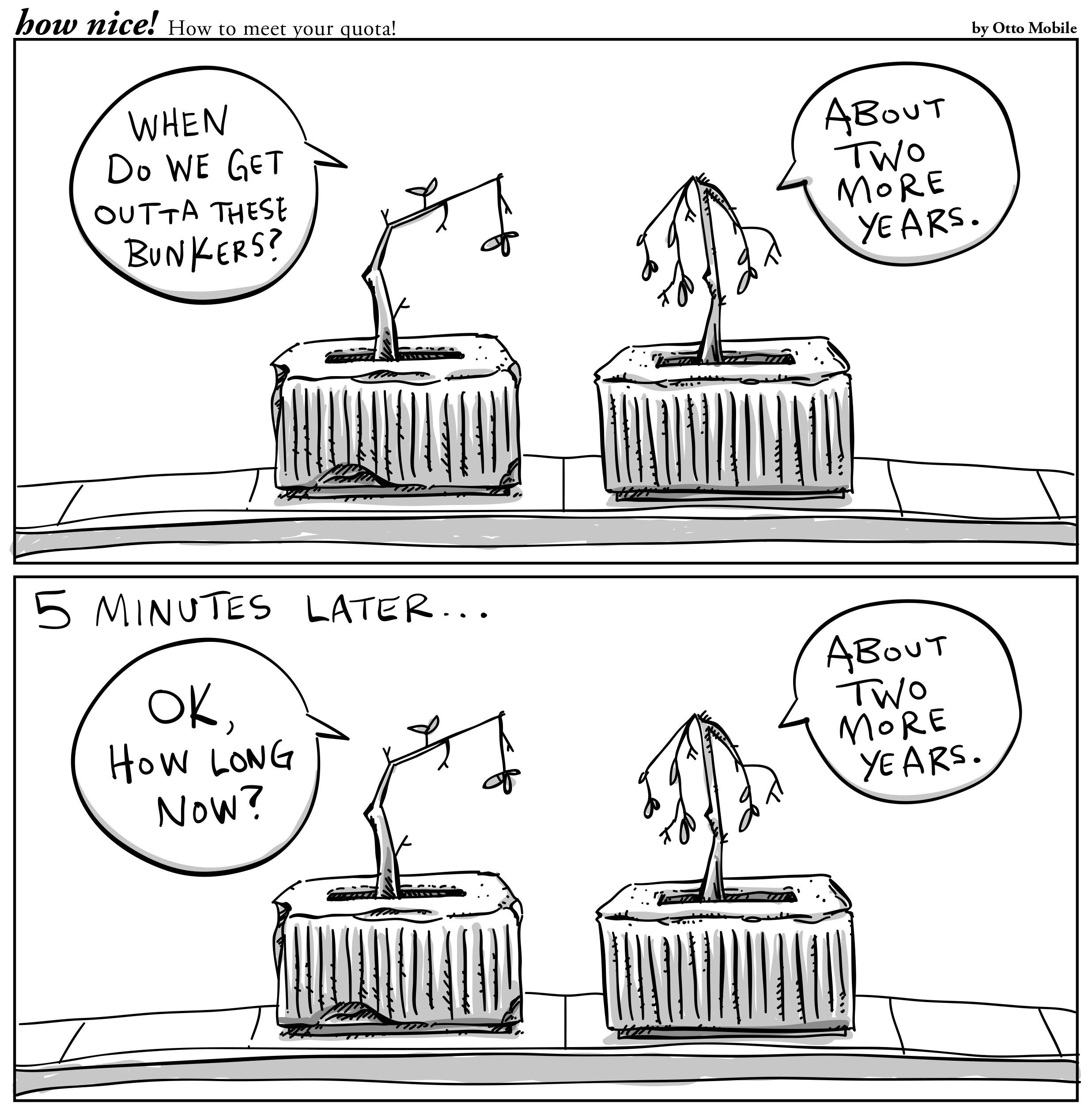
May 13th, 2016 · Comments Off on EDITORIAL CARTOON (May 2016): How to meet your quota!
Tags: General
May 13th, 2016 · Comments Off on NEWS: Central Tech field renewal back on track
By Brian Burchell
Intensive construction work has resumed on the athletic field at Central Technical School and it appears that the new artificial turf, track, and seasonal dome will be completed on schedule.
The president of Razor Management Inc., which is rehabilitating the field and will operate the new facility under an agreement with the Toronto District School Board (TDSB), said he hopes the work will be finished by August, even though the contract gives the company until September 1.
“However, we have advised the TDSB that we will not be entering into a shared-use agreement for the corner of Bathurst and Harbord streets, or make the improvements along Bathurst Street [the western flank of the field] given the tax issue,” said Razor’s president Mathew Raizenne.
[pullquote]
“We have advised the TDSB that we will not be entering into a shared-use agreement for the corner of Bathurst and Harbord streets”—Matthew Raizenne, president, Razor Management
[/pullquote]
These improvements were part of the terms of the mediated settlement negotiated at the Ontario Municipal Board, a settlement that was contingent on the agreement of all the parties. Raizenne said he is disinclined to participate now that his company is subject to an annual tax charge of $25,000 on what he believes is in effect public land in 100 per cent public use.
This is but the latest development in a story that has gone on for over four years. Earlier this year, Razor halted construction upon receiving an unexpected property tax bill in the hundreds of thousands of dollars, relating to back taxes for the facility it operates at Monarch Park Collegiate Institute. The company had been told to expect similar tax rates for the Central Tech field once that facility was up and running, and Razor downed tools in protest.
Razor has since decided to proceed with construction while it appeals the commercial tax assessment at the Municipal Property Assessment Corporation. Razor has also asked the TDSB to categorize the field as for public education use, which would exempt it from the MPAC assessment. To date, the TDSB has not done this, though the students will be using the facilities during school hours for TDSB programming.
READ MORE ABOUT CENTRAL TECH FIELD:
LETTERS: HVRA still on board for CTS plan (March 2016)
EDITORIAL: Ship to wreck (February 2016)
Construction halted at Central Tech: Student athletes launch online petition by Marielle Torrefranca (February 2016)
Agreement reached for Central Tech field (April 2015) by Annemarie Brissenden
To dome or not to dome, that is the question (February 2015) by Terri Chu
Editorial: Mobs don’t rule, nor do pawns (February 2015)
Dome plan inches closer (February 2015) by Brian Burchell
School board appeals ruling and loses, again (October 2014) by Brian Burchell
Editorial: A strategy run amok (September 2014)
Dome plan quashed by courts (September 2014) by Brian Burchell
Raucous meeting on CTS field (April 2014) by Annemarie Brissenden
READ MORE ABOUT CENTRAL TECH:
Central Tech alumni return to mark school’s centennial (November 2015) by Annemarie Brissenden
Central Tech celebrates 100 years (July 2015) by Annemarie Brissenden
Aircraft program grounded in 2004 (July 2015) by Annemarie Brissenden
Tags: Annex · News
May 13th, 2016 · Comments Off on NEWS: Watch out in the wee hours
There were five separate reports of robberies between April 14 and April 30.
By Geremy Bordonaro
The Toronto Police Service (TPS) is looking for two suspects in a series of armed robberies which have taken place between Harbord and Queen streets, and between Spadina Avenue and Markham Street.
There were five separate reports of robberies between April 14 and April 30. In all cases, one of the two men brandished a firearm, taking a number of items and cash from the victim at gunpoint. All the incidents took place between 12 a.m. and 4 a.m. and police are urging caution in this area between these times. Both suspects are described to be black males between the ages of 20 to 25 wearing dark clothing, with the first being lighter complexion and 5 feet 11 inches tall, and the second being 5 feet 8 inches.
Those with information on the crimes are being asked to contact the TPS at 416-808-1400 or Crime Stoppers at 416-222-8477.
READ MORE:
NEWS: Crime down overall in 14 Division (March 2016) By Brian Burchell
Tags: Annex · News
May 13th, 2016 · Comments Off on NEWS: Celebrating a century of life
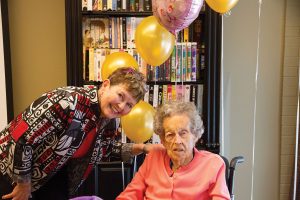
PHOTO BY GEREMY BORDONARO: Anne Rowbotham, shown above with her daughter Laurel, celebrated her 104th birthday at the Annex Retirement Residence. Rowbotham, who may be the oldest member of the community, grew up in Markham and joined the residence two years ago.
By Geremy Bordonaro
Residents and staff of the Annex Retirement Residence on Spadina Road gathered for a special celebration on April 2: Anne Rowbotham’s 104th birthday.
Rowbotham, who moved into the Annex retirement home two years ago, is officially the oldest member of the home.
Rowbotham’s daughter Laurel showed a slide presentation featuring pictures taken throughout her life. Pictures from her travels, home life, and many celebrations graced the screen and showed the extent of Rowbotham’s achievements. Cake and refreshments were served, and a certificate from Prime Minister Justin Trudeau congratulating her on this momentous occasion took pride of place.
Rowbotham was born on a farm outside Markham where she spent most of her childhood helping out on the farm. She worked as a teacher in a small one-room schoolhouse for three years before getting married and raising two children. She has six grandchildren and seven great-grandchildren.
Tags: Annex · News