
PHOTO BY JENNIFER ROBERTS/GLEANER NEWS: In July of 2007, Shadeem Provo and Khalik Provo, both then 14, compete for the ball on Hillcrest Park’s basketball court. Hillcrest Park received an A+ grade in our annual parks survey in 2007.

PHOTO BY JENNIFER ROBERTS/GLEANER NEWS: In July of 2007, Shadeem Provo and Khalik Provo, both then 14, compete for the ball on Hillcrest Park’s basketball court. Hillcrest Park received an A+ grade in our annual parks survey in 2007.
Comments Off on FROM THE ARCHIVES (JULY 2016)Tags: General
In this, part two of our annual survey of parks in the Annex, we step into new territory. The majority of parks reviewed this month are ones we haven’t covered in the past, and as in part one, we discovered great greenspaces mixed among the mediocre, comfortable niches, and one park that needs a lot of work. Also this month? An update on work at the Brunswick-College Parkette, which is showing a lot of promise.
Reviews by Geremy Bordonaro and Emily Rea.
504 Euclid Ave.
Time: 12:30 p.m.
Grade: A (last year A)
Reason to go: Healey Willan Park is great for small children. The space contains many play structures and toys for kids, with room to spare. Parents have more than enough seating with a lot of good vantage points for keeping an eye on their young. Thanks to the fences and an eye for cleanliness, the park is more than safe to use. Plenty of varieties of trees give a good amount of shade in case the heat gets bad. Overall this park is a complete package in terms of a family park.

Overheard: “Are there laser guns in the game?”
Did you know: Healey Willan Park is located on the former location of the Sisters of the Church convent.
15 Brunswick Ave.
Time: 12 p.m.
Grade: N/A
Reason to go: Once an overgrown disaster that highlighted not only the lack of green space in the area, but also the general neglect of existing parks, it’s been approximately five years since efforts began to have the parkette revitalized. Those five years have seen design competitions, cooperation between Joe Cressy’s (Ward 20, Trinity-Spadina) office and the Harbord Village Residents’ Association, and much scrutiny. When the parkette reopens this fall, it will be renamed The Doctors’ Parkette, and feature decorative pavers, seating areas, and improved planting.
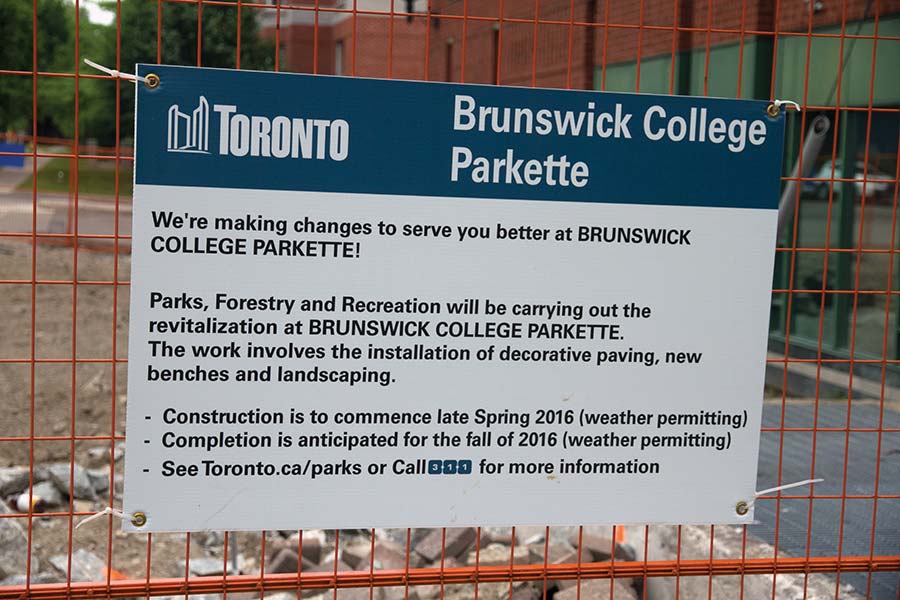
Overheard: The whirring and humming of construction machinery and nearby waitresses taking orders at Caplansky’s.
Did you know: In 2011 the Harbord Village Residents’ Association held a design contest to help push the city to redesign the area.
328a Walmer Rd.
Time: 11 a.m.
Grade: C
Reason to go: As the name implies, Casa Loma Parkette is just a short walk from Casa Loma. There is very little in this park save for a bench, a few trees, a picnic table, and a lot of free space, which has its positives and negatives. There is quite a lot of room to lie down on a blanket and relax or start an impromptu picnic. On the downside, there is very little shade, which may make it unbearable during especially hot summer days.
Overheard: “There’s a snapdragon shortage!”
Did you know: The nearby stables bear the names of the horses owned by Henry Pellatt, who lived in Casa Loma.
115 Cumberland St.
Time: 4:00 p.m.
Grade: A
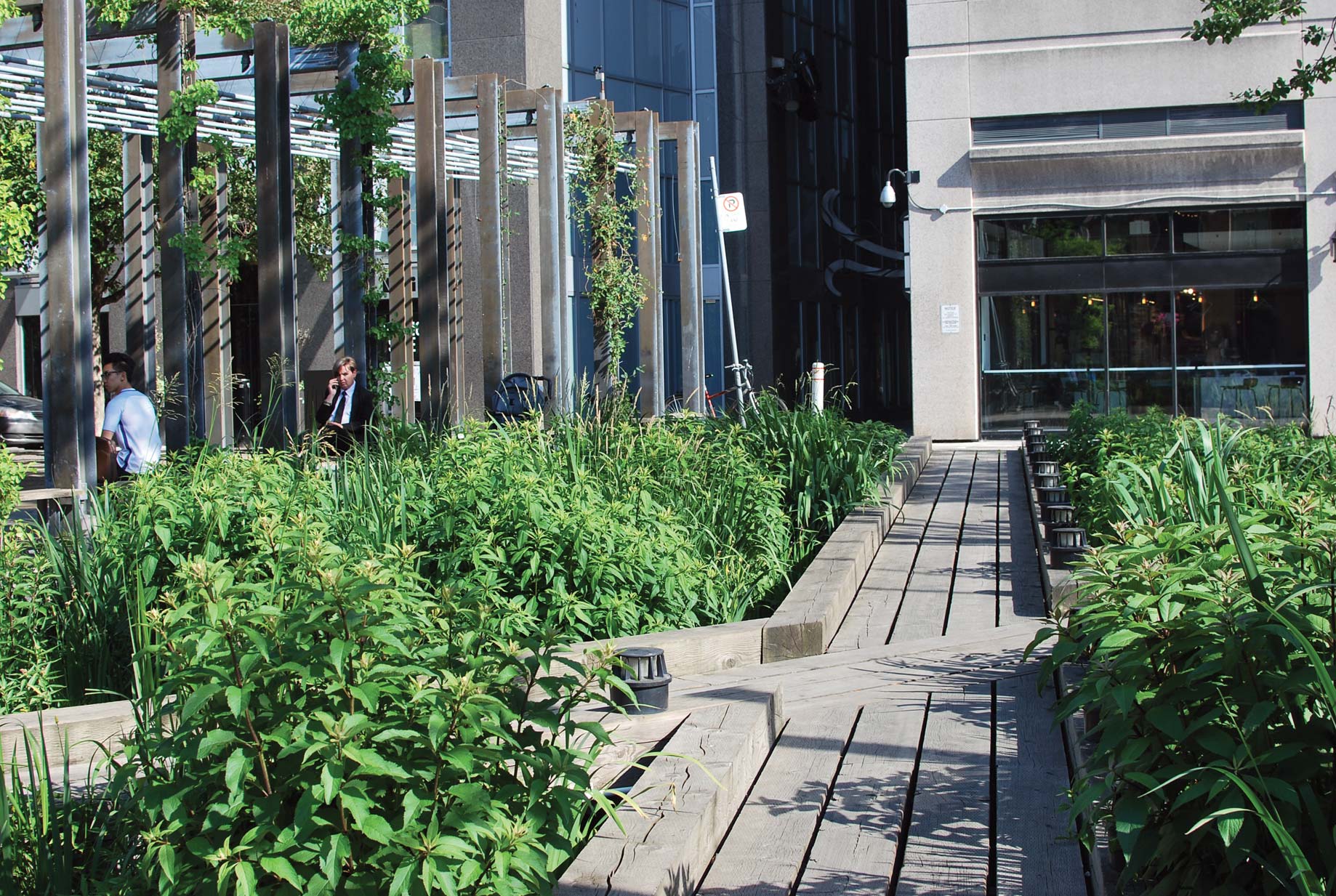
PHOTO BY EMILY REA/GLEANER NEWS: The Village of Yorkville Park is a natural extension of the area, and features some inventive uses of water as well as a piece of the Canadian Shield that is part art installation, part climbing structure.
Reason to go: Village of Yorkville Park is located in the heart of the busy, posh shopping district. It is a perfect spot for people-watching or enjoying a drink on a hot day. Children enjoy scrambling up the big rock, which is a piece of the Canadian Shield. The park has a water feature and seating in both the sun and the shade. It does not feel like an oasis, but rather a natural extension of the cosmopolitan neighbourhood. It would be nice to see more green space for lounging, but in an area where real estate is at a premium, Yorkville Park makes the most of its space and is well integrated in the neighbourhood.
Overheard: “Your gelato matches your dress!”
Did you know: The park is designed as a collection of various landscapes in Canada, including the prairies and marshes.
47 Queen’s Park Cres.
Time: 4:30 p.m.
Grade: B+
Reason to go: Queen’s Park’s beautiful and relaxing landscape sits by the Ontario Legislature, surrounded by Queen’s Park Crescent. A thick canopy of trees shades the entire park, breaking only to reveal the large statue that lies at the centre of the park. The paths that radiate out from the statue are popular with commuters passing by and runners out for their daily jog. Queen’s Park has plenty of benches, but no other features — it is a park for running, walking, or sitting, not playing.
Overheard: “Who is that in the statue?”

Did you know: The man in the statue at the centre of the park is King Edward VII, grandfather of Queen Elizabeth II.
819 Palmerston Ave.
Time: 2:00 p.m.
Grade: A
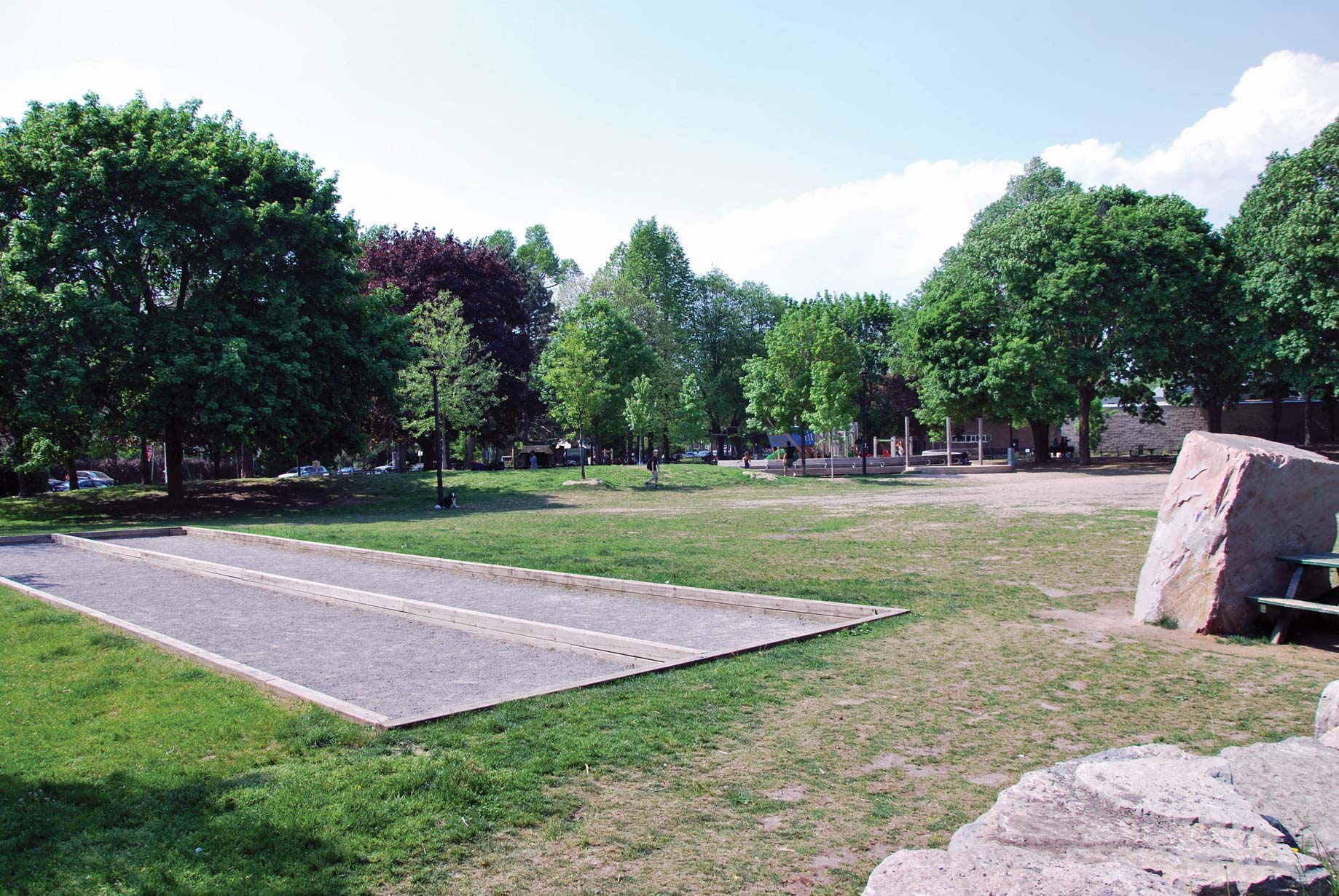
PHOTO BY EMILY REA/GLEANER NEWS: Vermont Square, with its pirate playground, bocce ball courts, and ample space, is one of the best we reviewed this month despite the sandy areas where the grass has been worn down.
Reason to go: After a refresh a few years ago, Vermont Square Park has one of the best playgrounds in the neighbourhood. Stylized to look like a ship, the play structure is inventive and popular among neighbourhood children. The park is spacious, with plenty of green space and seating. However, the field in the centre is worn down to dirt. Additionally, the area could use more trees to provide extra shade. Nonetheless, Vermont Square Park is one of the best parks in the neighbourhood.
Overheard: “Do we have to go home?”
Did you know: The park has bocce ball courts, a rarity in the city.
495 Huron St.
Time: 5:00 p.m.
Grade: D+
Reason to go: Huron Playground is in desperate need of an update. The grass is worn down to dirt throughout the park, meaning there is no pleasant place to lounge. The area smells of the litter strewn around, and graffiti marks the play structures and outbuilding. The park itself is a reasonable size and is located in a quiet area. If Huron Playground were re-vamped, it could be a perfect after-school spot for children from nearby Huron Public School, but in its current state, the playground is deserted and dingy.
Overheard: Silence.
Did you know: Huron Playground is getting a renewal starting this year.
468 Grace St.
Grade: B+ (last year A)
Time: 1 p.m.
Reason to go: Bickford Park serves as a great dog park. There’s a massive amount of space for dogs to run around and stretch out and dog bags and disposals are readily available. Despite this focus, however, there isn’t much for humans. The aged seating and park benches are very sparse outside the off-leash section, and while there is a baseball diamond in the park, with Christie Pits so close by, there isn’t much reason to use it. Dog owners should definitely have Bickford Park on their minds.

Overheard: “Hey yo! Boy, get off of her! Sorry about that.”
Did you know: Dogs stick out their tongues when they get hot in order to cool down.
READ MORE:
PART ONE: Green sanctuaries in the heart of the city (June 2016)
Comments Off on Part two of our 2016 parks reviewTags: General
By Annemarie Brissenden
So pervasive is the spectre of Donald Trump these days that it’s impossible to escape, even in the Annex.
“Thank god it wasn’t Donald Trump,” said one community member of Westbank Project Corp.’s plans for Mirvish Village during a June 13 community meeting at the Bickford Centre. Met with much laughter and applause, this was perhaps one of the few times everyone in the room was in agreement.
[pullquote]“The building has to fit with both the existing and planned context”—Graig Uens, Planner, City of Toronto[/pullquote]
It was City Planning’s first opportunity to canvass the community for feedback on the developer’s revised application for the project, which it submitted to the City of Toronto in May. Hosted by the planning department, the meeting included many representatives from Westbank, councillors Joe Cressy (Ward 20, Trinity-Spadina) and Mike Layton (Ward 19, Trinity-Spadina), as well as several officials from the city’s parks, transportation, and planning departments.
Planner Graig Uens provided some preliminary comments on the revised application. Noting that the parcel of land — which includes Honest Ed’s and Mirvish Village and is bounded by Bloor, Bathurst, Lennox, and Markham streets — is targeted for growth in context, Uens said that the revisions correspond to areas previously flagged by the city: increased green space and heritage conservation, and a refined built form. He added that the city is continuing to work externally with the applicant and internally to ensure new services keep pace with growth and intensification.
These latter concerns were the ones communities focused on the most during the question and answer session.
“Believe me, things are pretty dense there right now,” said Seaton Village resident Aaron Davis, who was echoed by a neighbour: “it is already difficult to get on the subway east from Bathurst. [With] no changes in transit capacity, how can the neighbourhood add 1,000 units?”
Some people expressed the need for greater bicycling services, while others, like one Palmerston Boulevard and Lennox Street resident, wondered how traffic would be handled, both during construction and after, especially in the context of development in the Bathurst corridor.
“It’s difficult to get up my driveway between 4 and 7 p.m.; I haven’t seen a clear analysis of how we’re going to handle that density.”
Connected to the questions about density are questions about height, particularly regarding the taller two towers, one of which tops out at 29 storeys.
“The towers stick out like a sore thumb compared to the rest of the community; the max should be nine storeys,” said a member of the audience, who identified herself as an architect.
Many asked how the application fits into the context of the Four Corners Study — which currently states that no building at Bloor and Bathurst streets should be higher than nine storeys — a planning document that would govern development in the area that is also underway at the city.
“Westbank has ripped [that] document to shreds,” said one person to much applause.
However, Uens was at pains to explain that “the southwest corner is a different animal; the larger site affords an opportunity to do more.”
“The building has to fit with both the existing and planned context,” he added.
Not all those who took to the microphone were opposed to the development. As all the units remain rental, some believe it will enable those who don’t anticipate being able to afford to buy a house in the Annex to continue to live in the neighbourhood.
An 18-year-old Harbord Collegiate Institute student with the demeanour of a young Joe Cressy stood up in “[full] support of this project. It will allow people to live in the neighbourhood.”
“Hats off to the [Westbank] team for listening, and incorporating the funky things that make the Annex so great,” said Geoff Cape, the founding CEO of the Evergreen Foundation. “I have teenage boys, and maybe they will be able to stay in the neighbourhood.”
“I think we’re close,” said Brian Burchell, chair of the Bloor-Annex BIA (who also publishes this newspaper). A supporter of the project from day one, he challenged the “dynamic duo” of Cressy and Layton to “find a way to make sure this does not end up at the Ontario Municipal Board, if we wish to show that we can effectively plan in this city without being under the constant thumb of that erratic provincial arbiter.”
All of Westbank’s submissions are available at the city’s planning portal. This article is part of a series of this newspaper’s ongoing coverage of the development.
READ MORE:
NEWS: Westbank submits revised application (June 2016)
DEVELOPINGS: Annual review reflects tension between community activism and OMB (March 2016)
Westbank towers over 4 Corners (January 2016)
City hosts first Mirvish Village community consultation (November 2015)
Residents’ associations share concerns for Mirvish Village (October 2015)
Westbank submits application (August 2015)
BABIA endorses Westbank proposal (July 2015)
How do you make it real? (April 2015)
Comments Off on NEWS (July 2016): Height, density still top concernsTags: General

PHOTO BY GEREMY BORDONARO/GLEANER NEWS (JULY 2016): A dance troupe lead by a violinist performs outside the Hot Docs Ted Rogers Cinema during the 20th Annex Family Festival on June 26. Hosted annually by the Bloor-Annex BIA (whose chair publishes this newspaper) and the Miles Nadal Jewish Community Centre with the support of many local businesses and organizations, this year’s festival featured a marching band jam session, street and stage performances, and food from restaurants across the neighbourhood.
Comments Off on CHATTER (July 2016): Family festival celebrates 20 yearsTags: General
By Geremy Bordonaro
A dispute between Caplansky’s Deli and the building’s landowner over repairs caused the restaurant to be closed briefly in June before a court order reopened it.
On June 6, the landlord of the popular deli at College Street and Brunswick Avenue unexpectedly changed the locks and terminated the restaurant’s lease. Home to the city’s first Caplansky’s Deli for seven years, the landlord said it was giving notice that the business had violated a term in its lease related to repairs.
Earlier this year repairs to the building, unrelated to the deli, had accidentally triggered the sprinkler system and flooded the basement. Caplansky’s paid for the sprinkler repairs and later for a city mandate to replace a fire panel. These repairs ended up being the cause of the closure.
“It is something we had done,” said Cody Kitchener, the media coordinator for Caplansky’s Deli, a few days after the incident. “We had to get our fire system upgraded and we paid out of pocket. We’re thinking that may be the issue but we don’t know with any sort of certainty.”
Caplansky’s Deli will continue to run in its original location for the foreseeable future.
Comments Off on CHATTER (JULY 2016): Court order reopens Caplansky’s DeliTags: General
By Geremy Bordonaro
A recent community consultation meeting demonstrated that there is wide support for designating Kensington Market as a Heritage Conservation District (HCD), although one aspect of the neighbourhood — its unique culture — may be difficult to quantify under the heritage designation.
Residents from across Kensington and Chinatown expressed their opinions on what makes the area unique, and how a designation could best protect the market, during the June 21 meeting.
While the feedback for the project was positive and enthusiastic, most of the attendees focused on the community’s culture rather than its architecture, which is what an HCD is designed to protect.
The community was labelled an HCD study zone earlier this year.
Feedback forms from the meeting will be available in mid-July for residents to read on the HCD Toronto website, which also has information on several other consultations across the city.
READ MORE:
NEWS: Kensington Market to become heritage district (May 2016)
NEWS: Community council approves Madison Avenue HCD (October 2015)
NEWS: Preserving a historic street (May 2015)
Comments Off on CHATTER (JULY 2016) Kensington Market consultation focuses on cultureTags: General
The boldly named Transformational Task Force is a massive rethink of how the Toronto Police Service (TPS) spends over $1 billion each year as guardians of public safety. It has issued an interim report that is chock full of trial balloons worthy of serious consideration. However, there are some glaring omissions that are perhaps attributable to the fact that this is, after all, a review of the police by the police.
[pullquote]It really is trying to leapfrog to a more modern, efficient, transparent, and accountable public service.[/pullquote]
Born of a longstanding frustration with the service’s seeming inability to come to grips with a budget that grows unstoppably, the task force deals with issues that go well beyond the accounting ledger. It really is trying to leapfrog to a more modern, efficient, transparent, and accountable public service. The political and temperamental alignment of this mayor, this premier, and, most importantly, this new police chief, is an opportunity that should not be squandered.
One cannot ignore the fact that last year 4,125 of the 7,800 uniform and civilian employees of the TPS were on the province’s Sunshine List, each earning $100,000 or more. About $900 million of the operating budget, or 89 per cent, is spent on salaries and benefits, and the service is locked into annual increases under a three-year collective agreement with the city. It’s no wonder the operating budget grows like it’s on autopilot.
Managing this expensive payroll and deploying the highly-trained staff to meet the shifting sands of crime incidents and crime prevention is key to spending precious public tax dollars effectively. After all, wage gains for police have gone up by 20 per cent since 2008 whilst crime rates have fallen. The police ought not to be exempt from the supply and demand economy. The task force was right to focus first on how police are deployed, suggesting using new technology and new thinking.
The 17 divisions from which the service operates no longer reflect the city’s individual neighbourhoods and their needs, so the task force recommends reducing the number of stations. In a positive, innovative step that would make the service more accessible and nimble, it would assign officers available by phone, email, text messages, social media, and via an enhanced TPS application, to work in specific neighbourhoods every day. Disbanding the Toronto Anti-Violence Intervention Strategy (TAVIS) — a blunt instrument approach in which officers without local knowledge are parachuted into higher crime areas — is also a good idea.
The task force recommends a more triaged approach to 9-1-1 calls. At the moment, the police are the primary responders and the recommendation is that uniformed officers limit their attendance to when there is an immediate personal safety risk or an urgent investigative need.
Getting the TPS out of the business of managing lifeguards and crossing guards will bring savings too. Many of the recommendations suggest offloading duties placed on expensive uniformed officers onto civilians either within the force, in other city departments, or even in some cases, private security.
The recommendations around “culture change” are disappointing and a muddle of euphemisms. It may be impossible for the police themselves to talk about the “thin blue line” and whether or not it is appropriate to continue to pay suspended officers who have been charged with criminal offences. Constable James Forcillo, the convicted murderer of Sammy Yatim, is a shining example of what is wrong with this practice. Between this interim report and the final one, the task force should summon the courage to address some of the real issues around police culture.
Overall, the community-centred vision is laudable. The attempts at changing the engagement with neighbourhoods and the utilization of new technology will bring the police closer to the people whom they have pledged to protect.
READ MORE:
EDITORIAL: Mayo no, marijuana maybe (June 2016)
EDITORIAL: It just makes census (May 2016)
EDITORIAL: An injection of leadership (April 2016)
Comments Off on EDITORIAL (JULY 2016): Turning the Queen MaryTags: General
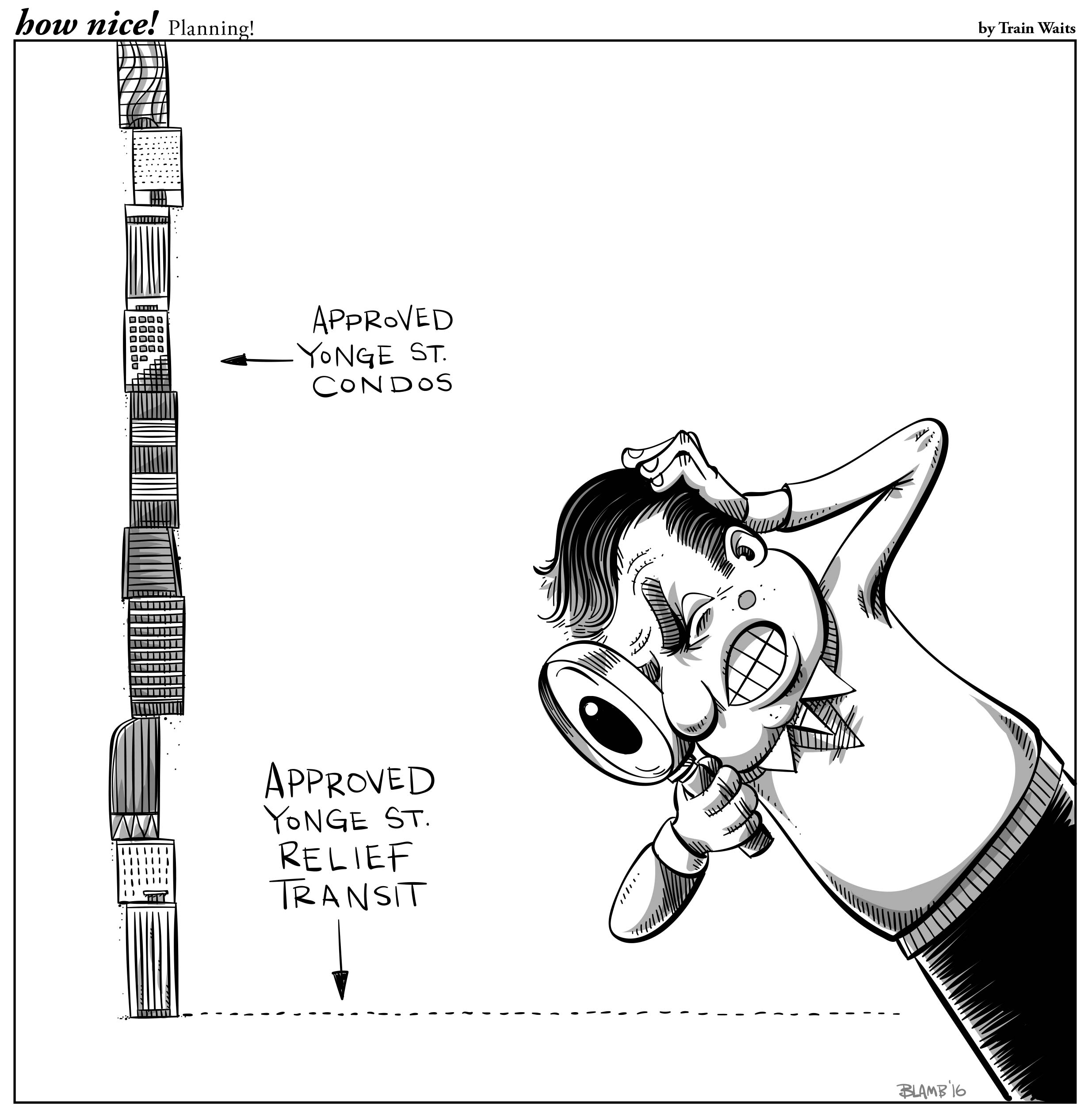
Comments Off on EDITORIAL CARTOON (JULY 2016): Planning!Tags: General
By Marielle Torrefranca
A student-driven short film project is being used to inspire a school curriculum regarding positive mental health for youth.
The initiative, titled Warrior Within, is run mostly by students and alumni of the University of Toronto Schools (UTS). The project involves using art, metaphor, and imagery to engage students in understanding stress and anxiety, as well as developing their own resilience.
[pullquote]“There simply aren’t enough mental health resources for adolescents in Ontario”—Deanna Kim, student, UTS[/pullquote]
Currently, the team consists of about a dozen students and is still open to growth. Students are taking on roles like acting, cinematography, directing, and musical scoring, and have access to a handful of professional mentors for one-on-one guidance. Mentors come from a variety of schools, and specialize in drama, dance, English, art, and photography.
The film and its facets will go on to inspire a curriculum based on creativity and art.
It will be a curriculum made by students for students, said Catherine Wachter, a guidance counsellor at UTS who is spearheading the initiative.
Wachter was inspired by her work as a guidance counsellor, which involves looking for engaging material to help her teach social, emotional, and mental health in the classroom.
“I really struggle at finding that sort of thing,” she said. “So I wanted to do a couple of things: use art to engage students’ emotions in the classroom, because then they can really relate to their own experience, but also use the student voice, because peers, I find, really, really listen to peers.”
Deanna Kim, a grade 11 student at UTS, will work alongside filmmakers and create art of her own that is related to the film, which will be used in conjunction with the curriculum.
“I have actually fought with mental illness myself,” said Kim, who sought treatment in Boston.
“There simply aren’t enough mental health resources for adolescents in Ontario,” she said. “I’m very very, lucky and privileged to have parents who were able to pay for that. But I know that definitely not all adolescents can afford to have that experience.
“I really want to help work with Warrior Within in order to communicate these sorts of strategies to people who might need them the most and might be facing barriers toward treatment.”
Mia Sanders, who graduated from UTS this year and is also creating visual art for the initiative, said the usual recommended coping techniques, such as trying to relax, don’t quite match the reality of what treatment is needed.
“We learn about or experience things like yoga and breathing in relation to mindfulness in school, which are really important parts of it…but there is so much more beyond that in terms of being able to observe your emotions and create this distance between feeling something and reacting to it,” said Sanders. “It can be quite a difficult and rigorous process.”
This is just some of the background that will drive the curriculum, which will be developed starting in January. With the guidance of Wachter and other students, Ben Swadron, a University of Toronto student, UTS alum, and aspiring teacher, will assist in the development of educational materials that can accompany the film in the classroom.
“We’re going to use everything,” said Wachter. “For example, it might be like ‘Okay, let’s look at this photograph series that Naomi [a student on the team] took of her response to the stress that we were talking about…. Let’s use that in conjunction with this little scene, plus this creative writing piece from Jonah, plus this art piece from Deanna.’”
So far, Warrior Within has been warmly received. At press time, the initiative’s Indiegogo campaign has raised $15,400, with donors from as far as California.
There’s still a long way to go, though, especially since Wachter hopes to renew the project every year. The campaign has set a fundraising goal of $45,000 to cover shooting costs, workshops for students, post-production, and educational mentors.
Leftover funds will be used to organize a celebratory gala and exhibition, where the film is expected to premiere next spring.
Shooting of the short film begins this month.
Listen to Marielle Torrefranca’s full interview with Catherine Wachter.
Comments Off on FOCUS ON EDUCATION (JULY 2016): Student project to help shape curriculum on mental healthTags: General

PHOTO BY NEILAND BRISSENDEN/GLEANER NEWS: Maureen Judge followed five well-educated recent graduates who are unable to find employment or paid internships for her most recent documentary, My Millennial Life.
By Clarrie Feinstein
In a documentary that premiered in May at the Hot Docs Ted Rogers Cinema, Maureen Judge explores youth unemployment and underemployment. For My Millennial Life, the Annex filmmaker followed five recent graduates who are all well educated, yet unable to find employment or paid internships.
[pullquote]“With My Millennial Life, I wanted to show the shift that is happening in the current economic infrastructure”—Maureen Judge, documentary filmmaker[/pullquote]
At the heart of the documentary are the personal accounts of five young, aspiring individuals, all of them pursuing their passions, even if it means having to work multiple jobs to support themselves. In telling these stories, Judge taps into what she views as a troubling part of the present economic climate.
“For me my documentaries are not earnest films,” explained Judge, who co-founded Makin’ Movies, a television production company that produces documentaries and television series. “The backdrop has a discussion of politics, it could be in terms of family politics, socio-political problems, the work environment, etc. With My Millennial Life, I wanted to show the shift that is happening in the current economic infrastructure.
“After I’ve established the backdrop I then ask, ‘How do people navigate their way within that system?’ Often from these personal accounts a lot of humour is found, which always offsets the pain that is being revealed. It allows the audience to feel something with depth; the human perspective and emotion is pivotal.”
As Judge sat in her dining room, discussing her career and film ventures, it was evident she had specific stories to tell and that documentaries allowed for the perfect synthesis of narrative and analytical research.
“I got to research. I could study, read, interview, and bring that all in with the creative aspect. After my first documentary — And We Knew How to Dance: Women and World War I (1994) — I fell in love with the medium.”
Judge’s initial studies at the University of Toronto were not in film but in science and philosophy. Only after studying French in Paris, where she attended weekly film screenings, did the spark ignite for her to pursue film as a viable career option. After attending graduate school at New York University in cinema studies, Judge realized she wanted to pursue the practical avenue of filmmaking: directing.
Over Judge’s career her films have garnered critical acclaim, making her a figurehead in the Canadian film industry. Her subject matter is varied, yet many works focus on certain distinct themes such as family relationships. As one of eight children Judge was always in a full household, experiencing multiple personalities and emotions.
“Every kind of joy, sorrow, and tragedy were all shared experiences.”
Her documentary trilogy, which she produced and directed in association with TVO, explored love and betrayal in parent-child relationships. The first in the trilogy, Unveiled: The Mother Daughter Relationship, was inspired by her own relationship with her mother, which Judge describes as “one of the most important relationships in your life. These family dynamics are universal and are worth exploring.”
Family is an integral component in her life.
Judge, who moved around many times in her childhood, says she would often respond to the question, “Where are you from?” with, “my family. They’ve been the one constant in my life.”
Often found cycling around the Annex, the filmmaker says she loves “the intimacy of documentary making. The small crew, the spontaneity that it allows, and hearing ordinary people’s stories.”
View My Millennial Life.
Comments Off on ARTS (JULY 2016): Making her markTags: General
By Joe Cressy
What makes a livable community? As we continue to see growth across our downtown neighbourhoods, we must focus on building livable communities, not just adding density. We must build vibrant neighbourhoods, and to be vibrant, neighbourhoods need community spaces, cultural spaces, and, critically, green spaces.
Over the last 20 years we’ve witnessed transformational change in the downtown. In the railway lands, an entire new neighbourhood, CityPlace, has been built in two decades. In the King-Spadina district, defined as Front to Queen streets and University Avenue to Bathurst Street, the population has grown from 240 people in 2001 to nearly 30,000 people today, and it will grow to an estimated 50,000 when all approved developments are built.
[pullquote]Green spaces and parks are critical to the livability and sustainability of life.[/pullquote]
Despite this tremendous population growth, we have not adequately invested in the vital social infrastructure that makes a neighbourhood livable such as community centres, libraries, affordable child care, and parks. In fact, we are so far behind that we don’t have solid information on which services are most deficient in each neighbourhood. But we are finally working to catch up now.
In October 2015, Toronto City Council approved our plan for a partnership between the City of Toronto and the YMCA to bring a new YMCA centre to the revitalization of the city-owned Waterworks building at 505 Richmond St. W. This partnership demonstrates a real step in building a livable community in the continually growing area.
But, critical to real livable communities and to combatting the ever-growing crisis of climate change is expanding green spaces. We need more parks, creative greening solutions, and most of all, the political commitment to make it happen.
On June 13, I was proud that the city’s government management committee helped us move forward in supporting our ward by taking the next step towards initiating parkland acquisition in King-Spadina. Over the last 18 months I’ve worked with city staff to identify a suitable large site for a new large downtown park. We’ve identified a site, and now we need the political will to acquire it — by sale, or if necessary, by expropriation.
Whether through acquisition or expropriation, proceeding with new parkland in this area is a critical step in building a livable community.
Expanding parks space is critical, but it is just one component. We also need to find creative solutions to green concrete spaces within our neighbourhoods. The Annex Residents’ Association’s longstanding parks and trees committee has been creating incentives to green the Annex for years. And more recently the Harbord Village Residents’ Association (HVRA) created an innovative neighbourhood plan.
In collaboration with the HVRA, we have created the Harbord Village Green Plan — a local, comprehensive vision to green forgotten spaces throughout the community. The plan identifies opportunities to expand and enhance green spaces throughout the neighbourhood, but zeroes in on laneways and flankage corners as key priorities to enhance our green space. Thanks to hard-working community volunteers, this is a solid foundation from which to grow green infrastructure. Croft Laneway has already been the subject of a pilot project by the HVRA to formalize laneway greening. Moving forward, we will be working hard on laneway planting, creating green punctures, introducing vining, and many other opportunities to restore and foster ecosystem health.
Whether you live in a condo tower or a low-rise residential neighbourhood, green spaces and parks are critical to the livability and sustainability of life. As downtown Toronto continues to grow, we must be proactive and creative about providing the spaces to grow trees as well.
Joe Cressy is the councillor for Ward 20, Trinity-Spadina.
READ MORE:
NEWS: Green sanctuaries in the heart of the city (June 2016)
NEWS: New landscaping for Lennox Street (June 2016)
NEWS: Second phase of park revitalization to begin (May 2016)
NEWS: Bloor Street goes green (April 2016)
NEWS: Huron Street Playground renewal (April 2016)
NEWS: City seeking street greening opportunities (February 2016)
READ MORE BY JOE CRESSY:
FORUM: Bike lanes on Bloor Street (May 2016)
FORUM: Untapped potential (February 2016)
Comments Off on FORUM (JULY 2016): Building a livable cityTags: General

PHOTO BY R.S. KONJEK/GLEANER NEWS: Ryan White takes a turn at the plate during recent baseball action at Christie Pits. White’s home run in the bottom of the ninth sealed a 13-10 comeback victory for the Toronto Maple Leafs over the Burlington Bandits on June 8.
By R.S. Konjek
For 48 seasons, the Toronto Maple Leafs have been playing baseball at Christie Pits.
Hoary old-timers with the longest of memories will tell you that at least once for every one of those seasons, they have watched the Leafs stage an epic comeback victory after falling way behind in a game. Seen it with their own eyes, honest.
Why doubt them?
[pullquote]The hearty fans that remained clustered around the slopes of the ballpark buzzed in anticipation. It was happening again.[/pullquote]
The Leafs play ball in a hitter’s league. The fences at the Pits are short and cozy. An inspired team could score runs by the bushel. There is no reason why the home nine couldn’t mount a late rally to overcome a deficit of four, six, or eight runs.
How about a deficit of twelve?
Such was the case during last year’s Intercounty Baseball League playoffs, when the Leafs came all the way back from a 12-0 score to defeat the Brantford Red Sox 16-15 in one of the most memorable games in Christie Pits history.
These miracle comebacks, they do happen.
There is a mystique to Toronto’s famous sunken ballpark. It says that no lead is ever safe and no game is ever done while the Leafs are still at bat.
That old Christie mystique was in evidence on June 8, when the Leafs hosted the Burlington Bandits.
The Leafs fell behind early.
Way behind.
After eight innings of play, the Bandits enjoyed a healthy 10-4 lead, and the Leafs were down to their final three outs.
June 8 will go down as one of those games when the Leafs came all the way back.
Online readers will want to open another window now and cue up some Wagner, Berlioz, or the theme from Rocky.
The Leafs came up to bat, and the wheel of fortune spun hard. A walk. Another walk. A two-run double. Four more walks, then another double to tie the game 10-10. The hearty fans that remained clustered around the slopes of the ballpark buzzed in anticipation. It was happening again.
The next man to the plate was Ryan White, the team’s second-year shortstop.
White’s rookie season with Toronto had been cut short by a knee injury. He did not play again until this summer, and now the spotlight was trained firmly on him.
Bottom of the ninth, two out. The game rested on his shoulders. It was do-or-die time. Clichés circled like bees. He was about to live the age-old dream played out by countless kids in countless backyards.
White dug in. The moments that followed would be memorable, not just for him but for his teammates and everyone who was there to bear witness.
“I was looking for a fastball over the plate that I could barrel up,” White recounted later. “I think the pitch was middle in, which I like.”
Burlington’s pitcher served up just the thing, and White did not hesitate.
First pitch. Gone. A walk-off home run — the most electrifying moment in baseball. With a crack of the bat that resonated like a cannon shot, the game was won 13-10.
Did he know he had hit a home run right away?
“It was way out. I was just hoping it didn’t hook foul.”
As he circled the bases, White’s teammates poured onto the field and surrounded home plate to receive the hero of the day.
“It was my first ever walk-off home run. Everyone was pumped. It feels great to be part of that unbelievable comeback with two outs in the bottom of the ninth.”
And with that, Ryan White added another chapter to the mystique of Christie Pits. His walk-off winner saw the Leafs continue their hot start to the 2016 season.
As the month of June progressed, the Leafs stumbled into a win-lose-win-lose pattern. They approached the end of the month with a winning record, but only just. Hopefully things will turn out for the better in the month of July.
The Maple Leafs play ball at Christie Pits every Sunday at 2:00 p.m., with a handful of Wednesday night games, in June and July. As always, admission to Leafs games at Christie Pits is free.
READ MORE:
SPORTS: Leafs ahead 3-1 after first four games of the season (June 2016)
SPORTS: The bats are back at Christie Pits (May 2016)
NEWS: Second phase of park revitalization to begin (May 2016)
NEWS: Christie Pits renewal set to begin (July 2015)
Comments Off on SPORTS (JULY 2016): Christie comebacks and walk-offsTags: General