
Proximity to four subway stations impacts the Annex
By Damola Omole
On Jan. 27, 2026, amidst heaps of leftover snow from a historic storm, the City of Toronto’s Station Area Zoning Project team hosted an open house at the West End Alternative School, where individuals from within and around the Annex community learned more about the city’s updated zoning for Toronto and East York neighbourhoods.
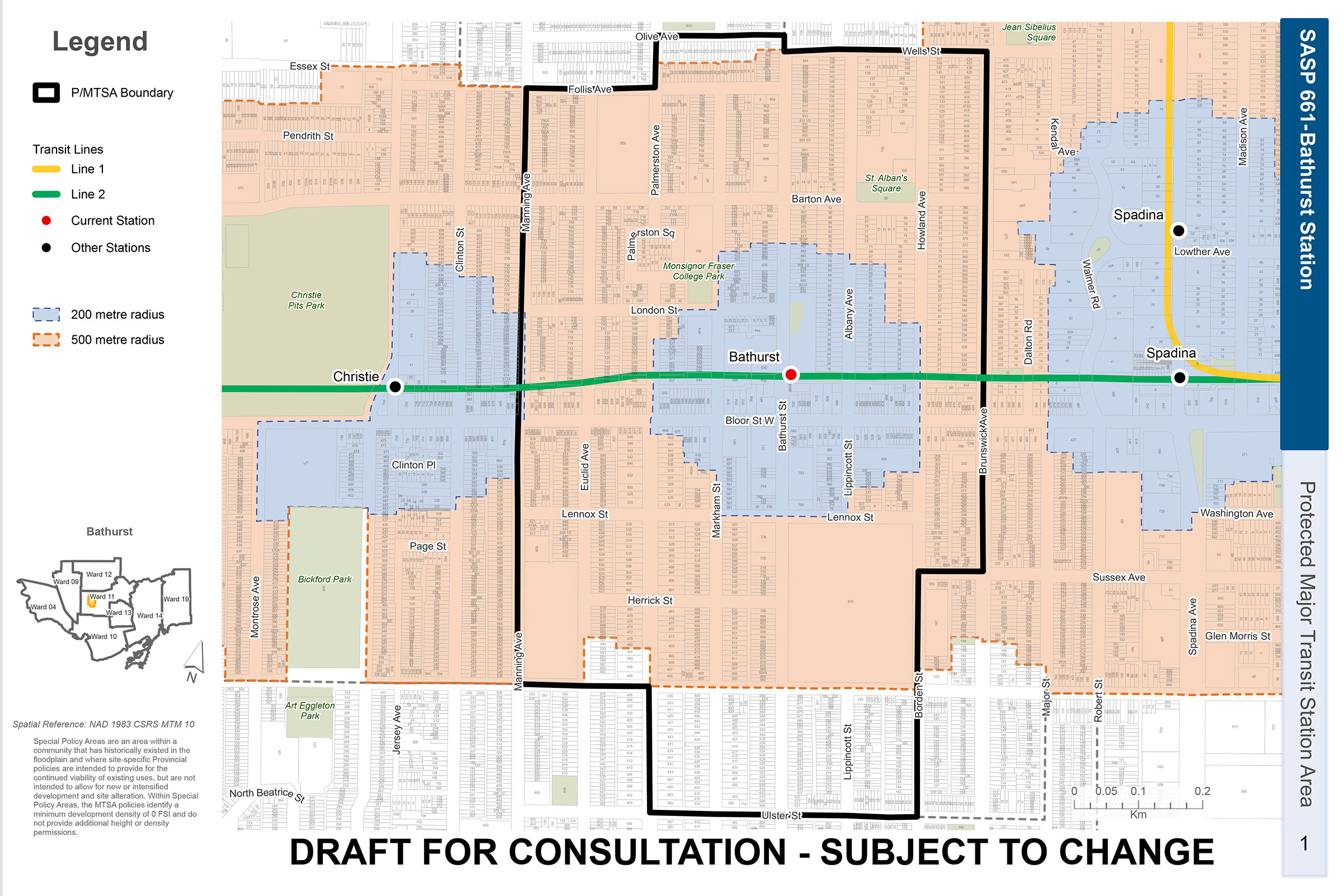
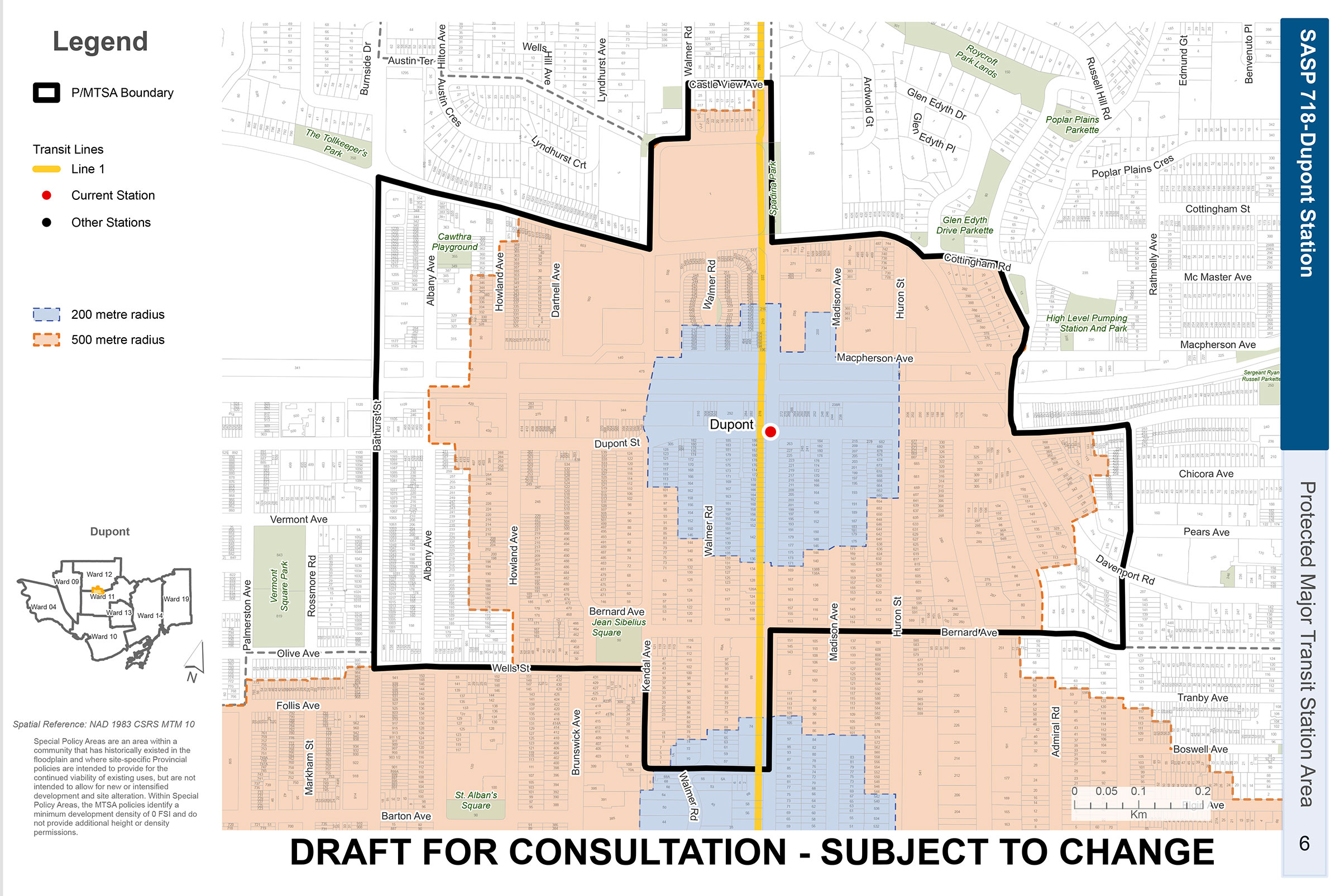
The city’s latest planning strategy involves updating neighbourhood zoning requirements to permit certain heights and densities to be built in proximity to Protected Major Transit Station Areas (PMTSAs) PMTSAs are a subset of Major Transit Station Areas, (MTSAs) which the city defines as areas within about 500 to 800 metres, or roughly a 10-minute walk, of existing or planned higher-order transit stations (subways, GO Transit, light-rail). There are currently 120 approved MTSAs across the city.
The distinction between PMTSAs and MTSAs is that, of the 120 approved MTSAs in the city, 95 of them (all PMTSAs) have required minimum densities where the city can also require affordable housing through inclusionary zoning.
The city and the provincial minister of Municipal Affairs and Housing established P/MTSAs through Official Plan Amendments (OPAs). Subsequently, in August 2025, the minister’s approval brought Chapter 8 of the Official Plan into effect, fostering a wave of changes like increased density and height permissions within 200 and 500 metres of the stations, as well as required minimum densities in PMTSAs.
This brings us to the city’s current goal which is to translate the new provincially approved policies into each applicable neighbourhood around Toronto.
The Planning Act directs the city to set zoning permissions to allow heights and densities, but not every site will be able to build to the maximum limit—there are different allowances depending on whether the site is designated as “Neighbourhoods,” “Apartment Neighbourhoods,” “Mixed Use Areas,” or “Regeneration Areas.”
“Neighbourhoods” include a range of residential uses within lower scale buildings, as well as parks, schools, local institutions and small-scale stores and shops; detached houses, semi-detached houses, duplexes, triplexes and various forms of townhouses as well as interspersed walk-up apartments with or without elevators that are four storeys or less.
“Apartment Neighbourhoods” feature apartment buildings and parks, local institutions, cultural and recreational facilities, and small-scale retail, service and office uses.
“Mixed Use Areas” include a wide range of residential uses, offices, retail and services, institutions, entertainment, recreation and cultural activities, along with parks and open spaces.
“Regeneration Areas” are areas of the city that are no longer in productive urban use and these sites will be open to a variety of commercial, residential, live/work, institutional and light industrial uses that can be mixed within the same block or even the same building.
Under the new policies, on sites designated as “Neighbourhoods” in Toronto’s Official Plan, multiplexes and apartments may be built up to 6 storeys within 200 metres of a station; up to 6 storeys fronting a major street; and up to 4 storeys beyond the 200 metre zone and not fronting a major street.
In “Mixed Use Areas, Apartment Neighbourhoods, and Regeneration Areas,” the permitted density of a structure within 200 metres of a station is a floor space index (FSI) of 8 or more. The permitted density of a structure between 200 and 500 metres from the station is an FSI of 6 or more.
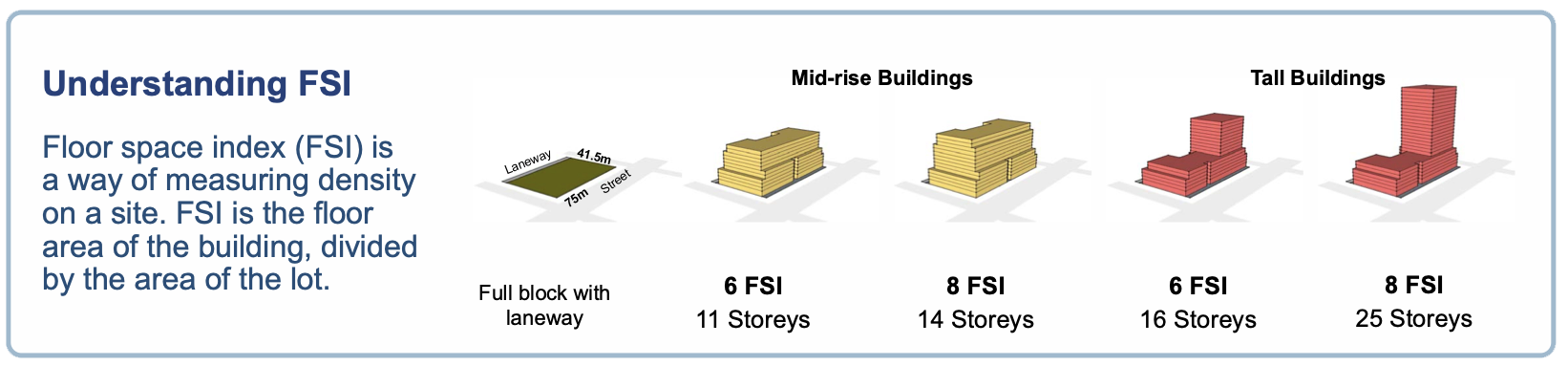
Up to 30 storeys is the permitted building height for “Mixed Use Areas, Apartment Neighbourhoods or Regeneration Areas” in Toronto’s Official Plan on large, multi-tower sites (that can fit three or more towers) within 200 metres of a station. The permitted building height decreases to 20 storeys when the structure is 200 to 500 metres from a station. Taller heights may be permitted if a block plan is provided that includes the creation of public streets, parks, open spaces, public art and a mix of building types.
At the open house, Kyle Knoeck, the City of Toronto’s Director of Zoning, provided more clarity. “The province and the city have new planning policies that mandate increased density of housing and also jobs around transit stations, and the point of that is really to maximize the benefit of all the investment that governments are making into building transit in Toronto,” Knoeck said.
When asked to comment on how the planning policies would impact the Annex specifically, Knoeck referenced the neighbourhood’s various transit stations.
“There are transit stations in the Annex primarily along Bloor Street, and so those stations will receive permissions for larger and denser development.”
He continued: “You know, one development near the Annex on the former Honest Ed’s site is an example of the scale of development that could be permitted in other areas near transit stations.”
Knoeck is referring to the iconic Honest Ed’s discount department store that operated from 1948 to 2016 at Bloor and Bathurst.
Since the store’s closure and sale in 2016, the site has been transformed into the Mirvish Village housing development. Much of Mirvish Village has been built already; however, once fully completed, it will have a park, high- and low-rise apartments, a food hall, and other amenities.
Knoeck also discussed how the city’s inclusionary zoning requirements, which necessitate affordable housing in new residential developments located near public transit, are factored in.
He said that “[inclusionary requirements] when implementing zoning in protected major transit station areas would allow the city to secure those affordable housing units. But now, the province has announced that they’re considering pausing the implementation of inclusionary zoning until 2027.”
The Ford government recently paused its affordable housing policy, calling the rules it wrote “unnecessary red tape and requirements” that make it more expensive to build. This has subsequently delayed inclusionary zoning policies in Toronto.
In a city seemingly marred by an affordability crisis, many spoke out against this decision.
Among them was Toronto Mayor Olivia Chow who frankly said, “People need homes they can afford.”
Knoeck, however, remained neutral on the city’s stance regarding inclusionary zoning.
After all, the city has yet to opt in or out of the inclusionary zoning program.
“We don’t have a decision on that yet, but right now, as it stands, we’re assuming that the zoning that we’re proposing here would enable us to implement inclusionary zoning, which means affordable housing.”
READ MORE:
- FORUM: Province late to the party on affordable housing rules (Sept. 2025)
- NEWS: Annex heritage properties at risk (Apr. 2024)
- NEWS: The race to preserve Annex heritage (July 2021)
- FORUM: Inclusionary zoning is the answer (Oct. 2020)
- CHATTER: Kensington Market HCD enters planning phase (Nov. 2017)
- NEWS: Preserving culture and history (MARCH 2017)
- FORUM: Our dynamic Kensington Market (November 2016)
0 responses so far ↓
There are no comments yet...Kick things off by filling out the form below.
Leave a Comment