
Renovation focuses on connection, access, and Indigeneity
By Mackenzie Currier
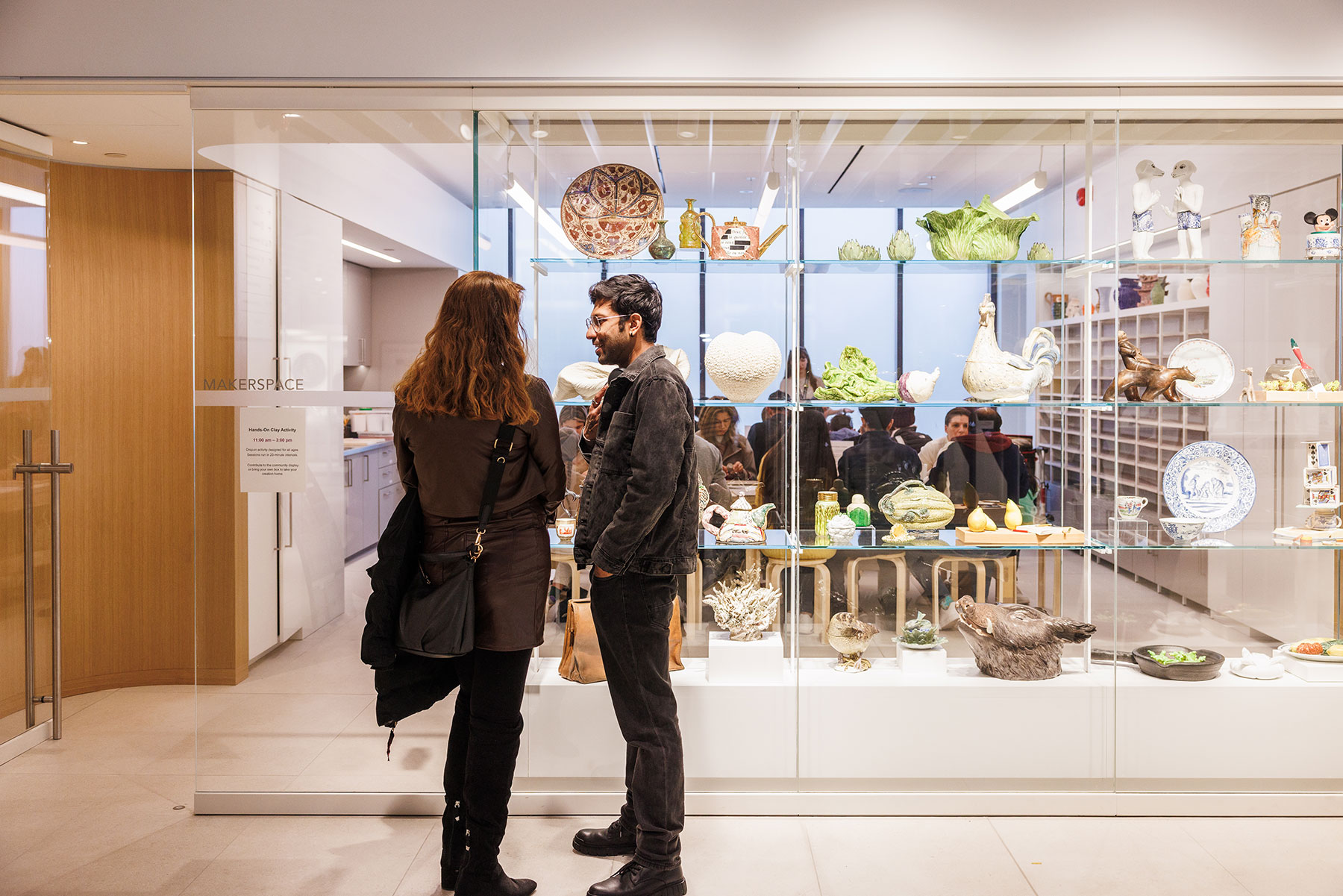
The Gardiner Museum, located at 111 Queen’s Park, opened its fully renovated ground floor on Nov. 6. The transformed space includes the Gardiner’s first-ever Indigenous ceramics gallery, new collection galleries, a Makerspace, where visitors can work with clay, and a Community Learning Centre.
The $15.5-million project was made possible by a $9-million contribution from the Radlett Foundation with support from private and public partners, including the Hilary and Galen Weston Foundation, the Lindy Green Family Foundation, and the Government of Canada. Though planning for the renovation began around 2016, the project gained momentum in 2022 following the Radlett Foundation’s generous gift in honour of William B.G. Humphries. The donation expanded the legacy of the late Humphries, a porcelain collector and philanthropist who was passionate about advancing the rights of Indigenous peoples. He envisioned a space that would unite diverse communities through clay and would include accessible education, programming, collections, and exhibitions. This project was built on the pillars of connection, access, and Indigeneity, and the design and curation of the space reflects these values. “This transformation establishes the museum as a dynamic and flexible cultural institution for everybody,” said Sequoia Miller, chief curator and deputy director of the Gardiner Museum.
As part of its commitment to represent and unite diverse communities, the Gardiner established anti-racism, anti-oppression and equity as foundational values. The museum also appointed its first curator of Indigenous ceramics, Franchesca Herbert-Spence, to support its mission to centre Indigenous voices and advance Indigenous self-determination. Herbert-Spence worked with architect Chris Cornelius, a citizen of the Oneida Nation of Wisconsin, when designing the Gardiner’s first gallery of Indigenous ceramics. Prior to Herbert-Spence’s appointment, the Gardiner’s Indigenous Advisory Circle had recommended that the pieces be acquired from artists in the Great Lakes region, with no time period constraints. Following these recommendations, Herbert-Spence commissioned pieces from artists on Manitoulin Island, Six Nations of the Grand River, and Curve Lake. She selected works that reflect the artists’ values and subverted the practice of including only one artist per community by sourcing pieces from multiple artists. She also included archaeological pieces from around these communities.
The gallery is presented in a wooden frame with a transparent copper mesh skin that serves as feathers. Architect Chris Cornelius wanted to create a “vessel that is part of the larger museum experience but also acts as a container to present the Indigenous ceramics within it.” When designing the display, Cornelius emphasized that these pieces are not artifacts of the past, but rather a continuation of Indigenous knowledge. He wanted his work to express something timeless. On the ceiling there is a 24-hour recording of the sky, compressed into 20 minutes, which gives visitors a unique and dynamic experience.
Gabrielle Peacock, executive director and CEO of the Gardiner Museum, asked, “How do we welcome people into the space? How do we connect them to the works in our collection?” Over the past two to three decades, the museum’s audience has shifted to reflect Toronto’s diversity. The Gardiner is also engaging more with younger guests and students and inviting visitors to engage with the medium in a hands-on way. By including art education, the Gardiner has joined a broader cultural shift toward making museums audience-focused rather than object-focused. The hands-on studio enables people to connect with ceramics and gain a greater appreciation for the collections and installations.
In the new William B.G. Humphries galleries visitors will experience ceramics spanning many geographies, cultures, and time periods. The collection encourages visitors to discover connections between pieces and reflect on their own lives as they engage with artifacts from Indigenous Latin America, Europe, and Canada. The Gardiner commissioned Nadia Myre, a contemporary visual artist from Montreal and an Algonquin member of the Kitigan Zibi Anishinaabeg First Nation, to create the installation A Line Through Time. Her pieces use ceramic beads and clay pipes to explore themes of cultural memory and exchange.
In discussing the impact of the renovations, Peacock hopes guests will be “astonished by the scope of ceramics that have been and are continuing to be made” as well as surprised by some elements of the new space. She hopes the renovation inspires people to discover ceramics and to learn more about themselves through cultural traditions.
Visiting hours are from 10:00 a.m. – 6:00 p.m. on Monday, Tuesday, Thursday, and Friday; 10:00 a.m. – 9:00 p.m. on Wednesday; and 10:00 a.m. – 5:00 p.m. on Saturday and Sunday. Ticket prices are $18 for adults, $14 for seniors (65+), and free for youth (18 & under), students, and Indigenous Peoples, with universal free entry on Wednesday evenings after 4 pm.
READ MORE:
- NEWS: Telling human history through footwear (Aug. 2025)
- ARTS: Hello April! (Spring 2022)
- ARTS: Online culture is real – dive in (Jan. 2021)
- ARTS: Global pandemic month eight: the show goes on (Oct. 2020)
- ARTS: Arts light up November nights (Nov. 2019)
- ARTS: Get your spook on for Halloween (City Election 2018)
- ARTS: Bata Shoe Museum celebrates heels and stars (JUNE 2017)