
Where the parties stand on key questions
Compiled by Brian Burchell
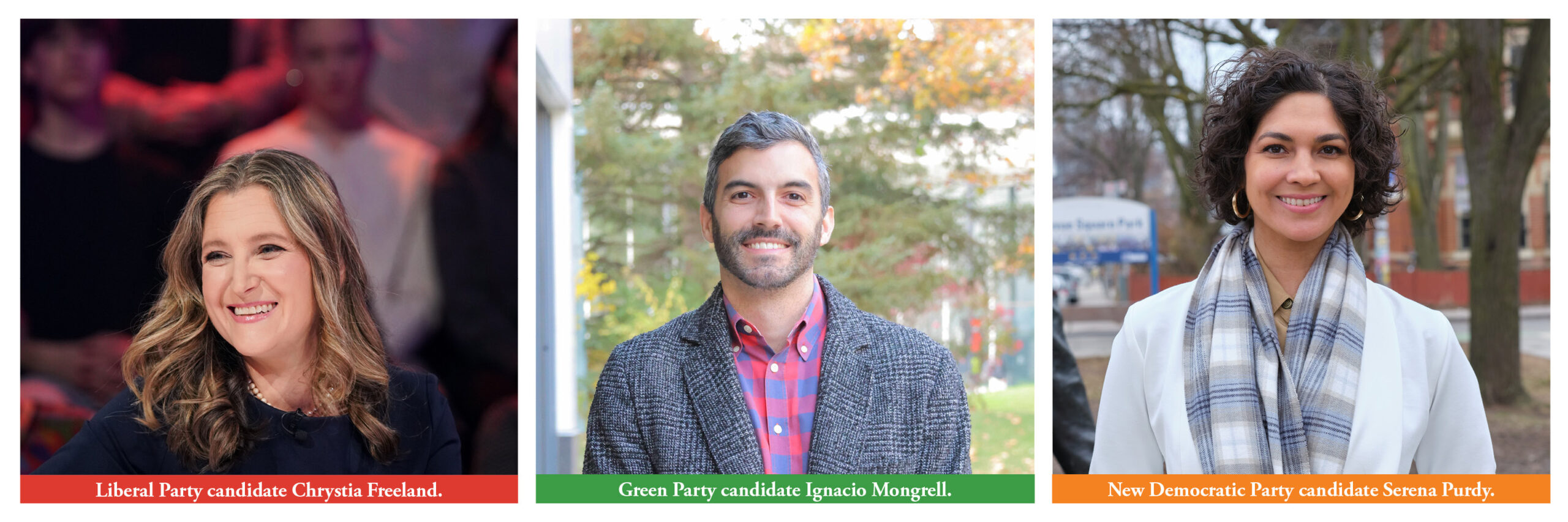
The Gleaner asked five key questions of four parties competing in University-Rosedale and is publishing each candidate’s answers to help voters make a more informed choice come voting day. Questions are compiled by the Gleaner’s editorial staff and answers are edited for length and clarity. Election date is April 28, 2025. For more information on voting, please visit elections.ca. Note: despite repeated attempts by the Gleaner the candidate for the Conservative Party of Canada did not reply to the questions.
Question 1: Donald Trump is threatening economic warfare on Canada ostensibly to force our annexation as a nation. How will your party respond to his threats?
Ignacio Mongrell, Green Party candidate: Donald Trump’s threats pose serious challenges to Canada’s sovereignty, democratic institutions, and economic stability. The Green Party will immediately strengthen our diplomatic relationships with democratic allies worldwide and build a collective defense against any economic or political aggression. We propose creating an “Economic NATO,” a coalition of nations committed to supporting each other economically and diplomatically when faced with external threats.
We will divest from U.S.-controlled defense and critical IT systems, prioritizing Canadian-made security and technology solutions to protect our infrastructure and economy. Additionally, the Greens will significantly enhance measures against foreign interference and disinformation, safeguarding our electoral integrity and public discourse.
Our strategy includes securing Canada’s borders and essential resources from economic coercion, ensuring key industries remain resilient against potential tariffs and trade disruptions. Unlike other parties, we won’t rely solely on the U.S. market—our plan diversifies trade relationships to help Canadian businesses and communities maintain stability and independence. By reinforcing our sovereignty and democratic values, we will stand firmly against Trump’s authoritarian threats and uphold Canadian independence and democracy.
Chrystia Freeland, Liberal Party candidate: Canada must remain strong, smart, and united against Donald Trump’s illegal and unjustified tariffs. Our Liberal government will respond forcefully and effectively to protect Canadian workers and our economy. Our reciprocal tariffs are targeted, and all proceeds will be used to uplift Canadian workers. Canada will never be the 51st state. We are collaborating with like-minded allies to develop new agreements aimed at diversifying our trade. Additionally, we are committed to rebuilding, reinvesting in, and rearming the Canadian Armed Forces to safeguard our sovereignty in an increasingly perilous and divided world.
Serena Purdy New Democratic Party candidate: Any response to economic warfare that doesn’t prioritize working-class Canadians will destabilize our country. As MP, I would fight to bolster domestic production capacity and minimize the impact of tariffs on consumers and the working class.
In response to threats of annexation, I believe Canada needs a stronger response to foreign interference in elections and the spread of disinformation.
The NDP will:
- Implement a Build Canadian Buy Canadian strategy to build more of what we need here in Canada and prioritize products made by Canadian workers in public procurement.
- Cut off the U.S. supply of minerals.
- Require federal projects to use 100 per cent Canadian steel.
- Apply dollar-for-dollar retaliatory tariffs. Also, 100 per cent tariffs on Teslas and a $10,000 rebate for Canadians who choose a Canadian EV instead.
- Put money collected through retaliatory tariffs into affected sectors like steel and auto manufacturing.
- Fix Canada’s EI system so every worker—including contractors—have security.
- Place an ad campaign in the U.S. that informs Americans that a trade war will hurt us both and that we are better off by working together.
- Protect communities and stop disinformation campaigns.
- Introduce new security measures, including a Foreign Influence Transparency Registry to stop illegal activity by foreign governments
Question 2: What measures will your party take to tackle climate change and combat its catastrophic impacts?
Chrystia Freeland, Liberal Party candidate: Our government has invested over $100 billion to combat climate change and build a clean economy. We are committed to achieving net-zero emissions by 2050. We created a $15 billion Canada Growth Fund that operates independently to attract private capital and investments in clean energy and clean technology businesses and projects across Canada. These investments are already creating more well-paying jobs and building Canada’s clean economy. We are also holding large polluters accountable and providing middle-class Canadians with resources to combat climate-related disasters.
Serena Purdy New Democratic Party candidate: Canadians are known for their intelligent innovation. We also need to hold extractive industries accountable for the full impact of their operations.
The NDP would:
- eliminate handouts to big oil.
- Provide free and easy-to-access home energy retrofits and clean power.
- Make big polluters pay for their pollution.
- Tax over-the-top profits of oil and gas companies.
- Invest in climate adaptation and disaster preparedness.
- Create hundreds of thousands of well-paying jobs by investing in clean energy, energy-efficient affordable homes, electric transit and zero-emission vehicles.
Ignacio Mongrell, Green Party candidate: The Green Party is the only party committed to real climate action. Unlike the Liberals, Conservatives, and NDP—all of whom still support pipelines and extending our fossil fuel dependence—we will immediately end the over $8 billion in annual fossil fuel subsidies. Many oil companies operating in Canada generate massive profits which flow largely outside our borders—Imperial Oil, for example, is nearly 70 per cent owned by the American company ExxonMobil, and over 70 per cent of oil sands production is foreign-owned. Canadians deserve better than to subsidize profitable corporations whose earnings leave our economy.
We will implement a legally binding timeline to phase out oil and gas extraction, aligning Canada’s climate targets with the Paris Agreement. We’ll invest urgently in renewables like solar, wind, and geothermal through a Green Innovation Fund and create a National Green Grid.
Our plan provides a just transition—offering comprehensive retraining for fossil fuel workers and funding renewable energy projects, some led by municipalities and Indigenous communities.
While other parties delay meaningful action, only the Greens have a clear, credible path to urgently reduce emissions and build a sustainable, equitable economy benefiting Canadians directly.
Question 3: The lack of affordable housing is a national problem that it is acutely felt in University-Rosedale. What federal measures would your party take to address the crisis?
Serena Purdy New Democratic Party candidate: Housing affordability is a key focus for me, as a candidate. I have seen the impact of eviction, displacement, and precarious housing in University-Rosedale. Our riding has already lost too many friends and neighbours. I want to see an end to the housing crisis. To accomplish that we need to support community building (land trusts and co-ops) and address the root cause: financialization.
The NDP will:
- Build more homes that people can afford, faster.
- Support first-time homebuyers.
- Stop renovictions.
- Lower rent.
- Ban corporations from buying up homes that are still somewhat affordable.
- Ban renovictions and fixed-term leases.
- Crack down on corporate landlords like Brookfield using AI to fix rent.
Ignacio Mongrell, Green Party candidate: Affordable housing is a human right. The Green Party will immediately declare housing as such and implement a robust National Housing Strategy focused on deeply affordable, non-profit, and co-operative housing. Unlike other parties, whose policies often enrich large real estate developers and speculators, our investments prioritize permanent affordability and community-driven solutions that serve residents rather than corporations.
We will allocate substantial federal funds directly to community land trusts, co-operative housing projects, and non-profit developments—this will address profit-driven speculation in the housing market. Our goal is clear: ensuring housing remains permanently affordable and accessible for generations and benefiting residents rather than large real estate companies.
Additionally, we will fund energy-efficient retrofits of existing affordable housing, lower energy costs for residents, and create local green jobs. Recognizing the disproportionate impact of the housing crisis on vulnerable groups, our policies prioritize marginalized populations, including Indigenous Peoples, seniors, disabled Canadians, 2SLGBTQIA+ youth, and women-led households.
By investing directly in communities rather than developers, the Green Party will guarantee that all Canadians will have equitable access to stable, affordable, sustainable housing—addressing the housing crisis at its root.
Chrystia Freeland, Liberal Party candidate: If re-elected, we will eliminate the GST on homes up to $1 million for first-time homebuyers. This tax cut will save Canadians up to $50,000, helping more young people and families enter the housing market and achieve the dream of homeownership. Since 2015, the Liberal government has introduced several measures to improve housing affordability, including the tax-free First Home Savings Account, the First-Time Home Buyers’ Incentive, and the Apartment Construction Loan Program, which encourages builders to increase housing supply. We’ve also supported cities like Toronto in cutting red tape and overcoming barriers to construction through the Housing Accelerator Fund, which is helping build more homes across the city.
Question 4: Though inflation has been curtailed, prices remain high, making the cost of living overwhelming for many. How will your party deal with the high cost of goods and services?
Ignacio Mongrell, Green Party candidate: Canadians are facing unprecedented affordability challenges due to persistent high prices. The Green Party’s solution is clear: implementing a Guaranteed Livable Income (GLI) so every Canadian can meet their basic needs. A GLI will reduce the financial stress and insecurity exacerbated by inflation and provide individuals with the economic stability to pursue education, job retraining, caregiving, or entrepreneurship without fear of financial ruin.
To tackle the corporate greed driving high prices, we will strengthen oversight and accountability for large corporations—particularly in the telecom, airline, and grocery industries—to eliminate deceptive marketing, hidden fees, and unfair pricing. Transparent, fair pricing standards will be enforced nationwide, complemented by anti-scalping laws and increased competition to reduce consumer costs.
Furthermore, investments in affordable housing, universal pharmacare, and public transit infrastructure will directly reduce household costs. By focusing on policies that bolster economic security, protect consumer rights, and maintain transparent, competitive markets, the Green Party will effectively tackle affordability and significantly reduce the overwhelming cost of living for Canadians.
Chrystia Freeland, Liberal Party candidate: The Liberal party will cut taxes for the middle class, create higher-paying jobs, and build the fastest growing economy in the G7. We will introduce a middle-class tax cut that will save two-income families up to $825 a year, by reducing the marginal tax rate on the lowest tax bracket by 1 percentage point. More than 22 million Canadians will benefit directly from this tax cut, and middle- and low-income Canadians will benefit the most. We are building upon the Liberal government’s achievements, including $10-a-day childcare, a National School Food Program, free birth control and diabetes medication, as well as the Canadian Dental Care Plan.
Serena Purdy New Democratic Party candidate: In 2019 I chaired a meeting of the downtown Business Improvement Associations (BIAs) to discuss their fears about the pandemic and prepare for the worst. I have stood beside and fought for the many small businesses that have become part of the fabric of our communities. As MP I would prioritize small business, fight policies that threaten to increase inflation, and fight for a stronger safety net for families struggling the most.
The NDP will
- Scrap the GST on grocery meals, diapers, kids’ clothes and more.
- Implement a price cap on essential items so working families can put food on the table for less.
- Bring in more price transparency, stop shrinkflation and increase fines for price fixing.
Question 5: Given the uncertainty of the outcome of tariffs and reciprocal tariffs on Canadian businesses, what measures will your party put in place to help businesses survive?
Chrystia Freeland, Liberal Party candidate: Amid current economic challenges, the Liberal Party of Canada has a bold plan to help Canadian workers and industries thrive during uncertain times. We will introduce a $2 billion Strategic Response Fund to increase our auto sector’s competitiveness and protect manufacturing jobs. We will also build an All-in-Canada network for auto manufacturing component parts to build more car parts in Canada, limit those parts crossing the border during production, and attract investment into our own industry. We are also working with premiers across all provinces and territories to build one Canadian economy and remove all federally regulated internal trade barriers by Canada Day. By cutting taxes for the middle class, making EI supports easier to access, and using all Canadian tariff proceeds to support Canadian workers we will ensure businesses thrive.
Serena Purdy New Democratic Party candidate: University-Rosedale is home to many independent, family-run grocers. Their hard work ensures that our communities can access the freshest, best-priced food. In Kensington Market, we have been doing the work of standing up to big supermarkets. As MP, I would stand up for independent grocers.
The NDP will:
- Support more competition in the grocery sector by helping small and medium grocers,including community-driven food co-operatives, get into the market and set up shop.
Ignacio Mongrell, Green Party candidate: The Green Party recognizes the severe impacts that tariffs and trade uncertainties create for Canadian businesses, particularly small- and medium-sized enterprises. We propose immediate, targeted financial support and strategic reserves of key tariff-affected goods, enabling businesses to continue production and retain employees while alternative markets are developed.
We will proactively diversify Canada’s international trade relationships, reducing our dependence on the U.S. market. Through our proposed “Economic NATO,” Canada will build strong, mutually beneficial trade partnerships with other democratic nations, stabilizing our economy against external economic threats and disruptions.
Additionally, the Green Party will support Canadian businesses through investment in innovation, helping them adapt and transition to sustainable business practices and diversified supply chains. Our strategy includes providing businesses with technical support and logistical resources, enabling resilience and competitiveness in new and emerging markets.
By directly addressing tariff impacts, diversifying our trade relationships, and fostering innovation, we will protect Canadian businesses, jobs, and communities from external economic pressures and build a strong, resilient Canadian economy.