
You can take the poet out of the Annex, but you can’t take the Annex out of the poet
MIKE MASTROMATTEO/GLEANER NEWS
By Mike Mastromatteo
More than a few observers have noted the “literary” element of life in the Annex.
Many writers, professors, and poets still live within its boundaries, suggesting in some ways that the Annex is more than the sum of all its streets, homes, buildings, and people.
One long-time Annex resident, Desolina (Desi) Di Nardo, is doing her part to expand the notion that this unique part of Toronto abets an artist’s creative muse.
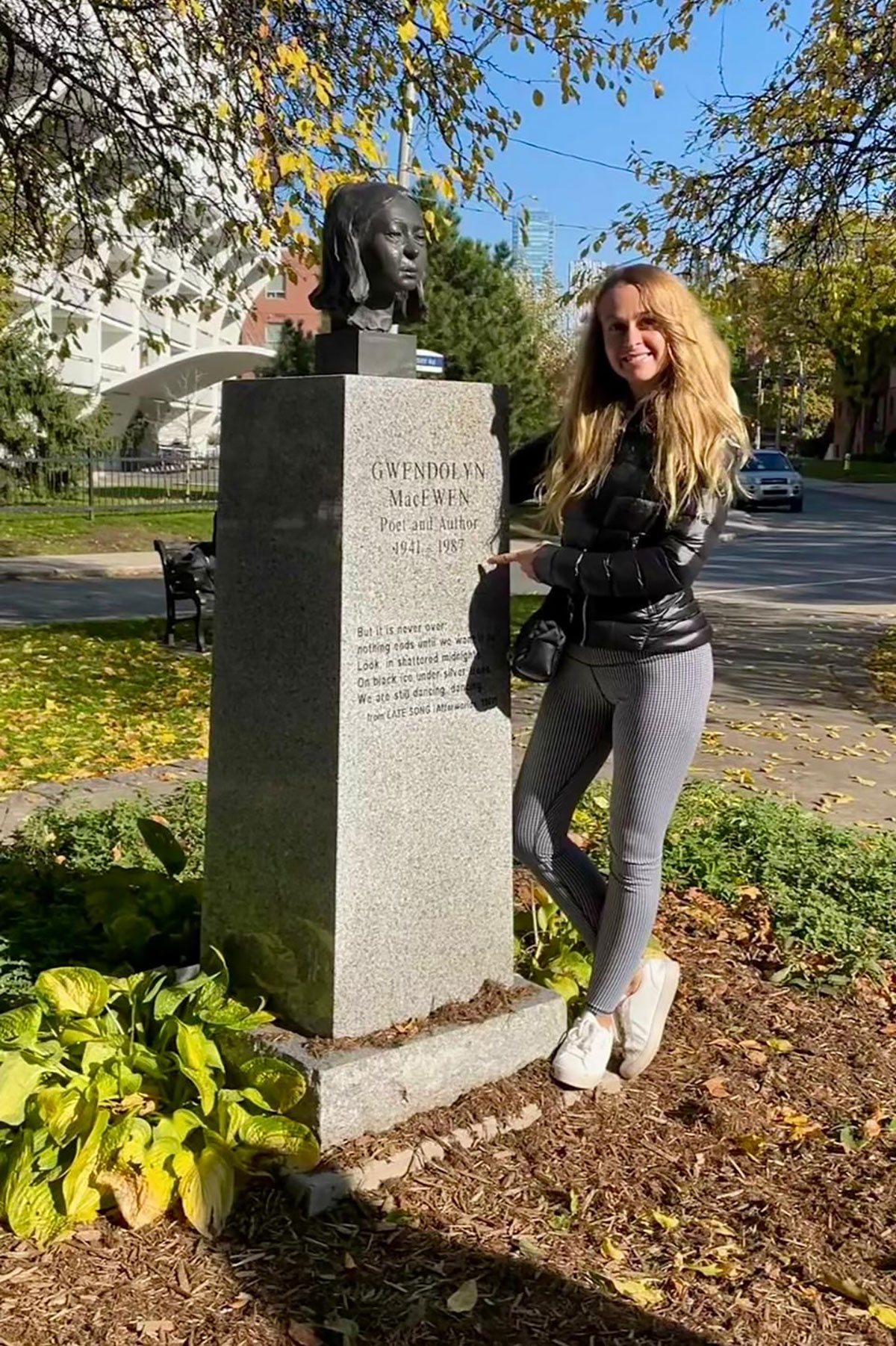
An instructor of English and communications at George Brown Polytechnic, Di Nardo is the author of more than 150 poems, many of which touch on the Annex experience. Her poem, Rainbird in the Annex, for example, mentions two Annex denizens, the late poet Gwendolyn MacEwen, and contemporary author extraordinaire Margaret Atwood.
The poem reads:
I make my way to MacEwen’s salient red door
to catch some remnants of her
a faint scent lifting into old familiar skin
her unbendable pronounced lightness absorbed by sky
deliquescent words lost to the sun
her cordless poetry smothered by wind
I float on
forgetting why I came and
become caught in Atwood’s wide-brimmed hat
I nestle in
and burrow seeds
surrounded by other flight
Rainbird in the Annex was chosen as one of the Toronto Transit Commission’s (TTC) Poetry on the Way offerings and was displayed on subway boards between 2005-2007.
Di Nardo was born on Borden Street and spent the first 40 years of her life observing the life and times of her community. Although she later relocated west of the Annex, she still draws on her experience here for her creative inspiration. Despite her modest nature, Di Nardo is quite comfortable taking on the title of the Annex’s unofficial poet laureate.
In an interview with the Gleaner, Di Nardo cited sense of place as a key factor in an artist’s creative expression. “I think the Annex was one of the reasons why I first got into poetry because the sense of place is such an integral part of who and what we become,” she said. “I don’t think people realize just how fundamental and important it is.”
Another particularly Annex-centric Di Nardo poem is Canadian Moose, a paean to Florence, a woman who lived on the streets near Bloor and Bathurst for a number of years.
This poem, written at the time former Toronto Mayor Mel Lastman was erecting gaudy moose sculptures all over the city, honours Florence, who despite her circumstances, became a welcome figure in the neighbourhood. “[Florence] was a landmark in the Annex. A real focal point,” Di Nardo said. “She was homeless, but she was one of the most respected figures in the neighbourhood.”
The poem reads in part:
Florence loves to smile from her bald toothless head.
Her thick fleshy body pushes out against constricting clothes.
She waddles in and out of stores looking at clerks …
Volatile, catapulting threats, mocking you with her eyes,
She disarms you.
Wanton streetwalker of a time long ago,
She now sails proudly through the crowds …
She is the moose you see strewn along Bloor Street.
Emblem of our city, she stands erect,
Taunting, parading her flag, claiming the streets,
Laughing at the silliness of it all.
In addition to her teaching gig at George Brown Polytechnic, Di Nardo has also worked as a poet in residence and has served as a consultant to Toronto school boards to promote poetry and creative verse in the classroom. She emphasizes that students need not strive for mastery when learning to appreciate poetry’s gifts.
“Poetry invites learners to speak from experience rather than performance, lowering the stakes while deepening the substance,” Di Nardo said. “As trust builds, students begin to articulate what they’ve long carried but never voiced. Poetry cultivates presence, openness, and the kind of shared exchange that allows genuine learning to take root.”
At a time when many poets lament the diminished status of poetry and creativity, Di Nardo emphasizes the many unsung benefits of the craft. She likens poetry as a form of therapy, turning grief into grit, or more poetically perhaps “ache into alchemy.”
She once promoted poetry at a Habitat for Women event organized to support women recovering from domestic violence and abusive relationships. She hosted similar workshops at the Hospital for Sick Children and the Centre for Addiction and Mental Health (CAMH).
“The women I worked with had endured coercive control. Their vulnerability was not a flaw but the residue of prolonged harm. Their stories had been silenced for years, and what they needed was a form that didn’t ask for polish, coherence, or permission. Poetry offered that opening—a form that asked nothing of them but presence, breath, and truth. This is why poetry becomes indispensable for those navigating vulnerability.”
For anyone who has suffered, whether from abusive relationships, coercive control, or bullying, poetry becomes, “a quiet reckoning, the truth that refuses to be patted down and buried.”
After all this time, Di Nardo still holds a special place in her heart for the Annex. Call it sentiment, nostalgia, or even hyperbole, Di Nardo salutes her Annex muse. “The Annex forms writers in subtle ways,” she said. “The old houses, the academic hum, the layers of class, migration, artistic ambition—all of it sets a tone. Café eyes, seminar rooms, literary signals: these are the soft forms of surveillance that tell you what a ‘Toronto poet’ should sound like, which themes feel sanctioned, which ambitions feel safe.”