December 5th, 2015 · Comments Off on Embrace refugees
“Let me assert my firm belief that the only thing we have to fear is…fear itself — nameless, unreasoning, unjustified terror which paralyzes needed efforts to convert retreat into advance. In every dark hour of our national life a leadership of frankness and of vigor has met with that understanding and support of the people themselves which is essential to victory,” said Franklin D. Roosevelt during his presidential inaugural address in 1933.
Though spoken during the Great Depression in reference to the economic crisis, his words are strikingly applicable as we seek to respond to a refugee crisis that is often juxtaposed with terrorist acts committed abroad.
The fear that is created by the tragic events in Paris is real. It is what we choose to do with that feeling that matters. We can hide, perhaps behind a wall, or we can remember who we are, what we stand for, and act with the courage of our convictions.
Subsequent to the attacks in Paris, 31 state governors in the United States — ignoring the fact that they have no legal authority in what is essentially a federal jurisdiction — have openly stated their opposition to accepting Syrian refugees. Also ignoring the fact that none of those who committed the atrocities in Paris were refugees (rather passport-carrying French or Belgium citizens), those governors seek only to seed intolerance and distrust with their disturbingly popular anti-refugee rhetoric.
By contrast, the Annex community has taken up the challenge of sponsoring Syrian refugees with particular, and heartening, vigor. One cannot get through the day without encountering a church group, community group, neighbourhood association, or neighbour simply selling cookies on Bloor Street for the cause.
Canada has a long and proud history of accepting refugees that dates to the late eighteenth century, when Black Americans fled slavery in the United States, and Scots Highlanders escaped a century-long destruction of Gaelic culture. And in the two centuries since then, many people have sought refuge on our shores. Those people — Poles, Italians, Czechs, Jews, Arabs, Tibetans, Chileans, Khmer Cambodians, 7,000 Ismaili Muslims from Uganda in 1972, 60,000 Vietnamese in 1980, to name but a few — make a long and rich list of those who are now helping to grow our country.
One particular wave of refugees, the 37,000 Hungarians who in 1956 sought refuge in Canada from Soviet tyranny, probably provides the best analogue for the Syrian refugees. The ’56-ers, who included mining magnate Peter Munk, publisher Anna Porter, financier Andy Sarlos, and journalist George Jonas, had a positive impact on our nation after they arrived. We even have local examples of their influence: Bloor Street west of Spadina Avenue was once fondly dubbed the “Goulash Archipelago”, with much of the real estate owned by “Annie-of-the-Annex” Anne Racz.
The Syrians, like the Hungarians, are highly educated, and come from a sophisticated culture with a long history that in many ways is a cradle of our civilization. Imagine what — with a little support — they could achieve here.
At this moment, we have an opportunity to make sure that we do not revisit the dark chapters of our history. In May of 1939, when an oppressive anti-Semitism had taken hold in Canada and permeated the senior levels of the government, the nation refused to welcome 907 German Jews fleeing Nazi oppression. Learning that “None is too many”, the refugees were forced back to Europe, where 254 perished in the Holocaust. It was a closed, xenophobic moment in our history that today provides us with an ethical yardstick.
During his second inaugural address in 1935, Roosevelt said that “the test of our progress is not whether we add more to the abundance of those who have much; it is whether we provide enough for those who have too little. Happiness lies in the joy of achievement and the thrill of creative effort.”
We should not forget our history and how it defines us, but embrace the opportunity to allow another positive defining chapter to be written.
Tags: Annex · Liberty · News · Editorial
December 5th, 2015 · Comments Off on
Tags: Annex · Liberty · News · General
December 5th, 2015 · Comments Off on Building neighbourhoods together
A Ward 20 year in review
By Joe Cressy
In Ward 20, we’ve had a busy year! We’ve worked hard on the dozens of development files that populate downtown, improving our green spaces, and building liveable communities — and we have a lot to be proud of.
We worked together on 484 Spadina Ave. (The Waverley/Silver Dollar Room), and after a long appeal at the Ontario Municipal Board, we won! The proposed 22-storey building was reduced to 15, with significantly reduced shadow impact on Lord Lansdowne Public School and heritage restoration of the Silver Dollar.
We’re working with the Annex Residents’ Association, Huron-Sussex Neighbourhood Organization, and Harbord Village Residents’ Association to stand up to aggressive development on Bloor Street, east of Spadina Avenue.
We’ve initiated the Davenport Triangle Study to ensure we’re planning sustainably in the Davenport Avenue and Dupont Street area. And, we passed the Madison Avenue Heritage Conservation District, the culmination of 10 years of work by the Annex Residents’ Association and City of Toronto staff. Together, we’re building and protecting neighbourhoods across our community.
In July, news broke that the Centre for Addiction and Mental Health (CAMH) on College Street was being threatened by displacement. Over 1,200 people signed our letter opposing its displacement, the neighbouring residents’ associations got engaged, and our voices were heard. CAMH announced in November that a court-appointed appraiser ruled in its favour. The appraiser found that “fair market value” for the facility should be based on the existing institutional zoning, a position held by CAMH, the City of Toronto, and the surrounding community. Thanks to our collective work, CAMH is here to stay!
In Harbord Village, we’ve worked with the Residents’ Association to develop the Harbord Village Green Plan — a comprehensive action plan to green forgotten concrete spaces in the neighbourhood. The final green plan was released in late November and, starting in the new year, we’ll be working to green flankage corners and laneways and plant trees in the neighbourhood. Also in the new year, we’ll be starting consultations on improving the Huron Street playground and Ryan Russell Parkette. This spring, we’re excited to be (finally) moving forward with improvements to Margaret Fairley Park and Brunswick-College Parkette.
We have also acted to improve traffic safety in our community. In the Toronto and East York District, our community council lowered the speed limit on all local roads to 30 km/h. We’re working closely with neighbours in Seaton Village, Harbord Village, and the Annex to continue to prioritize safety for all road users.
On Bloor Street, we’ve started consultations on a bike lane pilot project to run from Shaw Street to Avenue Road. Bike lanes on Bloor Street have been discussed for years, and working with local residents, businesses, transportation experts, and schools, I’m excited to see the project taking shape for 2016.
As a community we’ve all been shaken by recent events in Syria and around the world. I was proud that Toronto City Council responded to and approved my request for the city to develop a resettlement program for Syrian refugees. The program has resulted in the creation of an inter-divisional team at the city to lead the project, an inter-agency team (including the Canadian Red Cross) to coordinate services, and the provision of continued support to Lifeline Syria and other settlement agencies. But residents of Toronto have also been leading this work: in our neighbourhoods, local groups along Major Street, Howland Avenue, Palmerston Avenue, Robert Street, and many more have stepped forward to sponsor families. Toronto at its very best, if you ask me.
I’ve also heard from hundreds of neighbours over the past year on local and city-wide issues — and our Ward 20 team is working hard to respond, answer questions, and provide assistance. Across the ward, we’ve worked to build more affordable housing in Alexandra Park and CityPlace, we’ve secured a partnership between the city and the YMCA for a brand new community centre, we’ve initiated a $25 million project to animate space under the Gardiner, and we have stopped jets from flying from the island airport! It’s been quite a year.
There’s still lots of work to do. As I’ve discovered in my first year, in Ward 20 the work never stops. More importantly, the relentless work of our local residents (volunteer work, I might add!) also never stops. I look forward to continuing this work, together.
Joe Cressy is the councillor for Ward 20, Trinity-Spadina.
Tags: Annex · Liberty · News · Editorial
December 5th, 2015 · Comments Off on Getting down to work
Acting on a progressive economic agenda
By Chrystia Freeland
It’s one of my favourite traditions: doing one final subway canvass the morning after an election. It’s an opportunity to connect with my constituents in person, and thank them for their support. Expressing my gratitude also reminds me of how privileged and honoured I am to be serving as the first member of Parliament for the newly created riding of University-Rosedale.
I am eager to act on a progressive economic agenda that will shore up Canada’s middle class and make sure our capitalist democracy delivers for everyone, both at home and abroad. Domestically, we will end income splitting, lower taxes for the middle class, and institute our enhanced childcare benefit, while investing in better transit, more affordable housing, and greener infrastructure.
Internationally, as the Minister of International Trade, I will promote our Canadian brand of inclusive prosperity on the global stage. Since being sworn in on Nov. 4, I have travelled to the Asia-Pacific Economic Cooperation (APEC) summit in Manila, and participated in a very productive meeting. I discussed enhancing trade with our APEC partners, and announced Canada’s support for globalizing micro, small, and medium enterprises. I was also energized by the commitments on inclusive growth and women’s equality. On my way home to Canada, I stopped in Los Angeles, where I met with economic leaders, spoke with Lieutenant Governor Gavin Newsom of California about collaborating on the environment, talked about the close economic ties between Maine and Canada with Senator Angus King, had a fruitful exchange with the California state treasurer, and discussed partnership ideas on infrastructure and a green economy.
Shortly before I left for Manila, I expressed my deepest sympathies to the families of those who were killed in terrorist attacks on Nov. 13. Even as we stand with the people of Paris and France, and with all victims of terror around the world, we cannot lose sight of our Canadian values of diversity and inclusiveness.
As the proud daughter of a Ukranian-Canadian who fled Europe after the Second World War as a displaced person, I am as committed as ever to welcoming refugees to our shores. Our government is standing by its promise to resettle 25,000 refugees in Canada, in addition to the 3,098 Syrians who arrived between Jan. 1, 2014, and Nov. 3, 2015, and are already making their homes here.
Our #WelcomeRefugees plan consists of five phases, and aims to have 10,000 of the most vulnerable Syrians resettled in Canada by the end of 2015, with the balance of the 25,000 resettled by the end of February. In the first phase, we will work with the United Nations Refugee Agency to prioritize low security risk refugees — women and complete families — already registered in Jordan and Lebanon. In the second phase, approximately 500 visa officials will process interested refugees through interviews and information collection, after which successful applicants will be transported to Montreal or Toronto on privately-chartered aircrafts in Phase 3. Phases 4 and 5 will see the arrivals processed and settled in communities across Canada. We are already preparing to welcome our new community members by ensuring we have settlement supports in place that include schools, housing, and language training.
It’s a plan that balances our humanitarian responsibilities while being mindful of the protection and safety of Canadians, and I’m delighted that so many local residents are also raising money to sponsor families and welcome them to University-Rosedale.
As with these newcomers, I’m still discovering all there is to know about this riding, and how best to represent all of my constituents, whether they voted for me or not. I’m looking forward to partnering with my colleagues at the province and the city to work on infrastructure challenges, enhance rail safety, and move our economy forward.
Thank you all for your trust.
I wish you a very happy holiday, and all the very best for 2016.
Chrystia Freeland is the member of Parliament for University-Rosedale.
Tags: Annex · People · Editorial
December 5th, 2015 · Comments Off on YEARINREVIEW
Grassroots activism marks annual review
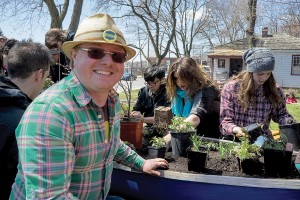
In May, David Suzuki Foundation Neighbourhood Park Ranger Aidan Nolan (above left) guided volunteers as they transformed a canoe into a garden in front of Tollkeeper’s Cottage at Bathurst Street and Davenport Road. Neiland Brissenden, Gleaner News
By Annemarie Brissenden
DEVELOPMENT DRIVES DENSITY DOWNTOWN
When was the Annex deemed downtown? Although the question — asked at a community consultation about one of the many “vertical rooming houses” inching up the midtown skyline — remains unanswered, it underscores the tension between residents, who see their treasured neighbourhood as uniquely historical and worth protecting, and developers, who see opportunities to raise condominiums, students’ residences, and big box stores. Westbank Corp. has submitted its plans to make Mirvish Village (including Honest Ed’s and adjacent stores on Bathurst Street) into a bustling mixed-use development with staggered building heights and innovations like a day care and bike valet, while designer Gregory Henriquez — a left-leaning architect with social activist bona fides — continues to connect with the community. But concerns linger about whether the area can absorb the increased density such development is sure to bring, particularly with so many other projects looming on the horizon.
BIKES ON BLOOR
Toronto’s formal cycling network continues to expand, even if it’s running at low speed. A pilot bike lane on Bloor Street West between Shaw and St. George streets will open this April, and two BIAs have commissioned a study on what impact the bike lane will have on the area’s demographics. It’s all part of the City of Toronto’s ambitious 10-year plan to make the city more palatable for cycling by connecting, improving, and adding to existing routes. Here at the Gleaner, we’ve been covering bike lanes and cycling networks for almost 20 years, so it’s a road we’ve ridden before. This time, we hope good intentions will lead to concrete results, and applaud optimistic developers like Westbank, who include such bike-friendly amenities as storage, showers, bike valet and repair shops in their proposed project designs.
HONOURING OUR HERITAGE
History in the Annex is ever present. Toronto Legacy Plaques and the Harbord Village Storyposts — both nominated for Heritage Toronto awards this year — mark where our everyday heroes lived, worked, and played. We’ve named laneways in honour of Canada’s first Black postman, boys who went to war never to return, and more recent favourite sons and daughters. This year, we celebrated the Harbord Bakery, which marked 70 years of baking bread with a beet borscht beverage, as well as the Toronto Public Library’s Lillian H. Smith branch, where the griffins have stood guard for 20 years. And, Madison Avenue became the fourth Annex area to be designated a Heritage Conservation District under the provincial Heritage Act, with two more areas under consideration. It all speaks to how our rich cultural and historical heritage continues to form — and inform — our neighbourhood’s character.
LIVING WITH LITERATURE
When Heritage Toronto honoured Gwendolyn MacEwen and Milton Acorn on Wards Island this summer, it reminded us of our area’s rich literary legacy, which continues to this day. Our neighbourhood is home to many writers whose work we endeavour to profile and uncover. We began the year with Catherine Gildiner, who closed her Bildungsroman trilogy with Coming Ashore, which balanced witty recollections of encounters with Jimi Hendrix, Northrop Frye, and Cecil Day Lewis with meditations on memory and philosophical treatises on the passage of time. Ismé Bennie’s White Schooldays chronicled growing up in apartheid South Africa, while The Ward captured the diverse, rambling nature of the city’s first immigrant ward, demonstrating how Toronto itself has evolved into a version of the Ward with the same diversity, the same challenges, and even the same obsessions.
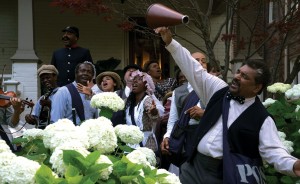
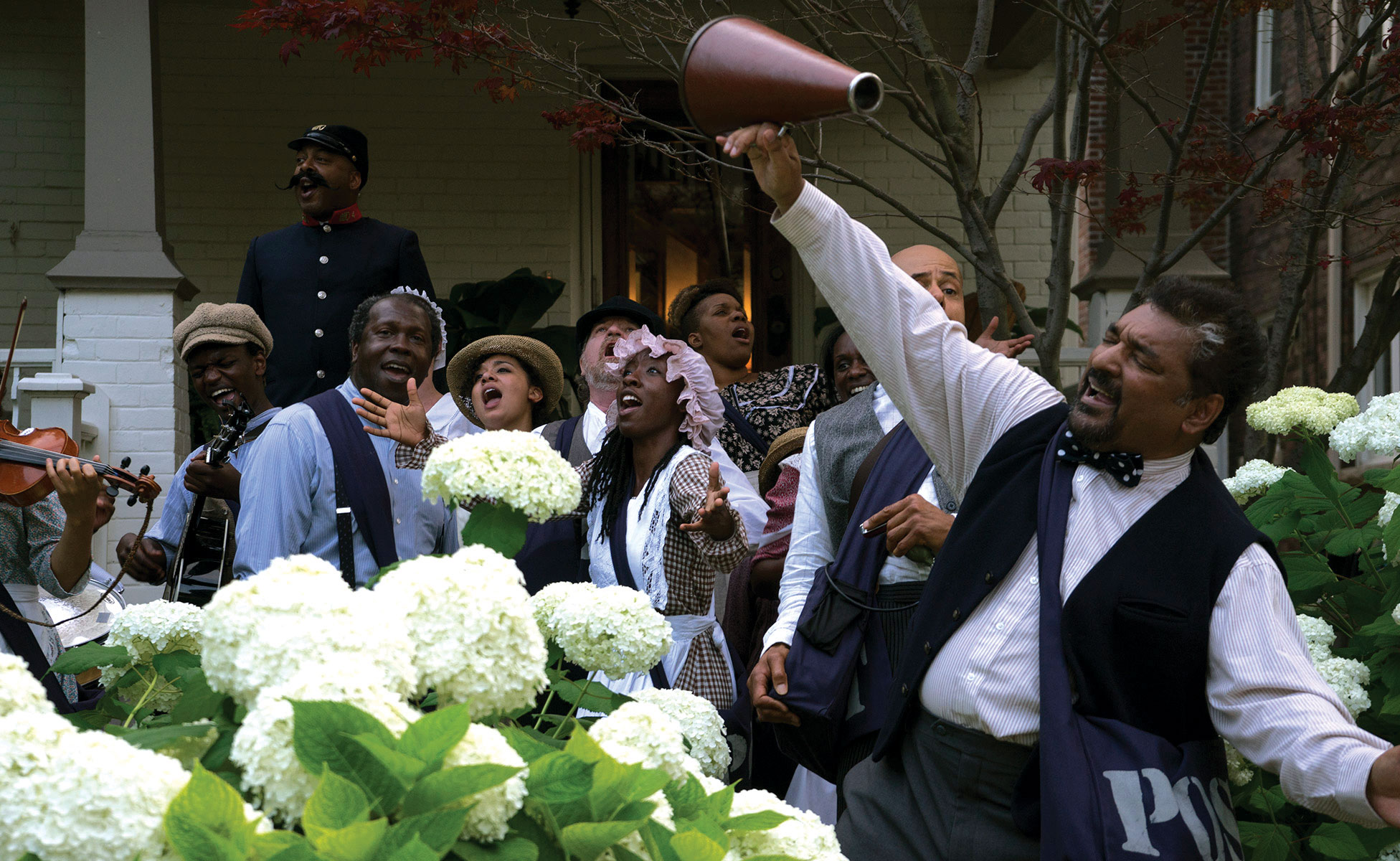
Sugith Varughese (foreground) as Councillor Earwaxin in The Postman performed on Palmerstong Boulevard this summer. Neiland Brissenden, Gleaner News
DEMONSTRATING DEMOCRACY
The year began with our newly-elected provincial and municipal representatives committing to working together and calling for a federal partner in Ottawa. The federal riding of Trinity-Spadina was redistributed into University-Rosedale and Spadina-Fort York, and the Annex was as engaged as ever in the run-up to the October election. With Trinity-Spadina member of Parliament Adam Vaughan running in Spadina-Fort York against Olivia Chow, the University-Rosedale field was opened up to a strong crop of candidates from all four of the mainstream parties. The new riding of University-Rosedale has a new member of Parliament (MP) and minister in Chrystia Freeland, who previously served as MP for Toronto-Centre. We hope those calls for a partner in Ottawa will finally be answered.
GOING GREEN
As the now resolved debate over the dome at Central Technical School demonstrated, we treasure our green space. We revel in our parks, caring for them with regular neighbourhood clean-ups, not just on Earth Day but year round. The Bloor-Borden Farmers’ Market returned to the Annex for an eighth season this year, featuring 17 vendors, children’s kiosks, and musical performances. And a new canoe garden — courtesy of the Canoe Garden Network — beached in front the Tollkeeper’s Cottage at Bathurst Street and Davenport Road.
WAITING ON THE WATERFRONT
Toronto’s waterfront remains top of mind for many Annex residents. When the red wave pushed the federal Liberals into office on Oct. 19, it may have washed out Porter Airlines’ hopes to bring jets to the Billy Bishop Toronto City Centre Airport. Adam Vaughan (MP, Spadina-Fort York) has vocally opposed any expansion to the island airport, and seems to have the support of many of his Liberal colleagues from Toronto.
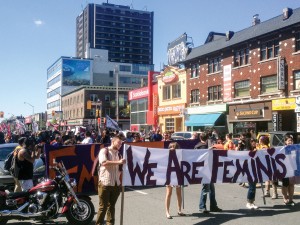
The University of Toronto community rallied on Bloor Street just east of Spadina on Sept. 14 after an announcement that online threats had been made against feminists. Brian Burchell, Gleaner News
STAGING THE STREET
From protests to performances, the Annex was home to a diverse array of street theatre this year. Kaeja Dance once again bridged art and audience when it brought its popular Porch View Dances back to Seaton Village in August. The Postman delivered history in Harbord Village and the Palmerston area, depicting the life of Canada’s first Black postman from the porches of houses along his delivery route. Installations courtesy of Nuit Blanche and the Harbord Village Pumpkin Festival kept our streets artistic, while Bloor Street rallies decrying homophobia and misogyny reminded us of our activist roots. And of course, we capped our year with the granddaddy of them all: the Santa Claus parade, which starts at Christie Pits.
Looking back 10 years
Our annual review in 2005 illustrates how much things have changed, yet stayed the same. A decade ago, the top story was a July blaze on Robert Street that caused $3.5 million in damages to the houses from 54 to 66 Robert St. Many of the houses’ residents were at a meeting seeking a heritage designation for the street when the fire broke out. The review also covered the launch of heritage studies for Brunswick Avenue, Madison Avenue, and the greater Annex area, all of which have now borne fruit, as many of these areas are now Heritage Conservation Districts. We reported on a decision to tear down the Bloor Street United Church (it’s still with us), and the benefits of Section 37 to the community (we haven’t spent all the money yet). Patios on Harbord Street were a hot topic of debate, and we lamented the closure of the McLaughlin Planetarium, while celebrating the decision not to replace it with condominiums. And we said “enough already” to elections and construction. Some things never change.
—Annemarie Brissenden
Tags: Annex · Liberty · News · People
December 5th, 2015 · Comments Off on Toronto City Council bans shisha
Proposed hookah lounge category voted down
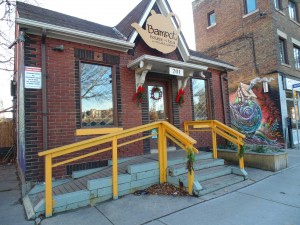
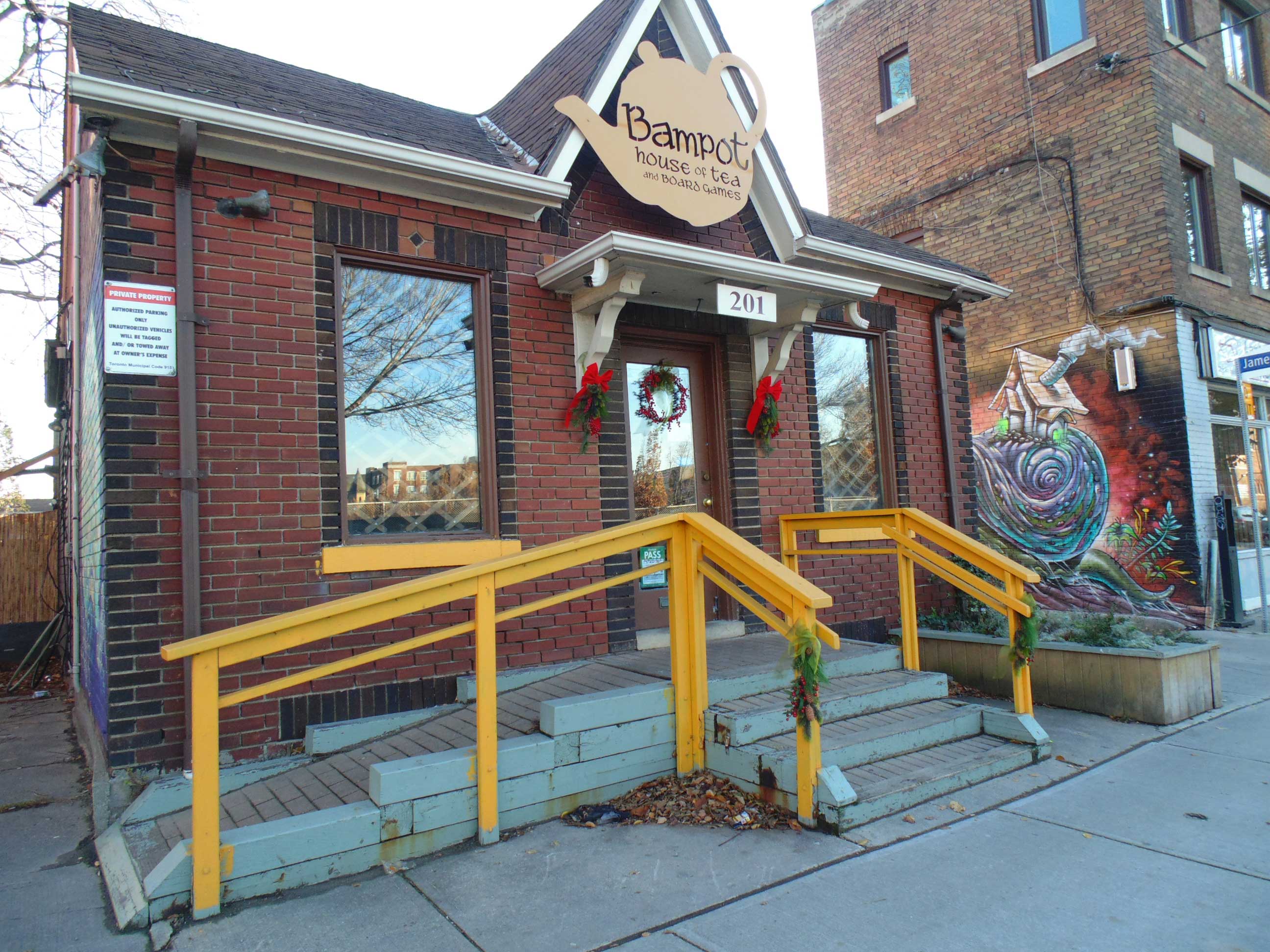
Bampot Bohemian House of Tea & Board Games on Harbord Street will remove shisha from its menu after a city-wide ban takes effect in April 2016. Corrina King, Gleaner News
By Dilara Kurtaran
Local shisha bar owners are scrambling to change their business model after city councillors voted 34 to three to ban shisha from Toronto’s lounges and restaurants starting in April 2016.
Toronto is the latest city to ban shisha. Peterborough, Brantford, and Barrie are three of the few cities that have already banned the public use of shisha, while Alberta, New Brunswick, Prince Edward Island, Quebec, and Nova Scotia have already banned hookah use in public.
A hookah is a tobacco water pipe with a bowl and a long hose that is used to smoke a tobacco and molasses mixture. Shisha is the flavoured molasses mixture minus the tobacco.
“They are destroying a culture basically,” said Andrew Lopes, who owns Bloor Street West’s Sheesha Lounge, which has been open since July 2009. “It is unhealthy, no doubt about it…nothing is good about smoking, but drinking is bad for you too, and so is smoking marijuana, which they are going to legalize.”
Lopes, who said he invested $250,000 in building his lounge, has already begun remodelling it into an all-you-can-taste Italian experience.
Transforming the Sheesha Lounge into the Chicago Don — an all-you-can-eat tapas restaurant — will cost an additional $50,000.
“They are taking away our life, I have kids and my mom comes here every day to make the food,” said Lopes. “If [the new restaurant] doesn’t work, we are going to have to sell our cars and our houses.”
He added that the city should have opted to regulate the smoking of shisha rather than instituting a complete ban.
Jim Karygiannis (Ward 39, Scarborough-Agincourt) voted against the ban, and proposed a hookah lounge category that would allow licensees to serve non-tobacco shisha and limit other offerings to coffee, juice, and tea (so, no food or liquor). Owners would be required to pay a special business fee to operate such establishments, which would be open only to those over the age of 19, and feature signs outlining the harmful effects of shisha smoking.
However, the majority of councillors still voted for the shisha ban, refusing to regulate hookah smoking instead.
“Public health has been monitoring this issue for the past few years,” explained Julie Amoroso, a policy specialist for Toronto Public Health. “Over the past few years the evidence has been increasing of the health effects.”
She said that Toronto Public Health has determined that prohibiting hookah use at licensed establishments in Toronto is the most effective way to address related health concerns.
Smoking lighted tobacco (including the use of water pipes) in enclosed public places has been prohibited by the Smoke Free Ontario Act since 2006, according to a Health Risks of Indoor Water Pipe Smoking report from 2014 by the Medical Officer of Health.
Herbal water pipe smoking exposes the smoker to similar or higher levels of some cancer-causing chemicals, including polycyclic aromatic hydrocarbons, heavy metals, as well as harmful levels of carbon monoxide and tar.
Further, the Ontario Tobacco Research Unit has determined that staff and the water pipe users in such lounges are exposed to hazardous levels of air quality.
“I’ve been smoking shisha for 15 years, and if I want to do it I can still do it from home,” said Mark Newell, who owns Harbord Street’s Bampot House of Tea & Board Games.
Thanks to the new ban, his café won’t be offering shisha to its customers anymore.
“It’s an attack on personal freedom, not cultural freedom,” said Newell, adding that society “bubble wraps” everything and people should have the right to make their own choice.
Tags: Annex · Liberty · News · Food
December 5th, 2015 · Comments Off on Groups raise funds for refugees
Organizations working with Lifeline Syria, Canadian Druze Society
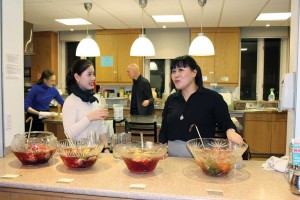
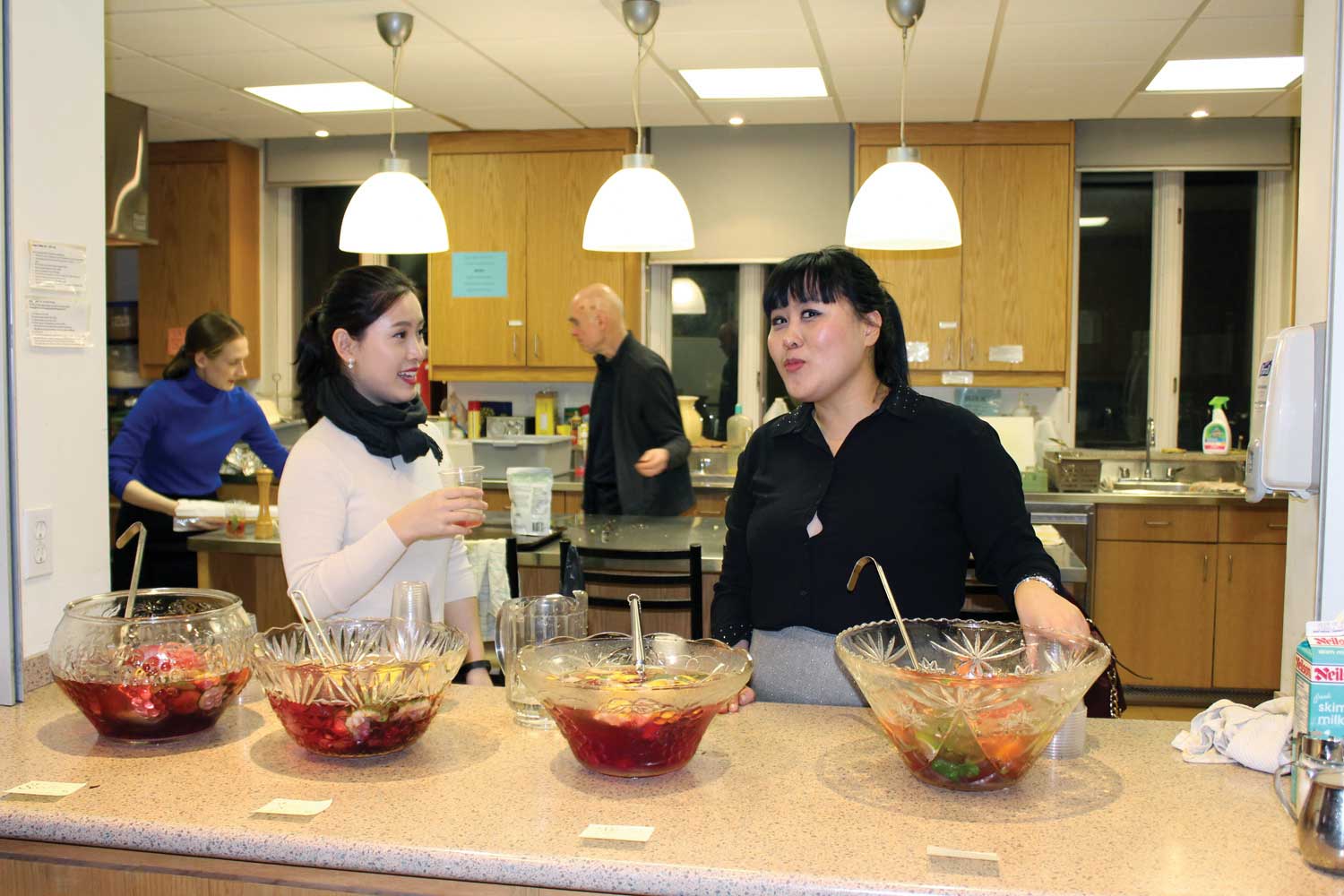
St. Thomas’s Anglican Church parishioner Tina J. Park (right) and friend Sowon Kim serve three flavours of fruit punch during a parish hall reception following the church’s Voices of Refuge fundraising concert. Photo courtesy Julia Armstrong
By Summer Reid
The Annex is a hive of activity as members of local churches, community organizations, and grassroots groups buzz with activities aimed at raising money to support the upcoming influx of Syrian refugees. Their efforts are culminating just as the federal government has outlined #WelcomeRefugees, its plan for settling 25,000 people from the war-torn country in Canada by the end of February, and private sponsorship is critical to meeting that goal.
“It’s part of our identity as Canadians; it’s part of our identity as Christians as well,” said Father Mark Andrews, the rector of St. Thomas’s Anglican Church (383 Huron St.), of sponsoring refugees. His church hosted Voices of Refuge, a November fundraising event of performances from local choir groups that included a reception featuring soups from Soup for Syria.
St. Thomas’s choir member Julia Meadows thought it was a fantastic idea to do a concert to raise funds to sponsor a family.
“It’s really great to see communities rising up, especially around this time of year,” said Meadows. “It’d be great if more groups, even secular organizations, were doing things like this.”
In fact, Howland Avenue residents Libbie Mills and Chris Wright are doing just that.
They are participating with Ryerson University — which is working with Lifeline Syria — to raise $65,000 to support a family of 12 from rural Syria.
“They’re currently in a refugee camp in Jordan and they’ve already been assessed by the Canadian government as high need,” explained Mills during a Nov. 12 meeting held by the Annex Residents’ Association. “[The family will be] brought here within six to eight weeks as permanent residents.”
Mills and Wright have raised nearly $2,000 from selling cookies on Sunday afternoons at Bloor Street and Howland Avenue, in addition to having received nearly $1,000 from direct donations. They are also planning other fundraising events like a film night and a Jan. 8 event at the Tranzac Club (292 Brunswick Ave.).
Another local group, the Palmerston Community Welcomes Refugees, has already exceeded its fundraising goal of $35,000 and raised $45,231, which is enough money to sponsor a family of six. The neighbourhood group, which has partnered with the Mennonite Central Committee, is also “developing a settlement plan to help welcome this family, orient them to life in their new community, secure housing, employment, navigate the healthcare and education systems, and access any other necessary services”.
“It doesn’t take much for someone to push a button to donate online and we are a community that loves to give,” wrote Palmerston’s Monica Gupta in an email.
Although local residents seem to be overwhelmingly in support of welcoming refugees to Canada, some have expressed concerns that security will be sacrificed in favour of speed.
“I think, obviously, the more the better, because it’s a really dire situation,” said Evelyn (who did not provide her full name) at St. Thomas’s Voices of Refuge. “But I wrote a letter to [the prime minister] saying that national security is also very important, so not to rush to honour his election promise because I don’t think Canadians will hold him to that.”
However, by the time they arrive here, most refugees will have been vetted by Canadian government officials as well as by the United Nations High Commission for Refugees (UNHCR).
And, as Ellen Woolaver of the Christie Refugee Welcome Centre explained, refugees assisted by her organization are often sponsored by three distinct parties: the centre, those sponsoring the refugee(s), and a church or community organization like the Canadian Druze Society.
“The Druze are a small ethnic group within Syria, and [in Canada] they have a community group, a community, and assets,” said Woolaver. “They are willing to sign applications for [Syrian families].”
She added that there are three types of refugee sponsorship: private, government-assisted, and the Blended Visa Referred Program. For the last category, which is new, the government matches groups who want to sponsor refugees with high-need UNHCR-registered refugees, and provides half of the necessary funds.
For further information on the government’s refugee plan, please visit www.cic.gc.ca/english/refugees/welcome. Email Monica Gupta to donate to the Palmerston Community Welcomes Refugees at mongupta@hotmail.com, and Libbie Mills at libbie.mills@ utoronto.ca to donate to Howland Refugee Support.
Gleaner News was a sponsor of Voices of Refuge.
Tags: Annex · Liberty · News · People
December 5th, 2015 · Comments Off on Fare hikes not the answer
Policy favours car ownership over public transit
By Terri Chu
To say that another Toronto Transit Commission (TTC) fare hike is disappointing is a mild understatement. When the Yonge line opened in 1954 with its first 12 stations, fares cost 15¢ ($1.34 in today’s dollars). The recent fare hike puts the increase at about 2.5 times above and beyond inflationary rates.
At the time the subway opened, the TTC operated under a complicated zone-based system. Suburban commuters paid a higher fare, as longer routes cost more to operate. As urban sprawl started to infect Toronto through the 1960s, suburban dwellers found more and more clout in City of Toronto politics and the “unfair” zone structure was abolished in favour of a flat fare of 30¢ in 1973 ($1.58 in today’s dollars).
This really solidified the entitlement that everyone should subsidize the cost of urban sprawl.
Transit systems depend on a large number of passengers going a relatively short distance in order to make effective revenues.
Relatively few passengers going a long way into the suburbs are a money-losing proposition.
When the new fare structure came into place, it was an acknowledgement that suburbs approved of, and wanted, government-subsidized transit to the suburbs. The TTC was no longer able to operate expensive lines to low density areas at a loss without a government subsidy.
During the recession of the 1990s, ballooning deficits made transit subsidies unpopular and, by 1996, the provincial government slashed subsidies to the TTC causing decreased service at increased prices, which dropped ridership and increased congestion on city roads.
The government of the day went as far as filling in a hole that was already being dug. While public transit has been scaled back in Canada’s largest city, in the same period we have seen roads widening.
In the 1950s, the 401 was a mere four-lane throughway compared to the 12 lanes now across most of the Greater Toronto Area.
The cost of vehicle ownership has kept pace with inflation whereas the cost of transit use has far exceeded it. In both 1954 and today, the average cost of a new car was about half of the annual household income. The cost of driving has been relatively flat in terms of earning power.
When the Metropass was introduced in 1981, it cost $29.75, about $74 in today’s dollars. Today, it costs double that after adjusting for inflation.
While Rob Ford made great headlines fighting the “war on the car”, the fact is that decades of public policy have favoured vehicle ownership and operation over public transit.
Is it any wonder that Toronto’s roads are congested and nobody feels like they get good value out of their public transit? Rome wasn’t built in a day and Toronto’s once world-class transit system didn’t turn into a laughing stock overnight either.
This is a result of decades of public policy designed to favour the car manufacturing sector and feed into a misplaced notion of “the American dream”. The result? North America’s most congested city costing the GTA an estimated $6 billion annually.
The debate at city council is infuriating to the outside observer not because of what is being discussed, but because of what isn’t. The needs of the system are largely outside of council’s control but there are steps it can take while the other two levels of government slowly decide how much money from Toronto’s own tax base it wants to give back to us.
- Raise parking prices: Toronto can’t realistically impose road tolls on its own but why is parking so cheap? Unless the marginal cost of driving is higher than transit, there is no ecnomic incentive to get out of the car.
- Bring back the car tax: this is self-explanatory. It brought much needed revenues to the city’s coffers by decreasing the subsidies to drivers for the upkeep of municipal roads.
- Bring back distance-based fares: three friends bar-hopping downtown should not SAVE money by hopping into a cab rather than the subway. If we want people to use transit, the fare system has to make sense compared to other alternatives.
- Outsource management: this isn’t about outsourcing jobs but rather outsourcing high level decision making to world renowned experts. Stockholm has done this successfully without reducing any frontline jobs. Ultimate decision making still rests with city council to ensure that the interests of Torontonians are looked after, but this can open the door for much more advanced transit technology. The comfortable modus operandi the TTC finds itself in is not working, and it’s time to leapfrog from baby steps.
While we are finally launching the state of art circa 1990s technology of Presto, places like Hong Kong have been so successful with their electronic payment systems that one can now use them to purchase one’s morning coffee. In such places the transit system is the backbone of society rather than an afterthought.
Rather than debating the cost of transit, the discussion needs to shift to what kind of society we want to build. One where transit is treated as a service to meet the needs of the poor, or one where transit is the backbone of a vibrant city?
As the provincial and federal governments decide how to direct the newly promised infrastructure funds, it will be important to look at the bigger picture.
Toronto needs help. While the city can take small steps in the right direction, it has limited reach. Toronto is so intertwined with neighbouring cities that city council alone can’t fix the problem. Leadership from Queen’s Park is needed. We are waiting.
Terri Chu is an engineer committed to practical environmentalism. This column is dedicated to helping the community reduce energy use, and help distinguish environmental truths from myths. Send questions, comments, and ideas for future columns to Terri at terri.chu@whyshouldicare.ca.
Tags: Annex · Liberty · News
December 5th, 2015 · Comments Off on A gleaning of reading
A local literary line-up for the holidays
By Annemarie Brissenden
Annex publisher Coach House Books, which celebrated its 50th anniversary this year and operates out of bpNichol Lane, boasts a bevy of award-winning reads: Fifteen Dogs gain human consciousness and language in André Alexis’s Giller Prize- and Rogers Writers’ Trust Fiction Prize-winning novel; editors John Lorinc, Michael McClelland, Ellen Scheinberg, and Tatum Taylor curate a jumble of stories from The Ward (reviewed October 2015); and Carl Dair writes about his travels in Europe in the mid 1950s in Epistles to the Torontonians, a first and limited edition that reproduces Dair’s letters in manuscript form.
Also from Coach House, RM Vaughan explores how sleep competes with our desire to stay connected in Bright Eyed: Insomnia and its Cultures, while an academic goes from too much to not enough Sleep (Doubleday Canada) in Nino Ricci’s latest, and recently sworn-in University-Rosedale member of Parliament and international trade minister Chrystia Freeland chronicles the rise of the new global super-rich and the fall of everyone else in Plutocrats (Anchor Canada).
Former mayor John Sewell explains How We Changed Toronto (James Lorimer & Company Ltd.), writing of civic life from 1969 to 1980 and those, like Jane Jacobs, who led the fight against the Spadina expressway. Editors Nancy Williams and Marie Scott-Baron also explore the fight to Stop Spadina! and recount other Huron-Sussex stories in Recollections of a Neighbourhood (Words Indeed Publishing), which was recognized by the Independent Publisher Book Awards.
Get out your crayons for United Colours of Kensington Market (City Blocks Culture Collective and Keep Six Exhibits) and celebrate this unique neighbourhood with illustrator Shengyu Cai and writer Bruce Beaton.
Retired restaurateur (of Mama Rosa fame) Rose Grieco remembers The District: Growing up in Little Italy (The Gypsy Press) and the friends and family of her childhood in her beloved neighbourhood, while Barbara Abdeni Massaad makes Soup for Syria (Interlink Publishers), which inspired a November fundraising reception at St. Thomas’s Anglican Church for Syrian refugees.
One of Westbank Project Corp.’s Honest Ed’s Alley consultants, Jeb Brugmann, explains how cities are changing the world in Welcome to the Urban Revolution (Bloomsbury Publishing USA), while the company’s Mirvish Village architect Gregory Henriquez co-authors Citizen City (Blueimprint) with Marya Cotton Gould about the potential of public, private, and not-profit partnerships. Explore the Woodward’s redevelopment, which also resulted from a Westbank/Henriquez partnership in Body Heat (Blueimprint) by contributor Henriquez Partners and editor Robert Enright.
Don’t miss the final memoir in Catherine Gildiner’s trilogy, Coming Ashore (ECW Press) (reviewed January 2015), or Jane Fairburn’s exploration of Toronto’s waterfront heritage along the Scarborough shore, the Beach, Toronto Island, and the lakeshore in Along the Shore (ECW Press). And Ismé Bennie comes of age in apartheid South Africa in White Schooldays (self-published) (reviewed May 2015).
Finally, Margaret Atwood imagines a dystopian future in The Heart Goes Last (McClelland & Stewart). You didn’t think we’d skip the Annex’s most famous author, did you?
Tags: Annex · Liberty · Arts
November 17th, 2015 · Comments Off on
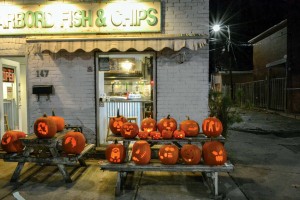
A patch of orange pitched up on the picnic tables in front of Harbord Fish & Chips beside Albert Jackson Lane for the popular Pumpkin Festival on Nov. 1. Sponsored by Wright Real Estate Brokerage, this annual event is presented through a partnership of the Habord Street BIA and the Harbord Village Residents’ Association. Courtesy Graham Rempe
Tags: General
November 17th, 2015 · Comments Off on
Tags: Annex · Liberty · Editorial · General
November 17th, 2015 · Comments Off on
Tags: General