March 11th, 2026 · Comments Off on SPORTS: Maple Leafs moving up to the pros (Feb. 2026)
New Canadian Baseball League will bring more baseball and excitement to Christie Pits
Dan Marra (right) celebrates a home run with his Toronto Maple Leafs teammates at Christie Pits last summer. CRAIG AIKEN/GLEANER NEWS
By R.S. Konjek
This summer, professional baseball is coming to Christie Pits.
After 106 years as Ontario’s premier semi-pro baseball league, the Intercounty Baseball League has rebranded as the Canadian Baseball League with professional status.
For fans of the Toronto Maple Leafs, it will mean more baseball and more excitement.
More baseball comes from an expanded schedule, which will see the regular season grow from 42 to 48 games. That means 24 games played at home.
It’s just a few months away. The Leafs’ season opener will be Sunday, May 10 at Christie Pits. Game time is 2:00 p.m., and they will face the Kitchener Panthers.
The first half of the season will be heavy on Sunday games, with seven of them scheduled across May and June.
For July and August, the schedule will flip to more night games, with 12 of them spread over Wednesday, Friday, and Saturday nights.
With the league’s new professional status comes a formal pay structure for players. Clubs will also be able to sign up to eight import players, up from the previous limit of five. These changes are expected to attract a higher calibre of players and make teams more competitive across the board.
A competitive roster will be a must, as fewer teams will qualify for the CBL postseason. Starting this year, the top three regular season teams will make the playoffs, with the fourth- and fifth-placed teams playing a wild card elimination game to join them.
The semi-finals and championship series will both be best-of-seven affairs.
Gone are the days when all or almost every club made it to the playoffs. Under the new format, every team will want to get off to a fast start to avoid falling behind early.
“We are more excited than ever and have been hard at work since last season ended preparing for 2026,” said a Leafs source. “We really believe that next year is going to be our best yet, on and off the field.”
One of the club’s biggest off-season developments is a partnership with the Toronto Mets of the Canadian Premier Baseball League, a development league for young players aged 13 to 18.
In December, the Leafs held open tryouts at the Mets’ brand new practice facility in Aurora. Over thirty prospects attended, along with a handful of returning unsigned players looking to crack the roster again. The session was overseen by Leafs’ manager Rob Butler and the Leafs’ new general manager Denis Bailey.
“Between Denis and Rob, the team has never had stronger leadership,” said the Leafs’ source. “We believe we will have the most competitive team in the newly branded CBL.”
As of January, no signings have been announced, but it is expected that the Leafs will start rolling them out as the season approaches.
When news broke that the league was transitioning to professional status and that clubs would be paying their players more than just an honorarium or travel money, local fans wondered if that would impact the price of admission to games at Christie Pits.
The good news is that the cost of general admission to Leafs home games will remain the same: free.
The club is also building on the fan-friendly experience crafted over the past two seasons.
“Fans can expect more improvements, surprises, innovations, and a generally enhanced experience,” said the Leafs’ source. “We may look to slightly expand the [paid ticketed] members lounge, as that continues to be successful. But there will be no general admission charge, as we continue to offer the best deal for our fans in all of professional sports.”
All nine of the IBL’s existing teams will be part of the new CBL for its inaugural season. That includes the Leafs, their longtime rivals the Barrie Baycats, and 2025 champions the Welland Jackfish. The league is looking to add more teams in the coming years.
The Dominico Cup, named for former Leafs owners Jack and Lynne Dominico, will carry over and become the CBL’s championship trophy.
More information can be found at www.mapleleafsbaseball.com.
March 11th, 2026 · Comments Off on IF THESE WALLS COULD TALK: Once upon a time at 27 Follis Ave. (Feb. 2026)
Former inhabitants include a grocer, a milliner, and a deaconess
The home at 27 Follis Ave. has hosted its full share of rich lives. MIKE MASTROMATTEO/GLEANER NEWS
By Mike Mastromatteo
On Follis Avenue, running west from Bathurst Street to Christie Street, there is a row of mostly semi-detached, two-storey dwellings.
The house at 27 Follis is the focus of this month’s “walls” story.
Among the many families and boarders who have called 27 Follis home, the Little family— mom Mary J. and daughters Maud and Jennie—might be the most intrinsic to the neighbourhood, yet the most commonplace as well.
The Little sisters were connected to 27 Follis for at least 31 years, from 1914 until 1945. One can almost see them in those days, gardening, keeping house, greeting neighbours, or taking the streetcar on Sunday mornings to the nearest United Church. Perhaps it was College Street United at the corner of Bathurst and College. Established in 1874 as a Presbyterian place of worship, it joined the United Church in 1925 and is one of the most prominent churches in the Annex.
We will get back to the Little family shortly, but for now, a few words about their predecessors.
It appears Follis Avenue developed a little later than the homes south of Bloor Street. It wasn’t until about 1910 that all the lots had been developed and had addresses assigned to them.
In 1911, 27 Follis was occupied by grocer, Thomas Horan, and then two years later by Mrs. Jennie A. Bach (most likely a widow).
Then came the Little family who would make their quiet mark on the neighbourhood for more than three decades.
Mary J. Little was a widow who raised two daughters. Maud was a milliner or “cutter” with several women’s hat fabricating companies while Jennie’s occupation remains a mystery.
Mary Little passed away in 1922, leaving daughters Maud and Jennie to fend for themselves, and fending for themselves turned out to have its hazards. As the Toronto Daily Star reported on July 13, 1932, the Little sisters fell victim to a pair of swindlers: “Hugh Hazelwood, 52, of Windermere Ave., said by police to be a former clergyman, and Robert F. Peacock, 32, living in a Jarvis St. hotel, were each remanded until July 20 for trial upon charges of fraud and false pretenses. Bail was set at $10,000. Hazelwood is charged with obtaining $1621 from two sisters, the Misses Jennie and Maud Little of 27 Follis Ave. by fraud. Peacock faces a charge of obtaining $2475 from the same two sisters by false pretenses. In both cases, police allege, the men had told the women convincing yarns of how small fortunes would be made with the sisters’ money.”
According to the Inflation Tool website, $1621 in 1932 would be equivalent to $35,916 today, while $2476 would be more than $54,000. Quite a loss indeed for the Depression-era Little sisters.
There is no record of the Littles receiving any restitution for the losses, but they managed to carry on at 27 Follis until 1945.
They likely supplemented their income by renting out a room to one of their United Church contacts. The municipal directories show an Agnes Coutie residing at 27 Follis Ave. from 1937 to 1938.
Sadly, Agnes Coutie, a retired deaconess and hospital visitor with the United Church, passed away on Jan. 30, 1939.
Nonetheless, Maud Little remained busy with church and social work. On Nov. 21, 1940, The Toronto Daily Star, mentions “Sister Maud Little” in a report about an Order of the Eastern Star (OES) bazaar and dinner. In the write-up, Maud is described as a “worthy matron.” The OES was akin to a sister organization to the Freemasons.
The Little regime at 27 Follis came to an end in 1946 when painter Peter Dubnyk purchased the home. Dubnyk lasted only a year before another long-time owner, Stanley Borowski moved in.
A porter at a department store, and later a salesclerk at Lipman’s Clothier, Borowski was a salt-of-the-earth type.
Although he passed away around 1971, wife Nellie remained in the 27 Follis home until 1980 and worked as a cleaner with Ontario Hydro.
More recent owner/occupants of the property include Elizabeth Butterworth, a long-term Ontario civil servant and a Mr. Sutcliffe, whose life and work remain undetermined.
With all those lives and experiences over the years, 27 Follis continued to accumulate charm and appeal.
A Dec. 17, 2004 real estate advertisement in the Globe and Mail, for example, described the Annex area home as “a much sought after neighbourhood for young families priced out of the prime part of the Annex.”
Today, 27 Follis has been modernized, and an additional half-storey has been added to the west side of the structure. But despite the new look, the house might still possess the spirit of the many who lived, toiled, and persevered since grocer Thomas Horan first called the place home in 1911.
March 11th, 2026 · Comments Off on CHATTER: The bicycle in the Court of Appeal (Feb. 2026)
Judges weigh Ford’s appeal of lower court injuction
By Albert Koehl
On a day when most streets, sidewalks, and bike lanes were still covered with snow from a giant downfall, it was the bicycle that found its way into the lofty corridors of Osgoode Hall.
Three justices of the Ontario Court of Appeal heard arguments about whether Premier Doug Ford’s decree to eliminate bike lanes from Bloor and Yonge Streets and University Avenue violated section 7 of the Charter of Rights.
At issue was the right to life and security of the person.
In a July 2025 decision, Judge Paul Schabas of the Superior Court of Justice had agreed with Cycle Toronto, and its pro bono lawyers from Ecojustice and Paliare Roland, that such a violation had indeed occurred.
Removing bike lanes increases the risk of injury and death for people who travel by bicycle, and the province had failed to justify this Charter infringement.
The test for a section 7 violation is: a) was there a deprivation of the Charter right, and b) if yes, was it carried out contrary to the principles of fundamental justice.
One element of part (b) of the test is whether the government’s decision was arbitrary.
The answer partly depends on whether there is a rational connection between the provisions of the law and its objective (in this case, to reduce road congestion).
The bike lane removal provisions of Bill 212 (now part of the Highway Traffic Act) were a last-minute add-on to the Bill.
The core of the Bill, which was not challenged, was a requirement for provincial approval of new bike lanes installed at the expense of a car lane. (Bill 60, subsequently passed, simply bans new bike lanes that remove a car lane.)
However, after first and second readings— and with public hearings on Bill 212 nearly complete—Doug Ford, at a meeting of the Empire Club, announced that the three popular bike lanes were to be eliminated. The announcement contradicted Ford’s own minister of Transportation who had stated there were no plans to remove bike lanes.
In the original hearing, Cycle Toronto presented expert evidence, accepted by Judge Schabas, about “induced demand,” namely that more car lanes simply draw more motorists, causing more congestion. But, is it enough, as one judge asked, for the court to be able to surmise a rational connection, even in the absence of evidence. Doesn’t it make sense for the government to think, even if its own experts suggested otherwise, that one more lane will add more room for cars and therefore reduce congestion? We will have to wait for the answer.
The final decision of the justices is likely to take several months. In the meantime, city residents will be able to enjoy the safety of bike lanes on Bloor, Yonge, and University—at least once the snow is removed.
Albert Koehl is a former lawyer with EcoJustice and the executive director of Community Bikeways.
March 11th, 2026 · Comments Off on LIFE: Coffee two ways (Feb. 2026)
A contrast in two Annex cafés
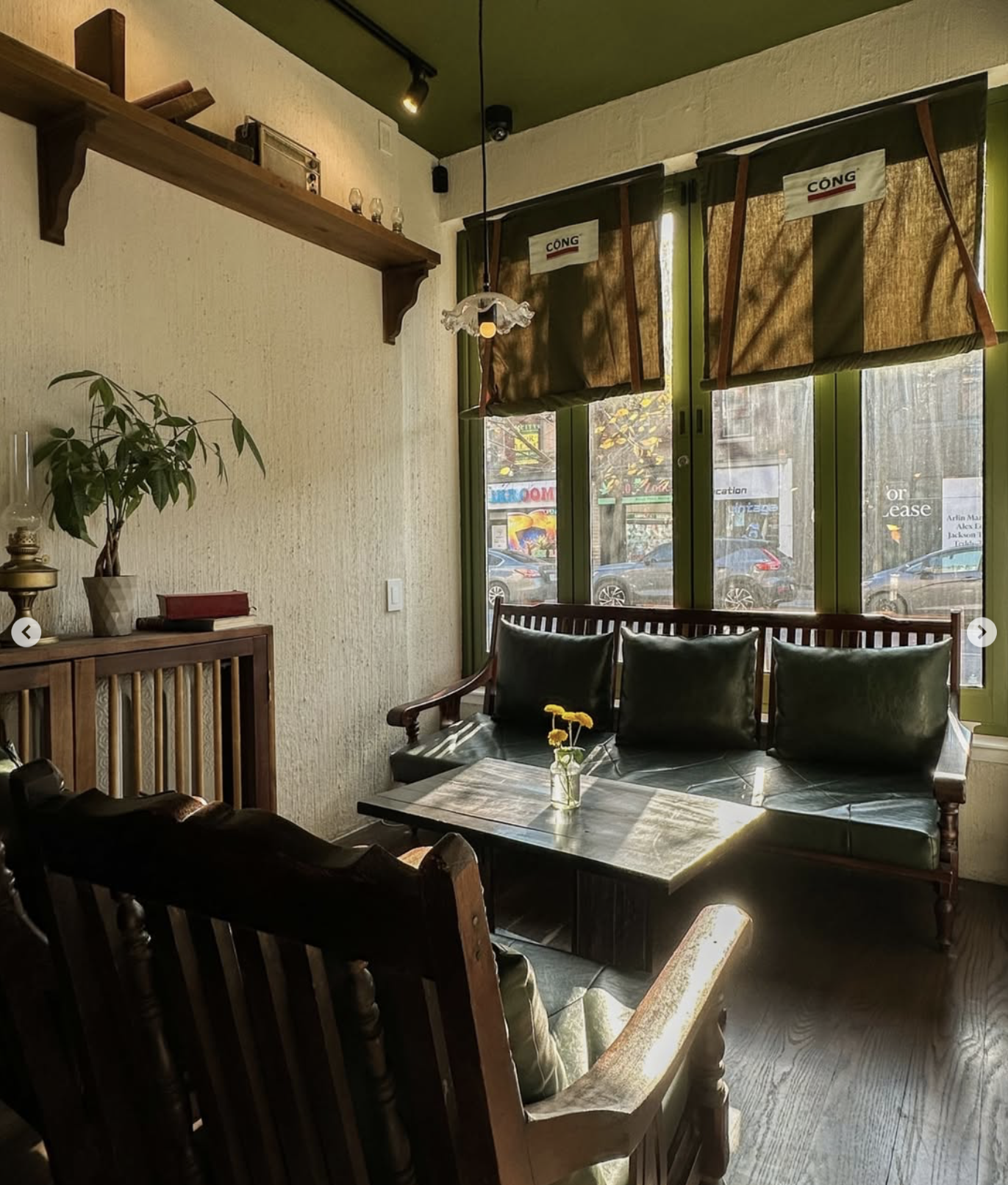
The cozy inviting interior of Công Cà Phê, at 424 Bloor St. W. offers a unique caffeine culture. COURTESY CÔNG CÀ PHÊ
By Howard Pressburger
The absolute worst news I ever got from my family doctor was to cut coffee out of my diet.
Okay, maybe I am exaggerating. He actually told me to cut down to two coffees a day; still, this was devastating.
Like anyone else faced with life-altering medical news, I went on a trip of a lifetime to experience a true Viennese coffee house. I went to Trieste, not Vienna. There are real Viennese coffee houses in Trieste, holdovers from the Austro-Hungarian Empire. Also, my uncle was living there, so I had a place to stay. When I came home, I had become a coffee snob.
Now, when I go out for coffee, I only frequent interesting, independent coffee shops, and fortunately, I don’t have far to go.
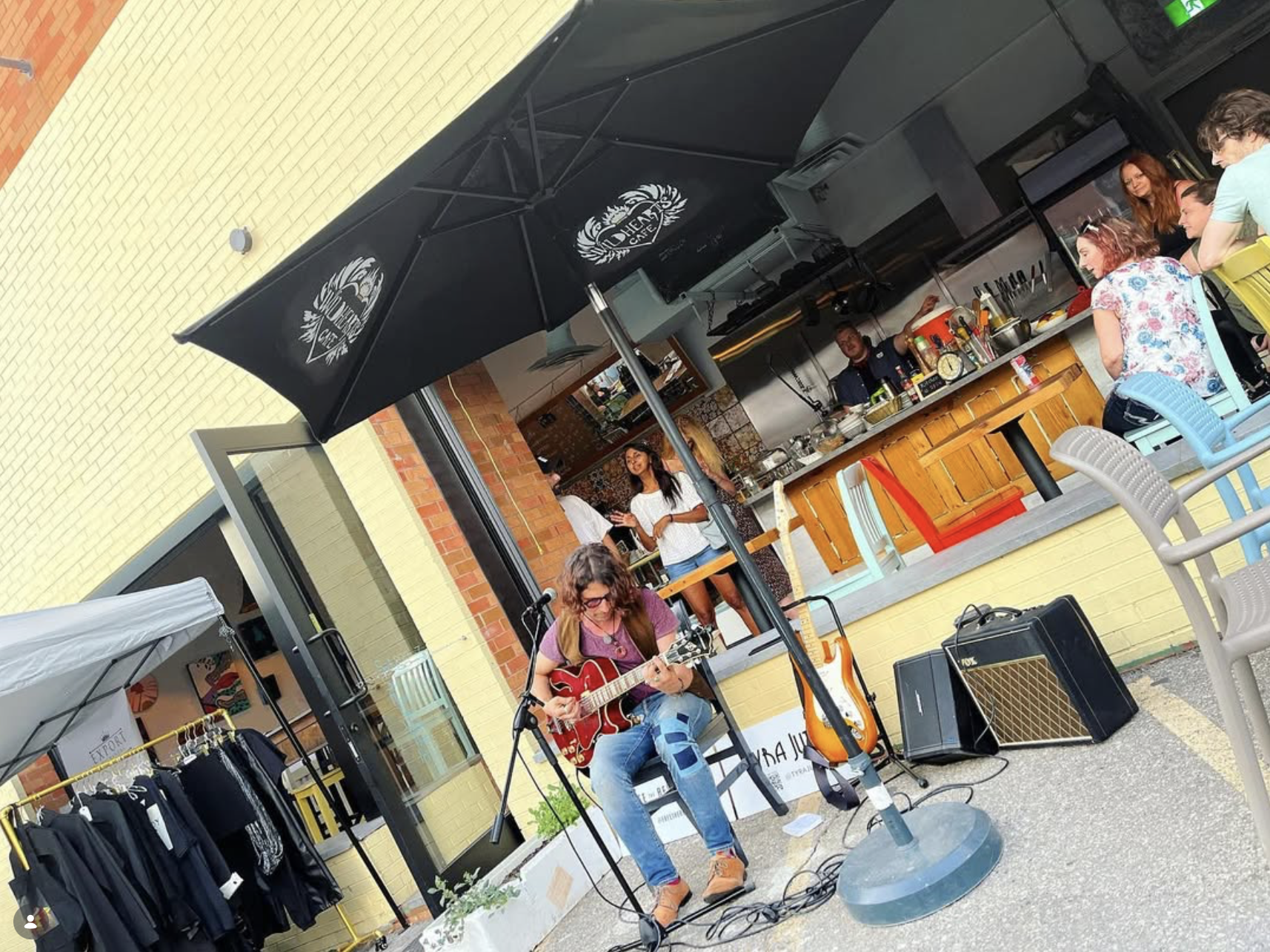
Situated on Borden, just behind 509 Bloor W., is Wildhearts Café. This is the pet project of Sean Lacey, born and raised close by in Little Italy, who previously helmed Voulez Vous Café in Leslieville. Sean was thrilled to finally find a new location just slightly off the beaten path. He rebuilt the space from the ground up with blue-green walls that seem to change with the mood, rough-hewn tables, antique gramophone sound horns as ceiling lights, and two large glass-paned garage doors which open onto a large patio.
Wildhearts Café features sliding garage doors out front and a great patio for summer coffee. It also welcomes artists and musicians. COURTESY WILDHEARTS CAFÉ.
Driven by a desire to build and foster community, the staff are selected not just for their barista skills, but also for their ability to be affable and inviting.
In addition to the standard espresso-based drinks (and drip coffee for the faint of heart), they offer a wide variety of teas, and two other standout hot beverages. The hot chocolate is made from red and dark cocoa—this was a godsend during the recent snowstorm and cold snap—and something called the Flu Buster. (I can personally attest to the efficacy and the truthfulness of this descriptor.) There is also a small, open kitchen, with a continually evolving menu of fresh baked goods, soups, and sandwiches.
Moving forward, Sean plans to add more community events such as a regular open mic, casual concerts, and literary events. All in all, Wildhearts has cemented itself in the Annex as a vital and big-hearted member of the community.
Across the street, half a world away yet across the street, at 424 Bloor St. W, is Công Cà Phê.
Part art installation, part coffee shop, I found it to be a surprisingly immersive experience. Fortunately, I had the guidance of Minh Nguyen who covers a lot of the day-to-day operations at Công. Meeting recently for morning coffee, he introduced me to a whole new caffeine culture. Having never experienced a coffee shop like this, it really made me rethink my coffee-related hubris. To put it succinctly, my mind was blown, and not just by the caffeine.
It starts with the coffee plant itself. Vietnamese coffee uses robusta beans which are well-suited to their growing conditions. However, this bean has a strong bitter flavour compared to arabica beans which most cafés like Wildhearts use. So, to balance out the bitterness, condensed milk is used as a sweetener. And if that’s not enough, it turns out that robusta beans have about twice the amount of caffeine than arabica.
I also learned that the climate plays a big role in coffee culture. Vietnam is hot, like really hot. Like plus 40 hot. Coffee is generally served cold, with ice that doesn’t seem to melt. It’s sweet, but not overpowering, and it’s got a bite. It is meant to be savoured over a few hours.
But the magical thing about Công is that each location is unique, and they’re all designed to evoke an aspect of life from Vietnam during the rebuilding phase after the war. The Annex location is about family life and evokes the resourcefulness of the time. It is set up with low couches in the front, like a comfy living room, but look closely, and you’ll see that the furniture is pieced together like Frankenstein’s monster. The wood panelling comes from a dozen different structures, the bookcases are cobbled together from boxes, and pictures are repurposed as art. I found it as mesmerizing as a George Segal sculpture.
Minh tells me they have a variety of customers including many local regulars. I asked him if there were any special customer stories. He said that Vietnamese living in Toronto really appreciate something authentic from home. He also confided he can tell when someone is homesick.
March 11th, 2026 · Comments Off on EDITORIAL: ‘An international relations earthquake’ (Feb. 2026)
There are times when Canada appears on the radar of American media, but for the most part, Canada exists on the margins. That all changed with Mark Carney’s recent speech at the World Economic Forum in Davos. Ezra Klein of the New York Times wrote that the speech triggered an “international relations earthquake.” Carney stood up to the bully without naming him.
The prime minister’s speech came as President Trump was wielding a big stick against Europe and the entire NATO alliance. Trump threatened to further tariff E.U. imports and invade Greenland, a territory of Denmark and a member of NATO. Trump texted the prime minister of Norway to say he was doing this out of spite because he was not awarded the 2025 Nobel Peace Prize.
Normally, European leaders take the lead among advance democracies in responding to U.S. foreign policy forays. But no one stood up. Carney stepped into the void and used his credibility as a former leader in global financial systems. It gave the so-called “middle powers” of the European Union the courage to stand up against American threats.
It appears that the United States is vulnerable because it is so indebted to other nations. If U.S. bond holders were to redeem their bonds the American currency would collapse, and with it, the economy. No one wants the world’s largest economy to collapse, but if the alternative is death by a thousand cuts at the hands of a man seemingly at war with everyone, so be it.
Some argue Canada should swallow its pride, play to Trump’s ego, and play it safe. The flaw in that strategy is that it won’t work. When Trump started to huff and puff at Canada, then-Prime Minister Justin Trudeau flew down to Mar-a-Lago to kiss the ring. That got us nowhere fast, only revealing weakness. Until Carney’s speech, the Europeans bent over backwards for Trump, signing trade deals that made no sense for them just to keep the U.S. as their customer. What did they get in return? Trump’s utter contempt in the form of more tariffs and the threat to invade Greenland, a NATO member.
It’s not all doom and gloom. Trump makes no pretense of idealism. His venality is in plain view, and he is guided only by his nakedly transactional ethos. The problem for Trump is that this creates a craving for the opposite. Enter from stage right, Mark Carney who offers hope. He proposes that nations should not be nostalgic for the past; indeed, he urges that the past is not as rosy as it may have seemed. The prime minister urges “middle powers” to unite, forge economic partnerships among themselves, and recognize that financial integration with the United States is a form of submission and dependence. Until Trump, the U.S. was wise to be measured in exercising its hegemony.
The alternative offered by the prime minister is an economic alliance of European and Pacific countries with Canada as the bridge. What really got Trump upset was the idea of a western economy where the U.S. is not at the table. This could take the form of a merger of the EU trade deal with the Trans-Pacific Partnership, which John Ibbitson of the Globe and Mail coined the “Atlantic-Pacific Trade Alliance or APTA.”
Of course, the risk Canada now faces is a less than favourable outcome in the upcoming USMCA renegotiation, the three-way free trade deal between Canada, the U.S., and Mexico. However, the future of that deal is already very much in doubt. Trump said that if the USMCA were scrapped, “it wouldn’t matter to me” because “I really don’t care about it.” Perhaps this is what Carney was foreshadowing when he said, “nostalgia is not a strategy.” He has made a calculation that Donald Trump is not a trusted partner, and he has chosen to stand up rather than lie down. The risk is you lose the very financial security that you are trying to salvage, but what Canada gets to keep is self-respect, and that feels very good indeed.
March 11th, 2026 · Comments Off on FORUM: A busy beginning to 2026 (Feb. 2026)
Budget, snow plowing, and a new Indigenous shelter
By Dianne Saxe
Happy February!
February marks the Year of the Horse—a symbol of energy, independence, and forward momentum. In the heart of winter, it’s a powerful reminder that this season can be about renewal, action, and connection with community. And the best part? February is packed with ways to beat the winter blues right here in our ward. Don’t miss the Lunar New Year celebrations festivities in Chinatown—a perfect way to kick off the season with energy and joy. Here are the top things you should know this month:
1. City budget
Under the mayor’s direction, the CFO has proposed a $18.9-billion operating budget for 2026, with a modest 2.2 per cent total tax increase. This low increase comes at a cost: some maintenance and capital projects will be deferred, which could lead to higher long-term costs and a less reliable city infrastructure. On the bright side, the budget avoids most service cuts and improves key areas such as the TTC (better frequency and no fare hikes), libraries (extended hours), and emergency and crisis response. The city has also honoured multi-year funding commitments, including the Toronto Arts Council, which will receive the second of five planned $2-million increases.
2. A path off the streets
The city has purchased 720 Bathurst Street to create a shelter and support centre for Indigenous men working towards leaving life on the streets. Indigenous people are overrepresented in downtown encampments and experience shows that culturally grounded, Indigenous-led services provide greater stability and better outcomes. The site will be operated by Na-Me-Res, a highly respected Indigenous organization with a strong track record in providing care while being excellent neighbours.
The first community drop-in meeting is scheduled for 5:30 p.m. on Feb.12 at 720 Bathurst Street. Neighbours are encouraged to attend, ask questions, and learn how this important project will support both residents and the wider community.
3. Better snow management
This has been an intense month for lake-effect snow. I’m grateful so many of you noticed real improvements in snow clearing this year thanks to major investments, better contractor oversight, faster snow emergency declarations, surge staffing at 311, more parking enforcement and salting, and citywide coordination during storms. Between Jan. 5 and Jan. 23 alone, 311 handled over 30,000 winter service calls, and our office worked closely with Winter Services to resolve urgent issues quickly.
We also strengthened winter support for people experiencing homelessness, and I want to thank Cecil Community Centre for again serving as an emergency warming site during the coldest days.
Other highlights in the ward:
• Crossing Guards: Congratulations to our own Khevin Enriquez, named Ontario’s Favourite Crossing Guard! Khevin keeps kids at Huron Street PS and Jesse Ketchum PS safe every day with care and professionalism—an example of the everyday heroes in our community.
• Recycling Transition: As of Jan. 1, recycling in Toronto has shifted to the province’s new system. Residents’ feedback is essential for improving the program. You can share suggestions with Jennifer Kerr, director of community & media relations at Circular Materials (jkerr@circularmaterials.ca).
• Seaton Park: On Jan. 19, we had a productive meeting about the Bloor Annex BIA stepping in to help maintain Seaton Park. With city resources stretched, this partnership ensures the park remains safe, welcoming, and well-maintained for everyone.
• Bickford Centre: Seaton Village residents have requested stronger city involvement at the Bickford Centre (Grace and Bloor). Because there was never a signed agreement giving the city access to the gym and pool, Parks staff are now beginning negotiations with the Toronto Lands Corporation to secure a new lease. This process will take 8-12 months but is a key step toward improved community access.
• Queen’s Park North: Following strong public input, a staff report will go to March council to finalize an agreement with U of T and the Weston family for park improvements. I’ve advocated to scale back construction, prioritize tree protection, respect the park’s heritage, and ensure the community has a formal voice going forward.
• Climate Action: While some major climate measures fell short in this year’s budget, several initiatives continue, including electric ferries, LED streetlights, cleaner city vehicles, expanded Bike Share, improved transit, energy-efficient buildings, tree planting, heat relief for seniors, safer winter maintenance, and zoning changes that support greener, transit-oriented neighbourhoods.
Finally, congratulations to the University of Toronto, recognized for the fourth time as one of the most sustainable universities in the world—a reminder that leadership in sustainability starts at home and inspires others.
Dianne Saxe is city councillor for Ward 11, University-Rosedale.
March 11th, 2026 · Comments Off on FORUM: A lurking health crisis is right in front of us (Feb. 2026)
Did you know that 20% of grade 10 teenagers vape?
By Jessica Bell
What is happening to health care?
In January I was alarmed when Hillary Buchan-Terrell from the Canadian Cancer Society told politicians at the pre-budget hearings in Niagara that 20 per cent of Grade 10 teenagers vape.
I expected to hear about health-care deficits, school budget cuts, and growing homelessness during these pre-budget hearings—and I did—but I didn’t expect vaping to also be a hot-button issue.
Vaping first came up in Pembroke, Ontario, when Kory McDonald from Rothmans, Benson and Hedges came to committee.
McDonald called for Ontario to do more to crack down on illegal tobacco sales, but I was more interested in the company’s explicit “commitment to a smoke-free future.” Wouldn’t this new mission statement harm its profits? It turns out, no.
A quick Google search taught me that some global tobacco companies have quietly evolved into the world’s largest vaping companies. Once tasked with the job of getting people hooked on cigarettes, now these companies profit from getting people hooked on vaping, including teenagers.
In Ontario, vapes are addictive, alluring, and easy to get. Vapes come in flavours like mango, berry, apple, vanilla custard, and coffee. Shops sell vape products right near schools because there is no rule banning stores from being close to schools, as there is with cannabis stores. Undercover investigations reveal some stores are selling to minors. Vape products are bought online with no age verification and delivered to the door via Canada Post.
Vaping is bad for your health. It causes lung damage and impairs concentration, memory, and brain development in youth. It increases the likelihood of someone taking up smoking, even though it’s marketed as a smoking cessation product.
It’s too early to know the long-term effects of vaping, but we do know that vaping involves burning and inhaling products that are known to cause cancer, such as nickel, tin, lead, and formaldehyde. I don’t want these chemicals in my Grade 8 daughter’s lungs.
It took decades of lawsuits, public education, high taxes, and legislation (like banning smoking in restaurants and bars) to reduce smoking rates to about 10 per cent. Even with that reduction, smoking contributes to up to 17 per cent of all deaths and costs the health-care system $7 billion a year.
Most of the people who testified at committee savvily couched their “ask” using the classic river metaphor: a prudent upstream investment stops an expensive downtown problem. Prevention is cheaper than treatment.
Treatment is expensive. Ontario’s 140 hospitals cost about $30 billion a year to run, making up about a third of Ontario’s health-care budget. Even this large investment is not enough to cover escalating health-care costs and the rising needs of our growing and aging population. In committee, we had three hospital CEOs tell us their hospitals are operating at well over capacity and that they need building upgrades and more staff.
Wise policy makers must focus on keeping people healthy and out of hospital. That’s the job of public health departments. They came to committee too.
In London, Emily Williams from the London-Middlesex Public Health Unit said that Ontario government funding cuts to their public health department has resulted in a “complete retreat from public health nurse presence in schools, except for immunization, oral health screening, and tobacco enforcement.”
A public health department’s mission is to prevent illness, not make money off illness. With consistent and sustained funding, public health departments would be able to address growing pressures like increased cannabis use and vaping among youth. Health experts are also recommending Ontario raise the legal vaping age from 19 to 21, get tough on shops that sell vapes to teenagers, ban flavours, and raise the price—all measures that cost Ontario next to nothing.
As the NDP finance critic, I want Ontario to spend its money wisely and prevent public health tragedies from taking hold. As a parent, I want every child in Ontario to grow into a healthy and well-educated adult. That’s why getting tough on vaping is the right thing to do.
Jessica Bell is the MPP for University-Rosedale and the Shadow Minister for Finance and the Treasury Board. You can reach her office at jbell-co@ndp.on.ca or 416-535-7206.
March 9th, 2026 · Comments Off on ON THE COVER: Gardiner Transformed (Jan. 2026)
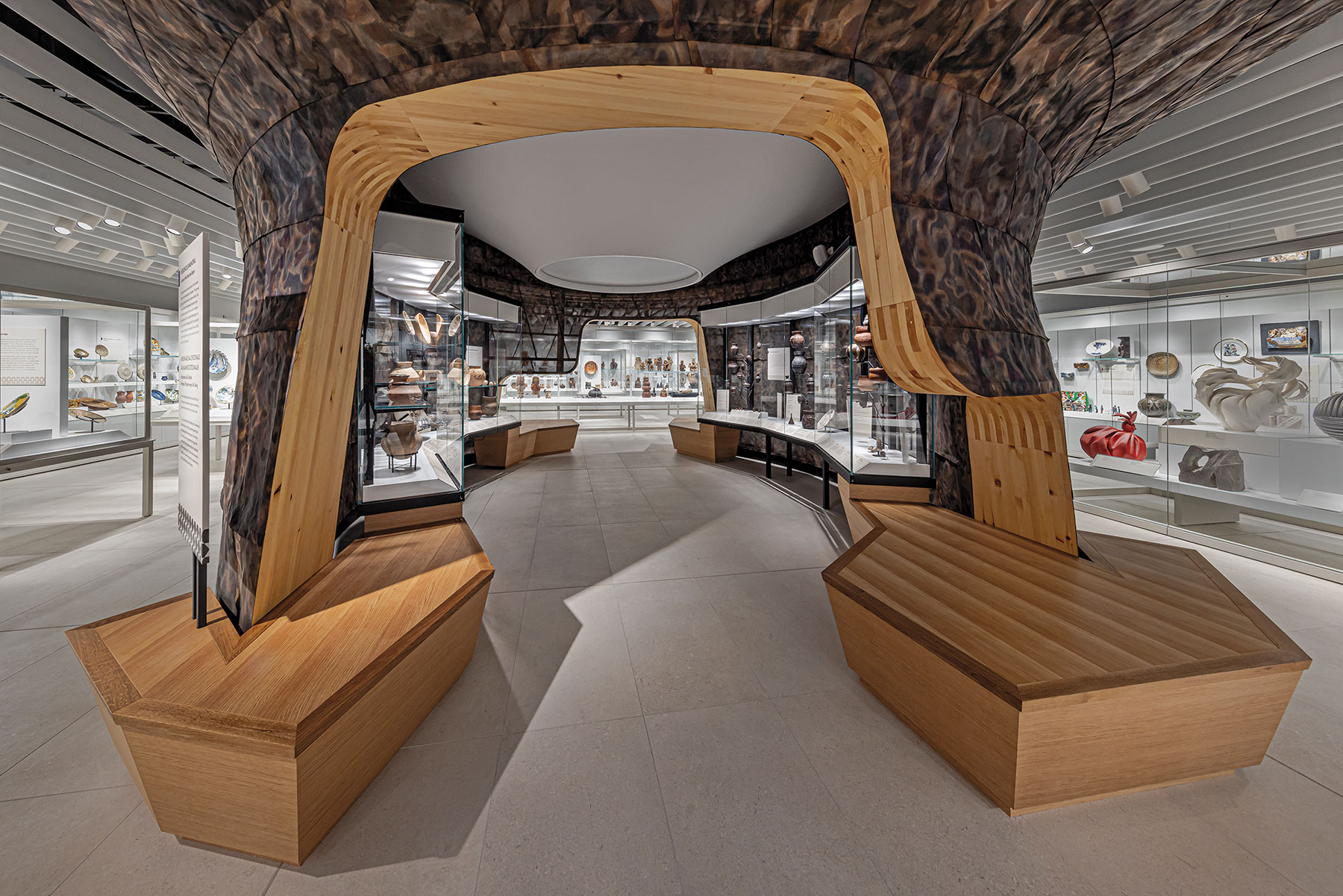
A view of the Gardiner Museum’s new ground floor Collection Galleries with the Gallery of Indigenous Ceramics at its centre. TONI HAFKENSCHEID/GARDINER MUSEUM
March 9th, 2026 · Comments Off on NEWS: City to convert former CSI building to homeless shelter (Jan. 2026)
Near Bloor and Bathurst, shelter will be Indigenous-focused
By Rose Haberer
The former home of the Centre for Social Innovation (CSI), at 720 Bathurst St., has entered a new phase. CSI sold the building for $16 million to an “anonymous social purpose entity,” later revealed to be the City of Toronto, which intends to convert the former co-working hub into an Indigenous-focused shelter.
“The city’s purchase helped CSI find a buyer in a very depressed real estate market,” said Tonya Surman, CSI co-founder and CEO.
CSI spent two years seeking a social-purpose buyer and was “delighted” when the city made an offer. Surman called the sale a “win-win,” solving a challenge for CSI and giving the building renewed social purpose.
“Converting the building into an Indigenous-focused shelter will meet a significant need in our city and will help address the disproportionate impact of homelessness on Indigenous people,” said Surman.
In 2021, the City of Toronto reported that Indigenous people represent 15 per cent of people experiencing homelessness but constitute only two per cent of the general population of Toronto.
The shelter, expected to open in 2028 or 2029, will house up to 80 Indigenous adults and include 24/7 staffing, on-site medical care, meals, laundry, and cultural programming. Its rapid purchase was made possible by the city’s 2022 Shelter Infrastructure Plan which allows council to approve multiple shelter sites at once and gives staff the authority to open or modify shelters without returning to council. As a result, nearby residents are often informed only after key decisions are made.
Paul MacLean, board chair of the Palmerston Area Residents’ Association (PARA), said he has been in contact with the city’s shelter services department, Councillor Dianne Saxe, (Ward 11, University-Rosedale), and nearby residents likely to be affected by the site.
“The only concern I’ve heard so far is that there’s going to be two to three years of construction. We can speculate all we want about what the shelter will be like, but that’s three years away,” MacLean said.
He noted that some residents who live near 720 Bathurst have already endured eight years of construction from the Mirvish Village redevelopment.
Residents on the east side of Markham Street, who share a laneway with 720 Bathurst, are expected to be particularly affected as they will be “essentially living in a construction zone rather than a neighbourhood.” MacLean emphasized that ongoing dialogue between these residents and the city will be essential as the project moves forward.
“People want this facility to be successful,” said MacLean, though he questioned what success would look like.
Councillor Saxe suggests that success for this project means the upcoming shelter must “be a good neighbour to the surrounding community,” a factor she says that will distinguish it from other shelters, such as St. Stephen’s Community House in Kensington Market.
She said it was near an injection site and known for disturbances. “I don’t want to see anything like that in my community, and I’m here to make sure it doesn’t happen,” she added.
The city has highlighted neighbourhood impact as a key priority, with shelter residents required to follow a “good neighbour” policy. The city has stated that the site will not include supervised drug consumption services and will not provide unregulated substances.
It will feature security measures such as cameras and controlled access. The city has also said it will work with Toronto Police to address concerns as the project moves forward.
Councillor Saxe emphasized that 720 Bathurst will not be a drop-in shelter. “The word ‘shelter’ is confusing—people think it means you just drop in. Residents will live at 720 Bathurst for six to eight months.”
She added that it will be run by a known Indigenous organization but could not disclose which one at this time.
When asked about concerns over the two-to-three-year construction period, Saxe said the work would be carefully managed, with clear communication and minimal disruption, while noting that such renovations are routine for older buildings. “This kind of construction happens in Toronto all the time. I am heavily involved in ensuring this is properly supervised, that complaints are addressed calmly, that there’s good communication with the neighbours, and that every precaution possible is taken to avoid disturbance. Yes, it will be loud, but it’s an ordinary feature of the city.”
With the shelter not expected to open for some time, the months and years ahead for the Palmerston community will be shaped by an interim period focused more on construction and consultation than on shelter operations.
To begin this next stage, the city says it will hold a community meeting early in the new year to provide an overview of its plans and address questions and concerns.
March 9th, 2026 · Comments Off on IF THESE WALLS COULD TALK: So many rich and diverse lives lived in these twin houses (Jan. 2026)
631 and 633 Davenport Rd. hosted a hardware store, cancer care club
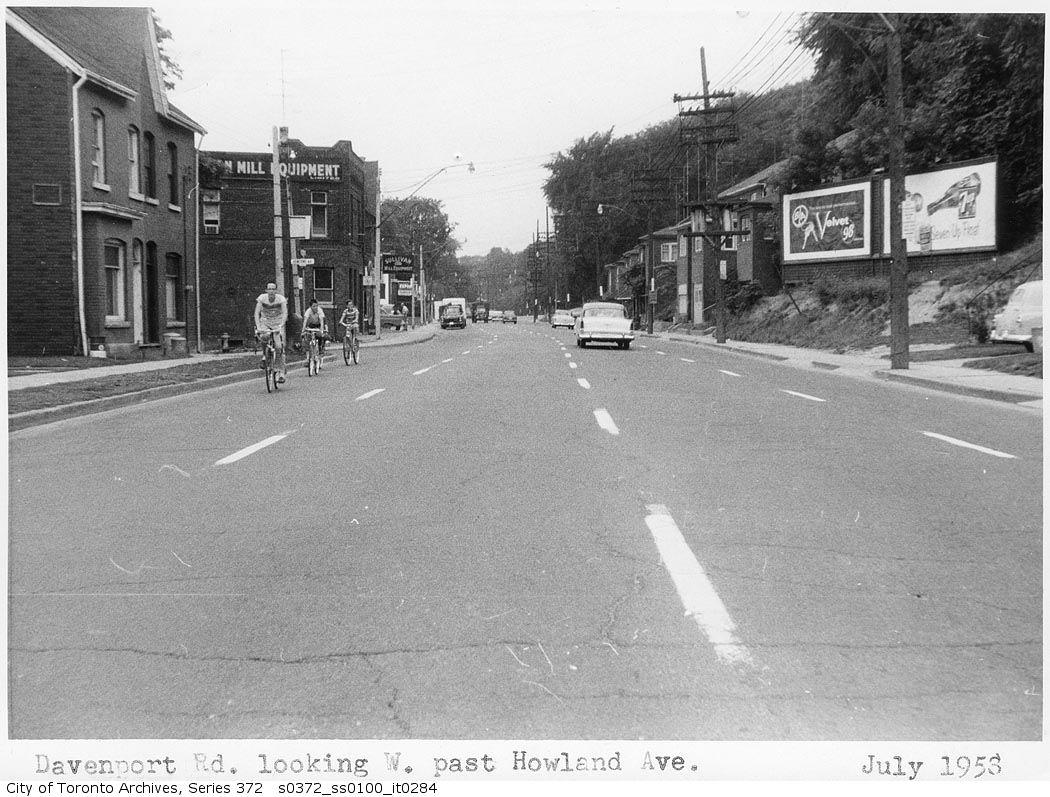
Davenport Road looking west from Howland Avenue in 1953. COURTESY CITY OF TORONTO ARCHIVES
By Mike Mastromatteo
Adjoining homes on the southeast corner of Davenport and Howland—an area once known as Bracondale—have a curious history coloured by the many lives and experiences that graced the homes over the last 140 years. (But the “walls” column parameters are wide and are not reserved for houses with dramatic histories.)
Designed in the neo-Gothic Victorian style, 631 and 633 Davenport for many years had no real addresses. Municipal directories from 1885 until 1914 only refer to the general location of the homes at the southeast corner of Davenport and Howland. It wasn’t until 1914 that the properties acquired the numbers 631 and 633 Davenport Rd.
The house at 631 Davenport has a prosaic enough beginning. One of the first occupants was a Frederick J. Nicholson (1915), whose occupation remains a mystery. He lived there until Alex Christie, a chauffeur for the T. Eaton Co., took up residency in 1918. Charles Wood, identified as a driver in the municipal directory, lived in the house from 1919 until about 1922.
For the next 28 years, the house was owned by Mrs. Emily Pilkington, widow of William, a labourer, who passed away around 1920.
Emily Pilkington raised two sons and two daughters in the home. The most notable, perhaps, was William Jr. (1919-1977), a graduate of Oakwood Collegiate, who served for many years as a cadet, sergeant, and inspector with the Toronto Police Force. William Jr. toiled with the morality squad on the force and was often quoted in newspaper articles about the decline of decency and morality in the Toronto of the 1950s and 60s.
A Toronto Daily Star article from Dec. 21, 1967 featured the following lead paragraph: “‘A
weird, LSD-taking cult that thrived in Yorkville recently drove many hippies into mental hospitals,’ Inspector William Pilkington of the Metro police morality squad said today.”
Presumably, the walls within Pilkington’s childhood home at number 631 readily glommed to the fact that he would become a law-and-order man.
During the Second World War, William was active with the Royal Canadian Air Force 415th Squadron. He joined the Toronto Police in 1945 and later became chief of police in Whitby, Ontario, from 1968 through to 1973. Pilkington died April 14, 1977, at age 58.
With the Pilkington family era’s passing at 631 Davenport, a number of short-term owner/occupants took over the property.
Andrejs Vaivods, a die finisher at De Havilland Aircraft, resided there in 1953, and salesman Lloyd McIntyre owned the property from 1955-1956. By the late 1950s, the house became a rooming home. It was vacant in 1958, but by the next year, Tauno Korhonen, an employee with the federal government had moved in.
Owner/occupants in the 1960s included Horace E. Roe, an employee of Canada Metal Ltd. and William Grimes, whose occupation escaped notice by the compilers of the municipal directories.
Other later owners/occupants include bank manager Paul Stain (1977) and Andy Freemark, possibly a real estate agent, in 1985-86
The house at 633 Davenport, much like its conjoined twin, also had some interesting characters dwelling within. Engineer James Turner resided there in 1915, followed by painter Percy Wheeler in the mid-1920s.
633 Davenport was a hardware store for its first 20 years. The interior was then renovated to serve as a proper two-storey home for a single family.
The name Harniman is closely connected to the history of number 633.
Hardware proprietor and builder James Harniman and wife Jane lived there from 1890 until about 1898. James, however, must have passed away before the turn of the century, as the 1900 municipal directory lists Jane Harniman as residing at 14 Follis Ave., the home of her brother-in-law, Alfred.
Curiously, another Harniman, Alfred, opened a hardware store in 1908 at 937 Bathurst St., just a little southwest of the Davenport store. Alfred, and a host of other Harnimans, including widow Jane, all lived together at 667 Manning Ave. from 1908 to 1910.
TTC mechanic Duncan Campbell occupied the home for 15 years from 1925 until 1940. His widow Jean was there until about 1950. As a TTC mechanic, one wonders if Duncan made the daily walk to the TTC barns on Bathurst, just south of Davenport, to tend to bus and streetcar mechanical problems.
One last anecdote about 633 Davenport—one that “walls” readers would no doubt appreciate—involves its time in the early 1980s as headquarters for the volunteer-run Cancer Club of Toronto.
The club was an information centre and support organization for patients undergoing treatment for various forms of the affliction.
It was operated by Sherry Bate, herself a cancer survivor, who for years lobbied for increased treatment options for cancer patients.
Andres Watson, the current owner of 633 Davenport and executor for the next-door property, has a special interest in seeing the houses survive the passage of time and condo development. He inherited the estate from his late mother Kulli Milles and has since operated the home as a rooming house for students and other tenants.
“Both interiors are almost time capsules,” Watson said in reference to their older interior design and building materials. He would like the homes to be designated as heritage properties. His fervent hope is that they will not be torn down and replaced by a new edifice totally at odds with the history and character of other old homes in the neighbourhood.
“I need help in getting it listed by Heritage Toronto,” Watson told the Gleaner. “I also want a buyer who will restore the house—not someone who will gut and renovate it. I want to sell the house to someone who loves and cares for the preservation of an original Victorian. I get to choose the buyer, and no house flipper or renovators need ever enter the house.”
March 9th, 2026 · Comments Off on NEWS: Inside the transformation of the Gardiner Museum (Jan. 2026)
Renovation focuses on connection, access, and Indigeneity
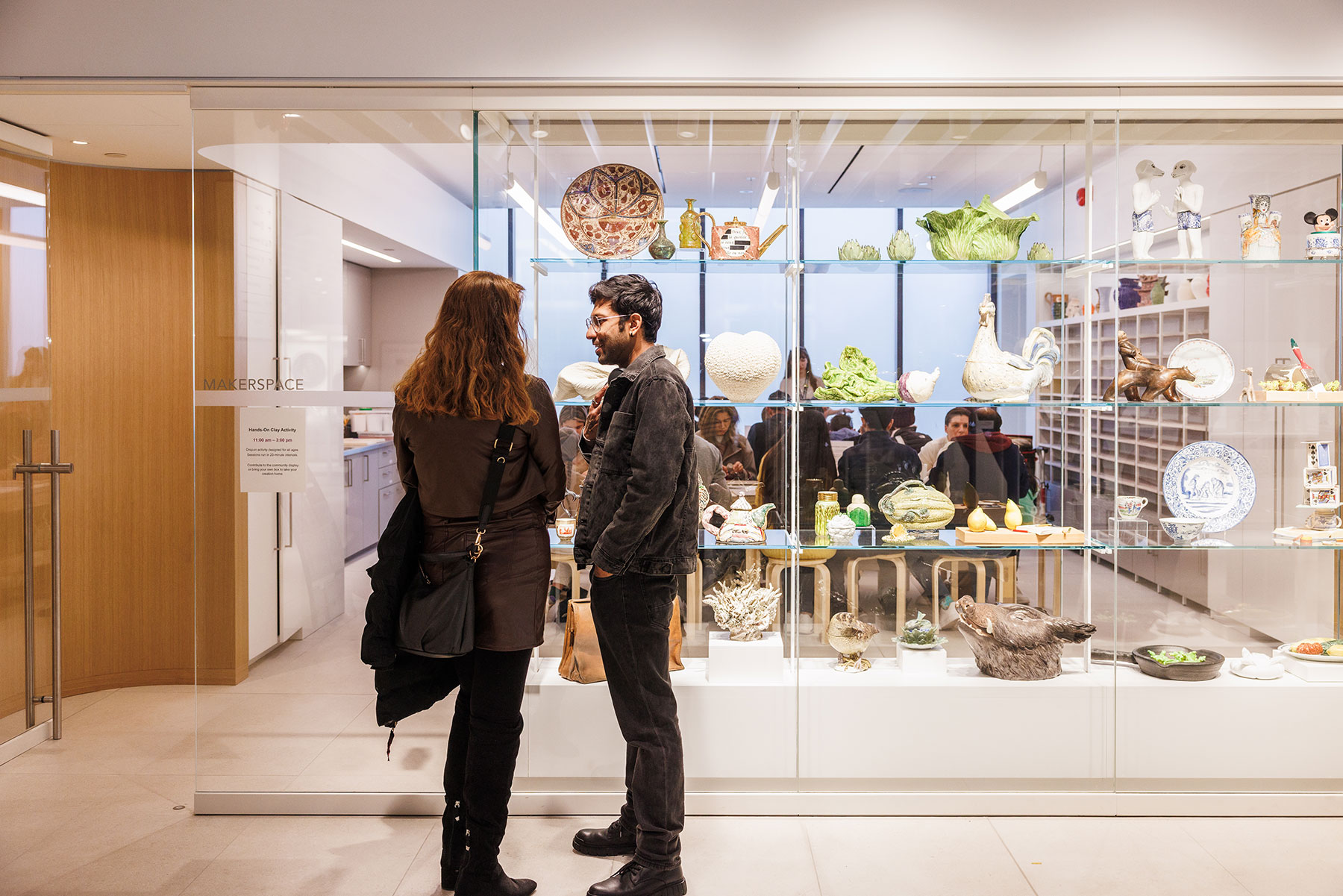
Visitors standing in front of the new Makerspace during the free opening weekend celebration on Nov. 8, 2025. BRITTANY CARMICHAEL/GARDINER MUSEUM
By Mackenzie Currier
The Gardiner Museum, located at 111 Queen’s Park, opened its fully renovated ground floor on Nov. 6. The transformed space includes the Gardiner’s first-ever Indigenous ceramics gallery, new collection galleries, a Makerspace, where visitors can work with clay, and a Community Learning Centre.
The $15.5-million project was made possible by a $9-million contribution from the Radlett Foundation with support from private and public partners, including the Hilary and Galen Weston Foundation, the Lindy Green Family Foundation, and the Government of Canada. Though planning for the renovation began around 2016, the project gained momentum in 2022 following the Radlett Foundation’s generous gift in honour of William B.G. Humphries. The donation expanded the legacy of the late Humphries, a porcelain collector and philanthropist who was passionate about advancing the rights of Indigenous peoples. He envisioned a space that would unite diverse communities through clay and would include accessible education, programming, collections, and exhibitions. This project was built on the pillars of connection, access, and Indigeneity, and the design and curation of the space reflects these values. “This transformation establishes the museum as a dynamic and flexible cultural institution for everybody,” said Sequoia Miller, chief curator and deputy director of the Gardiner Museum.
As part of its commitment to represent and unite diverse communities, the Gardiner established anti-racism, anti-oppression and equity as foundational values. The museum also appointed its first curator of Indigenous ceramics, Franchesca Herbert-Spence, to support its mission to centre Indigenous voices and advance Indigenous self-determination. Herbert-Spence worked with architect Chris Cornelius, a citizen of the Oneida Nation of Wisconsin, when designing the Gardiner’s first gallery of Indigenous ceramics. Prior to Herbert-Spence’s appointment, the Gardiner’s Indigenous Advisory Circle had recommended that the pieces be acquired from artists in the Great Lakes region, with no time period constraints. Following these recommendations, Herbert-Spence commissioned pieces from artists on Manitoulin Island, Six Nations of the Grand River, and Curve Lake. She selected works that reflect the artists’ values and subverted the practice of including only one artist per community by sourcing pieces from multiple artists. She also included archaeological pieces from around these communities.
The gallery is presented in a wooden frame with a transparent copper mesh skin that serves as feathers. Architect Chris Cornelius wanted to create a “vessel that is part of the larger museum experience but also acts as a container to present the Indigenous ceramics within it.” When designing the display, Cornelius emphasized that these pieces are not artifacts of the past, but rather a continuation of Indigenous knowledge. He wanted his work to express something timeless. On the ceiling there is a 24-hour recording of the sky, compressed into 20 minutes, which gives visitors a unique and dynamic experience.
Gabrielle Peacock, executive director and CEO of the Gardiner Museum, asked, “How do we welcome people into the space? How do we connect them to the works in our collection?” Over the past two to three decades, the museum’s audience has shifted to reflect Toronto’s diversity. The Gardiner is also engaging more with younger guests and students and inviting visitors to engage with the medium in a hands-on way. By including art education, the Gardiner has joined a broader cultural shift toward making museums audience-focused rather than object-focused. The hands-on studio enables people to connect with ceramics and gain a greater appreciation for the collections and installations.
In the new William B.G. Humphries galleries visitors will experience ceramics spanning many geographies, cultures, and time periods. The collection encourages visitors to discover connections between pieces and reflect on their own lives as they engage with artifacts from Indigenous Latin America, Europe, and Canada. The Gardiner commissioned Nadia Myre, a contemporary visual artist from Montreal and an Algonquin member of the Kitigan Zibi Anishinaabeg First Nation, to create the installation A Line Through Time. Her pieces use ceramic beads and clay pipes to explore themes of cultural memory and exchange.
In discussing the impact of the renovations, Peacock hopes guests will be “astonished by the scope of ceramics that have been and are continuing to be made” as well as surprised by some elements of the new space. She hopes the renovation inspires people to discover ceramics and to learn more about themselves through cultural traditions.
Visiting hours are from 10:00 a.m. – 6:00 p.m. on Monday, Tuesday, Thursday, and Friday; 10:00 a.m. – 9:00 p.m. on Wednesday; and 10:00 a.m. – 5:00 p.m. on Saturday and Sunday. Ticket prices are $18 for adults, $14 for seniors (65+), and free for youth (18 & under), students, and Indigenous Peoples, with universal free entry on Wednesday evenings after 4 pm.