November 17th, 2015 · Comments Off on The city’s diaper diversion ruse
Disposable diapers get taken out of green bin, sent to landfill
By Terri Chu
When people see my little one in a cloth diaper, I inevitably get questions about how I like them, what kind I use, and how eco-friendly they really are. While I try to answer most of them with grace, there’s one that’s been getting my goat and the City of Toronto really needs to educate new parents better.
Not one, but no less than FIVE moms have recently asked me some variation of “why even bother with cloth diapers when you can compost disposable ones now?” The first time I heard it I just thought someone wasn’t thinking this through, but by mom number five, it became clear there’s a big misconception out there.
Yes, Toronto allows diapers in the green bin.
No, plastic, toxin-filled diapers do not compost…even if they did, you probably don’t want to use them on your vegetable garden.
When they moved garbage from weekly to bi-weekly garbage pick up (alternating with recycling), there was some resistance, particularly from parents having to keep soiled diapers for two weeks. As a compromise, Toronto allowed diapers into the green bins so that residual household waste could then move to a two-week cycle. Toronto is one of few (if not the only) municipalities that has this quirk. Other municipalities just put up with stink for an extra week (this goes for cat litter and animal poop too).
Allowing diapers in the green bin does NOT mean that we have magically found some way to compost plastic. While the poop and the cotton lining might get separated out, the plastic and the absorbent chemicals are immediately sent to landfill. Diapers still end up in landfill, now just with a two-step process. (What is incomprehensible is that the “diverted” diapers also count toward the city’s waste diversion targets, as do a few other things, but that’s a whole other article.) Toronto giving in to complaining is part of the reason we have notoriously low quality compost. Poop from carnivores doesn’t make great compost.
Somehow in the decade since instituting green bins, moms in Toronto have been misled into believing that disposable diapers are somehow “green” because they go into the compost. One mommy blog went as far as describing the process of separating out diapers from other trash as a “good cause” worth the effort, whereas in reality it just means more work for someone at the receiving facility. It’s one thing to choose disposables for a litany of reasons, but being misled into thinking that they are “green” should not be one of them.
I fully understand the allure of disposable diapers. A lot of parents are also doing it solo, and a little one is enough of a handful without adding loads and loads of diapers to the mix. Disposables are convenient and great at preventing diaper rash, as these petrochemicals are fantastic at doing their job. No cloth diaper can possibly compete no matter how much arrowroot flour or cornstarch you throw onto a baby’s bum. There are legitimate reasons to use disposables and not everyone is an environment freak. What’s important to me, though, is that people make their choices based on accurate information.
Whether they intend to or not, the city accepting diapers in the green bin with little explanation of where it goes from there has misled moms for the past decade. The city needs to fix this misconception so moms can make the decisions for their family with the best available information.
This can be as simple as an information graphic on the annual waste management calendar that tells families what day their garbage and recycling will get collected. A simple diagram explaining that diapers get fished out and sent to landfill would suffice. I don’t think it’s reasonable to expect all moms to understand the nuances and complexity of our municipal solid waste system. Diaper mass also shouldn’t count towards the city’s waste diversion targets. If Toronto wants to be a green city, it needs to fix this smelly problem.
Terri Chu is an engineer committed to practical environmentalism. This column is dedicated to helping the community reduce energy use, and help distinguish environmental truths from myths. Send questions, comments, and ideas for future columns to Terri at terri.chu@whyshouldicare.ca.
Tags: Annex · Liberty · News
November 17th, 2015 · Comments Off on University community stops to remember
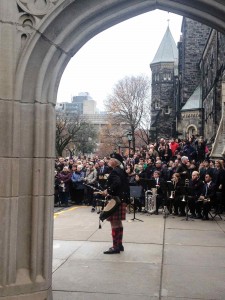
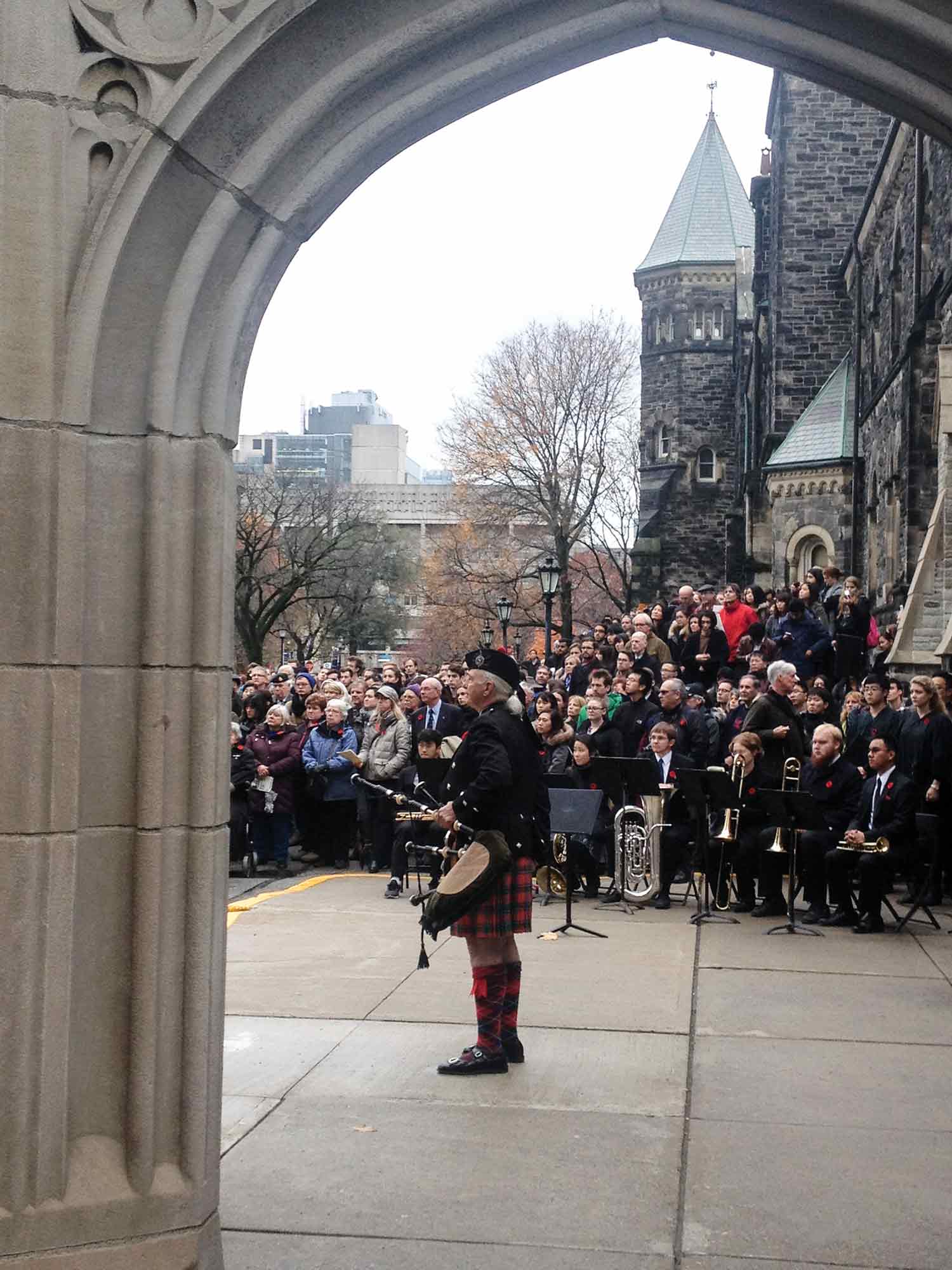
Harbord Village’s Rory “Gus” Sinclair stands for a moment of silence during the University of Toronto’s Service of Remembrance on Nov. 11. Held annually at the foot of the Soldiers’ Tower, the service — during which the university community honours the faculty, staff, alumni, and students who fell during the First and Second World Wars and other conflicts — includes the singing of traditional hymns, the laying of wreaths, and readings, including In Flanders Fields, written by John McCrae, a university alumnus.
Tags: Liberty · News · People · General
November 17th, 2015 · Comments Off on Pot herb survivors for your home
Summer’s over but they can still grow indoors
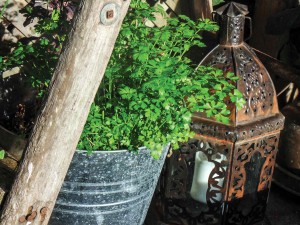
Lisa Lomax, Gleaner News
In this reprint of an article from October 1997, landscape architect Bardi Vorster helps us identify which herbs we can bring indoors and enjoy long after the first frost.
By Bardi Vorster
The first task when you mention herbs is to narrow the field. The ones we are talking about here are all edible — hence the term pot herb. There are often several uses for one plant; ancient remedies claim everything from medicinal cures to voodoo, but this is a gardening article so I will concentrate on growing them — successfully — indoors in winter.
What they really like
Of the many popular cooking herbs available, the following are some of the easiest to grow. As a group they are generally less demanding in soil types, although all absolutely require a well-drained mixture. Soils of slightly acid or neutral pH are best; don’t use the rhododendron fertilizer on them! It’s acid.
For rosemary, thyme, lavender, and oregano, try some crushed egg shells as a mulch. They are calcium sweet. It is also a common trait that herbs prefer soils which are not too rich. This means a lower organic content, so combining some “cactus mix” with the regular potting mix will at least ensure fast drainage.
When you consider that virtually all of these are native to Mediterranean climates, you can surmise that the biggest problem is the quantity and quality of light. Most herbs need full sun (four hours a day), so give them all you’ve got.
Although parsley, rosemary, mint, and oregano will tolerate some shade, indoors they do better with more light. Given the natural light levels in Toronto in the average winter, your plants will be virtually dormant or growing very slowly. Additional fluorescent light will help.
If you only have north light, face the fact that even the hardiest herbs will languish. Don’t forget to rotate the pot occasionally to keep them growing straight.
I’ve found that the best survival strategy for herbs indoors is to buy or transplant the biggest plant you have. Larger plants withstand variations in temperature and watering better and, of course, there is more to clip and eat. Although most herbs are easily grown from seed, now is not a good time to start. Grocery stores and garden centres offer plants at various seasons and at this time of year the St. Lawrence Market has larger specimens.
Water, fertilizer, and air
Don’t water your herbs on a regular schedule but rather as they need it. In fact, keep them on the dry side. Use room temperature water to avoid shocking them and be sure that they do not stand in water. Never let your rosemary dry out completely; it dies, seemingly overnight. Furthermore, appearances are deceiving, I cheerfully watered mine for a month before I realized it was absolutely dead!
As the plants are not growing very fast don’t overdo the fertilizer. Fish emulsion is gentle or 20-20-20 applied every month will keep them going. Good air circulation is healthy for plants and people and similarly drafts are not. It is best not to move the plants around, so they won’t have to adjust all the time.
If you are bringing plants inside from the garden, you should do so before the heat goes on. Acclimatize them in a shaded location for a couple of weeks. Examine them carefully for insect visitors and spray with insecticidal soap if necessary. Chives can be left outside until the frost kills the foliage. Trim back to 1.5? when you bring them in and soon new growth will spring up.
The following best-for-indoors culinary herbs have been selected for similar growing requirements and smaller size. They are all happy with daytime temperatures in the 70s and a night temperature above 40 degrees.
Chives: Allium schoenoprasum. Will be happy in a pot for years and the bulbils are easily divided if it gets overcrowded.
Lavender: Lavandula angustifolia. All parts are fragrant and it is much used in cosmetics. It is an uncommon flavour for food but the flowers are edible — lavender ice cream anyone?
Mint: Menta piperata (peppermint). There are many different flavours of mint; all of the plants are vigorous growers and should be productive in pots for six months or more.
Parsley: Petroselinum crispum. Harvest by cutting the outer leaves, leaving the central rosette to produce new growth.
Rosemary: Rosmarinus officinalis. An attractive evergreen shrub. The leaves are used to repel moths as well as to eat. Misting the branches is beneficial. Be especially vigilant about watering, but don’t overdo it.
Sage: Salvia officinalis. Replace the plants when they become woody as they are not as productive.
Marjoram: Origanum majorana. Keeps its flavour when dried but keep out of direct light to preserve colour and flavour.
Oregano: Origanum vulgare. The strongest flavoured one is Greek; however plants can vary considerably so you should taste before you buy.
Bardi Vorster is a practising landscape architect in the Kingston area. Her website is www.individuallandscapes.com/ and her email is bardivorster@gmail.com.
Tags: Annex · Liberty · Food
October 8th, 2015 · Comments Off on
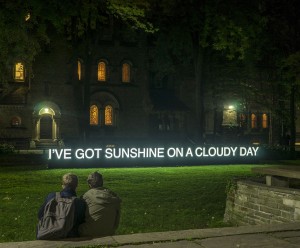
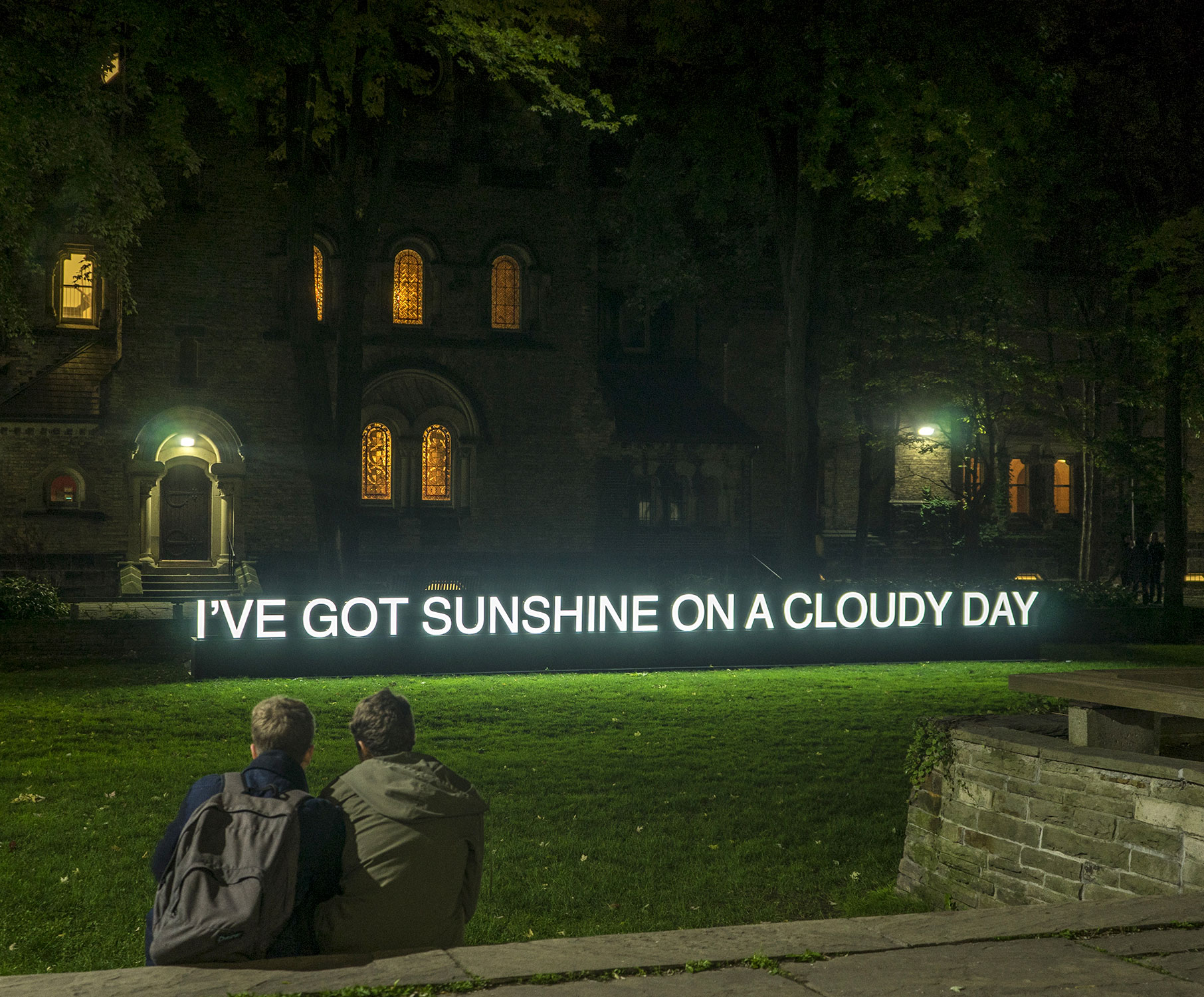
Art animated the Annex earlier this month as it hosted a variety of installations for Scotiabank Nuit Blanche on Oct. 3. Catherine Chan’s I’ve Got Sunshine on a Cloudy Day (above), at 15 King’s College Circle, is a literal and figurative representation of sunshine that asks: what brings light to darkness? Neiland Brissenden, Gleaner News
Tags: General
October 8th, 2015 · 1 Comment
University-Rosedale candidates tackle refugee crisis, social justice issues
By Annemarie Brissenden
Two University-Rosedale all-candidates’ meetings hosted in the Annex were a study in contrasts.
The first, held on Oct. 2 and arranged by a consortium of residents’ and business associations in partnership with three United Church congregations, was very much a well-attended local affair that focused on the social justice issues that the area’s citizens are known for championing.
The second was organized by the students of the Master of Global Affairs program at the Munk School in conjunction with the Canadian International Council. Packed to standing room only, the audience crowded into an overflow room to watch a more traditional debate that focused on global affairs and Canada’s place in the world.
Representatives from all four of the major parties were in attendance, as well as those from the Marxist-Leninist, Communist, and Libertarian parties. They debated a range of issues, considering everything from Arctic sovereignty, climate change, Israel, women’s issues around the world, and the war on terror.
On the last point, all the candidates (except, of course, the Conservative Party of Canada’s Karim Jivraj) were aligned in attacking the federal government for participating in military strikes in Iraq and Syria, vowing to pull out should their party be elected.
“Canada should be a force for peace,” said the Green Party’s Nick Wright.
For the Liberal Party’s Chrystia Freeland, Canada must focus on areas where it can make a measurable difference.
“How can we as Canada make a specific contribution that will have an impact?” she asked. “With ISIS, it’s refugees and training.”
Noting, “the war on terror has metastasized into a refugee crisis,” Freeland said that Canada has expertise on refugees, and can play a global role in addressing the crisis.
The New Democratic Party’s (NDP) Jennifer Hollett would “stop the flow of arms, funds, foreign fighters” and focus on deradicalization here at home. She was highly critical of the federal government for promoting a climate of fear, and said the NDP would repeal Bill C-51.
After missing the Oct. 2 debate, Jivraj came out swinging like a man who had strong-armed himself into a Nietzsche tome over a bowl of Wheaties.
“The fight against ISIS is probably the most defining political event of our age,” he said, aggressively defending Canada’s participation in the war on terror. “Stand up for human rights by committing to air strikes against the Islamic State.”
Jivraj also zealously championed international trade agreements, framed the missing and murdered Aboriginal women as a crime and punishment issue — “the time for inquiries is over” — not one of race, and asserted that environmental concerns must be balanced with economic interests.
Even though Jivraj’s absence at the earlier all-candidates meeting made for a much more collegial atmosphere, it did not go without comment.
“It’s a shame the Conservative candidate couldn’t join us,” said Hollett to much applause, “because the top issue I hear at the door is that it’s time for Harper to go.”
At times the candidates seemed to be campaigning for each other as they addressed a national strategy for pharmacare, housing, refugees, proportional representation, how to grapple with the findings of the truth and reconciliation commission, and climate justice.
“One of the most disgraceful things of the Harper decade is the total inaction on climate change,” said Freeland, thanking the churches for framing the question as climate justice, and adding that the Liberals would build on the work that the provinces had already done.
Hollett — “I don’t think we can talk about climate enough” — argued that climate change, social justice, and economic equity must all be seen as pieces of the same puzzle. She wants Canada to take a strong position and go into the United Nations (UN) conference on climate change in Paris this November with some of the most ambitious targets the nation has ever had.
Wright, who said that “the Green party is the only party that says no to tar sands and pipelines”, added that Canada must transition to a green sustainable economy to stop mortgaging its future.
The refugee problem also played a prominent role in this debate.
Hollett said that the NDP would meet the targets set by the UN and admit 10,000 Syrian refugees immediately, taking 9,000 per year thereafter.
“We would welcome 25,000 Syrian refugees, and contribute $100 million to help refugees on the ground,” countered Freeland, adding that as her mother was born in a Displaced Persons camp, the refugee crisis is a very personal one to her.
For Wright’s part, solving the refugee problem is a deceptively simple one.
“We have to stop pursuing wars of aggression, which,” he said to strong support from the audience, “will eliminate refugees altogether.”
Tags: Annex · Liberty · News
October 8th, 2015 · Comments Off on
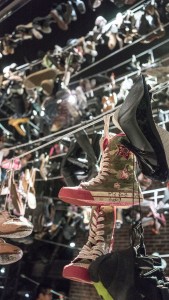
The public was encouraged to participate in Shoes That Line the Lane by donating and hanging shoes to celebrate an important memory or person. Created by Cyril Williams, this Nuit Blanche interactive installation outside the Bata Shoe Museum focused on the rite, ritual, and tradition of hanging shoes off wires in public spaces. Neiland Brissenden, Gleaner News
Tags: Annex · Liberty · Arts · General
October 8th, 2015 · Comments Off on Alive with history
Toronto Heritage recognizes HVRA Storyposts
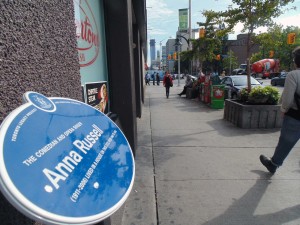
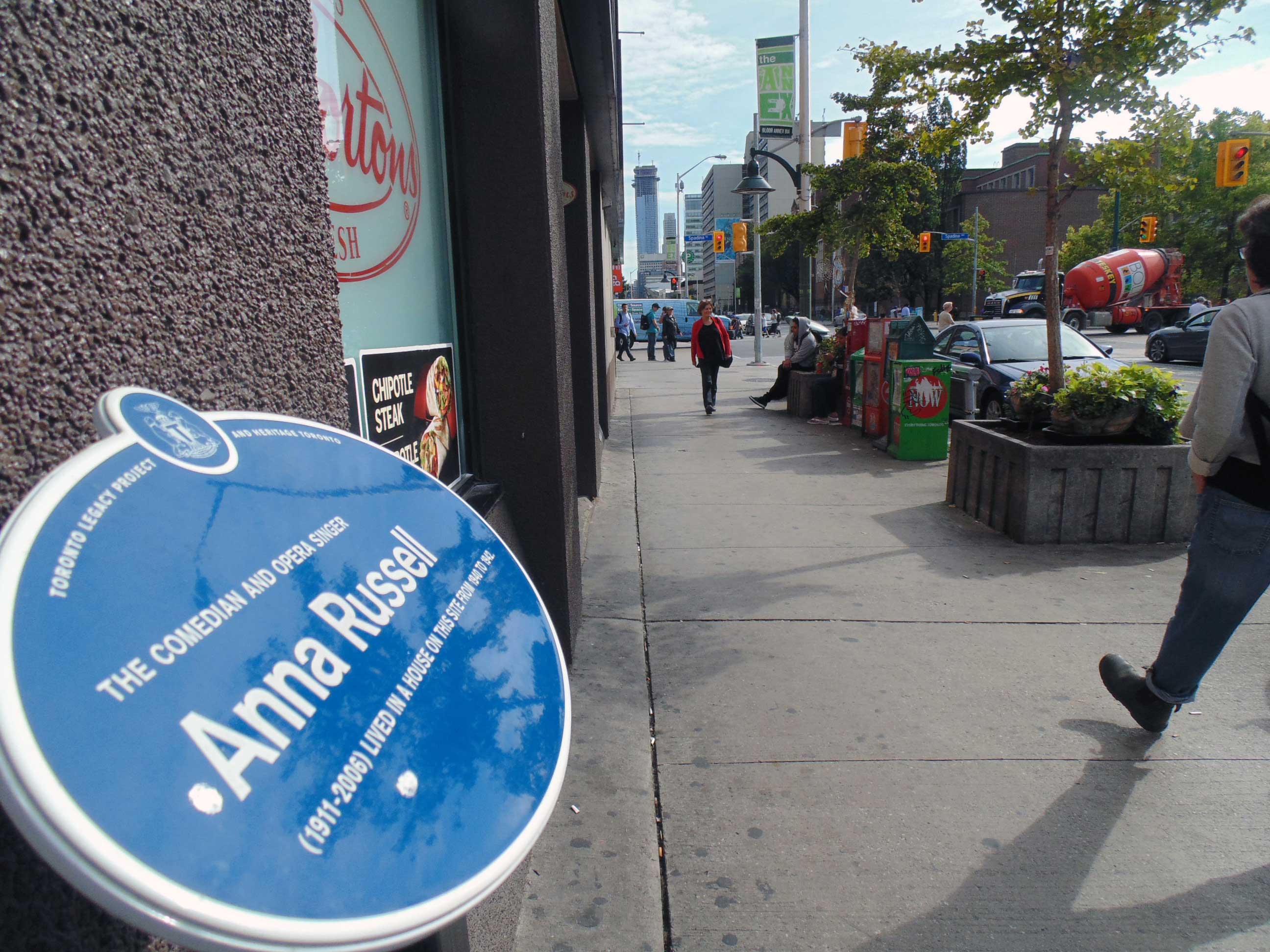
This Toronto Legacy Plaque on Bloor Street honours Anna Russell, the “funniest woman on the opera stage”, says Grace Westcott, chair of the Toronto Legacy Project. The group has been nominated for a 2015 Heritage Toronto Award, one of several Annex-related nominees this year. Brian Burchell, Gleaner News
By Annemarie Brissenden
How do we define a city’s heritage? Is it the network of buildings connected by meandering streets and avenues? Is it a shared history of accepted truths?
If this year’s nominees for the Toronto Heritage Awards are anything to go by, our heritage is as woven out of the conflicting narratives, shared memories, and individual triumphs of our collective past as it is from our built history.
“We are getting people to think of heritage as a much broader concept than buildings,” explains Dr. Nicole Schulman, the producer of the Harbord Village History Storyposts, a project of the Harbord Village Residents’ Association that has been nominated in the media category.
Located throughout Harbord Village, there are 24 Storyposts: bright yellow outdoor plaques with QR codes that, when scanned by a smartphone, guide listeners to an audio collage created from interviews with long-time residents, organized by theme. Some are light-hearted, recounting memories of the games children played, while others cover more serious subjects like racism and anti-Semitism.
Very much inspired by murmur, a documentary oral history project that records stories about specific locations, the Storyposts took about two and a half years to produce, and grew out of a companion project to capture the oral stories of the neighbourhood’s oldest residents before those stories were lost.
For Schulman, who notes that at times the individual voices contradict each other, the “oral testimonies convey the reality that there is not a single truth” and remind us that “we do have history, and it helps shape who we are today”.
One of the biggest challenges was figuring out where to locate the plaques: the one about chestnut trees, for example, is placed so a listener is looking at a chestnut tree, while the one about the games children played is placed in front of a park.
Choosing “which site does the most justice to the individual” is not always easy, allows Grace Westcott, chair of the Toronto Legacy Project, which oversees the Toronto Legacy Plaques in partnership with Heritage Toronto. “Sometimes you choose visibility over historical significance.”
Nominated in the community heritage category, the project has erected 37 distinctive blue plaques that mark where a person of note once lived or accomplished something significant.
There is a large cluster of plaques in the Annex honouring notables such as Lester B. Pearson (Admiral Road), Norman Bethune (Robert Street), and champion rower Ned Hanlon (Beverley Street). And, it’s hard not to miss Anna Russell’s plaque amid the hustle and bustle of Bloor Street just west of Spadina Avenue.
Westcott’s favourite plaque, however, is the one honouring Jane Jacobs on Albany Avenue.
Part of the Annex cluster, it’s located where Jacobs lived when she was fighting the Spadina expressway, between two trees that she planted, in an area that still exists as a result of her work.
“It’s redolent of Jane Jacobs and everything she stood for.”
Modelled on the blue plaques of London, England, which date to 1866, the program was founded in 2009 by Toronto’s then poet laureate Dennis Lee — of Alligator Pie fame — who wanted to bring greater prominence to the city’s great achievers. (Have you heard, for example, of Donald Coxeter, the most important mathematician since Euclid? There’s a plaque for him.)
For Westcott, the Heritage Toronto nomination is a recognition that “we’ve accomplished something… something that’s noticed and has value”.
“Encouraging recognition of the city’s heritage in all its forms” helps to remind us to preserve that heritage, says Kevin Plummer, the Heritage Toronto board member who chairs the Awards Working Group.
One of the buildings up for recognition in the architecture category is the one Uno Prii designed at 100 Spadina Rd.
Unlike the fate suffered at Prii’s 44 Walmer Rd., where the original distinctive balconies were removed and never replaced, the exterior appearance of 100 Spadina Rd. was restored.
“Uno Prii’s buildings were a cohesive whole, and the balconies were part of his original vision,” relates Plummer. “It certainly strikes a contrast to [44 Walmer Rd.] in terms of how the owner of 100 Spadina Rd. is trying to maintain the heritage of the building.”
There are two other local landmarks nominated in the architecture category, the sanctuary at Trinity-St. Paul’s United Church, which underwent significant upgrades to its accessibility, stage size, and acoustics, and the Munk School of Global Affairs, whose interior masonry, original windows, and interior staircase were restored.
For further information about the Harbord Village History Storyposts, or to hear them in their entirety, please visit http://www.HarbordVillageHistory.ca. For further information about the Toronto Heritage Awards, or to buy tickets, please visit www.heritagetoronto.org.
Tags: Annex · Liberty · News
October 8th, 2015 · Comments Off on
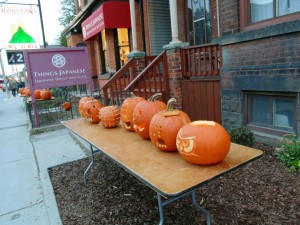
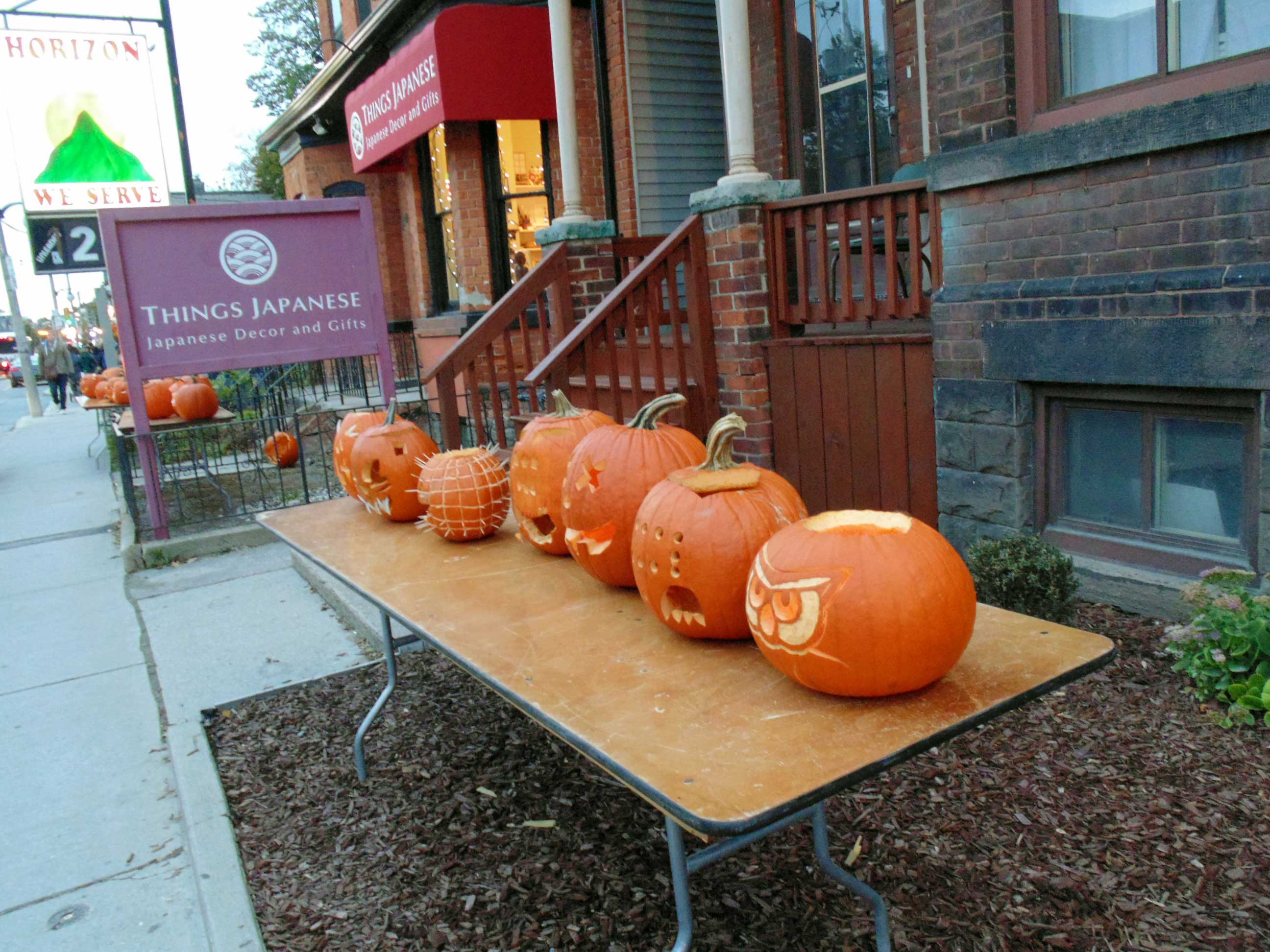
Harbord Village will once again be transformed into a pumpkin patch when the Pumpkin Festival returns to Harbord Street on Nov. 1 from 5:30 to 8:30 pm. Almost one thousand elaborately-carved candle-lit pumpkins will line the street for four blocks west of Spadina Avenue in the annual event co-sponsored by the Harbord Street Business Improvement Area and the Harbord Village Residents’ Association. Brian Burchell, Gleaner News
Tags: General
October 8th, 2015 · Comments Off on Community council approves Madison Avenue HCD
Madison Avenue is one step closer to becoming a Heritage Conservation District (HCD). On Sept. 8, the Toronto and East York Community Council endorsed a motion to designate Madison Avenue from Bloor to Dupont streets an HCD under the Ontario Heritage Act. The designation allows a municipality to protect and enhance the special character of a property or group of properties. The City of Toronto currently has 20 HCDs, three of which are in the Gleaner’s coverage area: Harbord Village Residents’ Association (HVRA) I and II, and the East Annex. Two more studies are also underway for HVRA III and the West Annex.
HCDs “are an incredibly important tool under the heritage act”, said Joe Cressy (Trinity-Spadina, Ward 20) in a previously published May Gleaner article, “to not just design a property, but to preserve an entire area’s unique character.”
The Madison Avenue HDC must be approved by City Council before the designation is made official. That approval is expected to occur in November.
—Brian Burchell and Annemarie Brissenden
Tags: Annex · News · General
October 8th, 2015 · Comments Off on Jet plan dead under Liberals or NDP
The Liberal and New Democratic Party (NDP) candidates for Spadina-Fort York (the southern half of what was formerly Trinity-Spadina) have come out strongly against any plan to expand the Billy Bishop Toronto City Airport. Sitting member of Parliament (MP) Adam Vaughan, and former MP Olivia Chow, who are running in Spadina-Fort York, have both said the plan to bring jets to Billy Bishop would be grounded should either of their parties form a federal government after the election Oct. 19.
“The Liberal Party will not reopen the Tripartite Agreement. No Jets. No Expansion. Period,” wrote Vaughan in a letter to Community Air, a local advocacy group that opposes the expansion of the island airport.
Chow was equally opposed to reopening the agreement in her letter, which like Vaughan’s was written in September, to the Clean Air Partnership.
“Porter Airlines and the Toronto Port Authority have to honour the existing Tripartite Agreement from 1983,” she wrote. “An NDP government will not amend the Tripartite Agreement to permit a runway extension for jets, or for any other purpose.”
The agreement, which governs the operation of the airport, is between PortsToronto (previously the Toronto Port Authority), the federal government, and the City of Toronto. However, many believe that the federal government controls PortsToronto, as it appoints its chief executive officer and board members.
The City of Toronto continues to study Porter Airlines’ request to bring jets to the airport.
—Brian Burchell
Tags: Annex · Liberty · News · General
October 8th, 2015 · Comments Off on Crime down except for localized gun incidents
Although gun crime is high in the entertainment district, neighbourhood crime and crime incidents related to gang activity is down, reported Staff Superintendent Francis Bergen of the Toronto Police Service at a 14 Division Community Police Liaison Committee (CPLC) meeting on Sept. 14.
Bergen said that gun crime has been “off the charts in the past three months with 19 shooting incidents resulting in five homicides”, but cautioned that the shootings, while alarming, were for the most part localized to the entertainment district of clubs and bars that has migrated west of Spadina Avenue.
Most of the incidents occur, explained Detective Sergeant Brian Kelly, when the 720 licensed establishments in the division shut down and patrons are lingering outside in summer conditions.
In its first meeting since June, the CPLC viewed reports spanning the three months period from June to September that showed residential break-and-enters down 55 per cent and commercial break-and-enters down 25 per cent, each over the same period one year ago. Robberies, such as cell phone theft, purse snatchings, and hold-ups, are at the same rate as last year, and represent a total number of 45 reports over the three-month period. Theft-of-autos is up 10 per cent from last year, but includes a spike in motorcycle thefts from parking garages in the south end of the division.
The division polices the area from the lakeshore to the south to the CPR tracks near Dupont Street to the north, and from Spadina Avenue in the east to Dufferin Street to the west.
—Brian Burchell
Tags: Annex · Liberty · News
October 8th, 2015 · Comments Off on Capturing the Ward
A jumble of stories about an area lost to time
By Annemarie Brissenden
Before there was Ed Mirvish and his free turkey giveaways, there was Merle Foster and her annual Christmas trees; parties the sculptor would throw in St. John’s Ward for children who would have little other pleasure during the holiday season.
Foster’s story is just one of many delightful snippets to be discovered in The Ward: The Life and Loss of Toronto’s First Immigrant Neighbourhood. Edited by John Lorinc, Michael McClelland, Ellen Scheinberg, and Tatum Taylor, it’s a ragtag collection of essays, photographs, and narrative memorabilia about the area bounded by University Avenue, and College, Queen, and Yonge streets. Now known for Nathan Phillips Square, City Hall, high rises of office towers and condominiums, for many years the rectangular swath of city blocks was part slum, part artist colony, and part way-station for the thousands of people who lived and worked there. Toronto’s first Chinatown sprang up there, the first synagogue was built there, and the first novel of Toronto — Morley Callaghan’s Strange Fugitive — was set there. It was where Black men and women escaping slavery prospered alongside refugees of Europe’s pogroms. For many, it was simply home.
The book does not attempt to be an exhaustive history of the Ward, but is — rather like the area it memorializes — a patchwork quilt of stories that aims to echo its jumble. Chronology is eschewed in favour of randomness, and each random patch has its own tone. One entry traces William Lyon Mackenzie King’s summer investigating the sweatshops of the Ward for The Mail and Empire, while another examines city directories for clues on one street’s evolution. There are reminiscences of the V-J Day celebrations in Chinatown, a story about a Sai Woo condiment dish — “a genuine Ward artifact” — and tales of bootleggers, sex-workers, and strikes at Eaton’s.
This purposeful randomness is not without some frustrations, however. Readers grapple with abrupt changes in tone, and can be startled from a dry historical tract into a rollicking tale about “my grandmother the bootlegger” with the flip of a page. It’s also not clear how or why each entry was chosen, or what, if anything, wasn’t included. A brief biography of each contributor is included at the back of the book (placing them alongside each entry might have made more sense), but there’s no discussion of why each writer was chosen. It almost feels as though everything were thrown together accidentally, or haphazardly. A little more formality would not have been amiss.
Neither would some exploration of the themes that provide a common thread between entries, particularly the notion that no matter how much we evolve as a city, we can’t seem to shake certain obsessions.
Consider that Charles Hastings, Toronto’s medical officer of health in 1911, “vehemently opposed the development of modern apartment buildings as a solution to downtown housing needs, claiming they’d degenerate into tenements”. Or that from about 1870 — when the “pace of urbanization in Toronto had become the subject of public interest” — the “city’s newspapers began to publish annual reports about building activity in each ward”.
Or that as early as 1896, King was proposing to improve living conditions in the Ward through improved transit, cycling, and mixed social-class housing. While writing about tuberculosis, Cathy Crowe notes, “As a street nurse, I was always drawn to Goss’s photos because they mirrored what I had witnessed in the flophouses, shelters and streets of contemporary Toronto”.
And a 1918 report released by the Bureau of Municipal Research, a non-profit advocacy group, recommended that “public schools should be open for community use after school hours”, and “any new housing developments should include adequate municipal services and employment opportunities for residents”.
Did you know?
- Several blocks of Toronto’s first Chinatown were razed to make way for Nathan Phillips Square
- The Hospital for Sick Children sits on land that in 1947 was a trailer park for people who couldn’t find alternate housing
- The Ward’s bootleggers were often older women who relied on the trade to survive; one of the Ward’s most notorious bootleggers, Bessie Starkman, was assassinated by an Al Capone henchman in 1930
- Before the formation of the Group of Seven, Lawren Harris did many paintings of the Ward; his first known painting of the area was titled In the Ward and exhibited in 1912
- America’s sweetheart, Mary Pickford, was from the Ward, and grew up in a brick home on University Avenue north of Gerrard Street
- The colourful houses on Gerrard Street, home to many artists and writers, inspired the creation of Mirvish Village
It seems ironic that the real story of the Ward, then, in a book that attempts to resurrect the memory of the area, is left out. The challenges faced by the Ward are as present as they ever were, and remain unresolved today. Our city has become one great ward, and as contradictory as the Ward itself once was. Let’s hope, though, that our future will not be limited to a random collection of essays in a book.
Tags: Annex · Liberty · News